A Convergence of Spirits: Decolonizing the Canvas
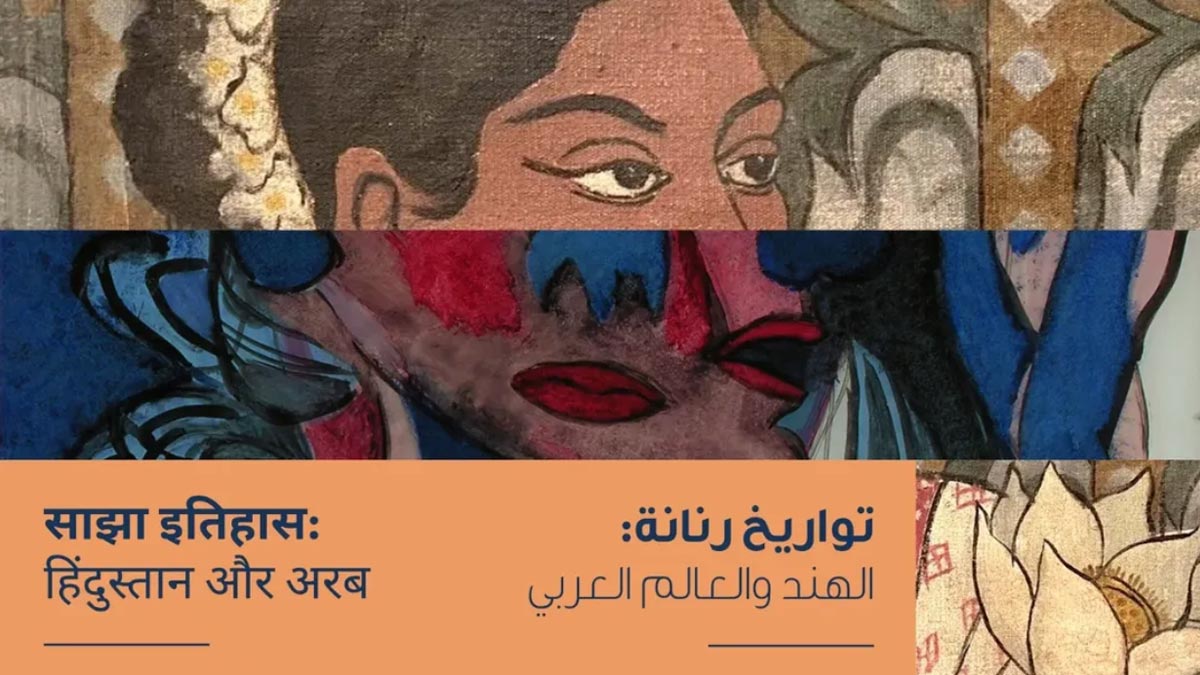
The Relationship between India and the Arab world has historically been encased through the monocle of ancient maritime trade, migration, and cultural exchanges. However, a watershed exhibition titled ‘Resonant Histories: India and the Arab World,’ at the Chhatrapati Shivaji Maharaj Vastu Sangrahalaya (CSMVS), Mumbai, is presenting a different trail of intellectual and aesthetic exchange between the two worlds. The wondrous exhibition, curated by Puja Vaish and Suheyla Takesh, has brought together the works of over 67 artists spanning Bahrain, Egypt, Kuwait, Iraq, Lebanon, Palestine, Syria, Tunisia, the United Arab Emirates, and India itself.
These artworks delineate and depict the T-junction of the 20th-century modernisms across the two lands. Although both lands are geographically distant, both have grappled with the same anti-colonial struggle and post-independence aspirations. The showcase borrows from both the Jehangir Nicholson Art Foundation and the Barjeel Art Foundation in Sharjah. The curatorial approach not only traces the disparities between the art of the two worlds but also emphasizes their plangencies. Reverberance can be traced between the two on the grounds of political, intellectual, aesthetic, and other spheres that emerged in their distinct modernist practices. Both worlds’ art has shifted significantly from a Eurocentric structuring and stepped into a more transregional exchange, and parallel developments.
The Event at A Glance
| Aspect | Details |
|---|---|
| Title | Resonant Histories: India and the Arab World |
| Duration | November 14, 2025 – February 15, 2026 |
| Venue | JNAF Gallery, CSMVS Museum, Mumbai |
| Collaborators | Barjeel Art Foundation (Sharjah) & JNAF |
| Number of Artists | 67+ artists from India and the Arab world |
| Participating Nations | India, Bahrain, Egypt, Kuwait, Iraq, Lebanon, Palestine, Syria, Tunisia, UAE |
| Curators | Puja Vaish (JNAF) & Suheyla Takesh (Barjeel) |
| Primary Themes | Decolonization, Non-Aligned Movement (NAM), migration, shared symbols |
A Deep Dive Into Its Thematic Core
The exhibition unfurls itself as a crosswalk of a plethora of conceptual trails, tracing how Indian and Arab artists navigated the overlapping currents of modernism within specific socio-political contexts. One of the strong themes of the showcase is mobility and cross-cultural learning. An Indian artist, Nasreen Mohamedi, uses innovative grids and abstract compositions that were moulded by her experience in Bahrain and Kuwait. Her compositions stand as a strong statement of transregional artistic encounter. Her artworks reveal a distinctive form of aesthetics that is shaped by the shifting paradigms of modernising movements.
The opening section is titled Visions of Freedom, by Chittaprosad Bhattacharya, which includes art pieces that encompass themes of liberation, conflict, hope, and disillusionment in the post-decolonisation period. His art critiques the hunger left in the wake of the British Empire. His work is juxtaposed with the Syrian artist Naim Ismail’s Al Fiddaiyoun. His artwork presents the geometry of Palestinian keffiyehs that symbolize resistance.
Beyond these, the exhibition opens doors to viewers to perceive how formal languages were shaped by both shared and divergent historical conditions. Both Indian and Arab modernists faced the same kinds of pressures while dealing with colonial legacies, redefining cultural identity, and engaging with international modernist waves in their times. These ideas are presented in their true heterogeneous forms and are showcased as a complex web of affinities and disjunctions that challenge linear art historical accounts.
Syrian portraiture and Emirati abstractions also find expression in the works of Indian artists like Francis Newton Souza and Gulammohammed Sheikh. Sheikh’s The Incomprehensible Animal (2000) depicts mythic traditions that connect Persian and Indian worlds. It reminds the viewers that the “Western Indian Ocean Grid” was once a unified cultural space.
Artpieces also depict a lotus held by an Egyptian woman and the “industrial waste” of a war-torn landscape. Finally, the concluding space of the exhibition displays themes of labour and migration. This is the space where Mohamed Kazem’s depictions of migrant workers in Dubai are placed in contrast with Sudhir Patwardhan’s laborers in Mumbai.
Key Highlights
- First comprehensive examination of artistic intersections between India and the Arab world’s modern art movements.
- Collaborative curation by institutions in India and the UAE, making extensive use of Barjeel Art Foundation’s holdings.
- Thematic threads that foreground anti-colonial struggles, migration, and post-independence aspirations.
- Artworks traverse genres, including abstraction, figuration, political commentary, and formal experimentation.
- Highlights of individual journeys, such as Nasreen Mohamedi’s work, influenced by time spent in Bahrain and Kuwait, illustrate how geography shaped artistic vocabularies.
- Unlike traditional art history that centers on European modernism, this show explores “horizontal” exchanges between the Global South, emphasizing how artists looked to one another rather than just the West.
- The exhibition vividly showcases the influence of the Non-Aligned Movement (NAM). Works depicting leaders like Mahatma Gandhi and Gamal Abdel Nasser serve as symbols of shared resistance against colonial hegemony.
- Nasreen Mohamedi’s time in Bahrain and Kuwait is reflected in her minimalist grids, while Vivan Sundaram’s Eclipse (1991), made with engine oil and charcoal, responds to the environmental and human devastation of the Gulf War.
- The show revives the history of the Triennale-India (launched by Mulk Raj Anand in 1968), which acted as a vital platform for Arab artists to exhibit in New Delhi during the 20th century.
- The show revives the history of the Triennale-India (launched by Mulk Raj Anand in 1968), which acted as a vital platform for Arab artists to exhibit in New Delhi during the 20th century.
Takeaway
This exhibition is a crucial step in moving towards a space of global modernism, which compels viewers to rethink the boundaries of art and its conceptual peripheries. Rather than emphasizing Western narratives, Resonant Histories highlights how non-Western artists also weave tales that are equally compelling and fascinating.
For too long, the story of Modernism has been told as a series of footnotes to Paris or New York. This exhibition effectively “de-centers” the West by showing that Cairo, Baghdad, Mumbai, and Shantiniketan were active nodes in a vibrant, independent network. It is a powerful statement that our histories were deeply intertwined in a shared “aesthetic of resistance.” This collaboration sets a high standard for how institutions in the Global South can work together to rewrite their own stories.