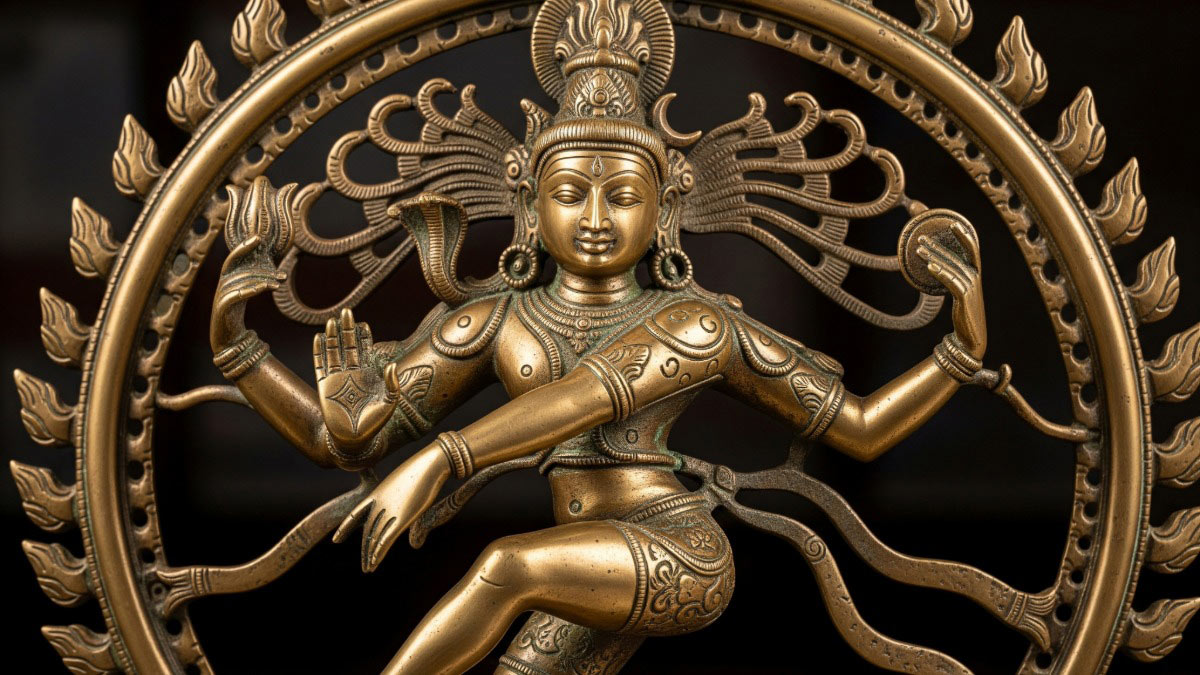
Who is Nataraja?
Nataraja is a Sanskrit term, derived from “nata” meaning “act, drama, dance” and “raja” meaning “king, lord”; it can be translated as ‘Lord of Dance’ or “King of Dance”. According to art historian Ananda Coomaraswamy, the name is related to Lord Shiva’s fame as the “Lord of Dancers” or “King of Actors”. Lord Shiva is one of the gods in the Hindu trinity, others being Lord Brahma and Lord Vishnu.
The concept of Lord Shiva as Nataraja has been well captured by sculptors, especially from South India. The Chola dynasty (r. 9th to 13th century) has been responsible for the creation of magnificent bronze images of Nataraja. Let us explore a few to know the story of these splendorous images!
Nataraja as an icon
The Nataraja icon is a profound and powerful depiction of the Hindu god Shiva as the divine cosmic dancer. It is widely regarded as one of the supreme achievements of Indian art, standardizing Shiva’s role as the creator, preserver, and destroyer of the universe within a single, dynamic image. It is a powerful depiction of the supreme in the universe. The standard Nataraja icon, perfected during the Chola dynasty typically features a four-armed Shiva performing the ananda-tandava.
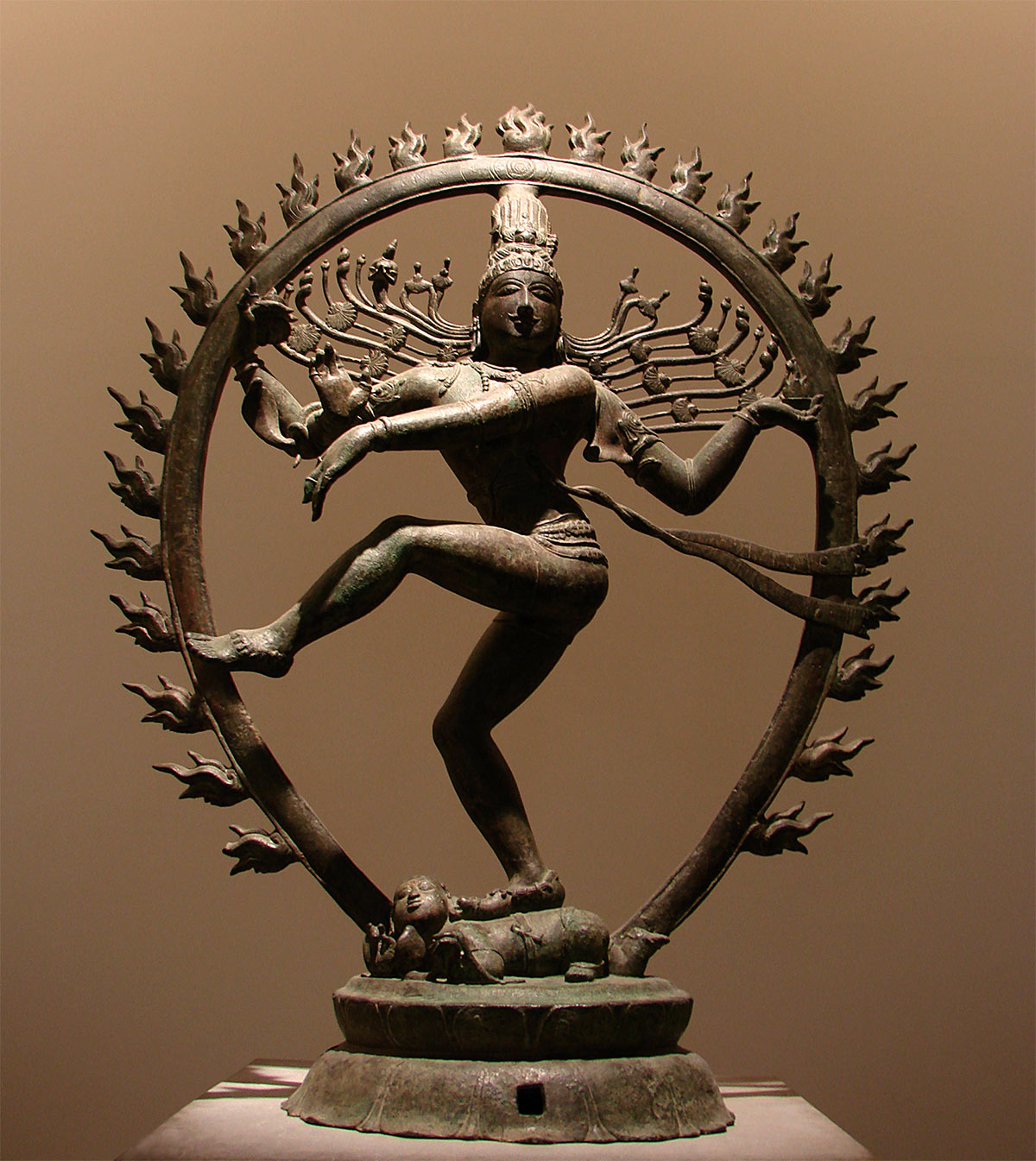
The upper right hand holds a damaru, an hour-glass-shaped drum that symbolizes the rhythm of creation and the first sound of the universe, ‘AUM’. The upper left hand holds agni or fire, representing the destruction or dissolution of the cosmos. The lower right hand is in the abhayamudra (gesture of fearlessness), offering protection and reassurance to devotees. The lower left hand stretches across the chest in the gaja-hasta (elephant trunk) pose, pointing toward the raised foot to signify liberation and grace. One foot firmly tramples the dwarf-demon apasmara purusha or muyalaka, who symbolizes ignorance and the ego. The other leg is lifted in the air, representing salvation; moksha. The ring of fire, prabhamandala encircles the entire figure, symbolizing the cosmic fire of the universe and the cyclical nature of time. The flying tresses of Lord Shiva’s matted hair, jata fans out from the intensity of the dance, often holding the goddess Ganga symbolizing the river Ganges and a crescent moon symbolizing time.
While early stone reliefs dating to the 6th century exist at the Ellora and Badami Caves, the iconic bronze form reached its mature expression under the Cholas in Tamil Nadu.
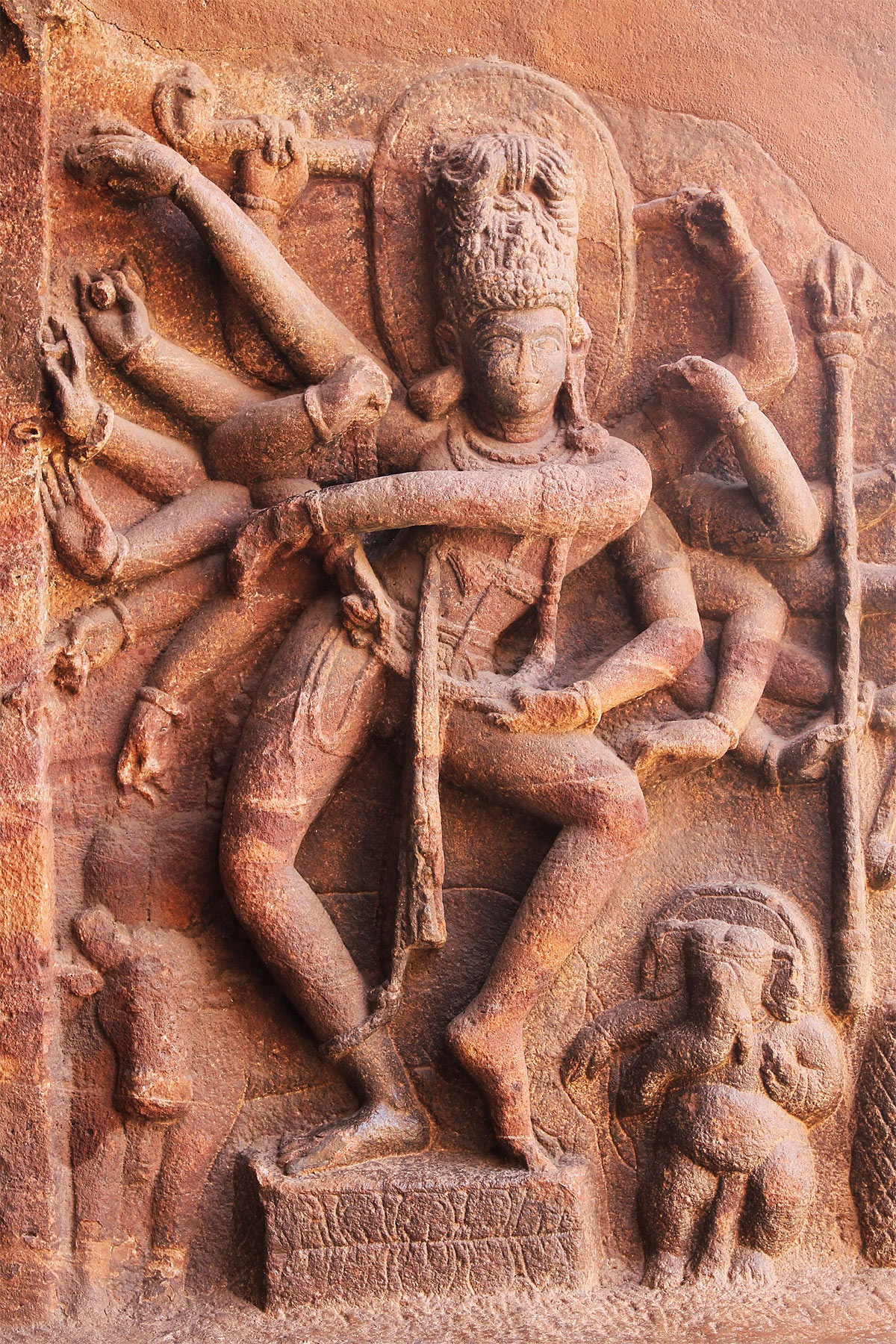
Chidambaram Temple in Tamil Nadu is considered the “earthly home” of Nataraja, where the cosmic dance is perpetually performed. The Nataraja has evolved from a religious icon to a global symbol of Indian culture and a metaphor in modern physics. A 2-metre high statue of Nataraja stands at the European Organization for Nuclear Research (CERN) in Geneva. It was gifted by India to symbolize the “cosmic dance” of sub-atomic particles, drawing parallels between ancient mythology and quantum field theory. The icon serves as the patron deity for Bharatanatyam: a traditional south Indian dance form, with its poses often depicted alongside the god in temple architecture.
Nataraja in Yogic Philosophy
This hymn by Sage Patanjali has an interesting story; the author and compiler of the famous yoga-suutras. Once upon a time, as the story of the origin of the hymn goes, Nandi, Shiva’s carrier would not allow Patanjali Muni to have Darshan of the Lord Shiva (Nataraja of Chidambaram). In order to reach Lord Shiva, Patanjali, with his mastery over grammatical forms, spontaneously composed this prayer in praise of the Lord without using any extended (`diirgham’) syllable, (without `charana’ and `shringa’ i.e. leg and horn) to tease Nandi. Shiva was quickly pleased, gave ‘darshan’ to the devotee, and danced to the lilting tune of this song. The place where this incident is said to have happened is Chidambaram (also known as Thillai), located about a hundred miles from Chennai, Tamil Nadu, India. It is considered to be one of the holiest places in India. In this temple, which has a gold covered roof, Lord Nataraja is present in a cosmic-dancing form.
Nataraja in Scriptures
A hymn in praise of the Lord of Dance from the Nataraja stotram reads –
अवन्तमखिलं जगदभण्ग गुणतुण्गममतं धृतविधुं सुरसरित.ह\- तरण्ग निकुरम्ब धृति लम्पट जटं शमनदम्भसुहरं भवहरम.ह । शिवं दशदिगन्तर विजृम्भितकरं करलसन्मृगशिशुं पशुपतिं हरं शशिधनञ्जयपतण्गनयनं परचिदम्बर नटं हृदि भज ॥
“Heartily resort to the great dancer, Lord Shiva, residing in the holy place, Chidambaram, who protects all the world. His lofty place is due to the indestructible good qualities. It is difficult to grasp his nature. He has held crescent moon in his forehead. His matted hair is covetous of holding the multitude of waves of the divine river, Ganga. He has dispelled the vanity of Yama and is capable of delivering men from the pangs of worldly life. The Lord of creatures, the auspicious God, in whose hand a young deer is dancing, has spread his hands in all ten quarters. The great destroyer has moon, fire and sun as his eyes”………….Patanjali
Nataraja Depictions in Chola sculpture
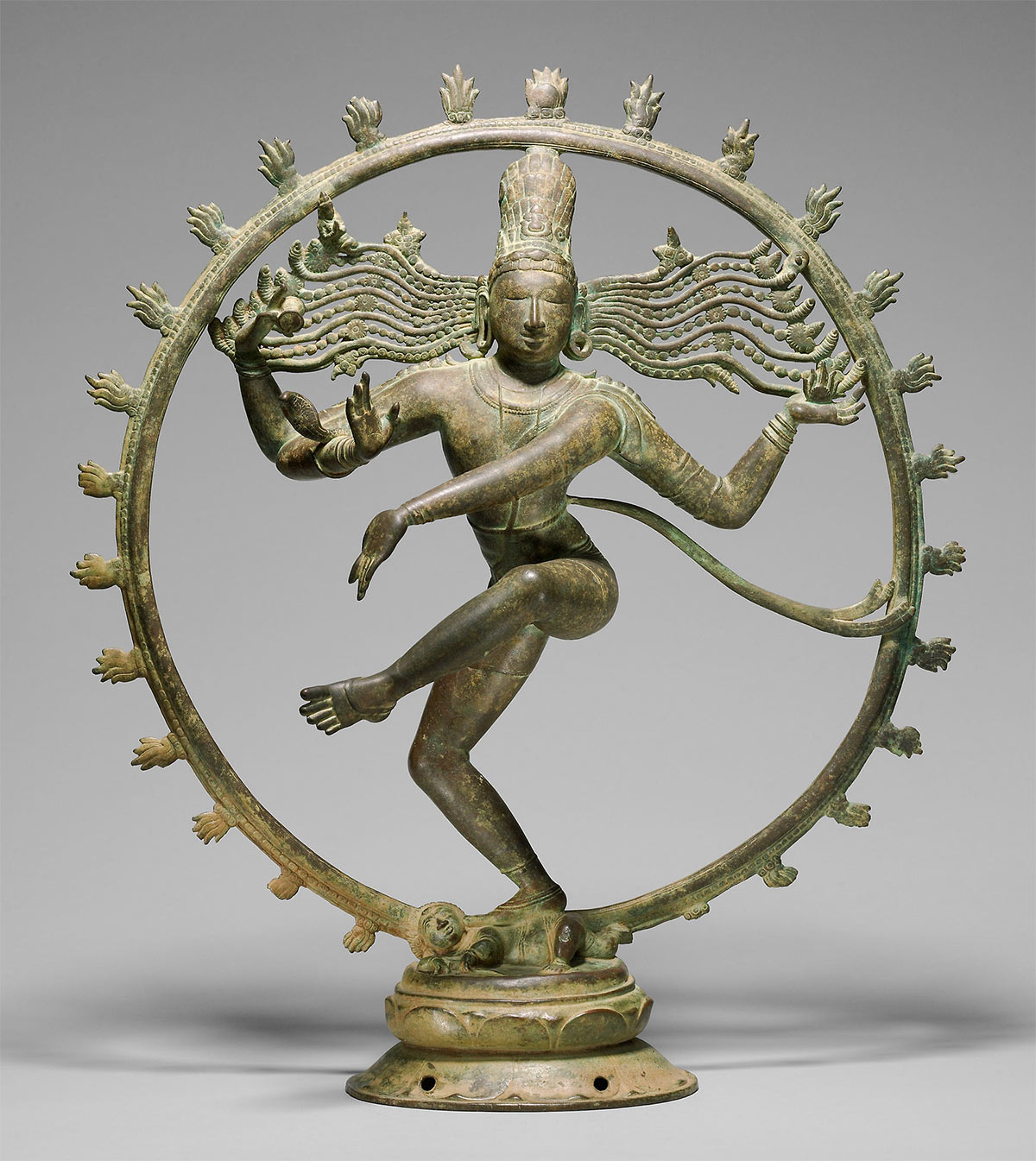
A Nataraja bronze preserved at the Met in New York of the height of 68.3 cm depicts Lord Shiva with the iconography of the ‘Lord of dance’ as described. He wears ornate jewellery around his neck, earlobes, on his wrists and feet. The ring of fire is a round rising from the pedestal where Lord Shiva tramples the dwarf-demon apasmara purusha.

Another part of the Nataraja stotram says –
अनन्तनवरत्नविलसत्कटककिण्किणिझलं झलझलं झलरवं मुकुन्दविधि हस्तगतमद्दल लयध्वनिधिमिद्धिमित नर्तन पदम.ह । शकुन्तरथ बर्हिरथ नन्दिमुख शृण्गिरिटिभृण्गिगणसण्घनिकटम.ह सनन्दसनक प्रमुख वन्दित पदं परचिदम्बर नटं हृदि भज ॥
“Heartily resort to the great dancer, Shiva residing in the holy place, Chidambaram. The tiny bells attached to his bracelets which are shining with innumerable gems of nine kinds are making a sweet jingling sound. The dancing movements of his feet are accompanied by the drum in the hands of Mukunda (vishnu) and vidhi (brahma). He is closely surrounded by Vishnu, riding a chariot to which a bird (Garuda) is yoked, by kartikeya, riding a chariot to which a peacock is yoked, by a troupe of Gana-s consisting of Srngi, Riti, Bhringi etc headed by Nandi. Prominent sages like Sananda and Sanaka are saluting his feet”………………….Patanjali
The 10th century bronze figure of Nataraja of height 69.3 cm. in the Art Institute of Chicago depicts a round prabhamandala and Lord Shiva in ananda tandava crushing apasmara. His matted locks flying depict the power of the movement.
At the LACMA, USA is a figure of Lord Shiva as Nataraja of height 76.2 cm made in bronze from 10th century Chola period. The King of Dance has his left leg high in the air with his stylised flying tresses and garment depicted very clearly. He dances on apasmara purusha on a lotus pedestal.
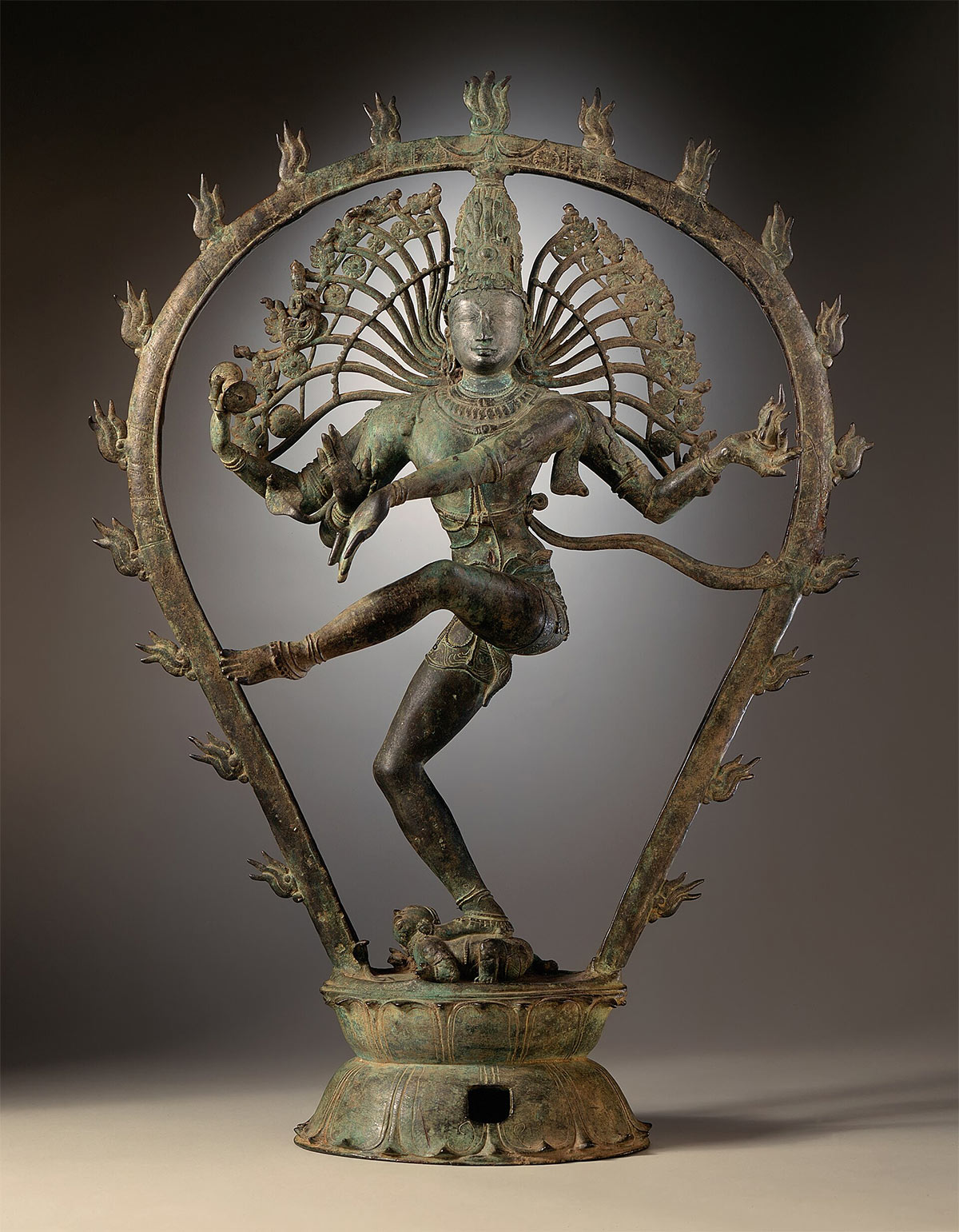
The Nataraja icon at Freer Gallery depicts the standard iconography with a bejeweled figure within the circle of flames crushing apasmara purusha. The expression is one of serenity as he performs ananda-tandava; ‘ananda’ meaning bliss.
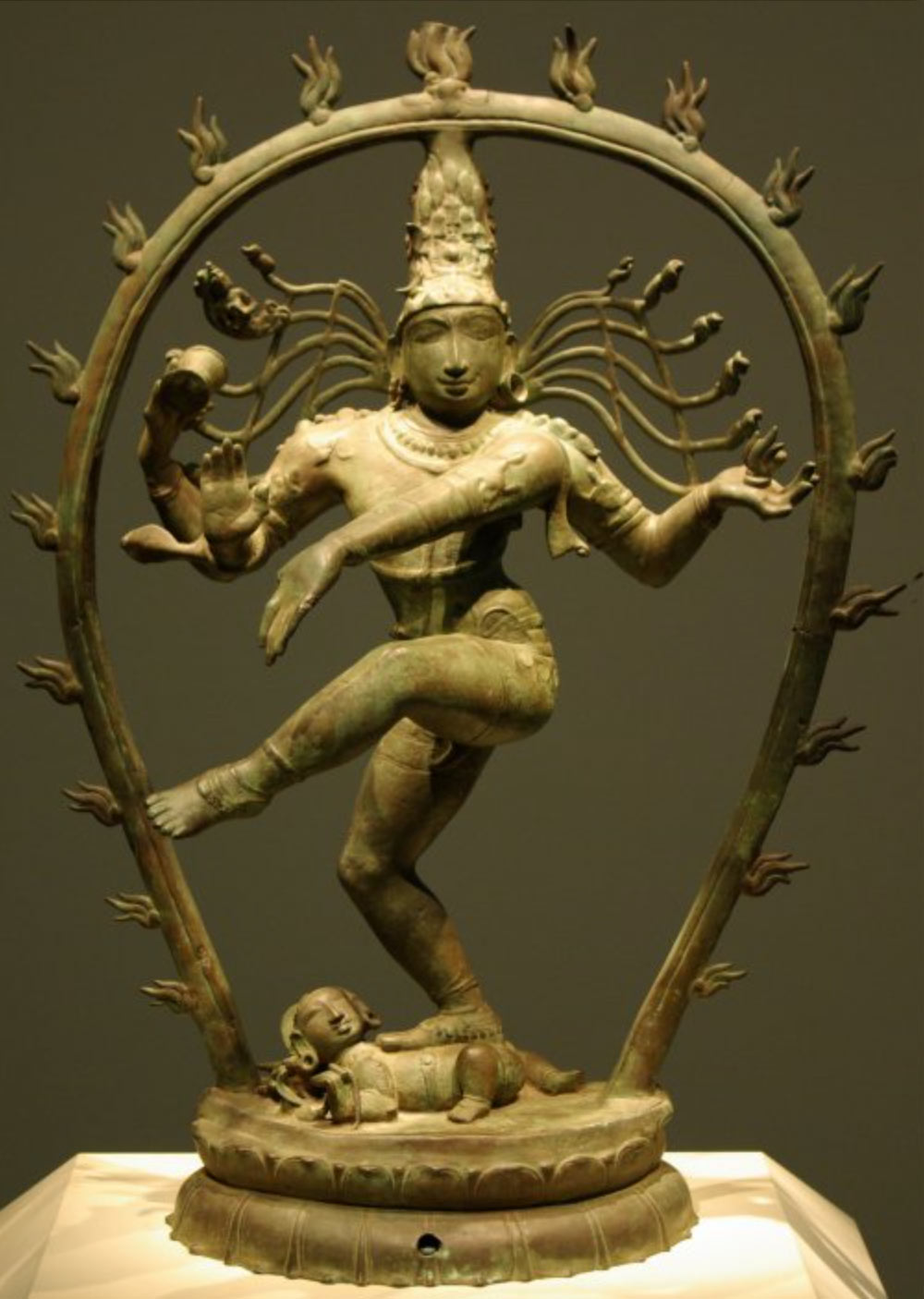
The Musee Guimet at Paris preserves a powerful depiction; a figure 76.2 cm. tall of the ‘Lord of Dance’. A Chola bronze from the 11th century with a circle of flames around the god Shiva with his jata flying and left leg lifted high in the air present a truly mesmerizing image.
Sculpting of Nataraja
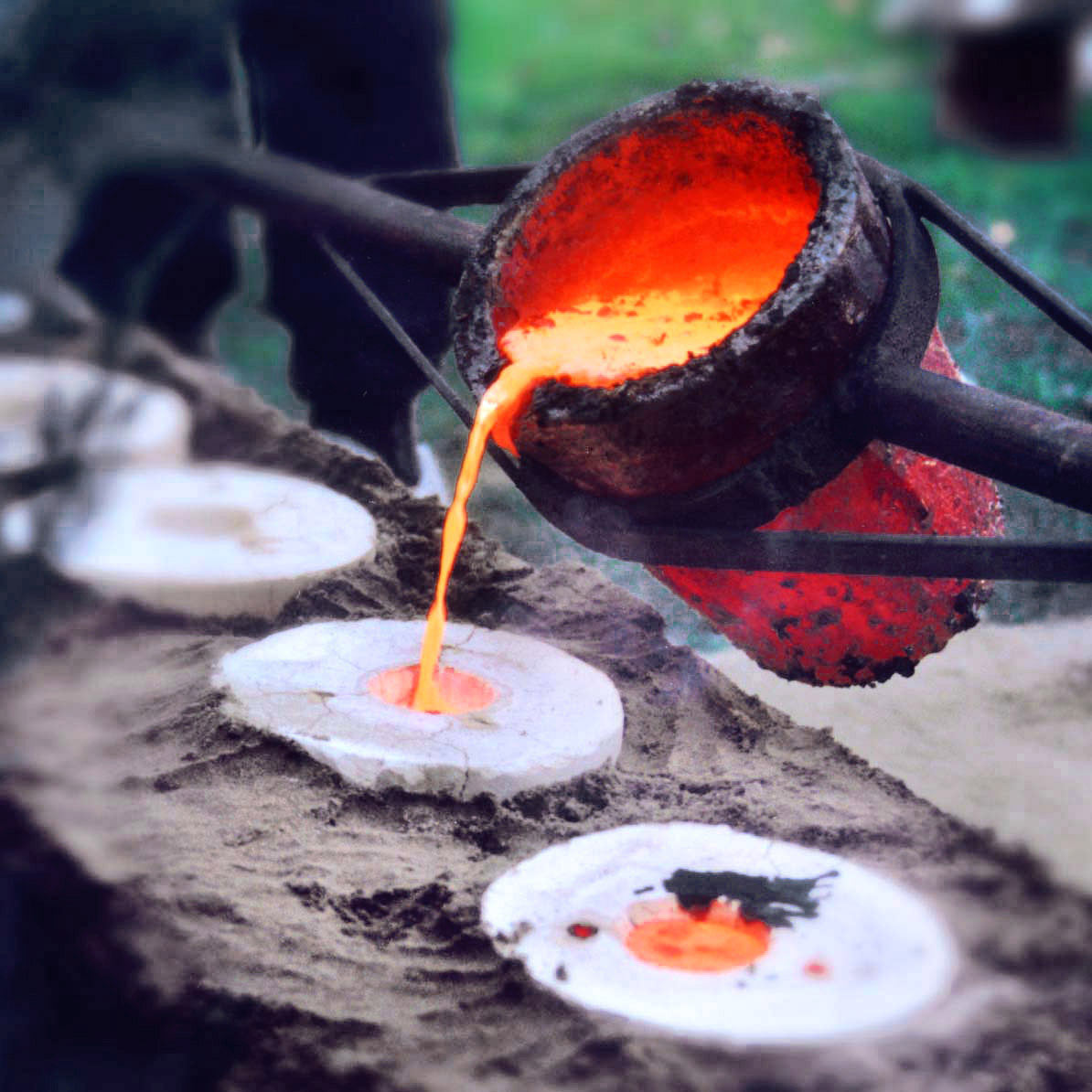
Chola bronze-casting used the sophisticated lost-wax – cire perdue or madhu uchchishta vidhana technique, involving sculpting a detailed wax model, coating it in clay to form a mold, melting out the wax to create a cavity, and pouring molten bronze into it, resulting in unique, highly detailed, and often inlaid statues as we see in the iconic Nataraja, with precision casting minimizing post-casting work. During the Chola period, the molds were so precise that minimal carving was needed afterward, creating exceptionally detailed and elegant figures. A five-metal alloy called panchaloha of copper, zinc, tin, silver, and gold was used, sometimes containing lead for improved fluidity, enhancing detail. Because the clay mold was destroyed in the process, each bronze was a unique work of art. For some main images, a solid casting method ghana was also used, creating dense sculptures, a practice still seen at Swamimalai in Thanjavur, Tamil Nadu. During the reign of the Chola empire, Raja Raja I commissioned a group of sculptors for the construction of the now famous Brihadeeswarar Temple.
The sculptors helped cast statues for another Chola gem, the Airavatesvara Temple and later settled at Swamimalai. The carving of bronze deities thrives to this day at Swamimalai and has a GI tag. The Government of India recognized it as a Geographical Indication officially from the year 2008-09. The Nataraja icon at CERN is also the contribution of the Swamimalai sculptors.
References
- Coomaraswamy, Ananda(1914) -The dance of Shiva, New Delhi: Munshiram Manoharlal
https://shaivam.org/scripture/Marathi/nataraja-stotram-m (accessed 15.01.2026)