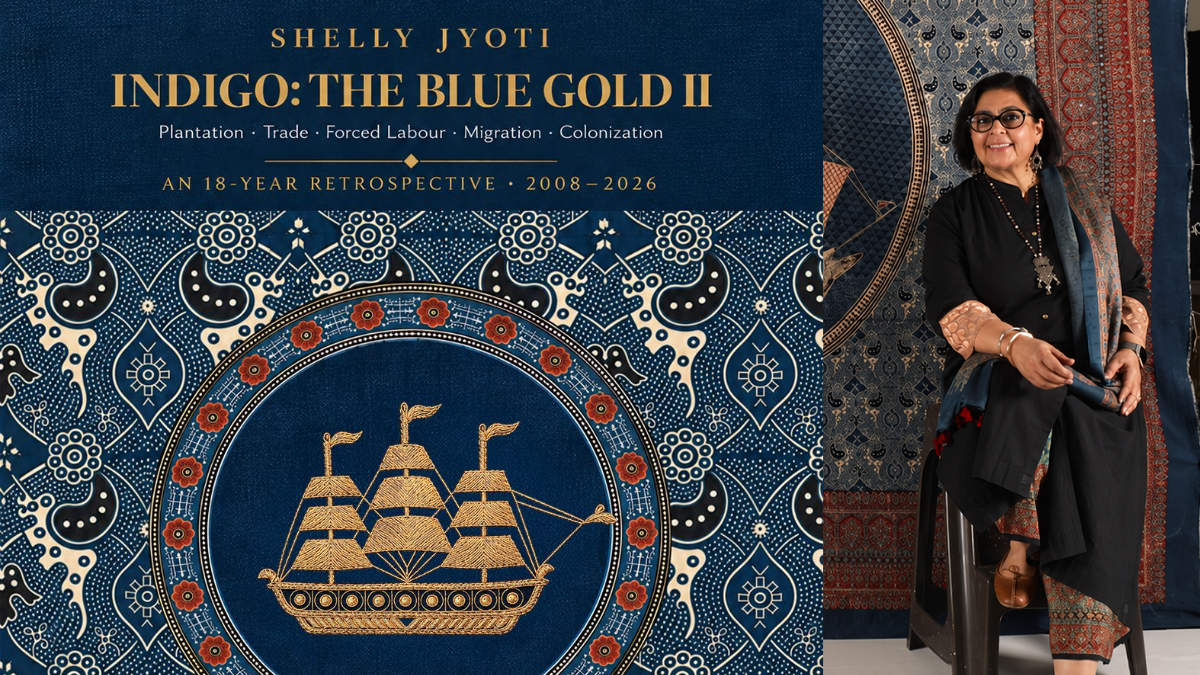
Shelly Jyoti’s Indigo: The Blue Gold II (2008–2026) brings eighteen years of artistic exploration of indigo, textile traditions and historical memory to Bikaner House, New Delhi. Curated by Prof. Lisa Trivedi, Professor of History at Hamilton College, New York, the exhibition runs from 27 October to 1 November 2026 at the CAA Building, Ground and First Floors. It examines how indigo connects India’s colonial past with histories of forced labour, migration, displacement and cultural regeneration.
From Colonial Commodity to Historical Record
The exhibition brings together works created between 2008 and 2026, tracing indigo from its place in textile traditions to its role in international trade and colonial economies. Jyoti’s early works address the exploitation of Indian indigo farmers and Mahatma Gandhi’s Champaran Satyagraha of 1917–18. Her practice subsequently expanded to explore the wider histories of slavery, indentured labour and the movement of communities across continents.
Indigo, often described as “blue gold”, becomes a means of examining the relationship between material culture and human experience. The exhibition considers how the production and circulation of a dye shaped economic systems while leaving lasting effects on communities and their cultural identities.
Khadi, Ajrakh and the Language of Textile
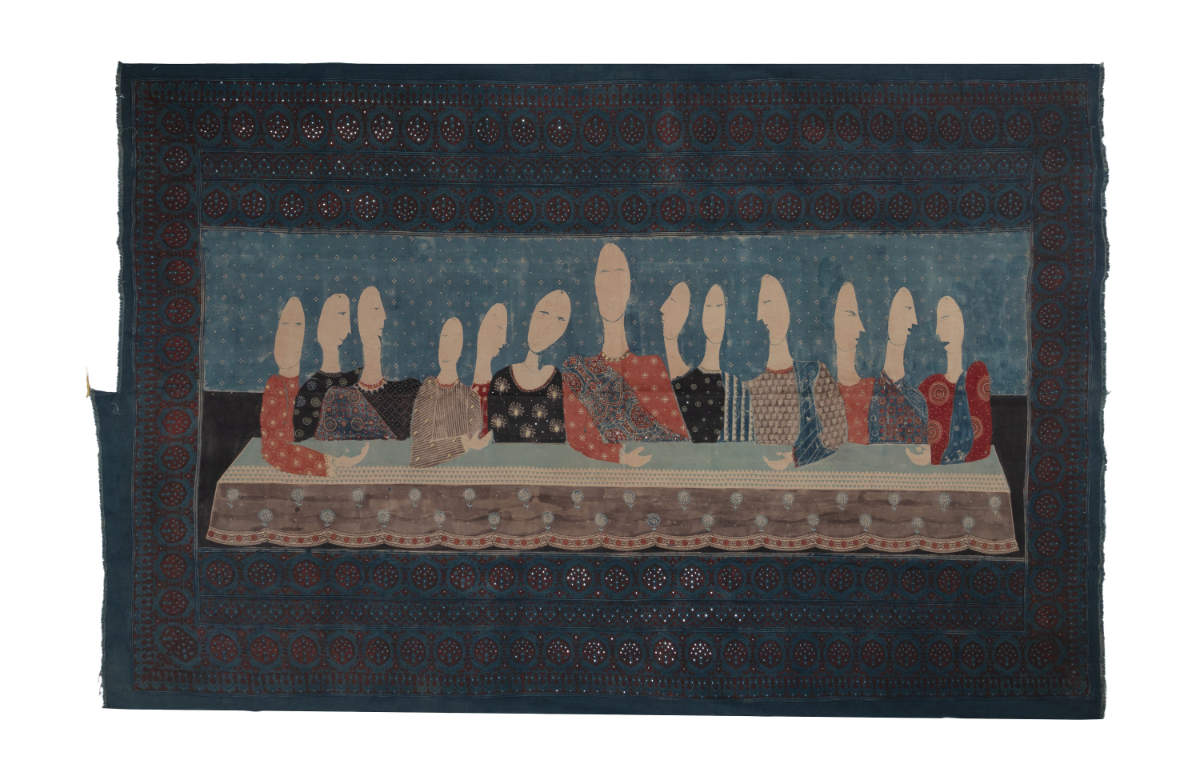
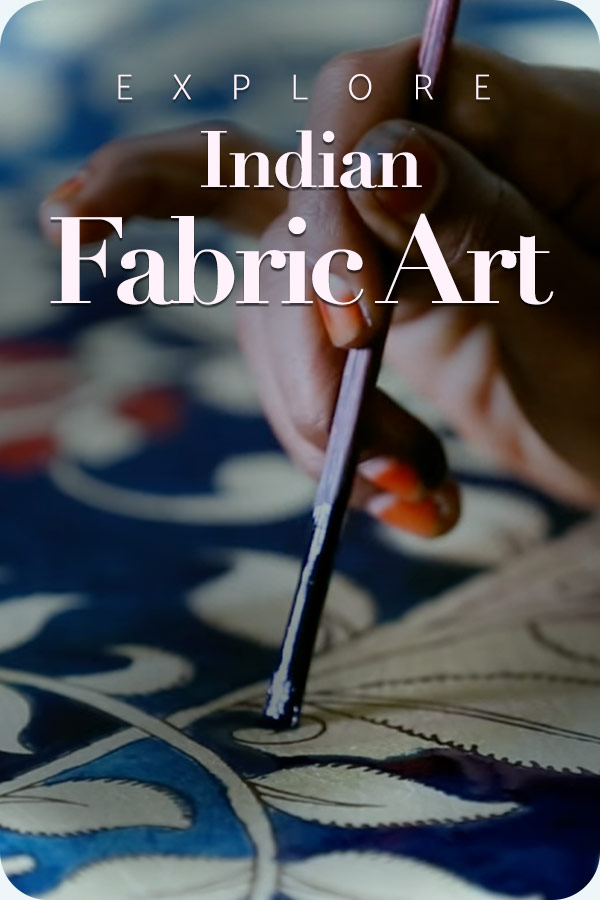
Khadi forms the material foundation of Jyoti’s artistic practice. She works with hand-spun and handwoven fabric, natural indigo dyeing, Ajrakh resist block printing, embroidery and mirror work. These techniques bring historical references into contemporary textile art.
Recurring motifs include ships, charkhas, fish, globes, faceless figures, seeds, roots and trees. Together, these images connect individual experiences with broader movements of people, knowledge and traditions. Jyoti’s sustained collaboration with Ajrakh master artisans in Kutch also places traditional craftsmanship at the centre of her work.
The artist’s engagement with indigo began in 2008 through a collaboration with Japanese American artist Laura Kina, Professor Emerita at DePaul University, Chicago. Their shared interest in textile history and cultural exchange helped establish a direction that Jyoti has continued to develop over eighteen years.
New Series Examines Migration Through Time
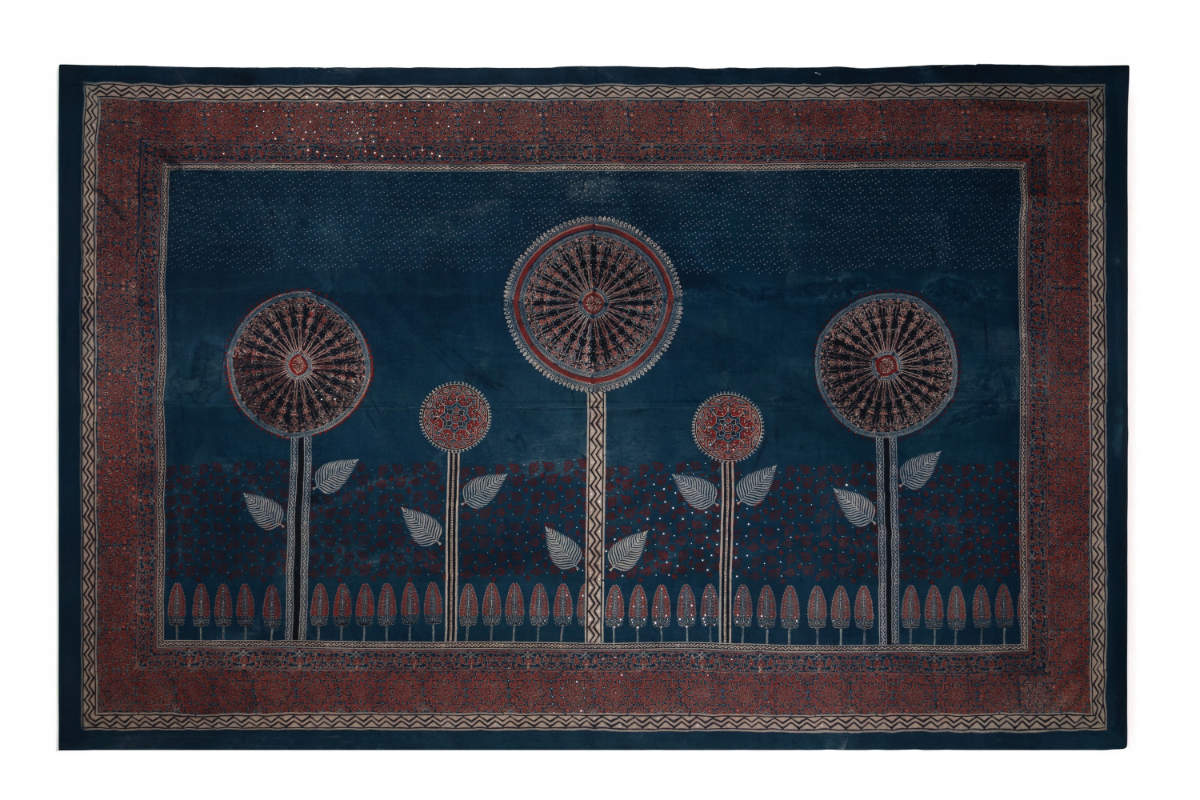
A central feature of the exhibition is Jyoti’s new 2026 body of work, Indigo: Migration Through Time. The series explores displacement, the transmission of cultural knowledge and the capacity of communities to adapt to changing environments. It is organised around three interconnected themes:
- Faceless Journeys: Examines enslaved, indentured and migrant communities whose labour contributed to the global indigo trade, including individuals whose experiences remain absent from written histories.
- Displaced Ecologies: Uses seeds, plants, roots and trees to consider how communities establish themselves in unfamiliar places and carry memories across generations.
- Unresolved Geographies: Moves towards abstraction, bringing together ideas of bodies, landscapes, water and movement to explore migration as both geographical displacement and a passage through time and identity.
Across these themes, textiles serve as more than visual objects. They become records of historical experiences and carriers of collective memory, connecting stories of exploitation and resistance with questions of adaptation and renewal.
Textile as a Living Archive
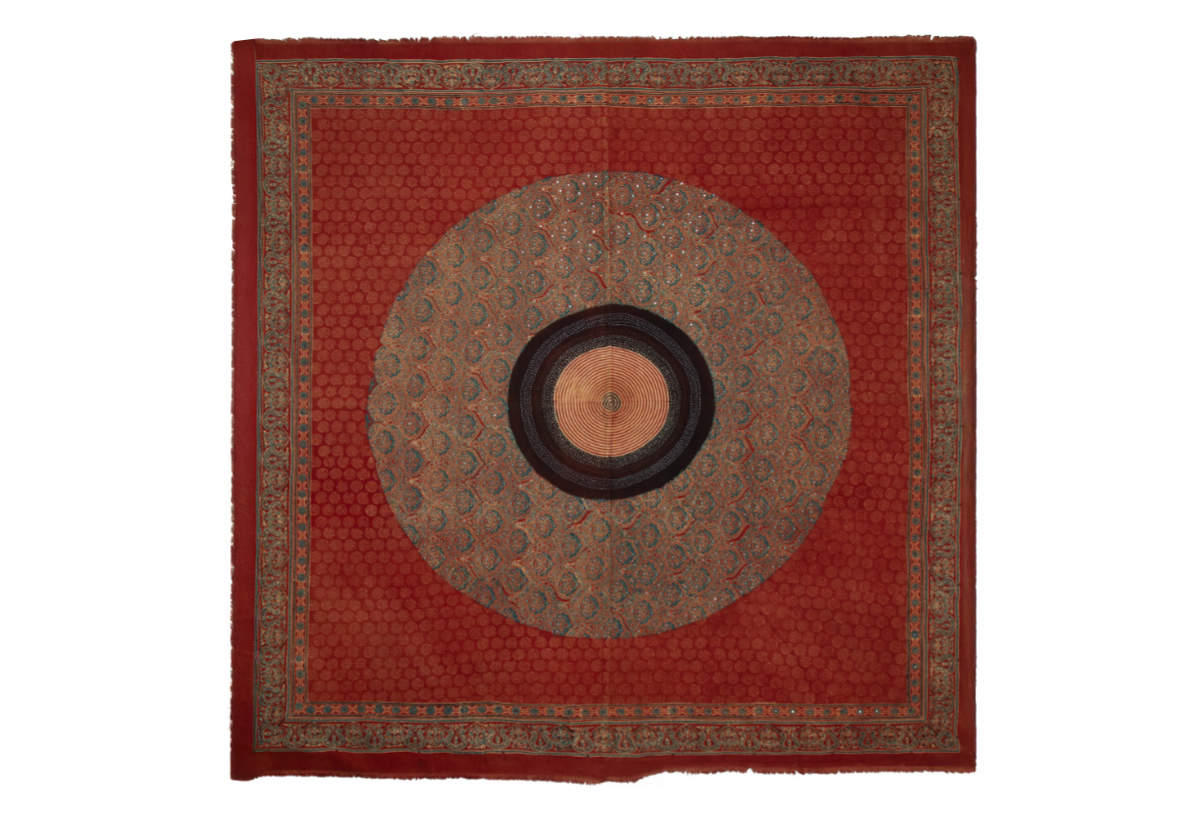
Jyoti views textile traditions as repositories of inherited knowledge, ecological understanding and intergenerational memory. Her use of khadi and Ajrakh links the physical processes of making fabric with the histories embedded in materials, patterns and techniques.
Her wider practice draws on Indian history and Gandhi’s ideas concerning nation-building, self-reliance and peaceful societies. According to her published biography, Jyoti trained in fashion design at the National Institute of Fashion Technology in New Delhi and holds an MA in English, with a focus on American Literature, from Punjab University, Chandigarh. Her work has been exhibited at institutions including the Indira Gandhi National Centre for the Arts and the South Asia Institute in Chicago.
Public Programme and Exhibition Details
The exhibition is supported by Good Earth Heritage Foundation as Patron Partner and the Indira Gandhi National Centre for the Arts (IGNCA) as Knowledge Partner. Its accompanying outreach initiative, “Indigo as a Living Classroom”, extends the exhibition through conversations, demonstrations, student engagement and guided interpretation.
| Event | Detail |
|---|---|
| Event Name | Indigo: The Blue Gold II (2008–2026) |
| Artist | Shelly Jyoti |
| Venue | CAA Building, Ground and First Floors, Bikaner House, New Delhi, India |
| Exhibition Dates | 27 October–1 November 2026 |
| Timings | 11 AM–7 PM, 28 October–1 November 2026 |
| Preview | 27 October 2026, 5:30–9 PM |
| Curator | Prof. Lisa Trivedi, Professor of History, Hamilton College, New York |
| Patron Partner | Good Earth Heritage Foundation |
| Knowledge Partner | Indira Gandhi National Centre for the Arts (IGNCA) |
| Website / Registration | Shelly Jyoti Official Website |
The scheduled programme includes:
- 27 October, 5:30–9:00 PM: Opening reception.
- 28 October, 11:00 AM–2:00 PM: Artist–curator conversation with school students.
- 28 October, 4:00–6:00 PM: Curator and artist gallery walk.
- 29 October, 2:00–4:00 PM: Panel discussion, “Indigo on Motion”, followed by tea.
- 30 October, 11:00 AM–5:00 PM: Talk and Ajrakh workshop with master craftsman Juned M. Khatri, followed by tea.
- 1 November, 2:00 PM onwards: Gallery walk with Shelly Jyoti, “Reading Indigo Through Time”.
Connecting Art, History and Contemporary Society
Through indigo-dyed textiles and traditional printing practices, Indigo: The Blue Gold II brings historical labour systems into conversation with present-day questions of migration, identity and cultural continuity. The exhibition offers visitors an opportunity to consider how artistic practice can document overlooked histories while keeping traditional knowledge in circulation. By connecting craft, memory and ecological regeneration, it also highlights the role of textile traditions in sustaining cultural inheritance across generations.