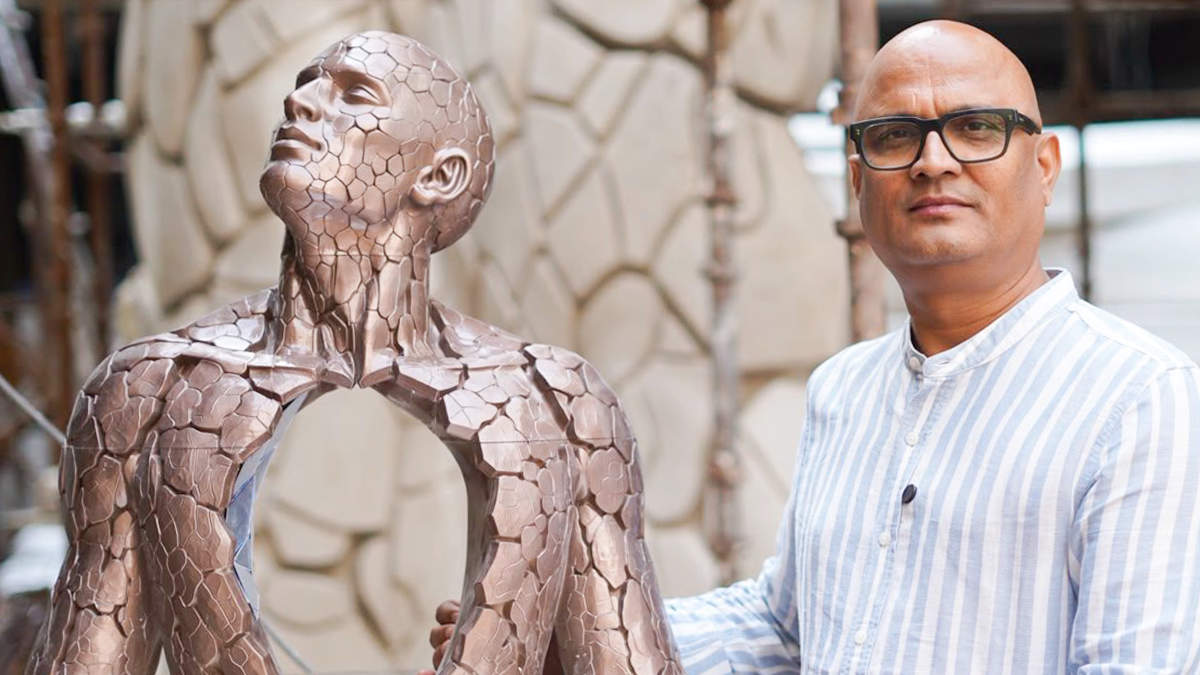
Indian sculptor Naresh Kumar Kumawat is set to present his monumental sculpture, “The Mirror Within”, at the India Art, Architecture & Design Biennale 2026 in New Delhi. Measuring approximately 22 feet in height and 14 feet in width, the installation draws inspiration from the Upanishadic philosophy of ‘Tat Tvam Asi’, meaning ‘You Are That’. Organised by the Ministry of Culture, Government of India, the Biennale will take place from 4 December 2026 to 21 March 2027, bringing together artistic practices across art, architecture and design.
A Sculpture Inspired by the Philosophy of Oneness
At the centre of “The Mirror Within” is the idea that the individual and the universe are interconnected. Inspired by Indian philosophy ‘Tat Tvam Asi’, the sculpture explores the relationship between human identity, self-awareness and the Universe.
Kumawat uses the human form as a means of communicating this philosophical concept. Rather than presenting a sculpture that visitors simply observe, the artist has conceptualised the work in which people become part of the visual experience. The artwork’s reflective surface captures reflection of the individuals standing before it, along with the sky and surrounding landscape.
As visitors move around the installation, the reflections change, creating an ongoing interaction between the artwork, its audience and the environment.
Material, Form and Symbolism
The installation is approximately 22 feet tall and 14 feet wide, the sculpture is made of mirror-finish stainless steel with bronze tones. One of its defining features is an open space in the chest, which represents the inner self.
The artwork brings together several symbolic elements, each contributing to its central theme:
- Upward-facing head: Represents awareness and the search for truth.
- Open chest: Symbolises the inner self and the idea of looking beyond external appearances.
- Reflective surface: Allows visitors to see themselves within the artwork, making them active participants in the experience.
- Changing reflections: Bring the surrounding environment into the sculpture, highlighting the relationship between individuals and the world around them.
Through these elements, Kumawat explores how the perception of an artwork can change depending on the person viewing it and the environment in which it is placed.
Connecting Ancient Philosophy with Contemporary Public Art
The India Art, Architecture & Design Biennale 2026 is organised by the Ministry of Culture, Government of India. According to the Biennale’s official information, the 108-day programme will extend across Delhi’s heritage monuments, museums, galleries and public spaces, with Purana Qila serving as its central venue. The programme includes exhibitions, installations, performances, conversations and workshops.
The historic architectural setting provides a context for contemporary artistic interpretations of India’s cultural and philosophical traditions. Within this framework, The Mirror Within seeks to bring an ancient philosophical idea into a public art environment through material, scale and audience interaction.
Naresh Kumar Kumawat’s Sculptural Practice
Naresh Kumar Kumawat is a third-generation sculptor who comes from a family with a longstanding tradition of sculpture. His practice includes monumental sculptures and public installations, with projects across India and several international locations. His work draws on Indian cultural traditions, history and themes connected with human consciousness.
His artistic approach combines traditional sculptural knowledge with contemporary materials and large-scale production. While many of his projects engage with historical, religious and cultural subjects, The Mirror Within places particular emphasis on individual perception and the relationship between the viewer and the artwork.
Artist’s Perspective on the Installation
Speaking about the concept behind the work, Kumawat said that his starting point was the question of how individuals understand themselves in relation to everything around them.
He explained that the open space in the sculpture’s chest and its mirror-finish surface were intended to express the philosophy of ‘Tat Tvam Asi’. He also noted that the viewer becomes part of the artwork when standing in front of it.
The artist hopes visitors will experience this relationship independently, without needing a prescribed interpretation of the sculpture. The work therefore leaves room for individual responses and personal reflection.
Biennale Dates and Visitor Information
| Event | Details |
| Artist | Naresh Kumar Kumawat |
| Artwork | The Mirror Within’ at India Biennale 2026 |
| Venue | Red Fort (official Biennale listing for The Mirror Men; confirm artwork title and placement) |
| City | New Delhi, India |
| Opening Date | 4 December 2026 |
| Exhibition Dates | 4 December 2026 – 21 March 2027 |
| Organiser | Ministry of Culture, Government of India |
| Entry / Tickets | Biennale Pass; check official website for booking details |
| Website / Registration | indiabiennale.culture.gov.in |
Takeaway
With The Mirror Within, Kumawat brings questions of self-identity, consciousness and Universal connection into the setting of a contemporary art event. By making the viewer’s reflection an integral part of the sculpture, the installation offers an opportunity to explore the relationship between the individual and the world around. It also contributes to a broader cultural conversation about how traditional Indian philosophical ideas can find expression through contemporary public art.