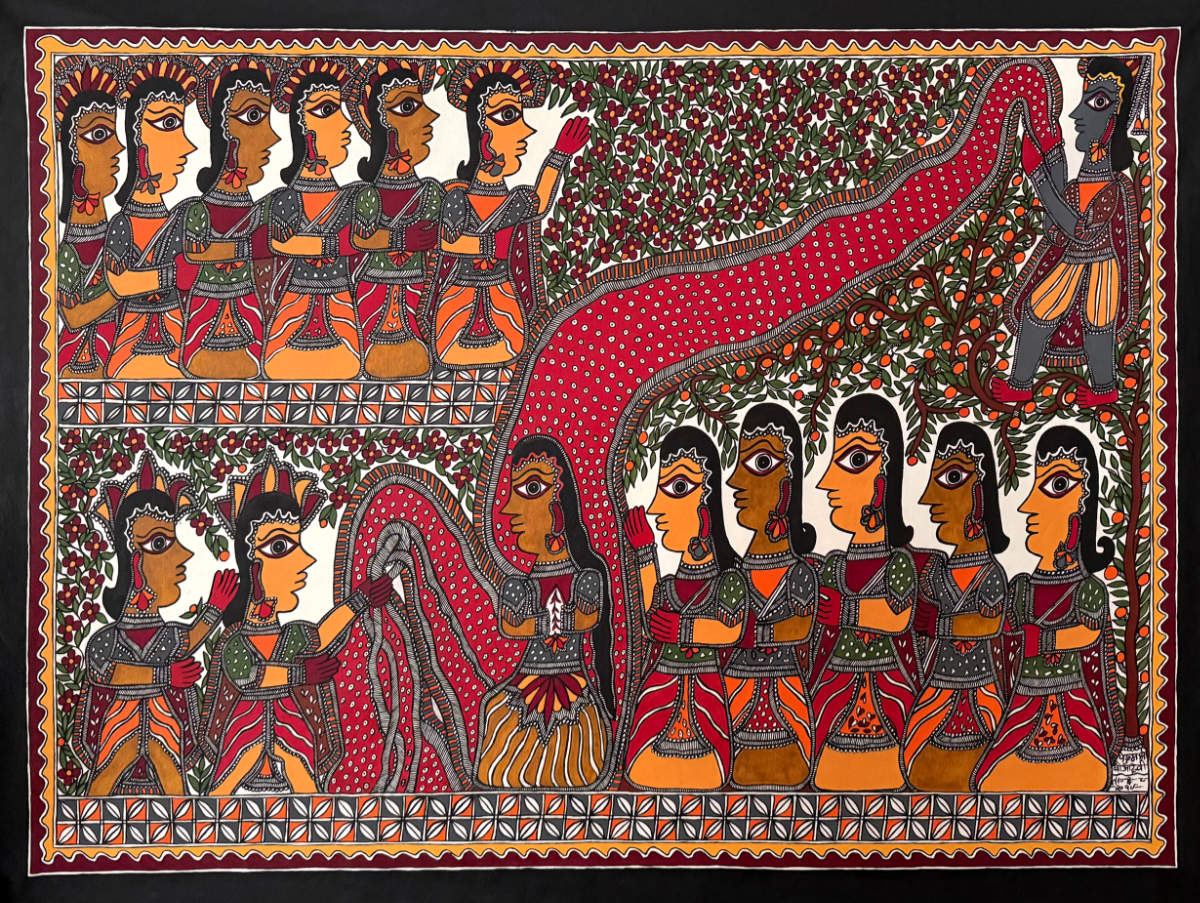
An exhibition celebrating the artistic journey of acclaimed Mithila artist Baua Devi will open at Bikaner House, New Delhi, on 12 December 2026. Titled Baua Devi: Custodian of Mithila Painting, the exhibition is presented by Palette Art Gallery and curated by art historian and curator Dr. Alka Pande. Running until 22 December 2026, the presentation will bring together approximately 100 artworks, tracing the artist’s practice from her early paintings to recent works created especially for the exhibition.
Suggested Story: Indian Folk Artists Who Brought their Folk Art to the World Stage
The exhibition examines the development of Mithila painting, also known as Madhubani art, from its traditional ritual and domestic beginnings to its recognition within the international art world. Through Baua Devi’s compositions, it explores how an inherited visual tradition has continued to evolve while retaining its connections to community, mythology and everyday life.
Baua Devi and the Evolution of Mithila Painting

Born into the artistic traditions of Jitwarpur village in Bihar’s Madhubani district, Baua Devi emerged as an important figure in the transformation of Mithila painting. Her career developed during a period when the practice began moving beyond the walls of village homes and onto handmade paper.
According to the exhibition’s accompanying press material, she was among the early artists identified by the All India Handicrafts Board for this transition. The shift helped bring a traditionally domestic and ritual practice into the public art market, creating opportunities for women artists to gain wider recognition and economic independence.
Baua Devi received the National Award in 1984 and the Padma Shri in 2017. Her work also gained international recognition through its association with the landmark exhibition Magiciens de la Terre at the Centre Pompidou in Paris in 1989.
A Visual Language Rooted in Tradition
Baua Devi’s paintings retain the distinctive visual characteristics of the Mithila tradition while incorporating individual narratives and interpretations. Her compositions frequently employ flat pictorial spaces, strong outlines, intricate patterns and densely arranged figures.
She works in the bharni style, characterised by filling figures and motifs with bold, saturated colours. The traditional palette described in the exhibition material includes black, yellow, red and white, associated with locally sourced materials such as soot, turmeric, vermilion and rice powder.
Mythological subjects, including episodes from the Ramayana and stories from the life of Krishna, appear throughout her practice. Her interpretations often give particular attention to women’s experiences, including the story of Sita. This approach connects familiar narratives with questions of identity, gender and lived experience.
Paintings as Records of Cultural Memory
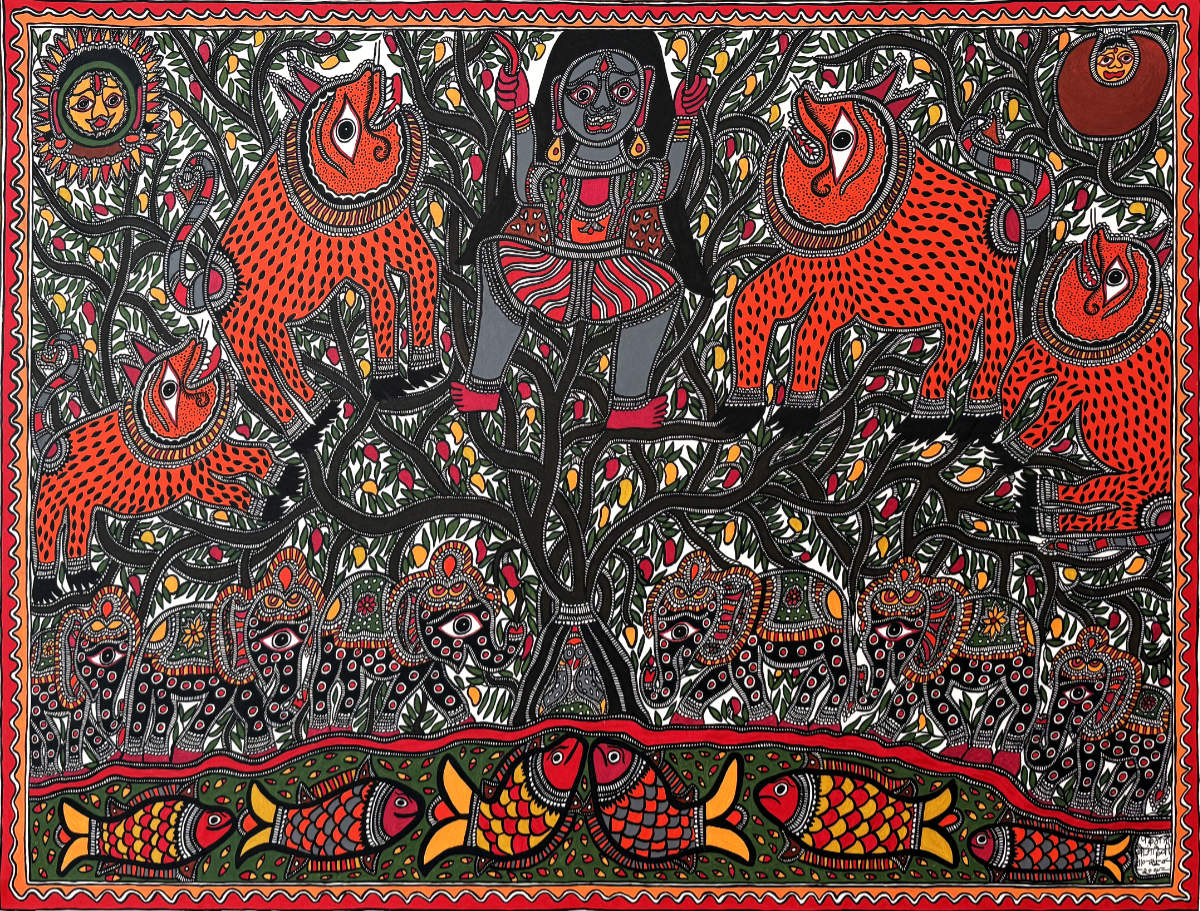
Beyond religious and mythological subjects, Baua Devi’s work documents the social histories and everyday experiences of the Maithil community. Her paintings bring together folk narratives, religious practices, personal memories and wider historical events.
The exhibition material notes that her subjects range from the personal loss of her first-born child to the global events surrounding the September 11 attacks. Recurring imagery includes Shiva, celestial bodies, snakes and narrative scenes drawn from Maithil folk traditions.
These subjects demonstrate the breadth of her artistic interests and the capacity of Mithila painting to respond to experiences beyond its traditional ritual settings. The works are presented as a visual record of cultural continuity as well as individual expression.
Dr. Alka Pande’s Curatorial Approach
The exhibition is curated by Dr. Alka Pande, whose approach places Baua Devi’s paintings within a framework of cultural memory and feminine expression.
The curatorial concept draws on the literary idea of feminine écriture, which considers how women articulate knowledge and experience through embodied, cyclical and non-linear forms of expression. Rather than approaching the paintings solely as social commentary, the exhibition considers them as an intimate archive of the artist’s inner and outer worlds.
This perspective also shifts attention towards the role of women artists in preserving cultural knowledge. Through Baua Devi’s work, the exhibition examines how personal narratives and community histories can be communicated through visual traditions, without depending exclusively on written records or formal historical accounts.
Approximately 100 Works Across Different Periods
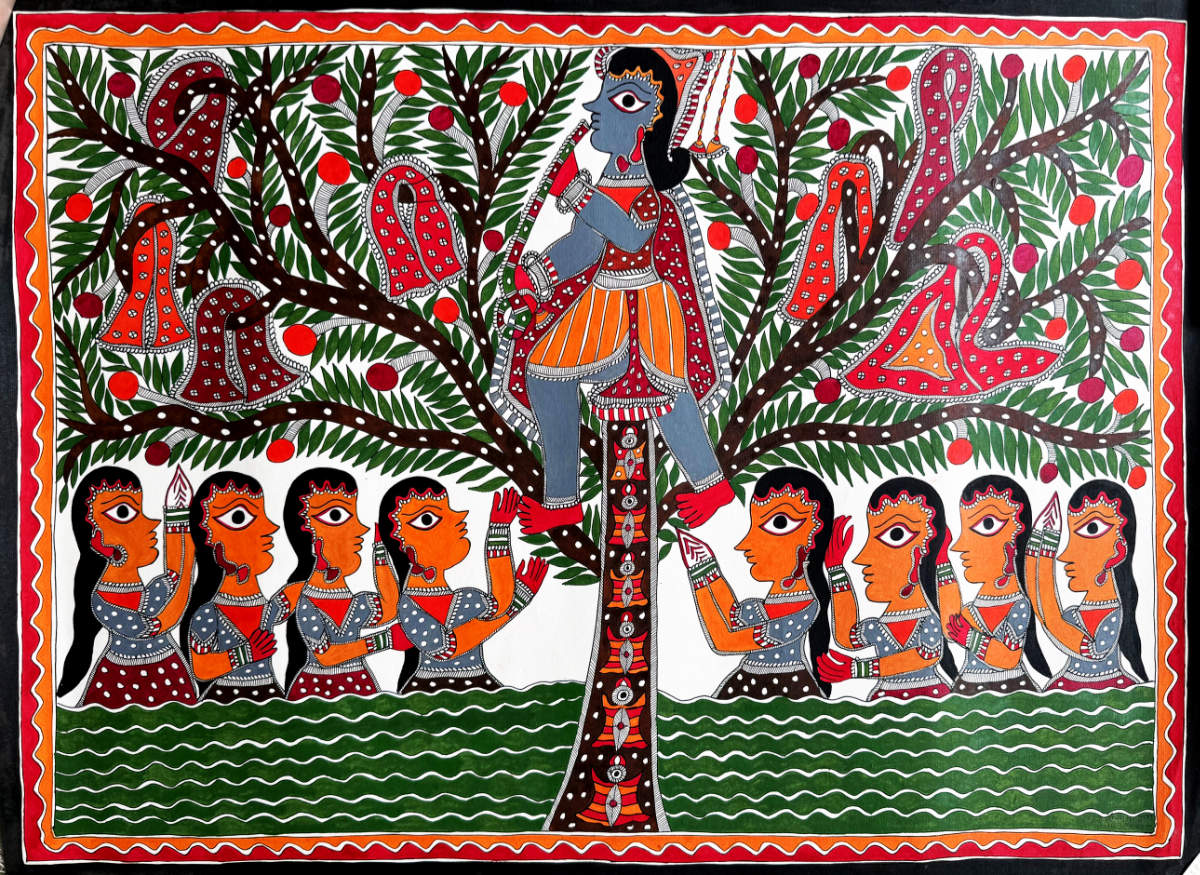
Bringing together approximately 100 artworks, the exhibition will offer an overview of Baua Devi’s artistic development. The selection spans her early practice and includes recent works made especially for this presentation.
Key themes and elements visitors can expect to encounter include:
- Mythological narratives drawn from the Ramayana and Krishna traditions.
- Depictions of women, family life and personal experiences.
- Traditional Mithila motifs, including snakes, celestial imagery and religious figures.
- Paintings documenting Maithil social practices and cultural memory.
- Works demonstrating the development of the artist’s visual language across different periods.
By presenting these works together, the exhibition aims to show how Baua Devi has maintained the foundations of Mithila painting while expanding its narrative possibilities.
Palette Art Gallery and the Exhibition Venue
Established in 2001 by fashion designers Rohit Gandhi and Rahul Khanna, Palette Art Gallery has developed a programme focused on contemporary Indian art, supporting emerging and established artists. Its exhibition history includes projects such as Bombay Boys, Burnish / Tarnish and 18 Dimensions.
| Event | Details |
| Title | Baua Devi: Custodian of Mithila Painting |
| Artist | Baua Devi |
| Curator | Dr. Alka Pande |
| Venue | Bikaner House, New Delhi, India |
| Exhibition Dates | 12–22 December 2026 |
| Organiser | Palette Art Gallery |
| Website | Palette Art Gallery |
Takeaway
Through this exhibition, visitors will have an opportunity to engage with Mithila painting as both an artistic practice and a repository of cultural knowledge. Baua Devi’s work brings together mythology, women’s perspectives and community histories, offering a way to consider how traditional art forms remain relevant across generations. The presentation also draws attention to the contribution of women artists in sustaining and shaping India’s regional artistic traditions.