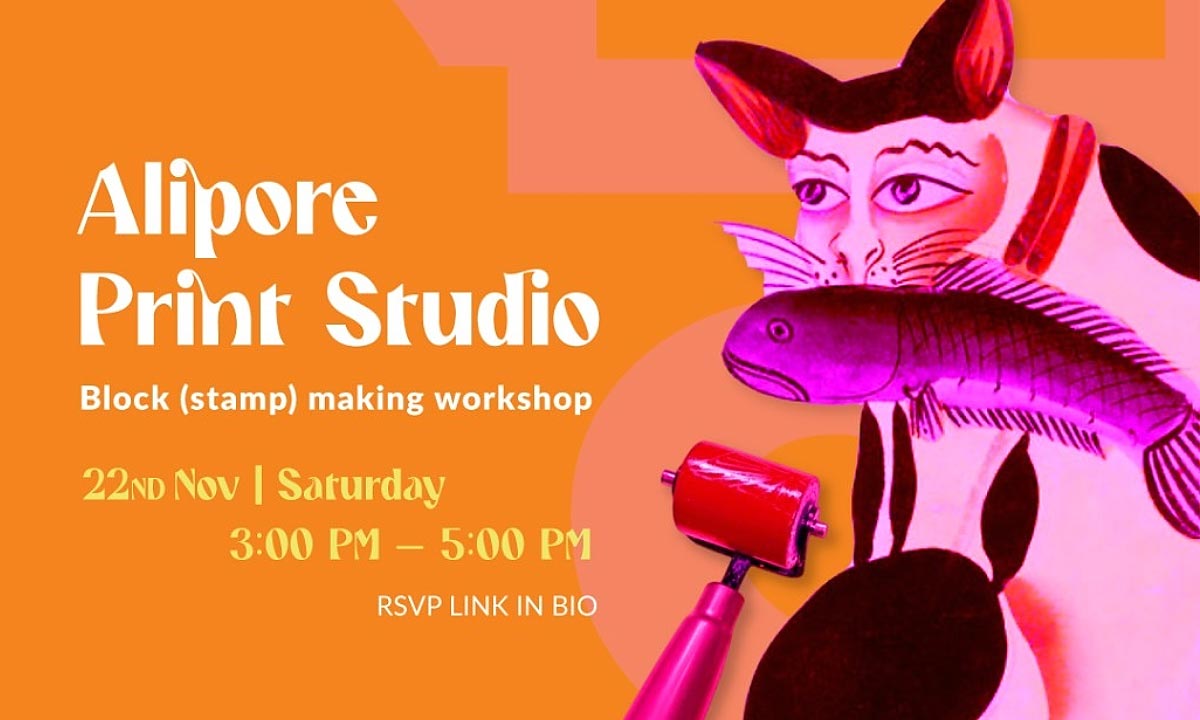
The city of joy, Kolkata, is intrinsically a space that is drenched in history and culture, and the city’s favourite ritual seems to be celebrating life through art. The Kolkata Art Weekender is presenting a unique constellation of events through one workshop: Alipore Print Studio, a block (stamp) making session hosted jointly by DAG Museums and Alipore Museum on 22 November, 3–5 PM. This hands-on workshop aims to offer an unforgettable opportunity to the participants by allowing them to step directly into the world of symbols and traditional printmaking, by seeking inspiration from a landmark exhibition on the 19th and 20th century Bengal art. This workshop promises an afternoon where myths and motifs return as a fresh source of amusement and tales for the ‘visitors-turned-printmakers’ for a day.
Re-Rooting this workshop
The initiation of this event is anchored in DAG’s ongoing exhibition, ‘The Babu and The Bazaar: Art from 19th and 20th Century Bengal’. This exhibition made Kolkata’s complex history accessible in a visually appealing yet understated manner. This exhibition is a treasure trove of the art forms that flourished and proliferated in the city during the colonial era. It includes Kalighat pats, commissioned Early Bengal Oil Paintings, and mass-produced prints such as woodcuts, engravings, and lithographs. The reverse-glass paintings are also a very thoughtful inclusion in this sequence. Curated by experts like Aditi Nath Sarkar and Sandeep Maitra, the exhibition articulates the dichotomy between the English-educated elites, i.e., the babus, and the popular bazaar or market prints. The presentation of the two distinctive genres together reveals how the prints circulated among people from different backgrounds and varied walks of life.
Taking inspiration from this, the forthcoming workshop shall open the doors to a portal where the paper, ink, and carved blocks become the circuits of Bengal’s layered history. Led by Chaiti Nath, a member of DAG’s team, the participants will be guided through a step-by-step experience that shall bind folklore and the 19th-century visual with hands-on craft work. Chaiti’s sessions are noted for their clarity and curiosity-inducing factor. She often initiates the sessions with a benign beginning, i.e., by putting forward questions like What happens when you translate an old story into a new mark? The main spirit of the session is inducted when tools are picked up, and participants get to know about the vocabulary of Bengal’s urban art through a trail of DAG’s The Babu and The Bazaar.
At the workshop, the VP of DAG Museums, Sumona Chakravarti, will guide everyone by introducing the segments. She is acknowledged for her expatriates in archival works and very approachable storytelling capacity. In her opinion, these artworks are not something restricted to the museum as relics, but are living ideas that continue to influence modern-day graphic visuals.
Inside the Print Studio: A Guild of Beginners
The Alipore Print Studio session will be conceived as a link between the historical context of the exhibition and contemporary artistic practices. The session’s premise is simple yet high-octane,i.e., to allow participants to “Translate myth and motif into print swatches.” The method that will be followed is the block printing technique, in which different patterns are carved into a block that is inked and stamped onto a surface. The atmosphere of the event is supposed to be very immersive in itself, encouraging people to “Work like a guild in a traditional print studio, foraging, carving, and creating individual prints into a collective body of work.” This sentiment of collective work and inclusivity makes it stand out and appealing. By engaging tools and materials of traditional printmaking, the session aims to leave a deeper imprint on everyone’s heart. As many people flock together, a sense of camaraderie is woven even among strangers. And in the final hour, individual prints produced by each participant will be assembled into one space, making it a collective work of many hands.
Through workshops like these, DAG continues its legacy of making history and art accessible to people irrespective of age, gender, and other factors, and nurtures a natural tendency to get intrigued by heritage and culture.
Event Details
| Event | Description |
|---|---|
| Title | Alipore Print Studio: Block (Stamp) Making Workshop |
| Host | DAG Museums & Alipore Museum |
| Date & Time | 22 November 2025, Saturday, 3:00 PM – 5:00 PM |
| Workshop Focus | Translating myth and motif into print swatches via block (stamp) making. |
| Inspiration Source | DAG’s exhibition: ‘The Babu and The Bazaar: Art from 19th and 20th Century Bengal’ |
| Lead Artist | Chaiti Nath (@mumtendu, DAG Museums Team) |
| Contextual Walkthrough | Led by Sumona Chakravarti (VP, DAG Museums) |
| Venue | Alipore Museum, Kolkata |
Key Highlights
- Hands-on block carving inspired by motifs from historic Bengal art
- Curated walkthrough of DAG’s exhibition for conceptual grounding
- Collective print-making experience in a guild-like setting
- A blend of history, technique, and personal creativity
- Part of the larger Kolkata Art Weekender programme featuring city-wide art events
Takeaway
View this post on Instagram
The Alipore Print Studio is a brilliant model for art engagement and contemporary creative practice. It makes one feel engaged and included, even if they do not possess true artistic skills. An interesting factor is that by modulating the workshop based on collective work, it also seeks to revive the tradition of communal, artisan-led traditions that have been replaced by industrial printing. This also recalims art from being ‘distant’ and makes it more tangible to people who also get a refreshing source of amusement through it. Thus, visitors shall not just perceive art, they will create some too, as they physically inhabit the cultural space. Therefore, this workshop is supposedly a warm invitation for people to sit, interact, and carve something meaningful that goes beyond being a trivial souvenir; it is indeed a celebration worth stepping in.