A Quick Glimpse Into The Exhibition
Portraiture as a genre has existed in history for a very long time. It grew in demand, especially within the urban centres where diverse social groups interacted. The human appearance has long served as the reflector of history. It apprehends the wavering ebb and flow of power, society, and identity. This persistent gesture is the central focus of DAG’s upcoming exhibition called “Face to Face: A Portrait of a City.” The exhibition will open in Mumbai at the DAG Gallery 1, The Taj Mahal Palace, Apollo Bunder, Mumbai, from January 8 to January 11, 2026. The thematic core of the exhibition revolves around tracing the portraiture of the city, its people, and history in the colonial and post-colonial era. The exhibition aims to trace the evolution of Bombay as a ‘heterogametic city,’ infiltrating through the narratives of social, cultural, and political spheres that have shaped the identity of the city.
The Colonial Canvas: Academic Realism and the Bombay School
The orbit of Portraiture in Western India is rudimentarily entangled with the establishment of British academic institutions. The establishment of the Sir J.J. School of Art in Bombay was a watershed moment in introducing the principles of European naturalism and academic realism to Indian artists. Hitherto, the visual representations drew inspiration from the Indian miniature or company school conventions. The proper academic conduct was instituted through the newly introduced curriculum that stressed anatomical precision and the Western technique of modelling (using light and shadow). This fundamentally changed how humans were drawn.
Early works at the beginning of colonial contexts were mostly commissioned under the patronage of local rulers and wealthy patrons. There were artists like Frank Brooks who produced the portraits of regional royals using European techniques. However, the prime chapter of development in the niche of paintings began with figures like M.V. Dhurandhar, M.F. Pithawalla, and D.C. Joglekar, who became instrumental in transforming portraiture into a tool used for chronicling indigenous life. These charismatic Indian painters absorbed the colonial art and percolated it into Bombay’s own identity.
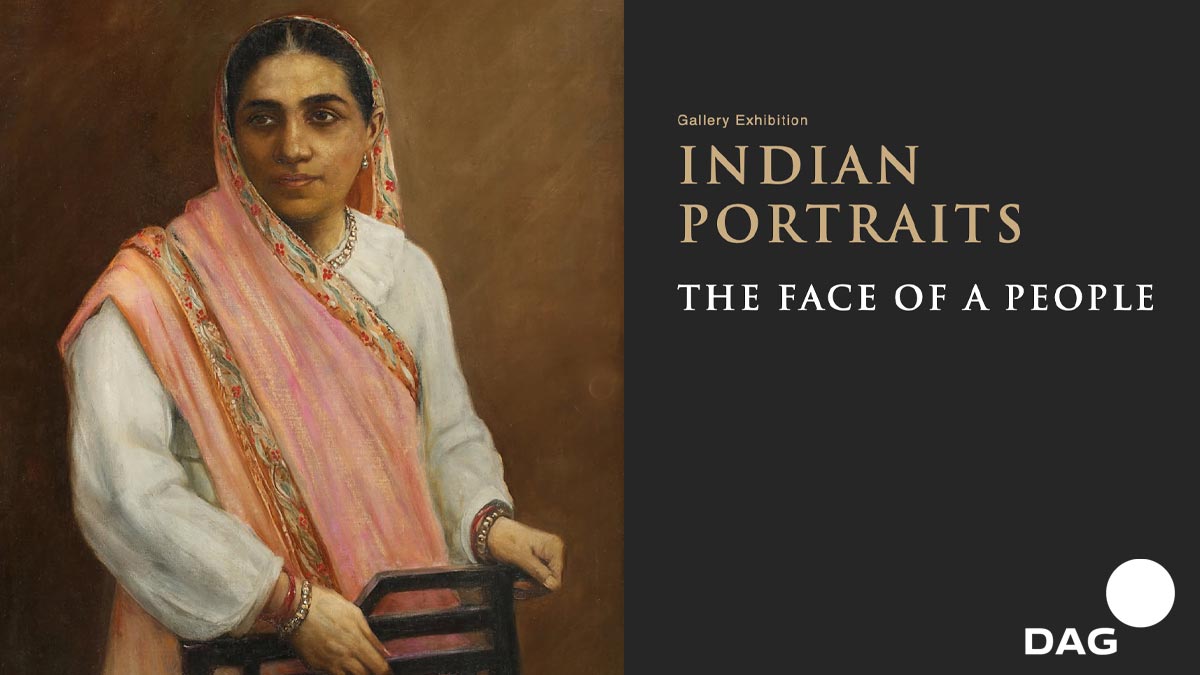
Later, the genre expanded and entailed people from a more diverse social strata. This included lay communities, shifting the focus of art from the elite to the broader social bases, sometimes including the subalterns. The portraits, therefore, began to capture collective memory. Hitherto, DAG’s initiatives, such as Indian Portraits: The Face of a People, show similar commitments to understanding how visual culture mediates collective identity and memory.
M.V. Dhurandhar: The City’s Foremost Chronicler
View this post on Instagram
Among the most significant figures who will be featured in the exhibition, Rao Bahadur Mahadev Vishwanath Dhurandhar occupies a distinct spot. As a product of the J.J. School, he executed the fusion of Western techniques with Indian subjects. In his career, he also rose to the position of becoming the first Indian Director of the J.J. School. His core orientation lies in European realism, but the subjectivity of his paintings revolved around his immediate surroundings in Bombay.
Dhurandhar left thousands of paintings, illustrations, and popular lithographs that reached the masses through postcards and calendars. His work oscillated between Indian mythological themes, such as Radha and Krishna, to historical depictions, and representations of contemporary life. He also bagged the patronage from the affluent Parsi community in late nineteenth and early twentieth-century Bombay. In 1928, Dhurandhar created illustrations for a Parsi Sanad (charter), depicting Parsi religious architectural features and community members in their daily life. He also received patronage from the Pathare Prabhu community to which he belonged.
Dhurandhar was contemporaneous with Raja Ravi Verma, but unlike him, Dhurandhar’s subjects, particularly his women, possessed a distinctive sense of tangible realism that felt closer to life.
The Exhibition At a Glance
| Aspect | Details |
|---|---|
| Title | Face to Face: A Portrait of a City |
| Venue | DAG Gallery 1, The Taj Mahal Palace, Apollo Bunder, Mumbai |
| Dates | January 8–11, 2026 |
| Curatorial Focus | Portraiture as a historical and cultural lens of Bombay |
| Artistic Range | Works from colonial academic realism to 20th-century Indian artists |
| Featured Artists | Frank Brooks, M.V. Dhurandhar, M.F. Pithawalla, Abalal Rahiman, and others |
| Organiser | DAG (formerly Delhi Art Gallery), a leading Indian art institution |
| Public Engagement | Exhibition supplemented by gallery programming and publication |
| Colonial Catalyst | The Sir J.J. School of Art introduced European naturalism, fundamentally changing Indian portrait style from miniature conventions to academic realism. |
| Shift in Patronage | Portraiture evolved from serving royal courts to chronicling Bombay’s middle classes, Parsi families, and diverse lay communities. |
Key Highlights
- The exhibition traces how portraiture in Bombay developed from European-influenced academic realism to nuanced representations by Indian artists trained in colonial institutions.
- It highlights the mastery of academic realism by the Bombay School artists, a movement often sidelined by the narrative of early modern Indian art.
- Portraits of local royalty, influential communities and everyday citizens are curated to reflect Bombay’s layered civic identity, shaped by empire, migration, commerce and cosmopolitan interactions.
- The exhibition brings together works across a broad time span and diverse artistic voices, from early colonial painters like Frank Brooks to local artists whose styles engaged both indigenous and Western visual vocabularies.
- Central artists include M.V. Dhurandhar, whose prolific output provided an unparalleled documentation of the city’s populace.
- By positioning faces, both of elites and ordinary citizens, as visual archives, the show situates portraiture as a mode of historical documentation rather than mere artistic production.
- The featured portraits act as a “collective memory” of the city, reflecting the layered identities of a restless, pluralistic metropolis.
Portraiture as a Socio-Political Document
The exhibition places these portraits in the utilitarian purview of socio-political documents. Each canvas denotes the social hierarchies through attire, posture, and background. The portrait of a Parsi businessman, for instance, speaks volumes about the community’s wealth and influence in commerce, just as a depiction of a daily life scene chronicles vanishing customs.
Today, urban spaces are reimagined in a plethora of ways, and amidst this, the classic portraits of these Indian masters offer a unique visual vocabulary through which the imagination of the cityscape broadens. The exhibition is an open invitation to people to reconsider how arts and visual histories shape the picturization of a particular thing, and in turn are shaped by civic memory.