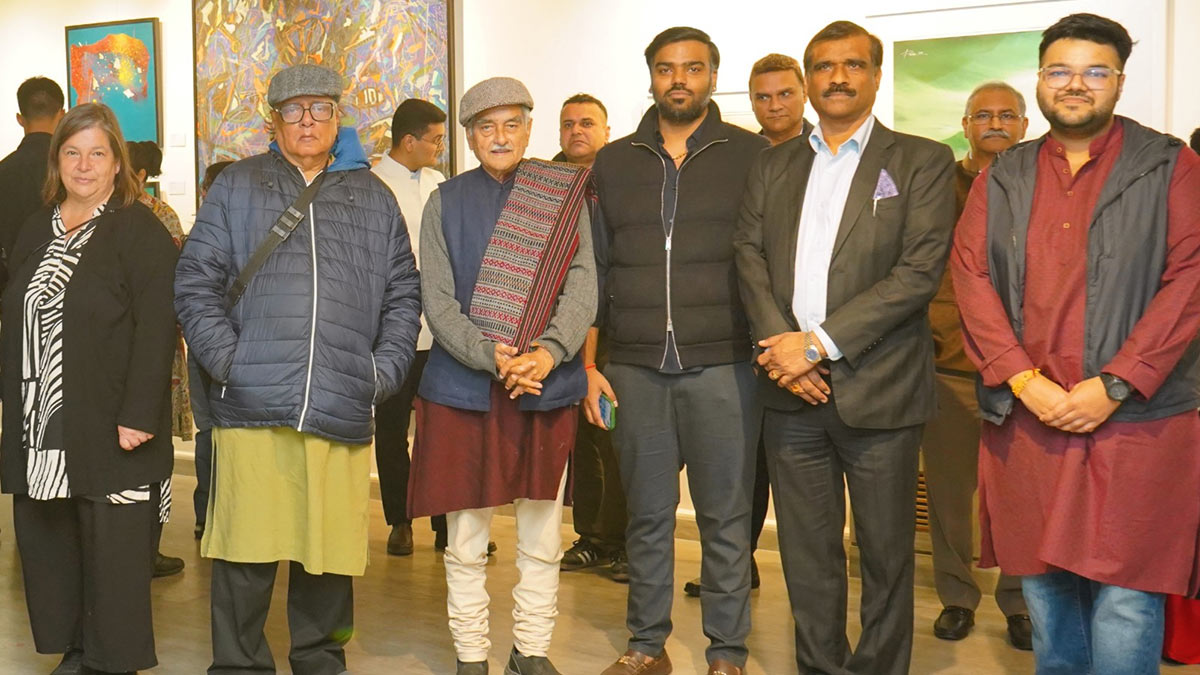
The Tarun Art Gallery, New Delhi, has officially opened its doors to a thought-provoking group exhibition titled “Linear Conversations: Between Line and Form.” This exhibition presents itself as a crucial juncture of contemporary Indian art. The exhibition aims to elevate and empower emerging artists and voices in the modern milieu. The showcase will continue to be on view till January 15, 2026, daily from 11:00 am to 7:00 pm, at M-7, M Block Market, Greater Kailash II, New Delhi. The exhibits accentuate the artistic potential of the “line.” The exhibits are willing to navigate through movement, emotion, and cognition in artmaking.
Linear Conversations metamorphose the creative space as a reflector that unfurls abstraction, structure, and rhythm. The exhibition exhibits the works of six artists, namely, Anup Kumar Chand, Bikash Poddar, Tapan Dash, Goldminson Aimol, Harshh Kumar, and Ishu. These artists engage in their distinct artistic practices that reconcile individual approaches with shared linguistic threads woven through line and form. This exposition opens up a window for art enthusiasts to engage with works that challenge traditional boundaries of structure and rhythm.
The Intersection of Geometry and Emotion: A Visual Narrative
The buildup of the exhibition is based on the “line,” demarcating the nascent notions and the fenestration of emotions. By coalescing the works of six distinct artists, the gallery has molded a safe space for the emergence of an eclectic style that melds with the syncretic dialogue expressed through these pieces. Each artist brings a unique medium and philosophical approach to the table, yet they are all united by an investigation into how linearity dictates our perception of space and movement. The curation of this exposition is guided by Director Tarun Sharma, who moved beyond mere aesthetics and highlighted the “conceptual tools” that artists use to articulate narratives, both personal and collective, making the “linear” a vehicle for storytelling.
Essential Exhibition Details
| Aspects | Details |
|---|---|
| Exhibition Title | Linear Conversations: Between Line and Form |
| Gallery Name | Tarun Art Gallery |
| Location | M-7, M Block Market, G.K. II, New Delhi |
| Inauguration | Preview held on December 18, 2025, with the presence of eminent critics |
| Exhibition Dates | Currently on view until January 15, 2026 |
| Visiting Hours | 11:00 am to 7:00 pm |
| Featured Artists | Anup Kumar Chand, Bikash Poddar, Tapan Dash, Goldminson Aimol, Harshh Kumar, and Ishu |
| Director | Mr. Tarun Sharma |
| Inaugurated By | Prayag Shukla and Vinod Bhardwaj |
| Conceptual Focus | Dialogue between line and form as structural and emotive devices |
| Gallery Heritage | Established in 1983, the modern and contemporary art focus |
Key Highlights
- Central to the exhibition is the exploration of “line” as a generative force, extending beyond formal composition to become a conduit for rhythm, texture, and movement in art.
- Works range across painting, mixed media, and experimental abstraction, allowing audiences to experience varied material interpretations of linearity and spatial dynamics.
- The curated ensemble blends more established practices with emerging sensibilities, showcasing the plurality of contemporary Indian artistic approaches to structure and abstraction.
- The exhibition preview was graced by Prayag Shukla, poet and art critic, and Vinod Bhardwaj, art and film critic, whose perspectives enriched the discourse around the artworks.
- Tarun Sharma emphasizes that the exhibition invites slow looking and sustained engagement, encouraging viewers to interpret line and form not just visually but conceptually.
- Located in the heart of G.K. II, the gallery continues its 40-year legacy of making high-quality Indian art accessible to the public.
A Closer Vision of The Artistic Lens
Artist Anup Kumar Chand presents his artworks with a unique aspect, where he employs linear elements to obfuscate the extremities between geometry and emotion. His artistic composition feels very organic and structurally molded. Bikas Poddar incorporates punctilious interlacings of lines that imitate tension and release. This creates a real effect in the eyes of the beholder and nudges the audience to bypass form and gesture in the traditional sense. Tapan Dash and Goldminson Aimol both use texture and contour in a dichotomous manner, where lines become active vectors of mise-en-scène. Harshh Kumar and Ishu demonstrate how line can be used as a narrative device, structuring not just shape but the emotional cadence of each work.
A Legacy of Excellence: Tarun Art Gallery’s Evolving Vision
Founded in 1983 by Mr. Surender Sharma, Tarun Art Gallery has emerged as a pillar of the Indian art market. It is acknowledged for its impressive collection of Indian masters. The gallery has displayed an extraordinary blend of historical depth and contemporary relevance. Under the directorship of Tarun Sharma, the institution has pursued a reinvigorated curatorial philosophy. His notions balance reverence for artistic lineage with an openness to experimental forms and ideas.
Mr. Tarun Sharma has nudged the organization towards a more contemporary and experimental future. This reinvention of curatorial thought is well reflected in “Linear Conversations.” The gallery is committed to authenticity and dedicates its resources to artistic integrity. By positioning established artists with budding talents, the gallery sustains cross-generational dialogues. Through this exhibition, the gallery will ensure a continuity of practice that is essential for the health of the Indian art ecosystem.
A Critical Perspective: The Power of Minimalist Inquiry
“Linear Conversations” is a bold move that forces the viewer to strip away the noise of the external world. This exhibition has an inherent sense of honesty in the artworks, as it compels the viewers to contemplate and reflect on themselves. When Tarun Sharma mentions that the intent is to “encourage viewers to slow down,” he is addressing a necessity for mindfulness. This exhibition is a testament to the fact that contemporary Indian art is not just about vibrant colors or social commentary; it is an intellectual and aesthetic proposition.
The precise focus on the “line” is what makes all the difference. With line becoming the fundamental foundational element of visual representation, the exhibition heightens the scope of mindful curatorial intent and features a fresh artistic vision amidst an age dominated by high-speed digital consumption. Thus, Tarun Art Gallery reinforces its role as a pivotal platform for critical exchange in India’s contemporary art landscape. The exhibition rewards those who engage deeply, offering insights that linger beyond the gallery walls and contribute meaningfully to ongoing dialogues in visual culture.