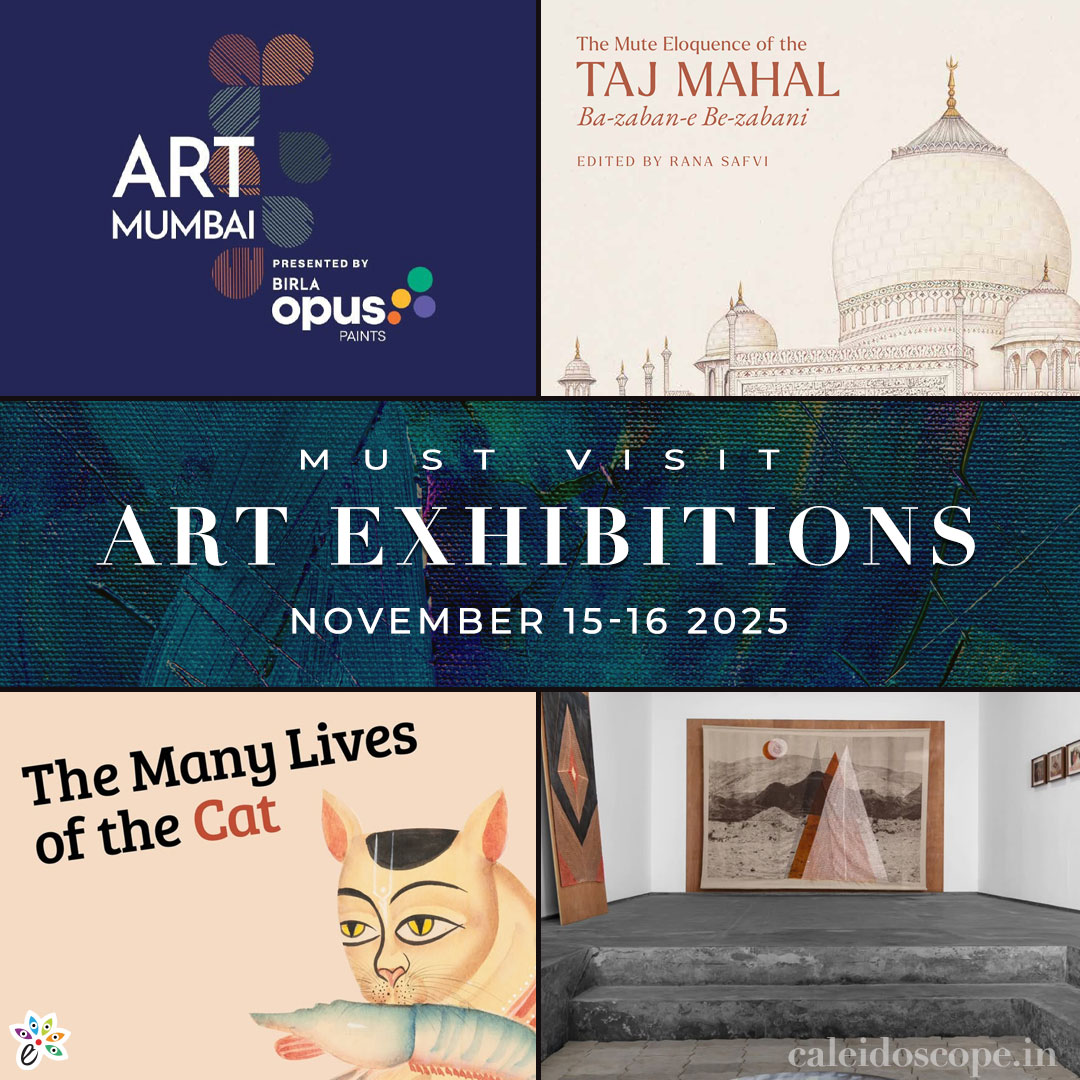
This weekend, India’s artistic calendar is filled with major events spanning almost all metropolises. From internationally focused art fairs to tribal affairs and modern art, this weekend has it all. Whether you want the thrill of discovering new artists or a quieter spot for a solitary exploration, something is waiting for everyone. Listed below are 5 five unmissable Art destinations that one simply cannot miss.
Weekend Art Events & Venues
| Events | Venue |
|---|---|
| Art Mumbai | Mahalaxmi Racecourse, Mumbai (13–16 Nov) |
| DAG – “The Mute Eloquence of the Taj Mahal” | DAG, New Delhi (25 Oct – 6 Dec 2025) |
| MAP – Museum of Art & Photography | MAP Bengaluru (selected shows through Nov 2025) |
| Experimenter – Sohrab Hura & Radhika Khimji | Experimenter Gallery, Kolkata (5 Nov 2025 – 3 Jan 2026) |
| Kalakriti Art Gallery – “Sculpting with Light & Darkness” | Kalakriti Art Gallery, Hyderabad (8 Nov – 31 Dec 2025) |
1. Art Mumbai: Mahalaxmi Racecourse, Mumbai (13–16 Nov)
View this post on Instagram
Art Mumbai has transformed itself into an epicenter of the South Asian art world with the third edition of ART Mumbai 2025. It has become the one-stop melting pot for gallery collectors, younger curators, and the curious public alike. Now at the Mahalaxmi Racecourse, the fair brings together a wide range of stakeholders, ranging from renowned galleries to budding artists. People shall witness life-size installations next to smaller ones, intimate painting booths, talks, and programmes that run throughout the fair days. There are homegrown houses such as Chemould Prescott Road, Nature Morte, and Experimenter. An attention-worthy highlight is the presence of Amrita Sher-Gil’s ‘Untitled (Tigers)’, the only known sculpture by the 20th century’s most prolific avant-garde artist. Furthermore, paintings of one of India’s modern masters, Tyeb Mehta, are also featured.
For weekend visitors, the fair is the best way to trace the contemporary market trends, such as trendy painting styles, new media experiments, cultural events, and much more. One practical tip: arrive early on Saturday to avoid the thickest crowds and to see installations in daylight. Art Mumbai, thus, serves as a potent platform for conversation, synchronization of different masses, critics, and the public in a vibrant, immersive art marketplace.
Exhibition Overview
| Event | Details |
|---|---|
| Artists Highlighted | Amrita Sher-Gil, Tyeb Mehta, Viren Tanwar, Sahil Naik, Carlos Aires |
| Focus | Convergence of Modern Indian and Global Contemporary Art |
| Environment | Large-scale, commercial, and critically significant |
2. DAG: “The Mute Eloquence of the Taj Mahal” (New Delhi; 25 Oct – 6 Dec 2025)
View this post on Instagram
This awestrucking exhibition is curated by the renowned writer and scholar Rana Safvi. The aim is to reframe the Taj Mahal not simply as a monument but as a cultural and visual archive. This exhibition gathers company-school paintings, early photographic prints, postcards, and modern reverberations to trace how the Taj has been looked at, reproduced, and placed in myth across time frames. The most crucial aspect of this event is that it offers a vibrant historiographical experience, as the artworks display an array of events from love stories, commerce, and most importantly, civic memory. DAG also schedules a walkthrough with specialists on the weekend to explore the contextual depth of the Taj’s mute eloquence.
Exhibition Overview
| Event | Details |
|---|---|
| Theme | Visual and historical representations of the Taj Mahal across centuries |
| Highlights | Company-school paintings, early photographs, postcards, and modern artistic responses |
| Why Visit | Offers a layered, archival, research-driven understanding of how the Taj has been imagined and reimagined |
3. MAP: Museum of Art & Photography, Bengaluru (selected shows on view through Nov 2025)
View this post on Instagram
Bengaluru’s MAP has several museum-scale exhibitions running into mid-to-late November, including exhibitions that reframe representation and perceptions: “VISIBLE/INVISIBLE: Representation of Women in Art”; “Ticket Tika Chaap: The Art of the Trademark in Indo-British Textile Trade”; “In celestial Company”; “The Many Lives of the Cat”, and more. Each of these exhibitions offers an insightful experience and exposure to unsettling pockets of our lives. The questions put forth by the canvases make the viewers uncomfortable, but ultimately provoke them to hold deep conversations from within, and gently pass through a contemplative state through which a positive insight is yielded. The motive is not just to fill the gallery spaces and offer amusement to people on weekends; the main motive is to put people into a space where they can judge their present reality and become more aware of themselves as well as their surroundings. Allow two hours to move through MAP’s permanent and rotating displays, and check for gallery talks or late openings that often coincide with weekend programming.
Exhibition Overview
| Event | Details |
|---|---|
| Exhibitions | “VISIBLE/INVISIBLE: Representation of Women in Art”, “Ticket Tika Chaap”, “In Celestial Company”, “The Many Lives of the Cat”, and more |
| Experience | Provocative, introspective viewing that challenges perceptions and encourages dialogue on identity, art, and lived reality |
| Why Visit | Museum-scale depth, diverse themes, and weekend talks/late openings |
4. Experimenter: Sohrab Hura, “The Forest” (and Radhika Khimji’s concurrent show), Kolkata (5 Nov 2025 – 3 Jan 2026)
View this post on Instagram
Experimenter in Kolkata brings together two of the season’s most compelling solo exhibitions. Sohrab Hura’s The Forest presents a corpus of fresh oil paintings, etchings on paper, and a video clip that circumnavigates themes of waiting, refuge, and fractured memory. In the adjacent gallery, Radhika Khimji’s works unveil themselves through subtle mark-making and spatial interventions that question how bodies and landscapes are constructed, erased, or reimagined. Seen together, the exhibitions form an insightful dialogue. Sohrab Hura’s cinematic, narrative tension contrasts with Radhika’s tactile, materially driven abstractions. The intellectual simulation generated by the two is distinctive as well as complementary. The rooms of Experimenter make both exhibitions equally rejuvenating, as they involve slower looking and multiple returns to the individual works.
Exhibition Overview
| Event | Details |
|---|---|
| Exhibitions | Sohrab Hura’s The Forest and Radhika Khimji’s concurrent solo show |
| Experience | A dialogue between cinematic, narrative fragments (Hura) and material, spatial abstraction (Khimji) in intimate gallery rooms |
| Why Visit | Perfect for slow, close viewing; works reward multiple passes; evening walk-throughs and weekend talks enrich engagement |
5. Kalakriti Art Gallery: “Sculpting with Light & Darkness” (Hyderabad; 8 Nov – 31 Dec 2025)
View this post on Instagram
Hyderabad’s Kalakriti gallery is featuring a vibrant sculptural group show curated by Ina Puri, bringing together three sculptors whose artistic practice ranges from bronze work to thread-based interventions. The material contrast is presented through a competitive format of metal vs. textile, monumentality vs. intimate assemblage, and celebrates Kalakriti’s long history of catering to regional contemporary practice. For weekend visitors to Hyderabad, this exhibition is an excellent scope of viewing experience that involves sculptural work that is subjected to varied interpretation by varied frames. The potential of the exhibition lies in its superb strategy of engaging with a plethora of materials intelligently. Each artist works with a different medium and explores the path of light and how it transforms certain pockets into darkness as well. Hyderabad’s art scene is steadily growing, and Kalakriti remains one of the few galleries that consistently presents exhibitions of this conceptual depth and intellectual quotient. Whether you are an art student, a casual visitor, or a collector, this exhibition invites everyone to observe how sculpture behaves not just as an object, but as a kinetic subject that shifts with every step you take.
Exhibition Overview
| Event | Details |
|---|---|
| Exhibition | A sculptural group show curated by Ina Puri featuring diverse materials such as bronze, metal, fibre, and thread-based works, exploring how light and shadow shape perception. |
| Viewer Experience | Large and intimate works interact dynamically with the gallery’s lighting; sculptures shift in meaning with the viewer’s movement, encouraging slow, atmospheric engagement. |
| Why Visit | One of Hyderabad’s strongest contemporary shows this season, Kalakriti’s thoughtful layout enhances the material and conceptual depth, offering an especially rewarding in-person experience. |
Key highlights
- Art Mumbai’s fair floor is the fastest way to spot market and aesthetic trends, great for collectors and curious newcomers.
- DAG’s Taj show reframes a national icon through artworks that together tell a cross-century story; strong for readers of material culture.
- MAP’s VISIBLE/INVISIBLE and related displays foreground underrepresented histories in the museum collection, intellectually dense and visually generous.
- Experimenter’s dual solo exhibitions in Kolkata reward slow looking: paint surfaces and time-based work that ask you to linger.
- Kalakriti’s sculptural show is an excellent reminder that three-dimensional art changes with light and movement.
Why does this weekend matter?
Art in India is currently oscillating between two factors, market-facing fairs and well-researched curatorial projects. This weekend seeps deeper into that split, as Art Mumbai delivers scale, visibility, and commerce; DAG and MAP deliver slow, archival, and museum–level thinking; Experimenter and Kalakriti remind us why galleries matter as places for risk and discovery. For art enthusiasts, students, and casual visitors, this weekend is a bustling opportunity to explore different facets of art that include socio-economic subjects to spiritual and self-contemplative topics. Art in India is evolving through multiple paths simultaneously, leaving its imprint on multiple media. To miss this confluence of exhibitions is to miss a crucial chapter in the ongoing story of Indian art. The level of diversity offered by the artists in all the cities is not just a means of passive viewing; it is an active act of engaging with the artworks and living them in the moment of viewing them.