The Indus Valley Civilization was one of the earliest urban civilizations in the world, which was contemporaneous with the Nile Valley of Egypt, Mesopotamia in Iraq, and the Yellow River in China. It was the largest of the first urban cultures. The immensity of the IVC can be equated with that of Mesopotamia and Egypt combined. The civilization was not only a geographical brobdingnagian, but was technically sophisticated with a well-delineated way of life. Among this expansive nexus of sites stood Rakhigarhi, now considered the largest Harappan site, surpassing Mohenjo-daro.
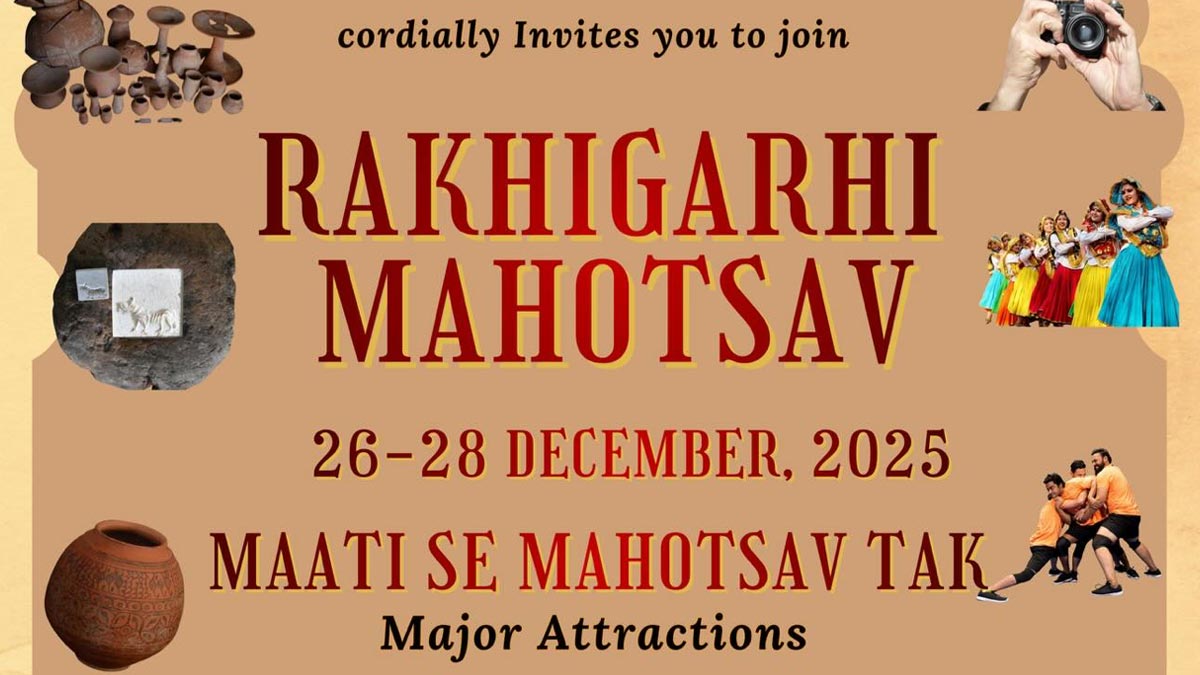
This nucleus of human civilization, dating back to a 5,000-year-old civilization, is breathing once again in the contemporary era from December 26th to 28th, 2025, as the Department of Archaeology and Museums, Haryana, is hosting the “Rakhigarhi Mahotsav.” This festival is a resonance of the theme “Maati Se Mahotsav Tak” (From the Soil to the Festival). Located in the Hisar district of Haryana, the archaeological site of Rakhigarhi is an area of heightened focus. The motto of this mahotsav is to reinvigorate the site into an experiential learning hub.
The Rakhigarhi Mahotsav is a celebratory event that aims to raise public awareness about the historic significance of its location. It belongs to the early & matured phase of the Chalcolithic civilization that features urban planning, ritual structures, rich crafts, burials, and even DNA traces that challenge the “Aryan Invasion” theory. This mahotsava is designed to reconnect the contemporary society with its ancient urban roots.
An Experiential “Museum” Under Open Skies
The Mahotsav is ideated as an experiential heritage trail, where archaeologists will conduct guided heritage walks across the excavation mounds. This will facilitate a tangible contact between the visitors and the structural legacy oddments of the ancient granaries, residential spaces, and ritual zones. These walks are supplemented by scholarly sessions where the Harappan settlements are decoded and interpreted through dialogues diving into themes like town planning, burial customs, etc.
Parallel to these will be pottery workshops where Harappan styles will be recreated. Meanwhile, there will be bead-making and painting sessions complementing it. Exhibitions curated by the Haryana Museums Department display excavated artefacts, digital reconstructions, and comparative Indus Valley panels connecting Rakhigarhi with Harappa, Mohenjo-daro, Dholavira, and Lothal.
The Mahotsav At a Glance
| Aspects | Details |
|---|---|
| Event Name | Rakhigarhi Mahotsav (Maati Se Mahotsav Tak) |
| Dates | 26th – 28th December 2025 |
| Location | Rakhigarhi Village, Hissar District, Haryana |
| Organizers | Department of Archaeology & Museums, Haryana |
| Entry Fee | Free (Registration needed: https://surl.li/bpklcg) |
| Primary Focus | Heritage education, rural tourism, and archaeological awareness |
| Major Activities | Heritage walks, workshops, rural sports, folk performances, exhibitions |
| Educational Outreach | Student quizzes, painting competitions, and photography contests |
| Community Integration | Self-help group stalls, craft mela, rural artisans |
Cultural Continuity and Rural Heritage
The virtue of the festival lies in the fact that it does not typify its proceedings and curation; it beautifully integrates Haryana’s rural living traditions. The mahotsav will feature folk dance troupes performing Saang, Khoria, and Dhamal, while rural sports such as kabaddi, wrestling (kushti), and traditional games reflect continuity between agrarian Harappan life and modern village culture. A striking highlight of the Festival is the display of handmade textiles, organic produce, terracotta artefacts, and herbal products by the Self-Help Groups. This initiative will continue heritage preservation while continuously boosting economic and women’s empowerment.
Key Highlights
- Heritage walks led by professional archaeologists
- Live pottery and terracotta workshops inspired by Harappan forms
- Archaeological exhibitions and digital reconstructions
- Direct interaction with experts regarding the latest DNA findings and excavation reports that have redefined the timeline of the IVC
- Evening folk performances that celebrate the living traditions of Haryana, showing the continuity of culture from ancient times to the present
- Rural sports demonstrations
- Student quizzes and Rangoli competitions
- A photography contest and painting workshops aimed at capturing the aesthetic beauty of the mounds and the rural landscape
- Craft Mela with Self Help Group participation
- Entry is free for all visitors
- The use of QR codes for free registration and digital mapping of the site to enhance the visitor experience
- Specific focus on student participation through inter-school competitions centered on Indian history and archaeology
Significance Beyond The Known Lines
The Rakhigarhi Mahotsav is strategically protracted towards the Government of India’s mission to boost heritage tourism. It also strengthens Haryana’s archaeological tourism framework. This Harappan site has been proposed for inclusion on the UNESCO World Heritage List. This mahotsav not only brings life to the site, but also emerges as a crucial instrument of exerting “cultural” soft power.
By arranging guided tours and creating a direct contact between crucial archaeological spots and citizens, this mahotsav deconcretizes the rigidity of historical knowledge and makes it accessible to all. It extracts the historical facts from school textbooks and presents them in an experiential format.
Reshaping The Civilizational Narratives with The Discovery of Rakhigarhi
View this post on Instagram
In scholastic opinion, Rakhigarhi is one of the important sites that takes exception to the early presumptions of the existence of the Harappan core only in Pakistan. This assumption was moulded by the discovery of “Harappa,” the first major urban center discovered, which was located there. As the emblems of the civilization, Harappa and Mohenjo-Daro, lay in what came to be known as Pakistan, Indian archaeologists, post-partition, fanatically began to search for Harappan sites within the new Indian borders. Finding “lost” Indus sites in India became a top research priority to ensure the new Republic remained a stakeholder in one of the world’s oldest urban civilizations.
The Site of Rakhigarhi was discovered by ASI in 1963. The major large scale exacvations began later under archaeologist Amarendra Nath. Other streaks of excavation were carried out by Prof. Vasant Shinde and Dr. Sanjay Manjul. Interestingly, the findings from Rakhigarhi sparked a debate around the origin of the civilization, as the site unearthed pre-Harappan culture dating back to almost 6,000 BCE. The early and mature phases of the site suggest that the civilization may have originated and gradually evolved in the Ghaggar-Hakra basin (present-day Haryana, India) and then spread to the Indus Valley, rather than the other way around.
Moreover, the DNA findings from the skeletons excavated from Rakhigarhi significantly challenged the Aryan Invasion theory. The DNA analysis of a 4,600-year-old female skeleton from the site revealed a descent from ancient Iranian farmers and South Asian hunter-gatherers. There were no traces of genetic linkages with the stated steppe pastoralists or “Aryans.” This advocated the foundation of an alternative, “independent” and “indigenous” origin of the people of this civilization.
Furthermore, the discovery of a gold foundry, a large number of beads of semi-precious stones, and seals indicates that Rakhigarhi was a major manufacturing and trade center with connections to other regions like Rajasthan, Gujarat, and even Mesopotamia.
Takeaway: A Confluence of Past and Present
The Rakhigarhi Mahotsav 2025 commemorates a phenomenal shift in the paradigms of archaeology and human history. It stands as a blueprint model for a democratic heritage demonstration. Unlike enclosed urban museums, this mahotsav extracts the essence of the archaeological landscape itself into an open-site museum.
With this initiative, Rakhigarhi is no longer a site of “Silent” ruins, but it has effectively transitioned into a site of living experience. By celebrating this mahotsav, the government is rebranding the archaeological site with a “heritage-first” mindset among the youth.
Rakhigarhi incorporates the piece of history that transcends empires, kingdoms, and scriptures, and brings a very crucial chunk of the past to the people of this age. The attendees will not just look at the heap of old bricks lined up, but into the remnants of the largest urban civilization of the ancient world. If we can learn to celebrate our “Maati” (soil) with such fervor, the legacy of the Indus Valley will never truly be lost. This festival is a step toward making history a living, breathing experience for every Indian.