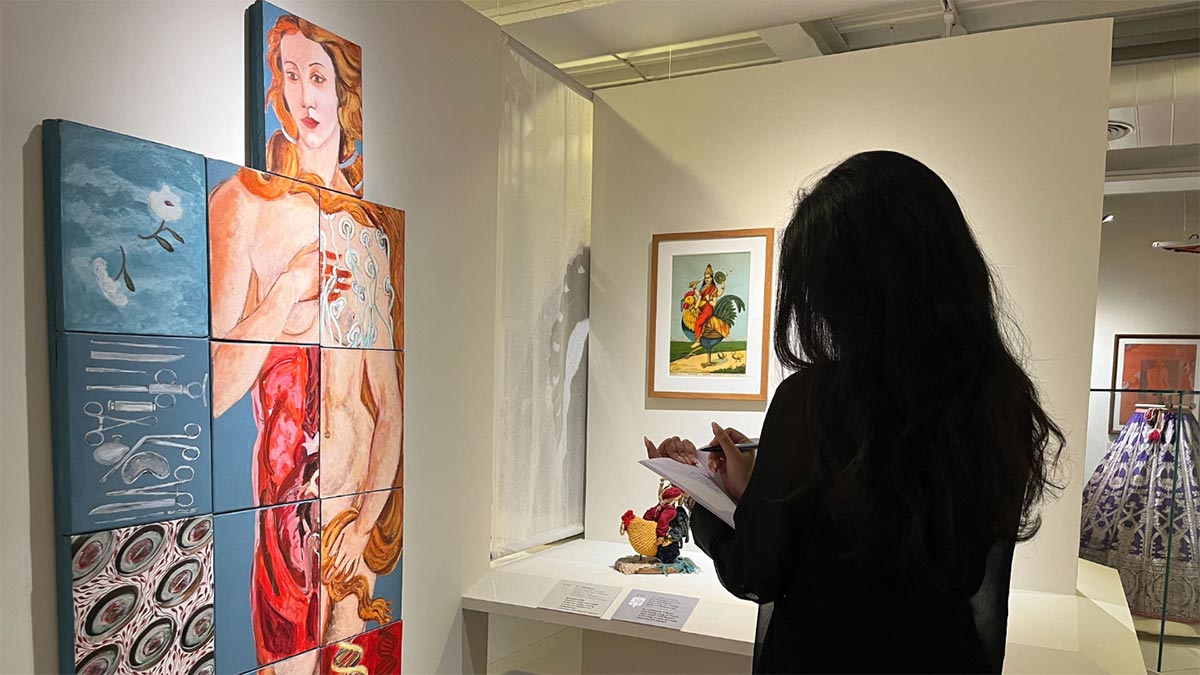
Museum of Art & Photography (MAP) in Bengaluru is housing an exhibition christened as “VISIBLE/INVISIBLE: Representation of Women in Art through the MAP Collection,” a chronological dialogue on gender and agency within the South Asian visual dictionary. Running for a transformative three-year period (February 2023 to November 2025), the exhibition challenges the paradox that limits the portrayal of women in art. There is an overwhelming visibility of subjects versus near-total invisibility in the agency and narrative. MAP Director and Curator Kamini Sawhney notes that the essence of the exhibition lies in addressing the historical imbalance where, for centuries, the image builders were predominantly male. This inherent structural bias permitted a very limited and biased entitlement to women regarding their control over mainstream representation, leading to the patriarchization of the creative field. But, even among the troop of males, exceptions do exist. For instance, the famous ‘Bharat Mata’ imagery of the Indian Nationalist Movement.
A Critical Lens on Female Imagery
The exhibition features approximately 130 artworks, spanning from 10th-century sculptures to contemporary photography, through four interconnected narratives. This juxtaposition of ancient and modern works compels the audience to witness how representations of women have been subjected to sequential construction backed by social constructs. The first section, ‘Goddess and Mortal’, explores the dichotomy between the venerated deity and a simple earthly woman. This is expressed through a beautiful contrast between a serene 10th-century sculpture of Brahmani (one of the saptamatrikas or mother goddesses) and Devi (1965) by Bhupen Khakhar, which amalgamates body ideals and religious niche.
The second section, ‘Sexuality and Desire,’ features the complexes of the female body as imagined by others versus the self. It juxtaposes the typical sexualized Bollywood representations, such as the poster for the film Anhonee (1952), where the female body is presented for the male gaze. Interestingly, the print of Saira Banu is placed next to the protagonist, Nargis, who openly explores female desire in Anhonee. The exhibition actively critiques how popular culture homogenizes and normalizes a sexualized and objectified representation of gender and the self.
The Essence
The power of the narrative unfolds in ‘Power and Violence,’ where the focus shifts to the dynamics of women’s lives, particularly in domestic and public spaces. Violence in the form of physical, sexual, or emotional abuse is directly addressed, as women are frequently subjected to these across public and private spaces. Works like Anoushka Mirchandani’s Wild Refuge (2021), presenting Sita in solitude, reflect on the isolation and refuge sought by women who are abandoned or neglected, pointing out domestic settings as a potential site of threatening actions. Furthermore, the final section called ‘Struggle and Resistance’ cherishes the moments when women successfully challenge mainstream norms and assert their autonomy. This section features contemporary artists like Gauri Gill, Anoli Perera, and Chitra Ganesh, whose works assert agency to the female self. Works such as Perera’s I Let My Hair Loose: Protest Series I (2010-2011) demonstrate significant acts of resistance that dismantle societal barriers.
The curators and the team ensured that the exhibition represents an inclusive space featuring commissioned works by artists such as Arshi Ahmadzai and Renuka Rajiv that expand their artworks to include underrepresented voices concerning gender and caste. To make the viewing experience more immersive and engaging, MAP has installed audio guides as well, enabling a multisensorial experience.
Exhibition Details
| Aspect | Description |
|---|---|
| Date | February 18, 2023 – November 30, 2025 |
| Venue | MAP Bengaluru, Manipal Gallery and Avanee Foundation Gallery (Fourth Floor) |
| Curators | Kamini Sawhney, Arnika Ahldag, Vaishnavi Kambadur, Riya Kumar, and Arshad Hakim |
| Artistic Chronology | The exhibition spans the 10th century to the contemporary period, demonstrating the enduring nature of gendered themes and the evolving artistic responses to them. |
| Curatorial Strategy | Works are juxtaposed to create deliberate contradictions, forcing the audience to engage in a critique of accepted norms rather than passive consumption. |
| MAP’s Role | The exhibition served as the opening statement for the new physical space of MAP, positioning the museum as a progressive institution committed to inclusive and critical art history. |
Key Highlights
- The show features over 130 works, including sculptures, textiles, paintings, and photographs, underscoring the diversity of media used to depict women.
- It is structured around four crucial thematic categories: Goddess and Mortal, Sexuality and Desire, Power and Violence, and Struggle and Resistance.
- The exhibition explicitly addresses sensitive topics such as physical, sexual, and emotional violence, providing a context for audience awareness and feedback.
- Accessibility is a core component, with commissioned tactile artworks and multi-lingual audio guides ensuring a broad, inclusive experience.
- It highlights the contribution of modern and contemporary female artists (e.g., Chitra Ganesh, Gauri Gill, Anoli Perera) who actively subvert and challenge the historical male gaze.
Takeaway
Having been displayed for a prolonged period of three years, “VISIBLE/INVISIBLE” is a powerful statement and a stand in itself against the complexities of gender representation in the creative fields. The exhibition functioned not only as a source of amusement but also as a retrospective space that engaged public discourses, research, and emerging POVs. This exhibition intentionally nudges the viewers into an unsettling spot as it rises beyond the structures’ societal boundaries and highlights the autonomy and agency of women who defied these boundaries. The exhibition also highlights progress in the visual culture where women are not just seen, but are duly acknowledged for their works. With this ongoing exhibition, MAP has definitely set up a benchmark in the whole of South Asia that questions history, demands reform, and features authentic voices.