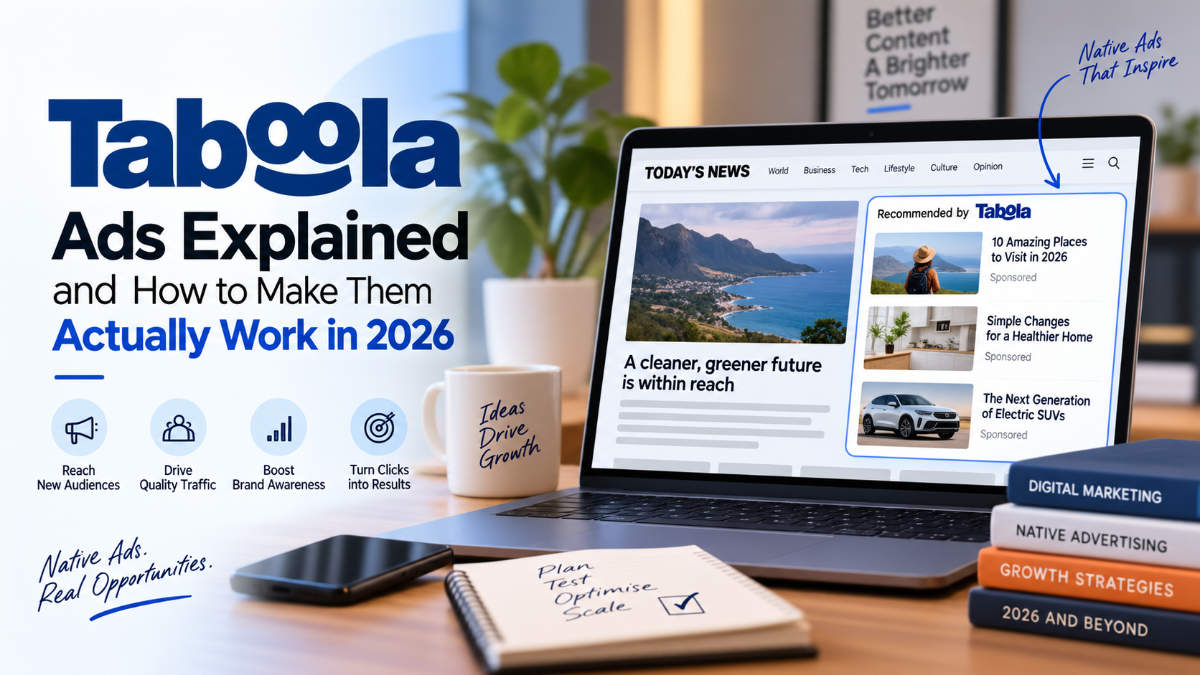
You have seen Taboola ads even if you do not know the name. They are the row of headlines with small pictures at the bottom of a news article. Some say “You won’t believe what this actor looks like now.” Some are real offers from real businesses. All of them are there because someone paid Taboola to put them there.
Taboola is the biggest company doing this. It reaches about 1.4 billion people a month across about 9,000 websites, and it has exclusive deals with NBC News, the USA Today network and Microsoft’s MSN. In the second quarter of 2026 it added Fox News to that list.
A lot of businesses try Taboola ads once, lose money, and decide the platform is junk. Most of them made the same three or four mistakes. This article explains how the platform works in 2026, what those mistakes are, and how to avoid them.
What Taboola ads are
Taboola is a native ad network. Native means the ad looks like part of the page. On a news site, that means it looks like another headline you might click.
You pay per click, in an auction. You write a headline, add a picture, and point the ad at a web page. Taboola shows it to readers on its network of websites. When someone clicks, you pay, usually somewhere between 20 and 50 cents in the United States. Broad, low-quality placements can go as low as 10 cents. Busy categories like finance push higher.
The important thing to understand is who is clicking. Nobody on Taboola was searching for you. They were reading a news story. Your headline caught their eye and they clicked out of curiosity. This is a very different person from someone who typed your product into Google. They are cheaper to reach, and they are much less ready to buy.
What changed in 2025 and 2026
Taboola rebuilt its advertiser platform in 2025 and named it Realize. If you read an old guide, half of it no longer applies.
Realize has four ways to bid. Fixed CPC means you set the exact price per click yourself. SmartBid is semi-automatic, raising your bid a little on clicks that look likely to convert and lowering it on the rest. Maximize Conversions is fully automatic and goes after as many sales as it can inside your budget. Target ROAS chases a return figure. Taboola’s own number is that Maximize Conversions cuts cost per sale by about 15 percent on average.
There is also Taboola Select, which is the top 15 percent of its US websites, including Yahoo, Business Insider, the Associated Press, CNBC and the BBC. You can choose to run only on those.
And there is DeeperDive, which is new. It is an AI that sits on news websites and lets a reader ask questions about the article they just read. Taboola puts ads inside those AI answers. The company’s CEO has said those ads convert better than anything else Taboola runs. You reach them through the same account you use for normal campaigns.
One more change that catches people out. Since early 2026, Taboola reads your landing page and scores it, not just your ad. Thin pages built to make money from ads get rejected on the page, even if the headline is fine.
The budget rule nobody tells you
Here is the number that explains most failed Taboola tests.
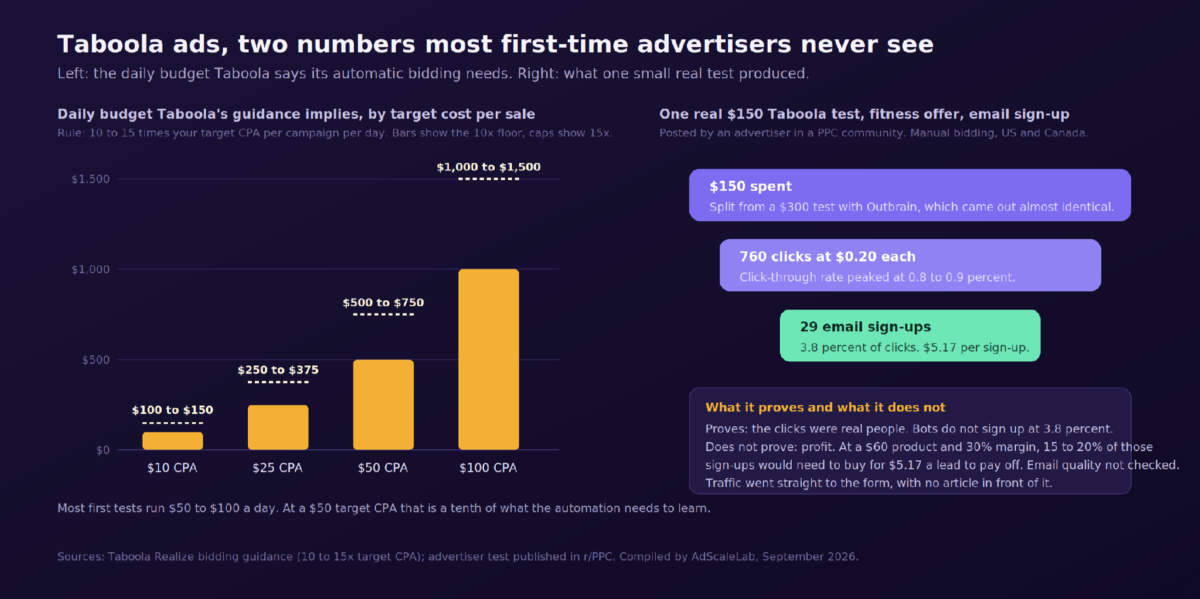
Taboola’s own guidance is that its automatic bidding needs a daily budget of 10 to 15 times your target cost per sale before it has enough data to work. If you want to pay $50 per sale, that means $500 to $750 per day, per campaign.
Most people who test Taboola run $50 to $100 a day. At a $50 target, they are spending a tenth of what the automation needs. It never learns, it buys the cheapest clicks it can find, and those are on the worst websites. Then the advertiser concludes the platform is junk.
The right side of that chart is a real test one advertiser published. He spent $150 on Taboola for a fitness offer with an email sign-up. He got 760 clicks at 20 cents each and 29 sign-ups, which is 3.8 percent of clicks, at $5.17 per sign-up. Outbrain, the other half of his $300 test, came out almost the same.
The test proves the clicks were real people. Bots do not sign up at 3.8 percent. What it does not prove is profit. His product sold for $60 at a 30 percent margin, so 15 to 20 percent of those sign-ups would have needed to buy for $5.17 a lead to pay off, and he had not checked how good the emails were. He had also sent people straight to the form, with no article in front of it, which is the next mistake.
Mistake one, sending the click to a product page
This is the big one. Someone who spent four years selling Taboola ads said pointing an ad straight at a product page fails about 99 percent of the time.
Think about the reader. They were reading the news. They clicked a headline because they were curious. Now they are looking at a price and a buy button for something they had never heard of ten seconds ago. They leave.
What works is a page in between. A long article, a list, or a comparison page that picks up the story the headline started, makes the case for the product, and only then sends the reader on to buy. The reader was promised a story. Give them the story first.
Mistake two, using your Facebook ads
Taboola ads look different because people see them differently. On Facebook the ad interrupts someone scrolling. On Taboola the ad sits next to an article and needs to look like it belongs there.
Polished brand ads with a logo and a product on a white background tend to die on Taboola. The audience skews older and is reading, not scrolling. The ads that work look like a headline with a picture. Taking your Facebook creative and uploading it unchanged is one of the most reliable ways to fail.
The specs are simple. A 16 by 9 image, ideally 1,000 by 600 pixels. A headline of 34 to 45 characters. Test several headlines, not one. Pause anything with a click rate under about 0.3 percent after a day or two.
Mistake three, never looking at where the ads ran
Taboola runs on thousands of websites. Some are great. Some are not. If you launch with no plan for which sites to avoid, your money flows to wherever the cheapest clicks are, and those are often the sites you would least want to be on.
The platform shows you exactly which websites served your ads. It lets you block sites. And it lets you set rules that block sites automatically. Two rules experienced buyers use from day one: block any site name containing a hash symbol or the word “push,” which show up a lot in low-quality app inventory, and block any site where the click rate is very high but the sales rate is very low. On mobile, a click rate over 3 percent is usually a warning sign. On desktop, over 1.5 percent.
Since early 2026 you can also block or allow specific sections of a website, not just the whole domain. That matters when a big publisher has one good section and five bad ones.
Mistake four, judging it in three days
Taboola needs 10 to 14 days to give you a readable result. The first few days are the system spreading your money around to find out what works. Reading the numbers during that time tells you about the learning phase, not about the platform.
Also, send it more than just the sale. If you only report purchases, a small campaign might show the system one sale every few days, which is not enough to learn from. Send add to cart, checkout started, and time on page as well. These happen far more often, and they let the system learn while the sales build up.
And read your results somewhere other than the Taboola dashboard. Taboola ads often start a purchase that a Google search or a retargeting ad finishes days later. The Taboola dashboard does not see that sale. Advertisers who use a tool that tracks the whole customer journey often find Taboola was making money when the dashboard said it was not.
What you can and cannot target
Coming from Facebook, the first thing to get used to is that Taboola cannot target by age, gender or interests. It does not know people that way.
What you can control: country, region and city; desktop, phone or tablet; operating system; browser; retargeting lists and lookalike audiences built from your own pixel data; which websites and sections you run on; time of day; and how you bid. And that really is the full list. Your headline, your landing page and your website list are the real targeting.
One practical tip. Run mobile and desktop as separate campaigns. Mobile has far more inventory, so a combined campaign sends almost all the money to mobile and your desktop test never happens.
Is the platform going anywhere
Worth checking before you spend, and the answer is reassuring.
In the second quarter of 2026 Taboola made $476.8 million in revenue, up 2.4 percent on the year, and a net profit of $4.3 million where it had lost money a year earlier. Its profit after traffic costs rose almost 12 percent. It raised its forecast for the year and has bought back about a fifth of its own shares since 2025. The stock still fell almost 30 percent on results day because revenue was lower than analysts expected. But the business is profitable, it is spending on the Realize platform, and it spent the quarter removing low-quality websites from its network, which is what an advertiser wants to hear.
Getting a Taboola account
Signing up for Taboola is free and takes a few minutes. Getting approved and getting past the early limits is the slow part.
New accounts get reviewed. Your landing page gets reviewed. Categories like finance, crypto and supplements go into slower manual review. A rejection often comes with no reason. And new accounts have spending limits and no one to call when something breaks. Getting a managed account with an assigned contact at Taboola usually takes a test budget of around $10,000.
A lot of businesses skip that by going through an account provider such as AdScaleLab. The account sits inside an existing relationship with Taboola, so the landing page is checked before any money moves, the spending limits are higher, and there is a person to reach when a campaign gets stuck. It is the same idea as using a customs broker instead of learning all the import paperwork yourself.
Either way, ask four questions before you pay anyone. When is my landing page checked, before or after I pay? What happens to money I do not spend? What happens if my account gets suspended? What am I not allowed to run?
The short version
Taboola ads reach a huge audience of people who were not looking for you. They are cheap to reach and slow to buy. The platform works when you send them to an article first, use headlines that look like headlines, block the bad websites before you launch, give the campaign enough budget and enough days to learn, and read your results in a tool that sees the whole customer journey.
It does not work when you upload your Facebook ads, point them at a product page, run $50 a day for three days, and read the dashboard. Almost everyone who says Taboola is junk did exactly that. The platform is fine. The setup was not.