A Deep Guide on Rich Lifestyle in Dubai

0

A-Deep-Guide-on-Rich-Lifestyle-in-Dubai

Imagine yourself waking up to cloudless blue skies and you breathe in the fresh air. You spend a day in the private club before heading to your preferred golf course. 

Afterward, your chauffeur then takes you to Ossiano for dinner, tasting seafood delicacies while viewing the Ambassador Lagoon with artistic brilliance.

You may think that a life like this is out of reach, but a redefined luxury awaits you in Dubai.

Opulent Properties in the City

Renowned homes in Dubai are a pinnacle of luxury, with the latest Smart home technology and ultramodern architecture. If you wish to lead a rich lifestyle, LuxuryProperty.com mentioned some of the most luxurious real estate areas in Dubai:

1. Downtown Dubai

Some of the most demanding apartments, including Dubai Mall and Burj Khalifa, are present here. Matter of fact, Downtown Dubai has always been a lavish neighborhood in the Emirate.

2. Palm Jumeirah

Have a taste of calmness in the artificial archipelago of Palm Jumeirah that was introduced by Nakheel Properties – a leading name in the real estate market of UAE. 

Discover beachside homes and be assured that The Palm is an eco-friendly project boasting an endless array of amenities and facilities. 

3. Emirates Hills

Being the first big-scale gated villa-only venture in the Middle East, one can enjoy prestigious residences constructed in Emirates Hills that overlook the Montgomerie Golf Course and serene lakes. 

You will be beside the family-oriented neighborhoods, such as The Meadows, The Springs, and The Lakes.

4. Dubai Hills Estate

This mega-development features luscious manicured garden villas, spectacular townhouses, and low-rise apartments. It is rightly known as a city within a city for the majestic development scope, and displays green trails, a championship golf course, and its Dubai Hills Mall.

5. Dubai Marina

This region undoubtedly gains a heavy global audience throughout the year. It is the biggest artificial marina in the world. In Dubai Marina, one can find exclusive waterfront homes, customized penthouses, and apartments.

6. Al Barari

Al Barari boasts one of the most upscale places to reside in the city. This sustainable showcases 6 residential districts situated inside the splendid gardens – Balinese, Water Garden, Mediterranean, Renaissance, Contemporary, and Woodland Gardens.

7. Jumeirah Islands

Enjoy a rich lifestyle in the 46 islands of the beachfront homes, including luxurious mansions, villas, and townhouses. Jumeirah Islands is recognized as one of the best areas having water views in the City of Gold.

8. Bluewaters Island

These artificial islands by Meraas Holding have magnificent seaside residences beside the city’s seafront observation wheel. 

If you like water adventures, this is the best place for you. Some irresistible on-site beach locations are also available – Hell’s Kitchen by Gordon Ramsay, and Caesar’s Palace.

9. Jumeirah Golf Estates

Golf enthusiasts love the rolling green scenery of Jumeirah Golf Estates, displaying 2 globally recognized golf courses, and hosting the DP World Tour Championship annually. This gated establishment features wholesome security and safety, assuring the utmost privacy.

You can expect to enjoy the highest quality of comfort with these homes, where you can call the butler services any time. If you prefer golf homes anywhere in the Emirate, remember that the size of these homes are usually larger than yacht homes seen in other countries. Investing in Dubai’s real estate market is definitely a wise decision.

One-of-a-kind Airlines of Dubai

Even traveling to this city is lavished with opulence. Enjoy the world’s top-class suite on Emirates Airlines. A first-class suite comes with cozy leather seats that can recline into a bed, a shower with a great collection of Bvlgari toiletries, a sliding door for better privacy, an access to the A380 lounge on-board, a complimentary chauffeur service, and a private cocktail lounge with a committed bartender.

Majestic Resorts and Hotels in Dubai

For the ones wanting to go to the Emirate (but still lacking their own opulent pad), or for those who are hunting for a wonderful staycation, below are the grand hotels and resorts where you can bask in a taste of Dubai’s rich lifestyle:

  • Armani Hotel Dubai
  • Burj Al Arab
  • Taj Hotel Dubai
  • Anantara The Palm Dubai Resort
  • One & Only The Palm
  • Ritz-Carlton, Jumeirah Beach Residence
  • Jumeirah Al Naseem
  • Bulgari Hotel & Resorts
  • Burj Al Arab

These options work equally well for the inhabitants hunting for a new place to enjoy the weekend or for the ones visiting Dubai for the first time. 

These resorts and hotels don’t compromise on luxurious activities and features, where you can get numerous ways to pamper yourself and bask in what the City of Gold has to offer.

Championship Golf Courses in Dubai

Golf lovers are undoubtedly spoiled in the City of Gold. Dubai is slowly but surely blooming into a new contemporary centerpiece of the golfing industry, particularly with all the top-tier golf courses present, such as:

  • The Els Club
  • Majlis Course in the Emirates Golf Club
  • Arabian Ranches Golf Club
  • Faldo Course in the Emirates Golf Club
  • Trump International Golf Club
  • Dubai Creek Golf Club
  • Fire Golf Course in Jumeirah Golf Estates
  • Earth Golf Course in Jumeirah Golf Estates
  • The Montgomerie Golf Club in The Address Montgomerie

Indulge in your passion for the sport with these high-end golf courses.

Exotic and Unbelievable Cars

For the ones who love exotic luxurious cars, the city presents the most posh supercars in the world. Million dollars of customized cars are a common thing luxury item here, as lots of Dubai occupants either rent out or own the following:

  • Ferrari 458 Italia
  • Rolls-Royce Phantom
  • Jaguar XFR
  • Bentley Continental Flying Spur
  • 2014 Cadillac ATS
  • BMW X5 5.0
  • Lamborghini Gallardo

Not only do these exotic cars boast unmatched speed, but they are a super status symbol. The price range of these cars are between $36k to $292k. An impressive and slick ride is guaranteed to commute from one opulent place to another.

Unrivaled Shopping Malls in Dubai

This article can’t be complete without shopping malls and branded retail stores in the city, as Dubai is the best shopping destination in the world. 

From antique art to lucrative bags, luxury brands are commonly available in the shopping hubs throughout the Emirate. Some of the frequently visited shopping malls in Dubai are:

  • City Walk
  • The Dubai Mall
  • Dubai Festival City Mall
  • Mall of the Emirates

Discover the best that the world has to offer in these hubs.

Premium Restaurants in the Emirate

Only in Dubai can one find the most high-quality and glamorous food providers in the world. Plus, Dubai’s nightlife is globally recognized, and there are themed nights, special events, and lucrative entertainment all-year for the Emirate dwellers and visitors alike. Care to visit the following happening spots for experiencing Dubai:

  • Jetty Lounge
  • Zuma
  • Buhayra Lounge
  • Pierchic
  • Bar 44
  • At.mosphere Burj Khalifa
  • SkyView Bar
  • STAY by Yannick Alleno
  • Sloane’s
  • Pai Thai

There are many other locales to kickstart a fun day with your loved ones, and enjoy the evening. But in case this is the first time experiencing the city, these spots are foolproof.

Amazing Food Hacks to Save Money on a Trip

0

Trips aren’t completed without munching on tasty food. If you are on a trip, food has got to be your best friend for the journey. It could get monotonous watching sceneries, and listening to the songs throughout your journey, here food comes to your rescue, and let’s be honest we get super hungry during our trips. While adding to the cost of fuel, you need to manage your food budget to make your trip pocket friendly and certainly stomach-friendly too. If you are on the go, food is your partner that will charge you up and make you feel energetic to endure the tedious route. Here are some quick food hacks for your trip to be economical. 

Stock up from the eatery outlets on the way

Food-Hacks-to-Save-Money-on-a-Trip-01
Image – Mohit Pareek

Fortunately, you belong to a generation where you can perform any task pin to plane through the internet. Some brands like Domino’s have some of their outlets situated on highways so that you could fill up your hungry stomach with their delicious and quick-to-serve menu. All you have to do to find these outlets is using your mobile by browsing for ‘Pizza near me’ or ‘Eating outlets near me.’ With the wide menu Domino’s have, you can order takeaway food that you can munch on while enjoying the journey. The best part is, they are the eatery which is known to serve and deliver food quickest and cheapest that will save your time and money which you can use to reach your destination punctually and efficiently. 

Prepare light food at home and stop only for heavy meals – 

Food-Hacks-to-Save-Money-on-a-Trip-02
Image – Scott Dexter/Flickr

Spending your money completely on food implies that you are not planning for your trip. Prepare and pack light food items like thepla, poha, sandwich, etc, that will not make you stop eating every next hour. While for the meals, something filling like pizzas, paratha pizza, slices of bread, beverages, and desserts can be the correct option, which you can order through Domino’s pizza delivery option through their app that provides heavy discounts. 

Carry instant food for the trip – 

Food-Hacks-to-Save-Money-on-a-Trip-03
Image – Nadir Hashmi/Flickr

Ready to make food items like Maggie, upma, soups, etc. that only require the minimum effort of adding hot water to it, and such items are made within minutes and are the go-to for any trip. These come at a reasonable cost and are quite filling for a hungry stomach. You cannot start your trip without stocking up on these. Instant food items require bare minimum effort and cost you a bare minimum too. Carrying instant food is like taking with you a food genie that instantaneously prepares tasty and quick food, granting satisfaction to your cravings during a long trip. 

Go for local meals – 

Food-Hacks-to-Save-Money-on-a-Trip-04
Image – pxhere.com

Who isn’t following ‘Vocal for local’ while on a trip try local food filled with rich culture and heritage and the best part is they charge you so less than those expensive cuisines out there. Local meals are healthy and keep your stomach at ease for long hours. Having a local meal at a ‘Dhaba’ is altogether an experience that you won’t ever forget, curated with various spices and herbs, such meals are healthy, pocket friendly, and most importantly nourishing. Stopping for local meals can also make your journey a learning experience as you come to know so much about local food items, their benefits, and the traditions attached to them. 

Take dry fruits and healthy snacks along – 

Food-Hacks-to-Save-Money-on-a-Trip-05
Image – Marco Verch/Flickr

Agreed that teaming up with junk food can be satisfying but that also proves to be a waste of money and bad for your health. Instead, pack a bag filled with enriching dry fruits and healthy snacks like protein bars to keep you active instead of bloated up. Few junkies are understandable but continuous munching on them can spoil your journey. Carry healthy snacking options and try to make your trip a blend of healthy and tasty. 

Trips are memorable and food adds so much vibe to our journey and that’s why it is essential that we go for wise and budget-friendly choices instead of grabbing our hands over anything and everything we come across. So, while on a trip, put on your favorite song, grab something delicious to eat, and enjoy your journey. 

Folk Dances of Rajasthan – Lively and Captivating

0
Folk Dances of Rajasthan
Image – Wikimedia

Known for its rich cultural past, Rajasthan is the royal state of India. Tribal music or folk music plays a key role in Rajasthani culture because tribal communities formerly had dominated the state. The dances and accompanying music are ballad-like, tell epic stories and that of eternal love. There are other songs of devotion, too. Folk dances of Rajasthan are performed on numerous auspicious occasions with the purpose of expressing happiness among themselves, as well as telling stories in a unique and enticing style. The emergence of princely states during medieval times also led to the evolution of folk dances, since the monarchs patronised different art and crafts. Each region has its own type and style of folk entertainment with diverse dances and songs since rulers from several cultures ruled the Rajasthan. It’s vivid, powerful and highly captivating. Here are various Rajasthani folk dances, you ought to know about.

1. Ghoomar Dance

Folk Dances of Rajasthan, Ghoomar
Image- Wikimedia

Ghoomar is one of Rajasthan’s most prominent folk dances, once played as royalty entertainment. Inaugurated by the Bhil tribe and then adopted by royal clans, including the Rajputs, women perform this dance form during festivals and important events like Holi, Teej and the arrival of a newlywed wife in the home she married into. The women wear traditional costumes, ghagra (a long, flowing skirt) and kanchli or choli (a blouse). To complete the costume, the face is covered by an odhani (a veil). The charm of the folk genre is its beautiful gestures involving swinging hands, clapping and twisting while singing traditional musical tunes. Together with a high pace and music, the coordinated movements between dancers and their whirlwind dresses are fascinating and delightful. In regions like Udaipur, Kota, Bundi and Jodhpur it is extremely popular. You will also often be prompted to join in the dance with the locals!

2. Kachhi Ghodi Dance

Folk Dances of Rajasthan, Kachhi Ghodi
Image- Wikimedia

Kachhi Ghodi is a renowned traditional dance performed by males from the Rajasthan district of Shekhawati. Tales of local bandits executed via mock sword wars are told in the dance. Men wear diverse traditional costumes such as a dhoti, turbans and kurtas, and they pretend to ride an adorned dummy horse. The whole dance is meant to be a symbolic exhibition of chivalry and valour. Dancers generally fake battles with swords to enhance the rhythm, while flute music and drums are played in the background as accompaniment. You can find this type of dance form notably in the Shekhawati region and in Jaipur and Udaipur, with it usually being performed during marriages or social functions.

3. Kalbelia Dance

Folk Dances of Rajasthan, Kalbelia
Image- Wikimedia

The traditional dance Kalbelia (or Kalbeliya), the Rajasthan dance, is often referred to as “Sapera Dance” or the “Snake Charmer Dance.” This dance was originated by the tribes of Kalbelia. It is a lovely form of folk dance where women wear an angrakhi- a jacket-like garment, odhani- a veil, and a black whirling ghagra- long skirt. They dance gracefully in groups curling around each other to imitate a snake’s movement. The music played in these dances are by men by utilising traditional instruments including the Dholak (a two-headed drum), the Khanjari (percussion instrument), and the Pungi (a woodwind instrument). Other traditional musical instruments, such as dufli, morchang and khuralio, are also available. The songs are based on folklore and mythological stories. The greatest sites to enjoy this kind of dance are Jodhpur, Jaisalmer, Bikaner, Barmer, Jalore, Jaipur, and Pushkar.

4. Bhavai Dance

Folk Dances of Rajasthan, Bhavai
Image- Wikimedia

Rajasthan is mainly a traditional folk dance performed by ladies of the State Tribal Communities of Kalbelia, Jat, Meena, Bhil or Kumhar. It takes many years that the dance takes ladies who balance 8-9 pots or brass pitchers on the head while dancing and twisting on the side of a glass or brass plate with their feet (sometimes even the edge of a sword). The graciously twisting movements of ladies paired with the balancing show their difficulties in society.  The dance form is paired with male singers and instruments like the harmonium, sarangi and dholak. During significant occasions and festivals, experts perform this dance genre. Since some respected hotels provide a closer insight into Rajasthan’s cultural and historical customs with these performances, visitors may expect a feisty and exciting performance during their visit to the State. Apart from that Jodhpur, Jaipur and Bikaner present some of the best shows of Bhavai.

5. Gair Dance

Folk Dances of Rajasthan, Gair
Image- Wikimedia

Gair is another of Rajasthan’s well-known folk dances from the Bhil community. This popular kind of dancing has two types or variants which go by the name of Dandi Gair and Geendad. Men and women both dance together, with appealing moves and colourful instruments. The men wear a long tunic-like skirt with a staff, sword, and arrow, while the women wear ghagracholi. The music to this genre of dance is performed on different traditional instruments, while dancers swing their arms to loud drums in a clock-wise and anticlockwise way. At each turn the dancers fall in, beat their stick, while the song is accompanied by a repetitive rhythmic thump of the drums. In the Mewar region, this dance type is performed. However, its varieties such as the Dandi Gair and the Geendad also exist in Marwar and Shekhawati.

6. Kathputli Dance

Folk Dances of Rajasthan, Kathputli
Image- Wikimedia

Kathputli is a famous puppet dance display that began in the Bhat tribal group of Rajasthan a thousand years ago; and was named after Kath, which means “wood” and putli translates to “doll with no life.” Kathputli are normally mango wood and cotton-stuffed. These dolls are usually 1/2 feet high and constructed in Sawai-Madhopur, Bari and Udaipur. The puppets are controlled and manoeuvred by strings on the limbs of the puppeteers. These people are also vocalists who give a special flavour to Kathputli dancing as they sing stories from Indian culture and mythology. Some of them also deal with current social challenges. Shadipur depot in New Delhi is the Kathputli Colony neighbourhood, where these puppeteers have been living over the years. The two leading institutes in the field of art preserve and promote the art of kathputli are Bhartiya Lok Kala Mandal in Udaipur, established by Devilal Samar in 1952 and Rupayan Sansthan in Jodhpur, established by Vijaydan Detha and Komal Kothari in 1960. The ideal spot to experience this popular Rajasthan dance is in the Marwar region.

Suggested Read – Kathputlis of Rajasthan – A True Cultural Asset of India

7. Chari Dance

Folk Dances of Rajasthan, Chari
Image- Wikimedia

Chari is a traditional type of folk dance hailing from the Saini communities of Ajmer and Kishagarh, the Gujjar. Women perform at major events such as marriages, festivals. These women have traditional dancing attire with a lot of ornaments incorporated in the costume. They balance brass pots (chari) with a light lamp inside their heads ( which is set on fire with cotton seeds soaked in oil) while also performing various tricks easily. The nagada, dholak and harmonium act as musical accompaniments. The music and colour of the dance contrasts with this region’s dull and dry climate. It brings enjoyment and vibrant energy to the people wactching it. Catch a glimpse of this dance form in Ajmer and  Kishangarh. 

8. Chakri Dance

Folk Dances of Rajasthan, Chakri
Image- Wikimedia

The word “Chakri” denotes a circle, as the name implies. It is a popular folk dance of Kanjar in several parts of Kota and Rajasthan district. It is usually done in groups of women. The dance shows the circular movement of dancers on their knees, who twist in circles. Dancers wear beautiful skirts with tons of traditional Rajasthani mirror work and the entire group looks radiant and colourful as they carry out the dance. The Chakri draws its name from Chakra which means the wheel, and it goes to indicate how quickly women move about when they spin like swift wheels. They cover a wide space as they continue to move without clashing with each other and still move around the group with much expertise. The music is quite important here because the dance is so rapid and agile. The women also sing when they dance to support the quick rhythm of the instruments. The music begins gently and continues to reach the height with the development of the dance. Nagara and the dholak are two major instruments played as accompaniments to the dance of Chakri. The Nagara is an instrument like a drum, and the beats are hard and loud, and they are the best music to play at a high level of energy for the performance. Dholak is another drum-like instrument, producing wonderful and lively music as well. Men play the Dholak or Nagara in most cases to support the women of their clans.

Suggested Read – Traditional Dress of Rajasthan: Reflects a Culture that Persisted Since Ancient Times

Through folk music and dance, the liveliness of Rajasthani traditions and culture is evident. Folk music and dance are life for Rajasthanis, and they have become habitual to their part of existence. Each style of dance performed here links the history and culture of Rajasthani. These traditional dances are colourful, stimulating, energetic and vibrant. Remember next time you are in the State, try and see these performances.

What To Expect When You’re a Hairstylist

0

Hairstylist

When you were younger, did you ever dream of being a hairstylist? Maybe you did the hair for all of your baby dolls and Barbie dolls. Perhaps you even tried to trim your hair a time or two. Now that you’re grown, being a hairstylist is a whole different story. It can be incredibly fun and rewarding but the profession certainly has its challenges as well.

Before you step into this career field, you should know both sides of the story. It just helps you to be prepared for the good times and the bad times. Take a look at these things to expect when you’re a hairstylist.

Long Hours On Your Feet

Most hairstylists work long hours. They spend nearly the entire day on their feet. You’re moving all around your clients that sit in the chair. Not only are you on your feet but you also might be hunching into awkward positions, depending on what you’re doing. Moreover, let’s not even get started on bending over the sink to wash hair.

It’s great to be active and on your feet, but spending this long on your feet and maneuvering into various positions could work a number on your back and posture. We recommend having routine chiropractor appointments to help with the inevitable back or neck pain you may experience. Offices like this chiropractor in Lone Tree Colorado build their practices to support people just like you so you can continue doing what you love most.

Hair Everywhere

No matter how great you clean up, hair will be everywhere. You will find slivers of hair on you all the time, even on your day off. Chances are your clients are finding slivers of hair long after they are gone too. It’s just the nature of the business. Most hairstylists incorporate a bit of a uniform that includes black jeans and a nice top. It’s simple and effective for them while ensuring they know exactly which clothes to wear to work to avoid hair on other outfits. An excellent piece of advice is to keep a lint roller nearby. This could help keep those hair slivers at bay.

Expect Anything

While you can be picky about your clients, you just never really know what you will get. Many hairstylists face the unknown when they start working with someone’s hair. Inside of that hair could lie any number of things. A client could sit in your chair with ticks, lice, and more. They could also sit in your chair with dirty, greasy hair, making it more challenging to work with.

You are in a position where you have to be prepared to handle any situation that might come at you. Some clients might look to you for advice because they have a hair issue they just don’t know how to manage. How will you help them handle it?

Up Close and Personal

As a hairstylist, there is no such thing as personal space. The same is true for your clients. You’ll be getting close to each other while you’re together. You’ll be working closely with your client’s hair. You’ll be all around the client and often right up in their personal bubble. So, say goodbye to your personal space.

On that same topic, hairstylists often get to be multitaskers. You’re working on hair but chances are you’ll want to chat with your client the entire time. You may find yourself becoming counselors and confidants in the time that you spend together. From sharing the ups and downs of life to filling in recent gossip, you’ll likely get to know your clients quite well.

Finishing Up

While being a hairstylist is absolutely a tough job, it can be rewarding. You constantly have new things and you see different people all of the time. It’s a fast-paced environment and the people that can pull it off are typically perfect for the task.

Handloom Expo, Delhi – An exhibit of Hand-woven Sarees and Stunning Outfits

1
Mekhla chadar saree
Mekhla Chadar sarees

Handloom expos are a wonderful way to showcase the rich heritage and skill of our local artisans. The ongoing Handloom Expo at Central Cottage Industries Corporation, Janpath is one such exhibition that is attracting visitors in droves. Open till 19th March 2022 from 10:00am to 7:00pm, the expo provides a platform for artistic and cultural interchange between weavers and art patrons. 

The handloom products

Handloom-Expo-Delhi
Left -Madhubani Painting Products, Right – Jammu Kashmir Pashmina Products

Products from Punjab, Uttar Pradesh, Rajasthan, Odisha, Madhya Pradesh, Delhi, Bihar, West Bengal, Karnataka, and Jammu and Kashmir are for sale at the expo. Visitors are captivated by handloom fabrics, particularly the evergreen Silk Sarees. Other artistic weaver gems include, the Banarasi sarees, Tussa silk from Odisha, Chanderi from Madhya Pradesh, Tant and Garuda silk from Bengal, Madhubani and Bhagalpuri textiles from Bihar -the list is endless. 

Traditional dresses from the north eastern states, such as the ‘Mekhela Chador’ of Assam speak volumes about the beauty of Indian Handlooms. In fact, the Mekhela Chador is one of the main attractions and highlights of the expo. 

The weaver’s views

According to Assam weaver Pranav, Mekhela Chador, a traditional sari is made exclusively with silk threads, while it is occasionally stitched with cotton threads and artificial fibers too. The sari’s unique designs are woven entirely by hand. The upper section of the saree is referred to as Chador, and the lower part is referred to as Mekhla.

Why are such expos important?

The handloom industry is one of a kind. This handloom expo’s main motto is to encourage visitors to wear the handlooms with pride and to adopt them in their daily lives. Also, such initiatives help promote the Indian weavers & textile artists by sustaining their livelihood & providing them with various marketing opportunities.

There is astounding richness that can tantamount to becoming almost magical and spiritual. Weavers are brilliant artists who use the canvas of the fabric to tell stories. However, the handloom industry also needs to be supported to become a commercially viable option, so that these artisans get their legitimate credit and due. Besides, handlooms are an integral part of the culture and social terrain of our country.

In our fast paced machinery world, handlooms are surviving, because they exude a rawness and beauty that is amiss in any other products.

Best Guide to Plan a Beautiful Trip to Australia from India

0

Guide-to-Plan-a-Beautiful-Trip-to-Australia-from-India-01

If you are looking to travel for pleasure and explore a new place, Australia is the best way to go! The picturesque locations and the variety in geographic locales offer the visitors the best of all worlds. If you are planning a trip to Australia, here is a guide you can use to make your trip beautiful and carefree. 

Also ReadDubai’s Top 5 Theme Parks You Must Visit

Tips to plan your trip to Australia

  1. Set the duration of your trip – The deterrent to sightseeing is only your jet lag. If you can deal with it, you can see a lot in 2 weeks. They are enough to go through the major sites in the country. 
  2. Budget for the trip – When you are making the budget, including the cost of getting a visa, accommodations, flight, meals, travelling within the country, and paying for travel insurance. 
  3. Get a visa in advance – There is no visa for arrival for Indians in Australia. Documents required for the Australian tourist visa from India are original passport with 6 months validity from time of travel, visa application form, pan or aadhar copy, financial statements, income tax returns, employment proofs, and slips, hotel bookings, marriage certificate (if married), flight bookings, and, cover letter mentioning details of passengers. Visa processing can take up to a month approximately. 
  4. Time to visit – The seasons in Australia are conducive for an enjoyable visit most of the year. The summers are hot and humid. Autumn is a great time for walking and hiking, and winter is perfect for snorkeling and diving. Spring can be hot, but it is a good time to visit rainforests and wildlife. 

Also ReadBeautiful Hill Stations in Kerala that You Must Visit on Your Trip

What to do and what to see in Australia?

Guide-to-Plan-a-Beautiful-Trip-to-Australia-from-India-02

Plan your trip around your interests and pick what you want to see. If you are planning to enjoy the picturesque landscape of Australia by road you can check out alphacarhire for affordable car rentals they are convenient, flexible, and cost-effective.

  1. Australia’s cultural attractions include the National Museum of Australia, Australian Parliament House, Australian War Memorial, National Gallery of Australia, and all these are located in Canberra. Australian National Maritime Museum, Opera Australia, Sydney House Opera are some of the cultural jewels of Australia situated in Sydney.  
  2. Some of the bewitching natural landmarks in Australia are Staircase to the moon, The turning of Fagus, Bioluminescent Plankton, Lavender Fields, Wildflower bloom, Aurora Australis, and many more. Out of these unique experiences, some are specific to the season, while some are worth seeing all year round. 
  3. You can take a walk or go on a tour and have splendid aboriginal experiences. These immersive experiences can be great, especially if you travel with your family. 
  4. If you are an adrenaline-lover, you can experience all kinds of adventure sports in Australia. You have a wide range that starts from camping and goes on to rafting, fishing, surfing, scuba diving, snorkeling. 
  5. The culinary experience in Australia can blow your mind and be an experience of a lifetime. You can dig into the freshest seafood and visit a winery, and you can visit amazing restaurants that are famous worldwide.

Also Read – All Set to Travel to the Maldives? Get Travel Insurance and Secure Your Travel!

Top places to visit in Australia

Guide-to-Plan-a-Beautiful-Trip-to-Australia-from-India-03

While you can visit the places around the cities you have planned, here are a few places that are definitely worth a detour. 

  1. Bondi beach – Perhaps the most popular beach in Australia, Bondi offers a list of things to do when you go there. You can spend an entire day relaxing by the beach and brunching while you laze. 
  2. Kangaroo Island – It has an unbelievably beautiful coastline that houses a lot of marine life and many kinds of animals. The native wildlife and farmlands are definitely worth a visit. 
  3. Margaret River – This small region offers adventure sports, beautiful wines, and beaches. The wine of this region has also made a mark on the world. 
  4. Alice Springs – Nestled in the mountain ranges, this small town has a lot to offer. You can have the chance to meet baby kangaroos and spend time stargazing. You can go on a hot air balloon adventure and take a walk through the Botanic gardens. You can peruse the local markets, visit the local brewery, and take a camel ride. 

Also Read15 Best Things to do in Dubai

Why is travel insurance essential?

Travel insurance is essential no matter which country you are visiting. While travelling there may be a lot of things that can go wrong without you intending to. If you have a travel insurance policy, you can get out of situations when you lose your baggage, your passport, and when your flights get delayed or cancelled. 

If you have an accident, then it takes care of the personal accident cover as well. Apart from an accident, you may get unwell and need medical attention. If you have travel insurance, you can file a claim and get your money back. Travel insurance protects you against paying for any of these. You can file a claim from your smartphone as well! 

Use these tips to plan a beautiful trip across Australia and enjoy the best the country has to offer. Plan an itinerary according to your interests to get the most out of your trip. The best part of going on a trip to Australia is that every region has its own specialty, and every region has something valuable to offer.

Kheta – An Exhibition of Embroidery Expression by the Shershabadi Women

0

There still are pockets in our country that are hubs of untouched and heritage art forms. Kheta is one such artistic expression that is exclusively practiced by the Shershabadi women from Krishanganj district in Bihar. Kheta are embroidered quilts with geometrical motifs. And bringing them to the limelight is the Kheta Exhibition 2022 held at the National Crafts Museum & Hastkala Academy, New Delhi from 4th March 2022 – 3rd April 2022. 

About Kheta and the Shershabadi women

Kheta-Embroidery-01

The Shershabadi community originally settled in the land given to them by Emperor Sher Shah Suri in the Malda district of Bangladesh. The community over the years migrated westwards along the rivers and today is settled in Krishanganj and other neighboring districts of Bihar and Bengal in India. 

Though similar embroidered arts, such Kantha from Bengal and Sujnis from Bihar are well-known, Kheta has largely remained elusive and undocumented. It is an art that has been passed from one generation of women to another. In fact, Kheta is so intrinsically woven in their daily lives, that the Shershabadi women do it every day whenever they get time, in between their household chores and responsibilities. 

The Kheta quilts are made from stitching and layering a few old recycled clothing, such as saris. The quilt are made using a needle and thread and their designs are inspired by natural patterns and geometric motifs like flowers, flowing rivers, betel leaves, movement of earthworms, basketry and more. However, over the years the Shershabadi women have developed their own unique quilting techniques of pure geometric forms, avoiding the figurative descriptions of Sujni and the circular patterns of Kantha. 

The social and cultural facets

Kheta-Embroidery-02

The Kheta quilts are usually used as blankets for newborn children or as mattresses for newlywed couples. Unlike, many other embroidery and quilting techniques, the Kheta quilts are designed single handedly by one woman alone. Each Kheta quilt is a signature style and design of one person. Also, the art of learning this form of embroidery and quilting is taught to as little as 10 year-old girls. Young girls pick it up and continue to create differently designed quilts throughout their life. 

However, another interesting cultural detail is that the community usually makes the Kheta quilts only for their personal use. It is a symbol of a women’s understanding and abilities. It is a skill that defines their role in their society and community. The Kheta pieces are, in fact, priceless possessions that are gifted to the daughter when she gets married or when she has children. 

But the Zamin Astar Foundation and Azad India Foundation in the last four years have been doing extensive work with the Shershabadi women artisans. And their efforts have hugely impacted the potential of having an international presence as well as fuelling grassroot level entrepreneurial ventures.

Many women from the community are looking forward to the myriad opportunities that their skill and art can help them unravel. They see the monetization and selling for their quilts as a way of helping them become financially independent. However, the Kheta quilts still remain an intrinsically personal and passion pet project for the Shershabadi women. 

About the exhibition

Kheta-Embroidery-03

The Exhibition is in collaboration with Craft Museum & Hastkala Academy, Delhi and in academic partnership with Indian Institute of Art and Design, Delhi, organized by Zameen Astar Foundation and Azad India Foundation. The exhibition will have a display of embroidered (quilted) products in textile gallery, workshops by the Shershabadi women for educational Institutions to learn the craft, expert talk(s), and film screening/audio visual sessions providing insights into the Shershabadi community and culture as well as sale of Kheta Products from the Museum Shop.

The Kheta project has been envisioned and documented by Saumya Pandey, Associate Professor, Course Leader Fashion Design at IIAD and a Co-founder of the Zameen Astra Foundation in collaboration with the Azad India Foundation from Kishanganj.  

The students of IIAD (Indian Institute of Art and Design) are also lending a helping hand. They were introduced to the Kheta craft cluster as a part of their Craft and Film making project. They worked with the women artisans to investigate their connection between technique and expression. The students under the leadership of various professors have worked towards documenting the craft, exploring the creation of livelihood avenues for the Shershabadi women and also preserving the craft itself. They have also helped in conceptualizing and designing the exhibition space and creating invites and invitation videos that spread the word. 

Summary
If your interest in the Kheta quilts has been piqued then the month-long exhibition is a must visit. Learn about this unique art and the women behind it all. Note the details below:

KHETA: An Exhibition Of Embroidery Expressions by the  Shershabadis
Venue: National Crafts Museum & Hastkala Academy, Bhairon Marg, Pragati Maidan, New Delhi 
Date: 4th March 2022 -3rd April 2022
Time: 10:00 am to 5:00 pm.

In Music Heaven – Era of 1970s

0

In-Music-Heaven

As a young boy growing up in 1970s India, my primary music source was Vividh Bharti, the national radio station. It mainly was Hindi film songs that dominated its airtime. Choice? What choice? We listened to what they played – and cherished it too. The radio’s frequent static and mono sound did not take away the enjoyment of listening to music in the comfort of our homes, in music heaven.

As much as Vividh Bharti loomed large in Indian households, we were a step ahead in the music game at our home. Our German-made Siemens gramophone record player not only made us envious of neighbours but also offered a luxurious experience in music in those days. At almost three feet tall and about two feet wide, this turntable was gigantic as far as music players go. My uncle, who had emigrated to the U.S., had left this proud possession behind for us, along with about a dozen LP vinyl records. Most of those records were Western classical music; it could have been Beethoven or Mozart, for all I know. To the young boy that I was, it all sounded like a background score.

But there was one record of the songs of the 1967 movie Shagird, which was the favourite of all in our fam­ily. I remember listening to the catchy tunes Dil Vil Pyaar Vyaar and Badey Miyan Diwane with great joy. Compared to the static-laden sounds of the radio, the crisp music—even though still flat and mono—emanating from those black vinyl records was an experience of delight available to a rare few in those days.  

A few years later, my uncle, now settled in the U.S., gifted us a Panasonic audio cassette player on one of his visits to India. And that started a cherished indulgence for my brother and me. We would take a new TDK cassette to Rhythm House, our local music shop, to record songs of our choosing. At 20 rupees for this service, this was an expansive indulgence considering our limited spending allowance in those days. But the payoff was a priceless privilege: we were young teens who could now own music personally cherry-picked by us!

It never occurred to us that spending an amount that called for sacrificing a good many ice-cream cones and video games at the parlour to get less than a couple of dozen tracks of our liking still left a whole universe of songs that remained unavailable to us. We were just tickled pink to have our curated music, no matter how limited in size. We would then play that tiny universe of songs repeatedly to the point of absurdity. I remember how the themes of Golmaal, the Utpal Dutt-Amol Palekar starrer comedy, played incessantly in my head even in the middle of school days. We had ordered those songs not because we thought that was great music, but because, I guess, that was what was trending at that time.

And then came a milestone moment in my musical journey. A new friend we made in the neighbourhood owned the latest, swankiest boombox. With its two prominent circular speakers, shining in all their metallic glory, the boombox not only looked way groovier than our modest and ageing cassette player but also boasted audio quality that was something to write home about.

That dazzling device was my introduction not only to stereophonic sound but also to Western pop music. I remember being blown away the first time I listened to ABBA on that boombox. Especially Voulez-Vouz!

We soon became addicts of friend’s growing collection of ABBA, Boney M., Michael Jackson and other icons of those times. For someone who had grown up between Indian melodies, these sounds of Western pop were downright psychedelic in their effect. Night Flight to Venus, in particular, I felt, accomplished its mission of transporting the listener to a place far outside the orbit of Earth, at least figuratively.

Fast-forward a few decades, and we had now notched up our music experience to a level unimaginable to our 1980s selves when we thought we were already at the peak of futuristic sounds. Today, our smartphones have the potential to provide us with 8-D surround sound audio. Top it with virtually unlimited choices of music from all around the world, earbuds with technology that would put to shame those fancy boomboxes from our past, and we now live in an age of musical nirvana.

On a recent Sunday, I perched myself, shirtless, on an easy chair on the deck of our suburban home in the U.S., intending to nurse my pain-riddled, arthritic body with some Vitamin D from the morning sun. Armed with my noise-cancelling earbuds and my subscriptions to Spotify and Gaana, I soon lost myself in a four-hour-long musical marathon that was as wild as it was satiating. As someone who enjoys good music in rare moods and by no means is a well-informed connoisseur of music, that morning, I made up for all those times in the car when I hadn’t listened to music (I prefer audiobooks or silence).

‘Wild,’ because of the extreme chaos of genres that I felt in a mood of mixing up. One minute I was playing Pitbull’s Give Me Everything Tonight,’ and the next, a classical bhajan by the timeless maestro, Pandit Jasraj. Sometimes you may be in the mood for a particular genre over some time. Still, there is a different kind of excitement in contrasting wildly divergent genres, one immediately after another.

In that single morning, I traversed a broad spectrum of music that included all of the following and surely more that I forget now: old Hindi hits, American classics from Frank Sinatra and Tony Bennett to Nat King Cole, ghazals, qawwalis, contemporary Bollywood hits, a cappella (Bobby McFerrin’s Don’t Worry, Be Happy), the fantastic contemporary music coming out of the Coke Studios of both India and Pakistan, and even some Persian classical instrumental. And since I was in the mood for experimentation, I also took in Barbershop Quartet and African American Choir songs. What is indeed wild is that the latter came in immediately following a beautiful rendition of Hanuman Chalisa by Shankar Mahadevan and Pandit Jasraj.

And did I mention the knock-out session between all of this, of the fusion of Zakir Hussain on tabla with Jazz drummer Eric Harland? Zakir is one artist, one genre, that I could happily do a whole four-hour stretch of. Not only is he a masterful virtuoso of his instrument, but he plays with his entire being. His dancing eyes and delightful facial gestures accompanying his brilliant improvisations during live concerts are a sheer joy to watch. His collaborations with diverse world musicians, each at the top of their game, are guaranteed mood elevators. And no one does jugalbandi—the playful, improvised interactions between two instrumentalists—like this Ustaad of the percussion. With playful aplomb, he teases out the best from his talented co-conspirators in any given concert.

Listening to Duma Dum Mast Qalandar by Nusrat Fateh Ali Khan is a treat in and by itself. What I felt, at least that morning, is that it is even more fun to listen to when it comes at the heels of Jerry Lee Lewis’s Great Balls of Fire!

Try it sometimes. Go on a crazy roller coaster of a ride in music constrained only by your imagination and your mood. No rules! Sitting on the deck on that warm, cloudless blue-sky day, I indulged in songs of white Christmas and loved it! That morning, even I didn’t know what was coming next till I was done with the track on hand.

About the Author

Parthiv N. Parekh is the editor-in-chief of Khabar, an award-winning monthly magazine for Indian-Americans (www.khabar.com/about). His writing has appeared in The Atlanta Journal Constitution, The Hill, Huffington Post (U.S.) and other publications.

4 Modern Kitchen Design Tips to Swear By

0

Modern-Kitchen-Design-01

There is no denying that the kitchen is the most frequented area of your home. So, it should be functional, convenient, and easy to use. Lately, people have been moving away from traditional kitchen designs to a more modern kitchen.

This is because a modern kitchen design is highly functional, looks stylish, and takes care of all your needs. If you want to transform your kitchen into a modern kitchen design, here are 4 kitchen design tips to swear by.

Colour Palette

The colour palette in a modern kitchen design is one of the most important aspects of it as it lays the foundation for your kitchen. When selecting the colour palette you must take various factors into consideration like lighting, space, kitchen appliances, and more.

It is important that you don’t get influenced by trends and select colour designs that are bold like dark shades and stripes as there is a great possibility that you will not like these in the next few years.

The best colour choice for your modern kitchen design is to go for something neutral and timeless. Going for a monochromatic colour scheme can be a great option. You can select two colours that are muted yet complementary like white and grey, and add an accent colour like yellow to brighten up the space.

Kitchen Islands and Walkways

A kitchen island can be personalised according to the modern kitchen design that best fits your specific needs. A kitchen island is multi-purposeful as it can be used for chopping, cooking, keeping appliances, and even eating.

 A kitchen island in modern kitchen design can be placed in the centre of the space or in one corner. The colour of this must be in tandem with the colour palette of the walls, floor, and cabinets.

A defining feature of a modern kitchen design is clean  and minimalist space. Which means having no clutter, and enough space to walk around. You must make sure that there is enough space to move around the kitchen freely and maneuver while cooking easily.

Minimalistic Design

A modern kitchen design must focus on the integral elements of the kitchen. It must be uncluttered, and clean. Unlike other kitchens, modern kitchen design doesn’t have any art or decorative pieces hanging from the walls or have any confusing textures.

The concept behind modern kitchen design is that less is more and there is no need to fill up space with things that don’t serve any purpose. This extends to the kitchen island and cabinets as well.

The cabinets in modern kitchen design emphasise minimalist design and clean lines which makes frameless cabinets a must-have. Their simple yet stark design gives a refined and elegant look to the kitchen.

Kitchen Appliances

There will be many appliances that will be kept on display in your kitchen, thus making sure that they fit well with your modern kitchen design is necessary. There must be sufficient space for your kitchen appliances while also leaving some free space.

The height at which the appliances are placed also needs to be appropriate. In your kitchen design, the microwave must be placed at a height so that it is easy to access for everyone. They also need to be kept away from corners as that may not allow the door to open all the way.

Transforming your kitchen into a modern kitchen design can seem daunting if you are doing it alone. So, you are looking for someone to bring your modern kitchen design ideas into reality, you can get an interior designer from a reputable company to help you. Livspace is a wonderful choice for this.

Livspace will understand your lifestyle and curate a modern kitchen design perfect for you. It has many modular kitchen solutions that can be customised based on layouts, colours, finishes, accessories, and more.

Royal Rajput Paintings – Expressions of Power And Glory?

2
Rajput-Paintings-Maharaja-Man-Singh-1
Maharaja Man Singh 1 – Wikimedia

The word Rajput means ‘son of a king’. Rajputana refers to the ‘land of the Rajputs’. The Rajput clans made up of different groups (not called Rajputs then) had begun to settle in the areas of Rajputana from the 6th century A.D. Much of Rajputana of yore is in present day Rajasthan state, Haryana and Gujarat, Uttar Pradesh, Himachal Pradesh and Madhya Pradesh in the Indian Republic. They claimed to have descended from the Suryavamshi race (descent from the solar deity Surya), the Chandravamshi clan (descent from the lunar deity Chandra) and Agnivamshi clan (descent from the fire deity Agni). The term Rajput came to denote a social class, which was formed when different tribal and nomadic groups became land owning aristocrats, and became the ruling class. The Rajputs came to be associated with valour, bravery and physical strength, and the art which came from the region reflects these traits with an underlying sense of pomp and ceremony as well. 

History of Rajput Painting

Rajput-Paintings-Dussehra-Sahba
Dussehra-Sahba – Wikimedia

The Rajasthani Schools of painting flourished between the end 16th and 19th centuries in the princely states, the rajwade and the thikanas, noble territories, in Rajputana India.  The School evolved from wall paintings and Western Indian manuscript illustrations, though Mughal, European and Chinese influence became evident in the later years of its development.

Suggested Read – Miniature Paintings of India: Evolution of Different Art Schools

The main schools of Rajasthani painting consist of four main schools that have sub-styles of the various princely states. Each princely state maintained their own atelier of artists, in spite of wars or changing political situations. The Mewar School contains the Chavand, Nathdwara, Deogadh, Udaipur and Sawar styles of painting; the Marwar School comprising the  Kishangarh,  Bikaner style of painting from Bikaner, Jodhpur, Nagaur, Pali and Ghanerao styles, the Hadoti School with the Kota, Bundi and Jhalawar styles and the Dhundar School of Amber, Jaipur, Shekhawati and Uniara styles of painting. The Rajput rulers and their life, Krishna Lila, Shiva and Parvati, the epics Ramayana and Mahabharata, the Bhagavata Purana, ballads and romances of yore, Ragamalas, seasons, landscape and animals are all in the repertoire of Rajasthani painting.

Themes in Rajput Painting

Rajput-Paintings The Battle of Haldighati by Chokha
The Battle of Haldighati by Chokha – Wikimedia

Rulers were often shown in their darbar or royal assembly, on horseback or in elephant processions with attendants, which showed their royal position. They were depicted hawking, hunting, sometimes playing polo as well. All these were royal pastimes. Rajasthani paintings were often politically charged and depict social values of the time. There have been paintings of the Haldighati battle between Maharana Pratap and the forces of Mughal Emperor Akbar. Some rulers had alliances with the Mughals, and helped them in their wars and were their vassals. However, the rulers wanted the paintings to portray their ambitions and establish their legacy. Therefore, paintings were often indicative of a ruler’s role and importance. The themes of the paintings were varied and interesting, showing the princes and rulers in different activities or purely as a portrait.

Let us check out some of these ‘royal’ and powerful depictions.

Rajput-Paintings-Royal-Portraits
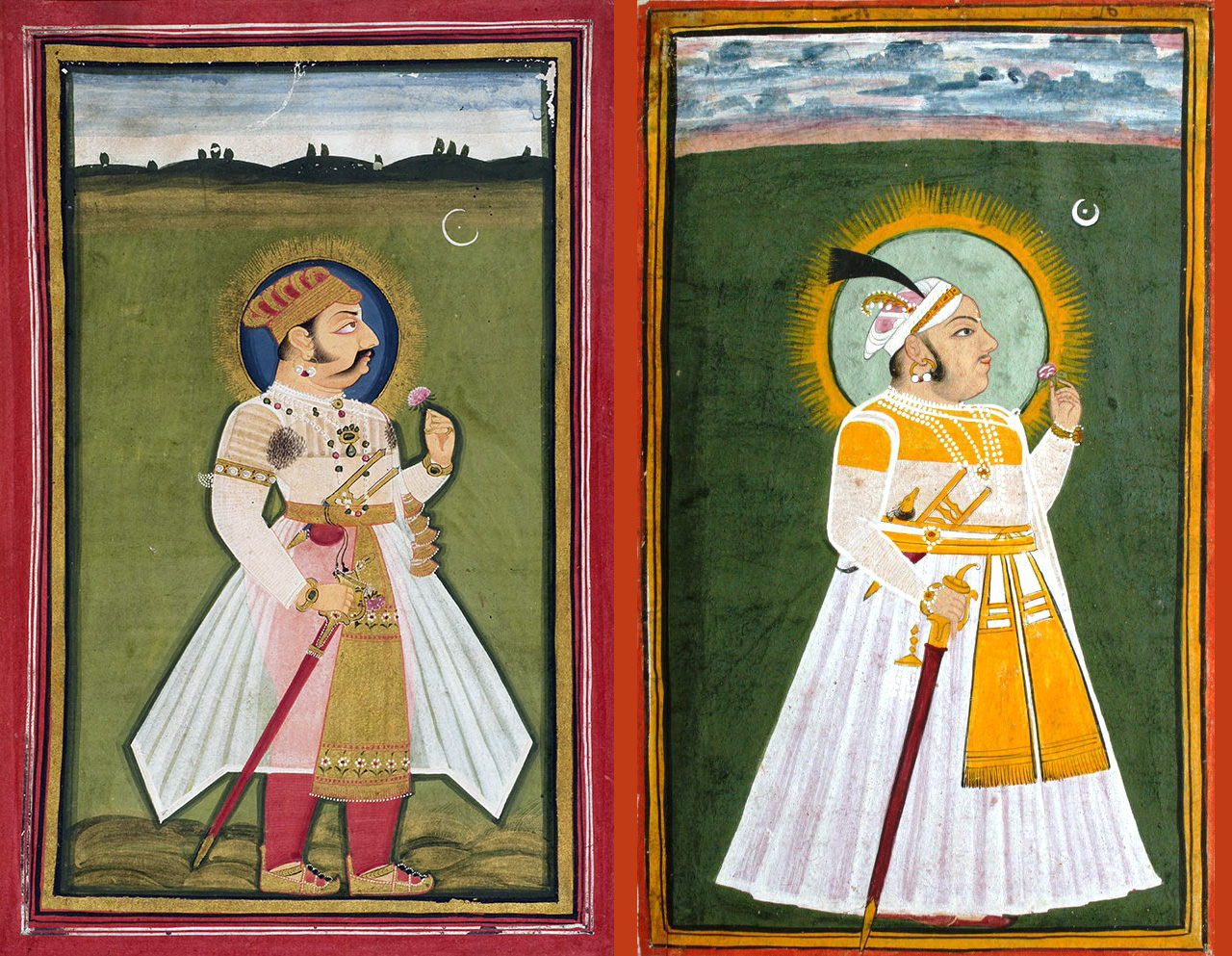
Left – Kumbha of Mewar, Right – Raj Singh II

A portrait of Maharana Kumbha of Mewar (r. 1433CE – 1468 CE) with the halo of the sun painted around his head; also a crescent moon is a part of the painting from the collection of Royal Asiatic Society, London dated to the 16th/17th century.. He is holding his ceremonial sword, wears jewellery and is dressed in royal finery. A picture of a royal persona is evident. In the next painting from the collection of the Royal Asicatic Society, London, the Battle of Haldighati which was a historic battle of 1576 A.D, between Maharana Pratap of Mewar and Akbar’s forces led by Man Singh of Amber is depicted; the Rana lost the battle but escaped. The image from early 19th century by artist Chokha of the Deogarh School captures the fierceness of the combat.

Suggested Read – Folk Art Forms of India – Defining Our Cultural Diversity