Celebrating the Power of Arts Education on World Art Day

0

Arts-Education-for-Children-01

Art is a rich part of Indian culture and heritage, a representation of our ideals, history, and creative spirit. Paintings and sculptures adorn museums and palaces just as they do our homes. Likewise, song and dance are tremendous parts of our cultural expression.

On April 15th, World Art Day will be celebrated all around the globe. The event reflects on the importance of fine arts in culture and history, and its date was chosen to commemorate the birth of Renaissance artist Leonardo da Vinci. The painter and architect’s work has influenced engineering, mathematics, and science, making him a prime example of the far-reaching impacts of the fine arts.

When our children are young, it feels natural to teach them to create, and to create alongside them. Chances to learn new skills and use their imagination to produce something they can be proud of not only ake them feel good, they contribute to a child’s well being and development.

Scientific studies have correlated arts education with positive social, emotional, academic, and physical outcomes for children.

  • Improved academic outcomes: A study measuring the academic achievement of eighth and tenth grade students with high levels of participation in arts education noted that participating students outscored peers on all measures of acacemic achievement. 
  • Helps young children learn to balance: After an eight week dance program for preschool children, those who participated in the program improved significantly in both balance ability and sensory-motor synchronization when compared to a control group. 
  • Increases tolerance and confidence: A study observing adolescent participants in a dance education program determined that dance education is associated with notable boosts to persistence, confidence, and tolerance of others.

To learn more about these and other studies, take a look at this thorough rundown by We The Parents.

Arts-Education-for-Children-infographic


To participate virtually in World Art Day activities, visit IAA/USA online by clicking here.

Traditional Dress of Rajasthan: Reflects a Culture that Persisted Since Ancient Times

0
Rajasthan traditional dresses
Image – charlotte.warren via Flickr

The costume of Rajasthan reflects a culture that has persisted since ancient times. Despite metropolitan influences, the people of Rajasthan still hold onto a traditional lifestyle and culture. Such is especially witnessed during times of festivities and occasions when communities gather together to celebrate. Olden forts, ancient towns, captivating folk arts, and recognizable costume and cuisine, all make Rajasthan a popular tourist destination among the Indian mass.

We explore the diverse colors of the traditional dresses of Rajasthan below.

Traditional Dress for Rajasthani Women

The conventional attire that the women of Rajasthan wear comprises the long exuberant skirt called Ghagra. The top garment is called Choli or Kurti. Along with this, they also cover their head or drape around their shoulders the long, light fabric called Odani.

Traditional-Dress-of-Rajasthani-women
Image – Ninara via Flickr

The Ghagra has gorgeous embroidery, is full-length, and pleated. Usually made of silk, cotton, crêpe, or georgette, it is available in a variety of bright colors and intricate patterns. The most predominant style of printing techniques is the Bandhej, Laharia, Tie-and-Dye, Mothra, and Chundri. The ghagra often has flourishing borders and Gota-Patti work which impart a regal elegance to the garment.

Traditionaal-Dress-of-Rajasthani-Woman

The Choli, Kurti, or Kanchli are equally elaborately styled, as per the requirements of the wearer. Mirror-work into the embroidery adds an attractive quality. Especially when teamed with beads, sequins, and coral shells. All such decorations embellish the garment with the signature of its ethnic originality.

Traditional-Dress-of-Rajasthani-Odani
Image – Nevil Zaveri via Flickr

The comfortable veil of Odani, or Chunar, protects the scorching climate of the desert. It is approximately 2.5 meters long and 1.5 meters wide. It is often embroidered with beautiful designs, prints, and beadwork. The woman wears it as what suits her. The traditional style is to tuck one corner into the ghagra, while the rest is taken across the chest and draped over the shoulder or over the head.

Traditional-Dress-of-Rajasthani-accessories
Image – Tom Maloney via Flickr

The gorgeous traditional accessories include the long necklaces known as Raani Haar, the Jadau sets, and the Aad choker. Maang Tika or Borla and pearl Bangadi or bangles are worn widely. Tribal women of Bhul, Meena, and Garasia communities wear ornaments made of brass and silver. Kaanbali (earrings), Bajubandh (armlets), Nathani (nosepin), Kardhani (waist-chains), and Bichuwa (toe-rings) also form important parts of the ensemble.

Traditional Dress of Rajasthani Men

Traditional-Dress-of-Men
Image – Lalithamba via Flickr

The customary attire for the Rajasthani man is the Dhoti, Angarkha, Kurta, and Pyjama. The Dhoti, prevalent across most Indian states, is a long, white cloth, usually of cotton, draped around the waist and tucked between the legs. The Angarkha is a robe-like garment worn along with Dhoti, generally by men of affluent social status. Tribal communities have adapted the attire into their traditional costume, reserving it for festivities and occasions. The Rajput clan wears the long, ankle-length Angarkha. The Puthia, or Angarkhi, is worn for daily use. It is shorter in length and the garment is fitted with the help of laces.

Culture-of-Rajasthan-Dress
Image – Public.Resource.Org via Flickr

The comfortable cotton Pyjamas are a loosely fitted set of pants, worn with Kurta or Mufti as the upper garment. Traditionally, the Kurta is supposed to be knee-length. However, the modern style and design patterns of the garment vary.

Headgear in Rajasthan

Traditional-Dress-of-Rajasthan-Headgear
Pagari – Pixabay

The headgear called Pagari is a mark of cultural prestige among the Rajasthani men. The cloth of the Pagari is two meters in length and about one-fifth meters in width. The style of wearing the Pagari differs according to caste and region. The Safas are specially designed Pagaris which are worn for special occasions, like weddings, and festivals. They are shorter and broader in size and more luxurious than regular Pagaris.

Traditional-Dress-of-Rajasthani-male-accessories
Man with Balis – Nevil Zaveri via Flickr

The men also accessories themselves with traditional ornaments. Large bangle-like Balis, ear-studs, and necklaces with crystal beads or semi-precious stones are the customary accessories. Men belonging to families from the higher social strata wear waistbands called Kamarbandh and the Patka. It is a piece of cloth placed over the shoulder.

Footwear in Rajasthan

Traditional-Dress-of-Rajasthani-male-juti
MojariFelix Francis via Flickr

The traditional footwear of the Rajasthani people is the Jooti or Mojari. These are leather shoes of intricate embellishments and are made of camel, sheep, or goatskin. The traditional style of Jooti is colored black or brown. In modern fashion, however, various multi-colored slip-on is also prevalent.

The costumes of Rajasthan form a brilliant and vibrant ensemble that forms an important part of the identity of a rich heritage. The people, thus, take pride in upholding their tradition.

10 Exclusive Indian Thrift Stores On Instagram To Up Your Fashion Game

8

Indian-Thrift-Stores-On-Instagram

The concept of the birth of thrift stores is not surprising; a pandemic with its havoc and the eye-opening message does call for sustainable practices. A thrift store is an online platform where apparel is upcycled and available at a relatively lower price than retail. Thrift stores on Instagram are easily accessible to people at a much discounted price. 

The waste produced in one fashion show is mostly unaccounted for. This shows the lack of heed to the subjects of sustainability and upcycling. The annual carbon footprint of the fashion industry exceeds 92 million tons, including landfills! This is why the niche trend of thrift stores becomes all the more necessary. 

Thrift stores also provide small and local business owners to establish their line of clothing. Similarly, for customers, it is a pocket-friendly choice to adorn inexpensive fashion. For environmentalists and scientists, thrift stores are qualitative as they are anti-fast fashion and environmentally viable. 

For the same reasons above, we have curated a list of 10 thrift stores online India for you to stay fashionably forward as well as eco-friendly:

1. Threadripper 

Indian-Thrift-Stores-On-Instagram-Threadripper

Threadripper is propagating the culture of upcycled, pre-loved, and handcrafted fashion. Their Instagram page store has a bold collection of everyday wear. They are also fond of tying & dying thrift wear for their customers. Instagram Handle: @threadripper.shop

2. Aimée 

Indian-Thrift-Stores-On-Instagram-Aimée

With a top-notch winter collection in-store, their minimal knits are something we are in love with presently. Instagram Handle: @aimee.loved

3. Paradime Thrift 

Indian-Thrift-Stores-On-Instagram-Paradime

If you love vintage prints like Argyle and apparel inspired by pop culture, then Paradime Thrift could be your go-to-store. With a big love for everything pocket-friendly, this store would meet all your fashion needs. Instagram Handle: @Paradimethrift

4. Candour.Oak

Indian-Thrift-Stores-On-Instagram-candour-oak

Here’s an online thrift store that caters to men’s fashion needs. If you have a guilty pleasure for sneakers, loafers, and branded tees, you might want to check out their Instagram page. Instagram Handle: @candour.oak

5. All Things Preloved 

Indian-Thrift-Stores-On-Instagram-All-Things-Preloved

Pritika Rao is the founder of this store. She, who has herself thrifted half her life, is doing her bit to promote this slow, pre-loved fashion revolution. Anything and everything couture is the central theme of this store. Instagram Handle: @_allthingspreloved

6. Pem Thrifts

Indian-Thrift-Stores-On-Instagram-Pem-Thrifts

PEM stands for the initials of the owners: Priyanka Advani, Eshita, and Mohita Kalra. The store deserves love for its handpicked and pre-checked essentials. They also offer selling with them for everyone interested in making thrifting an additional source of income. Instagram Handle: @pemthrifts

7. Thrift It Bro 

Indian-Thrift-Stores-On-Instagram-Thrift-It-Bro

If you are a bibliophile, nothing is better than turning into a thrift books buyer. Here’s an exclusive as well as a personalized collection of books available at a very reasonable price. Instagram Handle: @thriftitbro

8. Thrift Misfits

Indian-Thrift-Stores-On-Instagram-Thrift-Misfits

If you are a sucker for cute outfits and accessories, Thrift Misfits could be your OG choice. With a pretty perfect collection of skirts, tees, and shirts (bonus coordinated outfits), they ensure their clothes are sanitized well before dispatch. They aim to bring the joy of thrifting in everyone’s life and hence contribute to make this world lot more cleaner and greener. Instagram Handle: @thrift_misfits

9. Kefi Thrift Store 

Indian-Thrift-Stores-On-Instagram-Kefi-Thrift-Store

The thrifty efforts of two sisters Hasmina and Hasiba and their handpicked pieces are worth your try. The thrifty up wear will surely delight you. Instagram Handle: @thekefithrifts

10. Closet Reset 

Indian-Thrift-Stores-On-Instagram-Closet-Reset

Closet Reset is the effort and combined closet of three girls to reduce theirs and their thrift stores’ lovers’ carbon footprint. Fall in love with reset silhouettes of their store. Instagram Handle: @closetxreset

Thrift stores are not only limited to India, fashion influencers in other countries also run thrift stores check out this story on online thrift store Canada to explore the trending fashion happening in Canada.

Rush to these thrift stores to grab the latest items on sale. Also suggest us any thrift stores that you think we missed to list on this page. Happy Shopping!

Learning Languages from Home, Here is a Guide to Make it Easy For You

0

Author – Tamara Segal

Learning Languages from Home 04

People often recognize that being multilingual is associated with career benefits, but did you know that language learning can also enhance your cognitive health? Too often, people graduate from school and leave foreign languages behind in the classroom. Yet, there are some surprising advantages to tackling language learning later in life, too. As you learn a new language, you build up your communication skills, supercharge your brain with heightened activity in its language centers, and possibly even open yourself up to new work and travel experiences.

Fortunately, today’s language learners have a wide range of instruction options that don’t tether them to a traditional classroom. Finding time to learn a new language outside the home can be difficult for people with full-time jobs and busy households. By learning a language at home, you can adopt an instruction schedule that suits your time frame — and you can fit in practice when it’s most convenient for you. As you decide whether to embrace ESL or learn Japanese, Spanish, or French, keep the following information in mind to help you create a learning dynamic at home that supports your learning style.

The benefits of being multilingual

Learning Languages from Home 02

Although there are many new pastimes one might embrace — knitting or gardening, web design or data science — to fill time, learning a new language is both enjoyable and professionally useful. Today, the career marketplace is highly global. Bilingualism and multilingualism can catapult your resume to the top of an employer’s list, especially if the company is international and relies on its multilingual staff to communicate across borders. Learning Korean or German can open up an entire range of job opportunities that you may never have thought of before.

Of course, there are other benefits of learning a new language, too. Language learning actually enhances your mental health. As we age, our cognitive function can diminish just as our physical health can. But, language learning can reduce that cognitive decline, slowing its process as you forge new neural pathways. Learning a language can boost our ability to focus, keeping our minds alert and agile. Many people who engage in language learning report that the time they engage in the study actually improves their mood. As you focus on the enjoyment and challenge of your lessons, you’ll focus less on the stress of all things left undone, giving your mind the opportunity to recharge and rejuvenate from your usual anxieties and inner chatter.

Finally, you might opt to learn a new language so that you’ll be prepared to get out into the world and explore. Being multilingual makes you a more skillful traveler, building confidence and helping you navigate new, far-flung places for a grand travel experience. And learning a new language improves your communication skills — a core interpersonal and professional talent that’ll get you far in relationships, in business, and beyond.

How to set up your learning space

Learning Languages from Home 04

Of course, before you start pricing hotels in Barcelona or Paris, you’ll need to begin language instruction. But before you hire a language tutor or sign up for an online class, prepare your learning space at home so that you have everything you need to support your learning goals conveniently in one area. If you have a home office, you can enlist that space to learn, but you don’t have to dedicate an entire room to your new initiative. A special niche in your bedroom, kitchen, or family room will also suffice.

As you set up your language study area, you’ll want to ensure that it’s both quiet and comfortable. Distractions will prevent you from learning effectively. Opt for a space with good acoustics, since you’ll be doing a lot of language listening. Good lighting is important since you’ll be doing a lot of reading and writing. A desk or small table and comfortable chair are essential furnishings for your study area — but why not take your language learning space to an even more exciting level?

Whether you’ve opted to learn Hungarian or Turkish, why not set up your space with some international flair for inspiration? Add some travel posters to your wall, and keep a globe handy. Incorporate the spirit of your Spanish independent study with a Mexican blanket slung on your chair, or enhance your study of Chinese with some picturesque paper lanterns hung near your window. By creating a fun language learning space, you’ll have a special space with a retreat-like atmosphere that may very easily become your favorite place in the house.

Top 10 hacks for language learning

Learning Languages from Home 03

Once your study space is ready and you know what language you want to learn, it’s time to get down to business. Consider all the various applications available for learning a language at home. The following hacks will help you transform yourself into a multilingual virtuoso — or close to it! Keep them in mind as you develop your language learning goals and make your plan.

Enroll in an online course

Formal instruction is a good option for individuals who prefer to learn with a more-or-less traditional dynamic. If you’re concerned that independent study isn’t conducive to your learning style, consider this tried-and-true learning route. A formal course features highly structured lesson plans, assignment deadlines, and interaction with a teacher and classmates, albeit virtually.

Download the app

You’ve probably seen the advertisements online for any number of language learning apps. Less formal than an online course, these apps still offer learners a rich level of instruction designed to help them progress at a clip. Apps are ideal for independent learners who don’t have time to meet consistently for an online class.

Update your library card

Your local library system will have a wealth of materials to enhance your language-learning experience. Plan to borrow language dictionaries and picture books, novels, and even films in the language you’re learning so you can read, watch, and practice your listening skills. Check out materials in person or reserve them online and pick them up at your convenience.

Quality earbuds, headphones, or speakers

When you’re learning to speak a new language, you need to be able to hear your learning materials clearly. A speaker that crackles or earbuds that cut in and out will compromise your learning experience. Plan to invest in quality listening devices so that you can hear instructors or your language learning app with crystal clarity.

Use flashcards

Flashcards work for kids, and they will still work for you, too. In fact, if you have kids, you might want to enlist their help — invite them to quiz you on your German verbs after you quiz them on their multiplication facts. You can also find flashcard apps for literally any language you want to learn.

Hire a language tutor

There comes a point when you might hit a stumbling block or a series of obstacles while learning a new language. Don’t despair! Check with area colleges, and engage a language tutor. This can be especially helpful if you’ve never learned a foreign language before or you want to stay on track and pick up speed as you move from beginner-level learning to the more complex intermediate stages.

Find a learning partner

Convince your bestie, spouse, partner, or friend to consider learning a language with you. When you have a partner, you can keep each other motivated and take turns studying at one another’s homes. Of course, ideally, you’ll want to find someone who’s just as enthusiastic about learning Russian or Portuguese as you are, so choose your language learning pal wisely.

Listen to native speakers

One of the complaints that many students of languages have is that classroom and app models are too formal and not the stuff of everyday language you’ll hear on the streets of Rio, or Naples. Use your devices to track down native language speakers — like watching and listening to videos on the internet. This is particularly helpful if you plan to travel to the country whose language you’re learning.

Be kind and patient with yourself

Too often, people abandon their language pursuits because life interrupts them, and they find it difficult to resume their studies. Keep in mind that it’s okay to learn at your own speed and tempo. It may be asking too much of yourself to learn Italian in six months. If you need to adjust your goals, do it! The key is to keep going — and don’t be afraid to revisit old lessons when you need a refresher.

Immerse yourself in culture

Language learning may seem tedious at times, especially if you’re struggling with tenses or complex sentence structures. Maintain your motivation to keep learning by immersing yourself in the culture of the language. Learning Greek? Invite your best friend to a luncheon at your favorite Greek restaurant. Learning Spanish? Set Saturday nights aside for a tapas feasting! You’ll find that cultural immersion boosts your learning — and enriches your life.

Learning a new language enhances your life in numerous ways while providing you with a marketable skill. As you learn a new language, you’ll develop new communication skills, keep your brain agile, and even discover new writers and artists to read and enjoy as you encounter them in your studies. Before you know it, you’ll be fluent in the language of your choosing, and who knows where you could go from there?

10 Easter Dishes You Must Try

0

Christians across the world celebrate Easter. Easter eggs and bunnies are almost synonymous with the celebrations and joyous festivities. It is a time for families to gather and also a time for feasting after the long Lent. Beginning on Ash Wednesday the Lent is an important spiritual and religious abstinence that continues for six weeks and ends before Easter Sunday. 

Good Friday commemorates the crucifixion of Jesus Christ. Easter or Resurrection Sunday commemorates the resurrection of Christ from the dead on the third day after the crucifixion. Easter is thus, an important religious occasion fraught with prayers, sentiments and purposeful divinity. Though a major occasion in many countries of the world, Easter is celebrated with much fervor and enthusiasm in India as well. 

Some of the cities and states that have a sizable Christian population are well-known for Easter celebrations. Goa, Mumbai, Kerala, Meghalaya, Nagaland, Mizoram, as well as cosmopolitan cities, such as Bangalore, Hyderabad etc. are great places to be during Easter. 

Easter celebrations in India

10 Easter must try Dishes- Easter celebrations in India
Image – Pixabay

French, Portuguese and British colonization has played a role in influencing the Easter celebrations in India. In Goa the biggest crowds gather in Panjim at the Our Lady Immaculate Conception Church. Goa in fact, is where Easter is celebrated with much fervor including street plays, dance performances etc. that take place throughout the state. Carnivals and the ‘Way of the Cross’ a skit and march past are the highlights. In Kerala, which has a large Christian population, Easter is an important festival with a lot of family gatherings and bonhomie. Similarly, in the northeast, choirs in churches, dances as well as Vigil services or readings from the Testament are all a part of Easter celebrations. 

Easter delicacies

Easter also means the time to meet up with family and friends. And it also means enjoying delicious dishes together. So without much ado let’s plunge into discovering some of the most yummy and mouth watering Easter special dishes that are sure to keep craving you for more. 

Again the type of cuisine might vary from region to region depending on the style and flavors of cooking. However, overall the kind of dishes that are prepared during Easter are usually the ones that are the family’s favorite. Also, remember that after a long period of Lent, the dishes tilt slightly in favor of non-vegetarian preparations. 

Marzipan Easter Eggs

10 Easter must try Dishes-Marzipan Easter Eggs
Image – Wikimedia

Easter is quite not itself if one doesn’t think of Easter eggs. Easter eggs are in fact one of the most common gifts around the world. But when one thinks of them as a dish, Easter eggs made from marzipan are extremely tasty. Made from sugar, egg white, almonds and rose water, the mix is then shaped as eggs and decorated with icing or flavors. 

Hot Cross Buns

10 Easter must try Dishes-Hot cross buns
Image – Wikimedia

The Easter Hot Cross Bun is a traditional bread prepared especially in England. Many bakeries and homes in India make the delicious hot cross buns which are a delight when straight out of the oven. Traditional bakers in many parts of the country, especially southern India, continue to rake up these warm squishy buns which many take home to break their Good Friday fast. 

Deviled Eggs

10 Easter must try Dishes-Deviled Eggs
I,age -alanagkelly / Flickr

Another egg recipe, the classical deviled eggs are a perfect side dish on any meal or also a great breakfast dish. Filled with a paste made from egg yolk the stuffing can be made of mayonnaise, mustard sauce or many other ingredients depending on taste. 

Chicken Curry

10 Easter must try Dishes-Chicken curry
Image – Pixabay

Alright, this one has a vast scope and might seem a sweeping generalization, but chicken curry is definitely one of the most enjoyable dishes during Easter. Made in different ways across the country and homes, the chicken curry is the staple dish that goes with almost everything, including paratha, rice and palappam and appam. In Kerala usually toddy is used in the preparation of palappam and the curry is prepared with typical spices from the state. 

Fugias –

Easter-Dishes-Fugias
Image – Akshata’s Recipes

A deep fried sweet bread the fugias is a dish prepared by those living in the eastern region of India. It is a Roman Catholic dish and is also prepared by the community living in other parts of the country, such as Mumbai. The bread is a mixture of flour, sugar, eggs, milk, yeast and is also eaten with the different Easter curry specials.

Sorpotel and Sanna

10 Easter must try Dishes-Sorpotel and Sanna
Image – Xantilicious /Facebook

Coming from Goa and also Mangalore the fascinating sorpotel is a Portuguese dish. Made from meat and prepared in vinegar sauce, the curry is eaten alongside the soft, white steamed rice and coconut bread called Sanna. The sorpotel can also be prepared with pork. 

Turkey kurma

10 Easter must try Dishes-Turkey kurma
Image- Canadian Turkey/ Pinterest

Turkey is another hit ingredient during Easter. Many different dishes made from turkey are prepared, such as turkey korma or turkey balls with gravy etc. The Turkey curry is particularly a favorite in Puducherry and also prepared during Christmas. 

Naga curry

Easter-Dishes-Naga Curry
Image – Wikimedia

The food from northeast is relatively untouched by modern ingredients and has traditional and distinct flavors to it. Some of the Easter curries include the Naga Pork curry also called Awoshi Kipki Ngo Axone rich in special flavors. There is also the Anishi or black curry made from fermented leaves that are then smoked. Anishi is often eaten with bamboo shoots along with fresh fruits. 

Sea food starters – Sea food delicacies are a must especially when it comes to Goan cuisine. Shrimps sautéed in different flavors or the spicy Prawn Balchao are perfect Easter recipes for seafood lovers. The juicy prawns can also be eaten alongside rice. 

Simnel Cake – A popular Easter fruit cake the Simnel is a popular sweet dessert in the UK and Ireland. Made of different layers of almond, marzipan and decorated with balls on top, the Simnel cake is a definite Easter special. 

Easter is a time of festivities that are accompanied with a deep sense of spiritual influence too. It is a period after abstinence through Lent and hence the burst of flavors on the palate are only a natural outcome. Sweet dishes and cakes are in season, as much as are grape wines and starters. However, the non-vegetarian platter is enviable with dishes prepared from meat, chicken, pork, duck and rabbit. Though fewer households in recent times prefer duck or rabbits and have shifted to meat and chicken, the variety across the recipes is wonderful. This is more so, because different regions and cities have their own special Easter recipes that are often shared when the community or household shifts to another base. 

Finally, Easter is a time for prayer and forgiveness. A solemn occasion that brings one closer to the divine. But like all festivals, there is symbolization that makes it identifiable to people across all religions. The Easter bunny and eggs are a favorite artistic expression for all no matter which religion or caste. Similarly, the Easter celebrations, like many other religious celebrations in the country, are a perfect reminder of how cultural unity and inclusivity are the need of the hour. So why not celebrate Easter in your home with some special dishes and celebrate the oneness that is so weaved in our social and cultural existence.

Traditional House of Kerala – Adding Beauty to the God’s Own Country

0
Traditional-House-of-Kerala
Image – Quora

Blessed with abundant greenery and mesmerizing beauty, Kerala is, without a doubt is one of the most beautiful places on earth. From the coconut trees and paddy fields that adorn the state to the magnificent mountains and tranquil backwaters, the land is blessed with enthralling and exhilarating beauty. Hence, it comes as no surprise that the state is known as “God’s own country.” Apart from its scenic beauty, the state is also home to a rich and diverse culture and heritage. The state’s traditions and culture can be observed through the traditional house of Kerala. They are an embodiment of the customs and heritage of the state and hence occupies a significant part in the history and culture of the state.

Nalukettu

Nalukettu – Riju K

The traditional houses of Kerala are known as Naalukettu (“Naalu” means four, and “Kettu” refers to blocks). Typically a Naalukettu house would comprise four blocks. The Vadakkini (the Northern Block), Padinjatini (the Western Block), Kizhakkini (the Eastern Bloc), and the Thekini (the Southern Block). Though however, it can be observed that some wealthy and larger families also build Ettukettu (meaning eight blocks). Even Pathinaaru kettu (meaning sixteen blocks). In Ettukettu, the house would include two central courtyards, and in Pathinaarukettu, the house would consist of four central courtyards.

Tharavad

Usually rectangular, the Naalukettu is constructed large enough to accommodate all the members of the family. In earlier times, joint families were the norm, and the Naalekettu was passed on through generations. A Naalukettu, which has belonged to a particular family for generations, came to be known as the Tharavad of the family. The Tharavad was a source of great prestige and honor for the family which resided in it.

Traditional-House-of-Kerala-Tharavad
Image Courtesy – Tharavad

Construction

Usually made of teak wood, Mahagony, sandalwood, and the wood from the jackfruit tree and bricks, the Naalukettu houses had a unique architecture. The house included doors and windows made of wood, verandahs with wooden pillars, Padippura, and the Nadumuttam. These homes had better ventilation and lighting, which allowed the home to be well aerated at all times of the day. Also, owing to the better lighting, the house was always well lit. The architecture of the house is also equally brilliant and majestic. Almost all the Naalukettu houses are built in a unique manner. This enables them to blend in perfectly with their natural surroundings. The people residing in the state are well connected to nature. hence their homes too are designed in such a way that they merge in entirely with the nature that envelops them. Almost all the traditional Naalukettu houses are carefully placed in the center of the courtyard, in the lap of nature.

Traditional-House-of-Kerala-using-vastu
Pathmanabapuram Palace – Thejas Panarkandy via Flickr

Astrological Significance

These traditional houses are built based on the Thatchu Shastra or the Vastu Shastra. They are made in such a way that the house faces the east direction, and hence the entrance of the house is also placed in the east direction.

Climatic Endurance

The roofs of these houses are also quite different from that of others and are sure to grab the attention of anyone who visits the state. The roofs are either pitched or sloped and are embellished with incredible tiles. They are built in this unique fashion due to the climatic conditions of the state. Kerala is a land where rainfall is quite common. In this scenario, the sloping roof is more suitable than a flat roof. For the tiles, sometimes clay was used, which provided a cool atmosphere for the house members. In most of these traditional houses, the roof’s color is a unique shade of red.

Padippura and Poomukham

Traditional-House-of-Kerala Padippura
Padippura – Prabha Nair via Pintrest

However, in modern houses, a wide range of colors are used. The entrance of the Nalukettu or the traditional Kerala house is known as the Padippura. This entrance comprises a traditionally designed door and a tiled floor, along with a sloped roof, which resembles a temple. After you enter the padippura, one reaches the poomukham. Poomukham refers to the shaded veranda space. The veranda usually is quite spacious and gives a grand appearance to the house.

Charupadi

Traditional-House-of-Kerala-Charupadi
Image – Pintrest

The charupadi is, in simple words, a built-in wooden seat that is constructed to face the Poomukham. In the olden days, the charupadi was used by the elders of the home to interact with any outsiders who visited them.

Nadumuttam

Traditional-House-of-Kerala-Nadumuttam
Image – Wikimedia

However, the most distinguishing factor of a traditional house in Kerala is undoubtedly the Nadumuttam, situated at its center.

The Nadumuttam is open to an air courtyard shaped like a square or a rectangle, located in the house’s central part. At the time of rain, members of the house can enjoy it by standing around the floor of the Nadumuttam, inside the house. The Nadumuttam also provides the space for the members of the family to gather together. Apart from just being a meeting place, this place also serves as a place for the family members to celebrate festivals together. These traditional houses even include a pond, which was used exclusively by the members of the family.

Traditional-House-of-Kerala-pond
Nalukettu has its own Kulam or Pond – Wikimedia

Apart from this, the Naalukettu houses also involved a kitchen, veranda, granaries, dining room, bedroom, Pooja room, and a well. The traditional houses of Kerala always seem to be in harmony with their natural surroundings. These traditional Nalukettu houses were usually built in the midst of nature and had planted around its courtyard a wide variety of trees. This shows the amity between people and nature, which is still prevalent in the state.

However, as time passed, the nalukettu, which used to be owned by joint families, slowly became replaced with nuclear families, building modern homes. Modern houses built in the state also share some of their characteristics with the traditional houses of the state. The pitched or sloped roof is an apt example to show the influence of the traditional Nalukettu homes in today’s modern homes. Most of the houses built in the present day would include the pitched roof, but instead of a single shade of red, a wide range of colors are used.

Traditional-House-of-Kerala-01
Image – Lensnmatter via Flickr

Nowadays, some modern houses also add a small central courtyard (mostly roofed), which signifies the Nadumuttam. It was present in the traditional Naalukettu houses.

The Nalukettu homes were designed elegantly. They accurately reflected the state’s culture, traditions, and rich heritage. As one observes the Naalukettu houses’ construction, one feels enchanted by the architectural brilliance.

These houses were built so that they are well accommodated to the changin seasons throughout the year. Living in these homes, one would never feel distanced from nature but instead would feel that they too were a part of nature. Naalukettu houses thus still occupy a very significant role in the history and culture of Kerala.

Bohra Sisters: A Sisterly Upholding Of The Good Old Days Through Art

2

Bohra-Sisters

Childhood was undeniably the happiest phase of our lives. And if you have lived through the early 90s, you have lived through the good old days of Doordarshan (especially Chitrahaar). Now, when we see something distinctly similar to the good ol’ days, our nostalgic vein is triggered. The virtual throwback through animations, doodles, graphics and music satisfies our thirst for the innocent days. Bohra Sisters (@bohrasisters) is one such Instagram page that we discovered recently. This sister-duo animates GIFs and slow-motion graphics inspired from their lives set during the 80s-90s with music from our lovable Indian cinema.

Bohra Sisters take you through the lanes of their lives which are hella relatable! The gramophone, the flavoursome chuski, the lonely letter box, the lalten to the rescue days are some recurring symbols that are unmissable. Bohra Sisters through their videos infuse a sense of homecoming. We talked to one of the Bohra Sisters aka Zainab Bohra to gather a perspective of their work:

So who are sister-creators of the Instagram handle @BohraSisters? 

Bohra-Sisters

My name is Zainab and my sister’s name is Sakina. We two are the creators, curators, runners of the Bohra Sisters. Professionally, we both are engineers but soon after, we shifted into the field of designing. I used to work as a graphic designer in a digital marketing agency and my sister was into marketing. However, we both quit our jobs and are currently concentrating on Bohra Sisters. We also enjoy motherhood this way (since we both had a baby last year!). While I am based in Kuwait, Sakina resides in California. Yes, we are working virtually from two different continents (giggles)!

What motivated you both to pursue a business in designing?


View this post on Instagram


A post shared by Bohra Sisters (@bohrasisters)

We actually started the Bohra Sisters page as a side hobby. My sister always loved to draw everyday life. Once I became interested in designing and animation, we thought this would be a good side project to work on, together. We started small, but slowly yet soon, we started receiving major appreciation from our viewers. It was the love for the art that was very familiar to them. This motivated us to continue pursuing our passion.

Which is the personal favorite innocent day’s memory of the Bohra Sisters?


View this post on Instagram


A post shared by Bohra Sisters (@bohrasisters)

All the videos that we make are in a way inspired from our favorite childhood memories. Be it the old, gadget free days motifs and symbols like nani ka batua, knitting/stitching, gramophone, chuski days, or the radio. If I had to choose one, I think one of my most cherished memories was having a sweet tooth for Gulaab Jamun with my Dadaji. Every sunday, he used to get Gulaab Jamuns for us. Despite his diabetes, he used to covertly bring them in by hiding them in his pocket. 

Another one, especially close to my sister’s heart was sipping malai chai with our Naniji. Naniji used to save some extra malai everytime as she loved it. 

That is adorable! I am guessing you have shared some of your childhood with Indian cinema as well. How long have you stayed in India?

We moved to India during the gulf war and resided there for almost 7 years. Our most precious childhood years were in India! Undoubtedly, we love the Indian Cinema and routinely incorporate its songs in our animations. Oh, and we visit India often!


View this post on Instagram


A post shared by Bohra Sisters (@bohrasisters)

Any favourite musicians/songs/movies that you would like us to know?

Sakina loves all the Shyam Benegal movies! It will be really hard to pick one song but I think no song can come before Aayega Aane Wala from the movie Mahal for her. And I am a big fan of animation movies and my all time favorite is Lion King. My favorite singer is Asha Bhosle and my favorite song is Oh Mere Sona Re from Teesri Manzil.

There is so much diversity in your posts. What other themes and values will we be seeing in the future?

There is too much negativity in today’s world and all we want to do is spread love through our posts. Our videos are inclusive of souvenirs of childhood (like kite flying and chuski), festival motifs (like Diwali torans and plum cakes), promoting Indian tourism (like Charminar) and social initiatives (clean environment and Yoga).


View this post on Instagram


A post shared by Bohra Sisters (@bohrasisters)

Talking about the millennials, do you think they are drifting away from their cultural roots?

Everyone is entitled to their likes and dislikes. We are no one to judge others for the choices they make. In fact, India itself is very culturally diverse and millennials add their flavour to this culture.

How do the Bohra Sisters earn from their stop motion illustrations? How are people outsourcing your service?

Our clients pay us to make customized videos for them. They range from invitation videos for various occasions to product marketing videos.

And how do you seem to intermesh the present world with the classic cinema and cultures?

It’s not that tough. India has been blessed with amazing talent and artists. Our classic cinema, which was called the golden age of cinema, has plenty of evergreen content that’s actually timeless and remains relevant over generations.


View this post on Instagram


A post shared by Bohra Sisters (@bohrasisters)

What is in store for us as social media consumers in the future?

Our mission and vision has always been to bring a smile to people’s faces and spread love by showcasing our loving memories through the lens of the most popular thing in our culture – our Indian cinema. And we will try to continue that in the future as well.

To get your customisations, drop them a DM on Instagram at @bohrasisters

Great Indian Scientists and Researchers That Every Indian Must Know

0

Most-Famous-Indian-Scientists-and-Researchers

People depend on science in their daily lives today more than they can imagine. Scientific discoveries began many years ago and great men and women discovered things like the bulb, wheels, medicine, and simple machines.

From the last century, scientists have continually improved the inventions and discovered more. Great Indian scientists like S.S. Abhyankar, famously known for his contributions to mathematics, played a big role in modern science. There many renowned Indian scientists and researchers whose influence today is felt worldwide.

C V Raman

Indian-Great-Scientists-C-V-Raman
Sir C. V. Raman

The 1930 Nobel prize winner Chandrasekhara Venkata Raman is famous for his discovery of the scattering light phenomenon. In his scattering of light discovery, he wrote that light that goes through a transparent material has some of it deflected and changes its wavelength. The phenomenon came to be famously known as the Raman scattering and the effect is called the Raman effect.

Born in 1888, Raman made history as the first Indian and non-white person to receive a Nobel prize in the science field and for making great steps in the research process. He founded the Raman Research Institute located in Bangalore. Raman died in his institute’s gardens in 1970.

Sir M. Visvesvaraya

Indian-Great-Scientists-M-Visvesvaraya
Sir M. Visvesvaraya

Mokshagundam Visvesvaraya was a renowned engineer and was also recognized as a scholar and statesman in India. Born in 1860, he became the Diwan of Mysore between 1912 and 1918.

The Indian engineer invented the block irrigation system and the automatic sluice gate, which are considered the most engineering marvels. He also developed a better way to filter water via collector well, something that was rare in other parts of the globe. Visvesvaraya received Bharat Rama, the highest recognition in India.

S.A. Ramanujan

Indian-Great-Scientists-Srinivasa-Ramanujan
S.A. Ramanujan

Srinivasa Aiyangar Ramanujan is known for his love of mathematics and is regarded as a genius. At a young age, he received a pure mathematics book which helped him develop his unique mathematical formulas and ideas.

He would write his discovered ideas and formulas in notebooks which later came to be known as Ramanujan’s Notebooks. He didn’t graduate from college and in 1911, he wrote a research paper on Bernoulli Numbers and published it in the Indian Mathematical Journal.

The journal helped him become known. He later joined Trinity college in the US and became a famous mathematician. In the US, Ramanujan became the second Indian to join the Royal Society of London. He died in 1920.

Prafulla Chandra Roy

Indian-Great-Scientists-Prafulla-Chandra-Ray
Prafulla Chandra Roy

Prafulla Chandra Roy was a famous chemist in India and he would donate his money to the government of India to help develop chemical science. As a result, he gained the title of a philanthropist. He founded a chemistry research school, the first of its kind in India, and was recognized as an educationist.

Roy continued pursuing his work of chemical research involving organic and inorganic nitrates, which created a big impact in India and beyond. He further researched mercury and discovered that it could be used in Ayurvedic medicine. His work is useful in modern India.

Considering the great contributions made by scientists and researchers in the past, we can say students today have better chances to invent greater things. As a student, you could do better if you take ample time to research. You will be able to write wonderful papers and produce unique research-based scientific discoveries.

However, if you find yourself unable to do conclusive reports and write unique papers, you might consider sourcing for help. A commendable place to consider will be studyclerk.com/buying-research-paper for buying a research paper from your choice of a professional writer. The site is well-known has plenty of reviews because of its outstanding work quality.

Homi J. Bhabha

Indian-Great-Scientists-Homi-Jehangir-Bhabha
Homi Jehangir Bhabha

Homi Jehangir Bhabha is respected for his work in Quantum Theory. Born in 1909, he studied nuclear science in Britain, and on his return to India, he managed to convince Congress to start a nuclear program for India. The Atomic Energy Commission of India was formed and he became its first chairperson. He died from a plane crash in 1966 and is today respected as the father of India’s atomic energy.

Salim Ali

Indian-Great-Scientists-Salim-Ali
Salim Ali

Salim Moizuddin Abdul Ali, famously recognized by the alias name  Birdman of India, was an established naturalist and ornithologist. His love for nature led him to strongly defend the great silent valley forest from being destroyed.

Today, the forest is home to Silent Valley National Park. He co-authored and published a book called Birds of India and Pakistan and later wrote an autobiography titled Fall of a Sparrow. His famous recognitions were the 1958 Padma Bhushan and the 1976 Padma Vibhushan.

Birbal Sahni

Indian-Great-Scientists-Birbal-Sahni
Birbal Sahni

Birbal Sahni was a famous paleobotanist, geologist, and archeologist in India. He spent his time studying plants and fossils found in the Indian subcontinent. He founded The Paleobotanical Society of India, through which the Institute of Palaeobotany was started in 1946.

He was admitted into the Royal Society of London in 1936 and later became the first person of Indian origin to be awarded the highest British scientific honor.

Conclusion 

When each generation works hard to invent things, it serves as a base for the next generation to become better. From the last century, many Indian scientists and researchers sacrificed their resources and time to discover things that are useful to many generations today. Currently, many discoveries are being made in India as another generation of scientists spends time in laboratories and the field researching.

If you liked this article don’t miss the below ones

Unsung Heroes of Indian Science – Part I
Indian Scientists – Unsung Heroes – Part II
Indian Women Who Broke the Barriers & Became the ‘Firsts’
Abdul Kalam, You’re My Hero!

Author Bio: 
Paul Calderon has everything that a good writer and editor must have. He has been trained and coached by the pioneers in the writing industry and has professional qualifications from premier institutes. His rich work experience and natural flair for writing have helped him carve a name in the industry and gain a massive fan following.

How Much Does Fine Art School Cost in India?

0

Fine Art School Cost in India

Art is a way of experiencing life, and India has always been famous for its vivacious culture. The maintenance of the ancient cave art at Bhimbetka is a testimony to this. Through the pages of history, clay work, pottery, and other work of Indus Valley civilization have garnered the attention of experts till date. The Mughals and Persians were also patrons of the fine arts and helped it reach new heights. Moreover, let us not forget that India got independence from the British raj and has housed artistic geniuses like Raja Ravi Varma, Jamini Roy and MF Hussain ever since. After you decide which college to choose, you may be interested in getting help with your admission essay, and services like https://writemyessayonline.com will help you with that.

It is common for a country with a huge history of arts to have a great number of youngsters interested in arts. As a result, to cater to the huge population, there are several Fine Art Schools in India of par excellence. Among thousands of universities offering such courses, here are the top nine of them that could provide you with the utmost services for fine arts.

It is common for a country with a huge history of arts to have a great number of youngsters interested in arts. As a result, to cater to the huge population, there are several Fine Art Schools in India of par excellence, and many of them offer online art degrees as well. Among thousands of universities offering such courses, here are the top nine of them that could provide you with the utmost services for fine arts.

1. College of Art New Delhi

The fee structure reasonably stands at around 55,500 for a three year course, amounting to approximately 18,500 annually. Ultimately students can get their goods of painting. It will foster a great way for students to come up with their fresh artistic marvels weekly. Moreover, another major thing about this fine arts institution is that they will prepare you from the ground level. One does not need to have the prerequisite knowledge, just an interest in the field is enough to be eligible for this course.

2. Faculty of visual arts, Banaras Hindu University

Another institution of excellence in the field of fine arts. The institution has a fee structure of 1.53 lakh annually. The institution has always been one of the major custodians of the Hindu form of arts and its adaptability and enhancement of the course material through time has solidified this university as a frontrunner for decades.

3. Sir J College of Applied art, Mumbai

The fee structure of the Bachelor of Fine Arts stands for 75 000 annually with total fees summed up to 3 lakhs for four years. They provide several scholarships for the same. This institution’s notable feature is that it is located centrally in the city known as the heart of art and culture of the nation. The college is one of the first institutions of its kind in the country and was established its way back in the year 1879 in the colonial era of India. The prime reason for founding the university was imparting European culture to native Indians. Over the years, the university has played an important role in harnessing the country’s culture and art.

4. Faculty of fine arts, Maharaja Sayajirao University of Baroda, Vadodara

The fee structure of this college ranges from 16,700 to 49,200 depending on what course one chooses annually. What sets this institution apart from the other is that it sets the gender ratio to 1:1. This is done to foster equality and promote fairness of arts and culture among all its students.

5. Faculty of fine arts, Jamia Millia Islamia, New Delhi

The university offers both regular and part-time courses in the field of fine arts with its fees starting at 12,000. Furthermore, the sheer number of electives that are offered to its students is laudable. The college has an excellent infrastructure.

6. College of fine arts, Trivandrum

The college is one of the top institutions, with one of its remarkable features being that there are 50% of seats are unreserved, whereas the other 50% are then allotted to the ST, SC, and OBC candidates in the proportions of 8%, 15%, and then 27% respectively. Established in 1881, the fee structure of this institution is a little on the higher side which stands at around Rs 2.68 lakh annually.

7. Jawaharlal Nehru Architecture and fine arts university, Hyderabad

The fees of fine arts in the institution is Rs 20,000 annually. There are numerous amounts of scholarships that are offered for all those who cannot afford the same. Moreover, the college boasts of distinguished highly qualified faculty, and most of whom have more than two decades of experience in the fine arts faculty. The staff here is extremely learned and due to the praiseworthy student-teacher ratio, the students get a lot of hands-on experience to work with their faculty members.

8. Government College of fine arts, Chennai

The art courses in this institution offer a good number of opportunities to their students. Most people who have graduated from this place recently are working as faculty members in other institutions. The entire course’s fee structure is standing somewhere near Rs 3 lakhs in the institution.

9. Department of fine arts, Mahatma Gandhi Kashi Vidyapith, Varanasi

It is a private institution that was established back in 2006. The fee structure here is around 20,745 for a three year course. The notice here is that it is the most technologically advanced school of fine arts in the whole of India.

Disclaimer: All the fee details mentioned above are collected from the credible sources, but we cannot guarantee that the same will remain static for ever. Please do contact the college administration to get the latest fee structure.

The Flame of the Forest: The Flames that Rekindle Hope

6

The-Flame-of-the-Forest-Flower-02

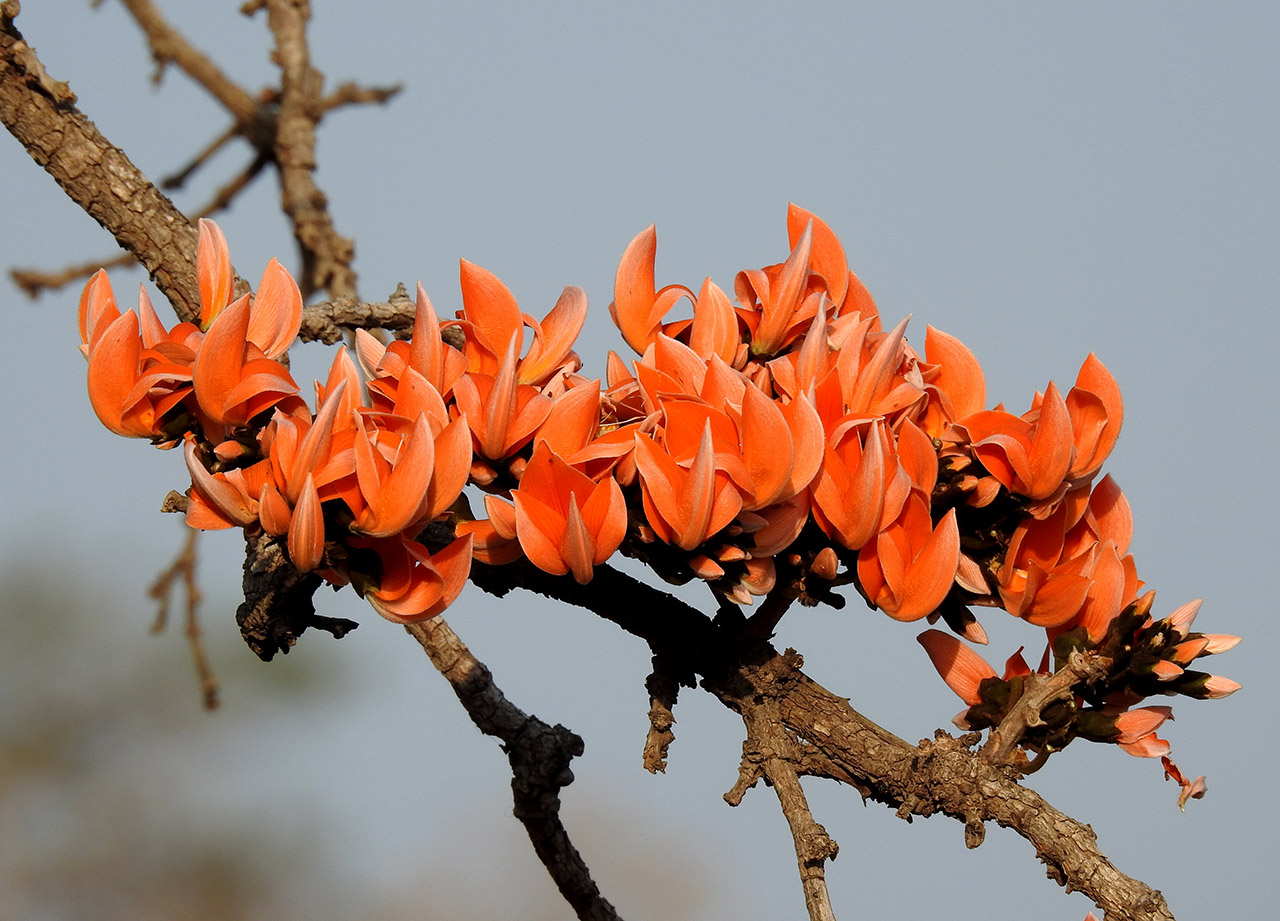
The flowers are on a sojourn; they have illuminated the dry forests with their glittering hues, like the fire flames that illuminate the darkness. 

At the winter’s fag end, in the month of February, the teak intensifies shedding its broad leaves and the entire landscape wears a desolate look. But nature has its own equation to keep its beauty intact and the flame of the forest reminds us of this power of protean nature.

No sooner does dryness hit the deciduous forests of Central India, than nature dons a new avatar. In the spring springs the hope, as the flame of the forest begin imparting a majestic appearance to the seemingly desiccated forest landscape.   

By introducing the flame of the forest, nature imbues the rufous landscape with freshness and hopefulness. With the flower’s arrival, the landscape rejuvenates, and a poet is made to express his emotions:

The-Flame-of-the-Forest-Flower-01

The spring is in her glory,
as she has received her favourite flower.

Wavering by the gentle breeze,
the flames spread the orange hues throughout.

With the flames burning against clear blue skies,
the nature goddess is shining.

Flowering in the dense jungle,
the flame of the forest has brought cheerfulness.

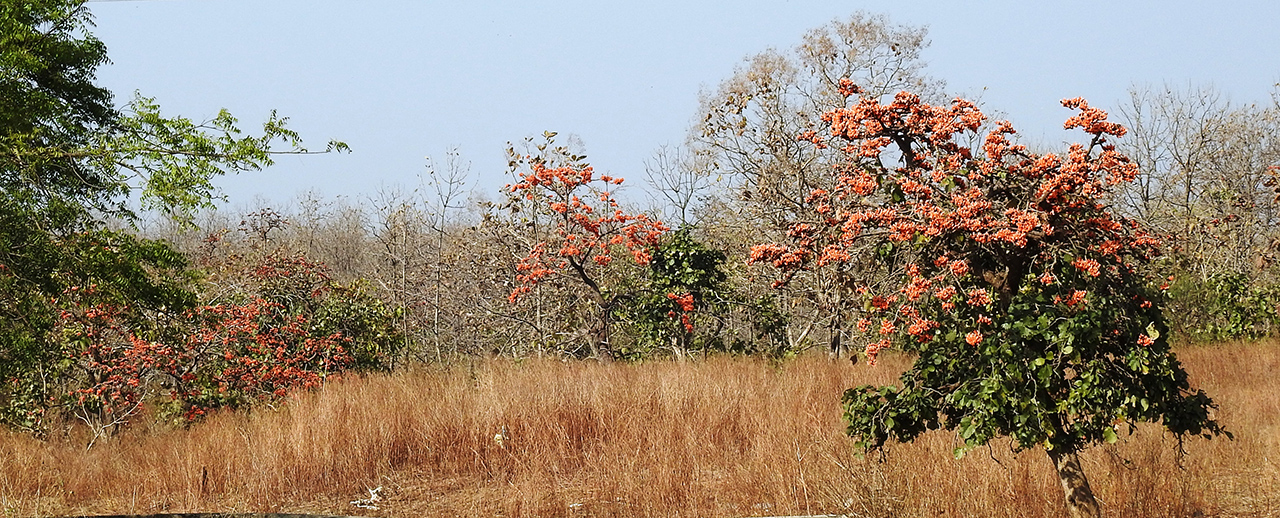
As you take a drive through the jungles of Central India, your eyes are automatically riveted to gleaming flame-orange flowers. Burningly shining in the hot afternoon, they set themselves starkly against the tawny backdrop. Now, otherwise unnoticeable palash (Butea monosperma) trees become distinguishable in the landscape interspersed with mixed-deciduous vegetation.

The-Flame-of-the-Forest-Tree-01

When seen from a height, the jungle appears all speckled and blotched with orange and vermillion shades. At a time when the teak has denuded, the leaves have parched, and the ground is all covered with thick leaf litter, the flame of the forest adorns the jungle.

Coinciding with the season of the Holi festival, the flame of the forest is also called the Holi flower. The fame of the flower being traditionally used to make Holi colours is quite widespread across the country. With the blooming flowers, the mercury rises slowly towards 40 degrees Celsius.

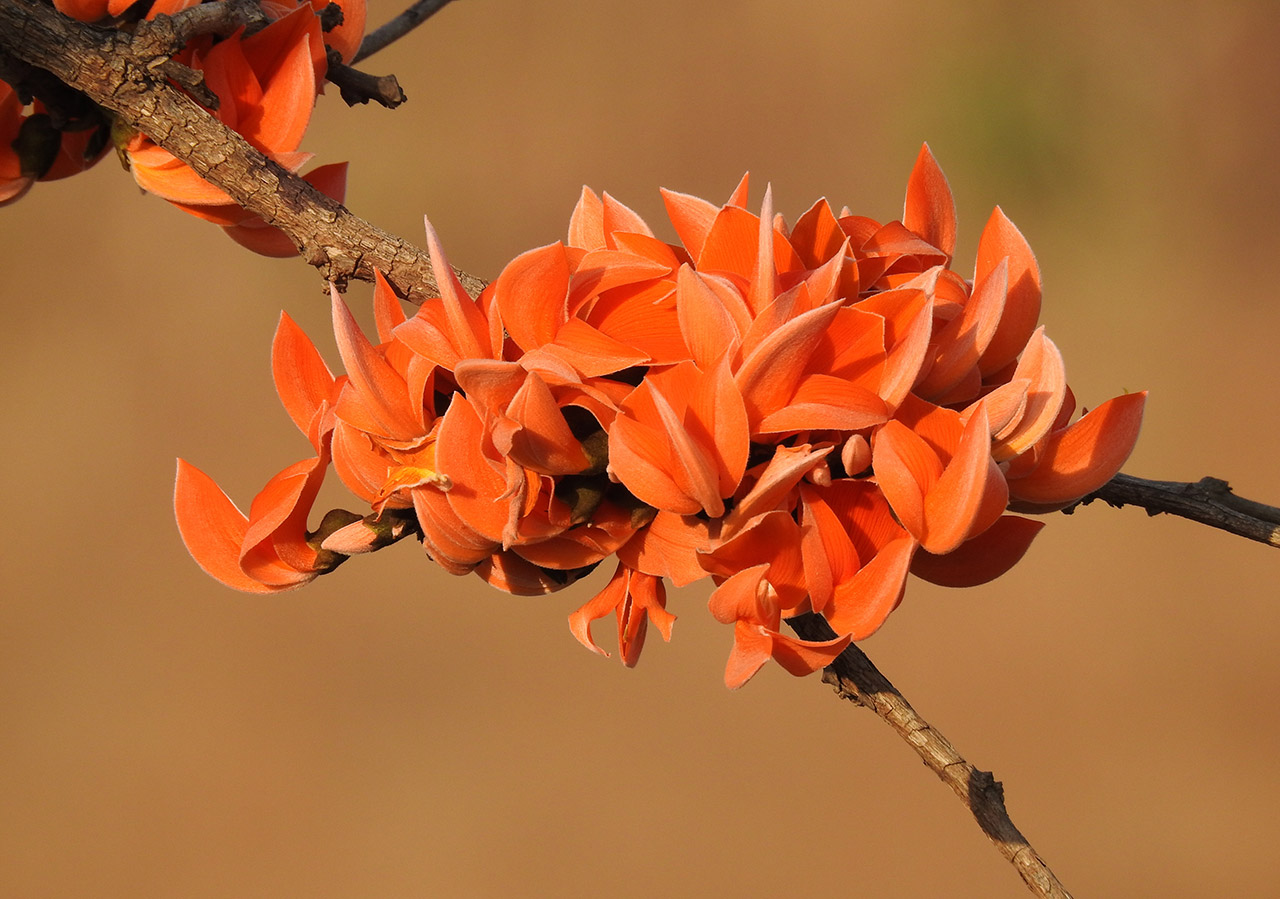
The flower’s unique appearance amazes one. In the middle is one cone-shaped petal that rises, assuming pointed end. Two curved petals emerge from dark black velvety sepal on either side of the pointed petal. The orange flowers and black sepal bring to the fore, literally, the painter in nature. The juxtapositioned individuals form bunches that appear like fire flames in the mildly hot spring afternoons.

The respite the flowers offer to avian species during the transition to summer justifies the old adages: “nature remains in her beauty throughout the year” and “she knows how to regulate the cycles.” 

The-Flame-of-the-Forest-Flower-03

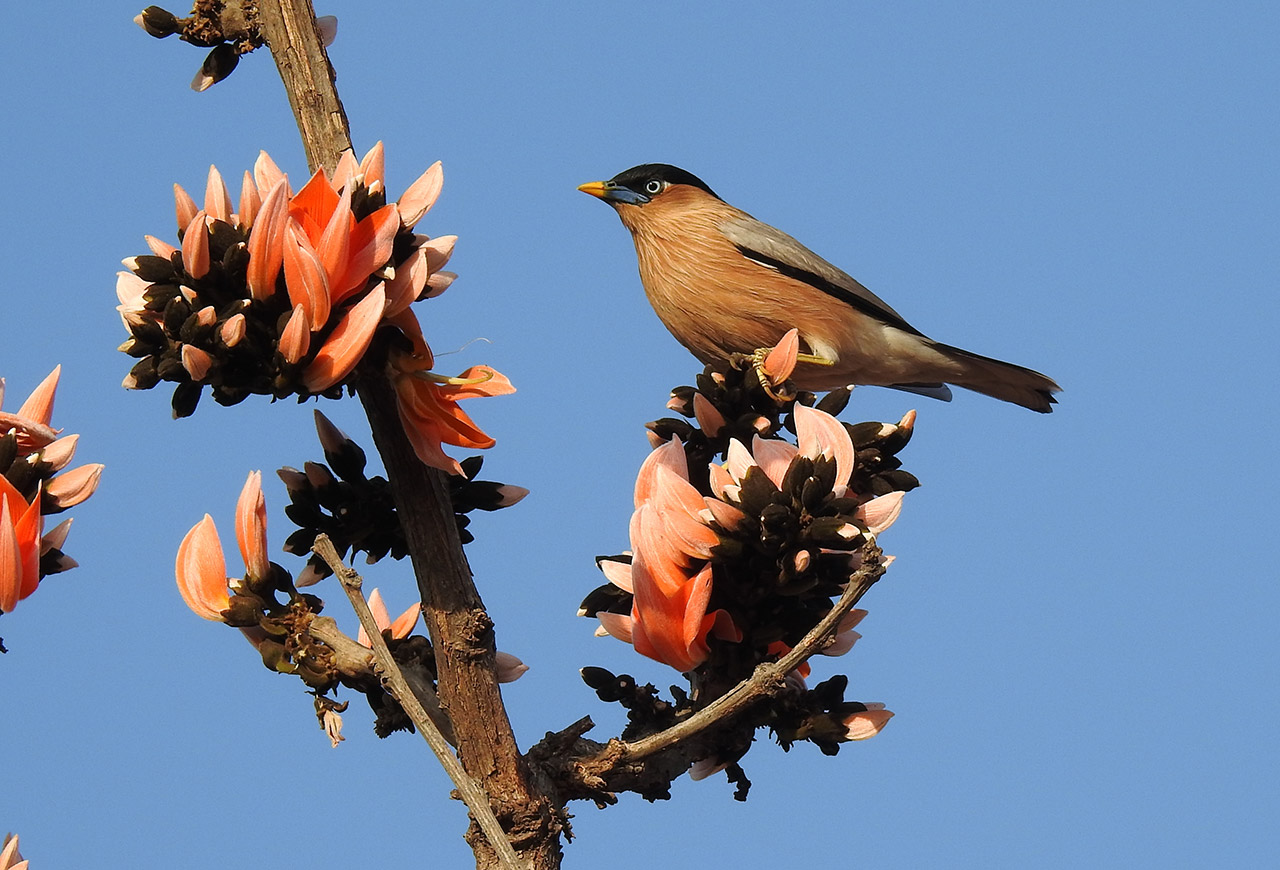
As drying vegetation leaves birds and bees scrambling for food, the flame of the forest invites them to have a feast. Right from an apparent plum-headed parakeet to the tiniest red ant, wildlife is all enthused. The chestnut-shouldered petronia and the bramhiny starling cleverly camouflage themselves amidst the flowers, as they suck the nectar. The purple sunbird mounts itself on top of bunches and flutters, in between, amidst the shining shades.   

When nature has all her energies dissipated, the flame of the forest arrives to revitalize her and maintain the equilibrium.

But then, the floral guest has to bear the brunt of climate change– erratic rains and fluctuating temperatures. Also, fast-expanding human settlements pose potent dangers to the landscape that hosts the lovely flower. 

The sustainable existence of the soft floral species – a nature’s angel – however, is capable of offering powerful impetus to decimate the negative impacts of climate change and human actions. With intensified conservation, we can have the flames burning. 

Remaining unflickered throughout their stay, the flames keep satiating nature’s needs, before finally getting extinguished by themselves. Finally, the flame of the forest wilts and falls to the ground. The sojourn ends!