The Indian Epics in Popular Culture

0
The-Indian-Epics-in-Popular-Culture-01
Image – William Jon / Flickr

Indian mythology is mainly embodied in the two great Indian epics, The Ramayana and The Mahabharata. Despite the disparity between the cultural subsections within the Indian subcontinent, the backbone of the Indian civilization is formed by these two epics, irrespective of individual religious beliefs. Several hundred centuries after, these epics continue to shape the society and politics of modern India to a greater degree than one might imagine. This is primarily because of the universal and timeless truths that are contained in the two epics which hold true even to this day. The epics continue to survive in this manner not only by word of mouth and traditions passed down through generations, but more so because of the way in which they have been adapted into popular culture.

The novels and movies that have been inspired by the epics focus mainly on the set of events which are now almost iconic in its dimensions, while examining the philosophy enshrined in them. The philosophy that pervades the two epics is interpreted differently by different generations, for each has a distinctive outlook which makes it unique. In fact, the very storyline and characters can be seen in a different light once the eventualities are seen from a new perspective. These modern readings are mainly focused on the relevance of the epics in the modern day and they are undertaken by novelists of the specific genre who seek to uphold the epics in a manner hitherto unexplored. 
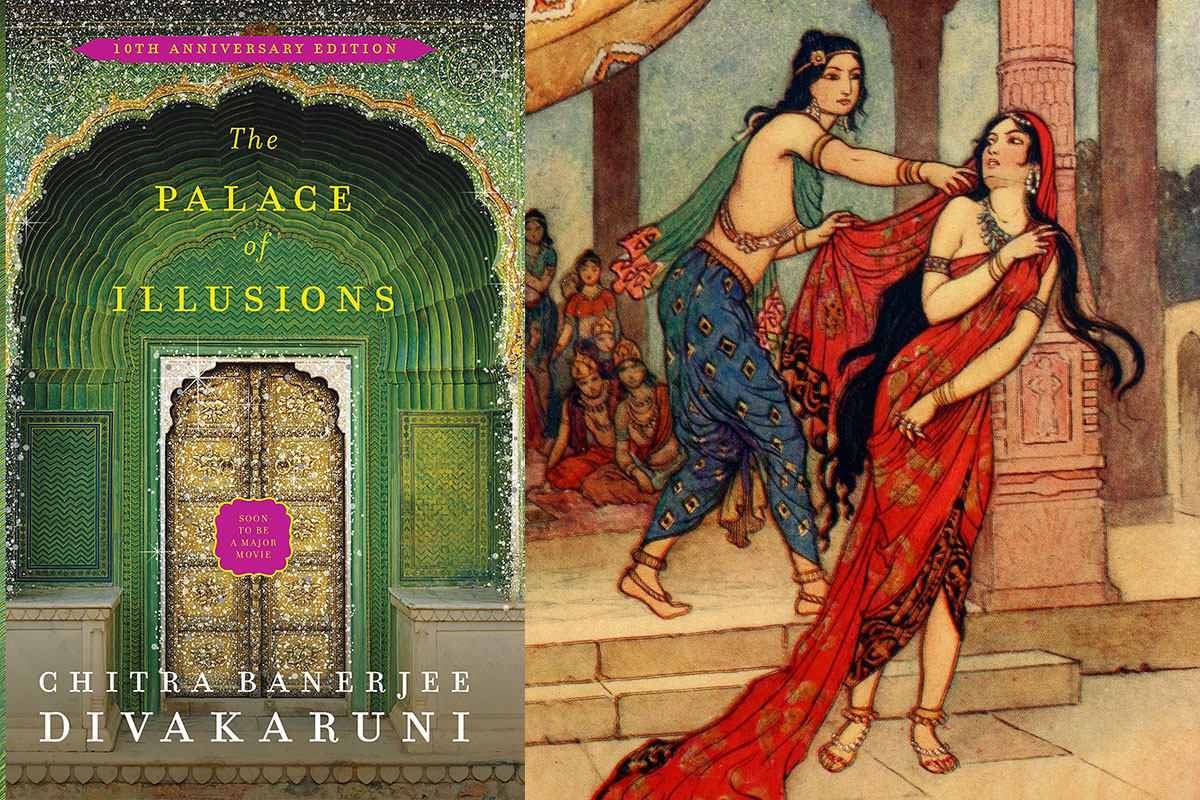
Chitra-Banerjee-Divakaruni’s-The-Palace-of-Illusions
Image – Wikimedia

In recent times, Chitra Banerjee Divakaruni’s The Palace of Illusions is one such novel. Without modifying the details of the events of The Mahabharata it presents the epic from the perspective of Draupadi, that is, the woman’s narrative of a patriarchal discourse. Princess Panchaali’s fiery passions and ambitions are highlighted as the novel traces the story of her birth and culminates in the legend of her death, focusing on her experiences and rationalizing her choices. The God Krishna is treated as another character in the novel, which emphasizes upon the sibling-like relationship Draupadi shared with him. Certain sections of the story are sensationalized to entertain a new generation of readers, such as the unrequited love Draupadi harboured for Karna.

Since the events are told from her point of view, it shocks the reader by illuminating certain aspects of very well known episodes of the epic which seem in a different light through the eyes of the Pandavas’ wife. Ajaya: Roll of the Dice is another well known fictional work by Anand Neelakantan based on the same epic. An entirely different narrative is found in this novel which is written from the perspective of Duryodhana of the Kaurava clan. It is a rare piece of work which explores the great war from the losing side, providing a rationale for their actions even if not seeking to justify them. There are several non-fictional works which have not been mentioned here which undoubtedly add immensely to the revival of the popularity of the epics, including philosophical writings such as Gurcharan Das’s The Difficulty of Being Good.

The-Indian-Epics-in-Popular-Culture-02
Agin Pariksha of Sita – Wikimedia

The ideas and spiritual tenets of The Ramayana have also prompted a wide variety of fiction writing, such as Divakaruni’s take on the epic in The Forest of Enchantments. This rendition pays tribute to the women characters of the story, specifically Sita, but also acts as a commentary on the misunderstood women who do not occupy the centre stage – such as Kaikeyi or Surpanakha. It treats the story in a different light, where motifs of loss, betrayal, and honour come together to highlight the struggle of women to establish their autonomy in society.

The-Indian-Epics-in-Popular-Culture
Right – Jataayu Vadha – Wikimedia

Neelakantan’s Asura tells the story of the Asura clan with Ravana as their leader, told from the first person narrative point of view of Ravana himself. In a defence of his actions, Ravana recounts the tale of the oppression faced by his class of supernatural beings and justifies his acts which through his version are seen as those of heroism. Yet another exemplary work along this strain is Amish Tripathi’s trilogy inspired by the Ramayana beginning with Scion of Ikshvaku. This is an imaginative reworking of the myths revolving Lord Ram’s birth, exile, and triumph but is somewhat sensationalist in its addition of events to the tale which are not originally part of the story. Excluding these there are numerous on screen adaptations of the ancient tales both in the form of TV shows and movies, which help to perpetuate the interest in these works.

Delicacies that Compete to be the National Dish of India

0
National-Dish-of-India
Image – Pixabay

Food is the thriving force in our life which can change our mood in a click. Whenever, we travel to different places… one of the top things on our list is to try the traditional food of that place. That’s why, food and travel are closely associated to each other as both help to resurface and discover modish things of newfangled places. When it comes to declaring the NATIONAL DISH of a country, it becomes quite difficult for a country like INDIA to choose, for it  is too diverse and variegated in the food culture. The topic of “NATIONAL DISH” hit the internet way back in 2017 because of media reports which surfaced online claiming that Khichdi had been declared as the national dish of India. Although all such claims were found to be false. The main reason why the government can’t declare any dish as the national dish of the entire nation is owing to the different food specialities present in each place.

India along its length and breadth is very much diversified. Each region is different from the rest and has its own uniqueness which makes it portentous. As such, there is no dish which is declared as the national dish of India. But there are some major competitors for the title, let’s take a look at them one by one.

1. Bhajiya

National-Dish-of-India-bhajiya
Image – Wikimedia

Bhajiyas are the famous Indian evening snacks. They add a taste to the season, especially the rainy season with its crispy spicy flavour which is enough to make mouths water. They are super famous in the streets of our country. One of the best things about bhajiyas is …that …they are cooked from all sorts of different veggies …right from onion to spinach. Bhajiyas define the culture of each state very well showcasing the speciality of the region through its unique taste and different savour of chutneys. One must try this unique Indian food on the street stalls to enjoy the best version of it.

2. Khichdi

National-Dish-of-India-Khichdi
Image – Devika / Flickr

Khichdi is a food loved by large number of peeps. It is one of the most affordable foods and is eaten mostly during the period of fasting. It is considered as one of the most healthy food stuffed with nutrients and at the same time, it  is a light food which is good for people facing digestive problems. It is commonly used as a ‘Prasad’ offered to goddess Durga during the Navratri season. Each region has a special touch and taste to it, that’s why many consider it to be the most suitable food to be declared as the national dish of India as this dish indicates national unity of the whole country through food.

3. Jalebi

National-Dish-of-India-Khichdi Jalebi
Image – Pixabay

Jalebi is a spiral-shaped crispy Indian dessert very famous among the people of North India. This sweet dish is made of refined wheat flour, sugar, clarified butter and milk. Along with this, saffron can also be added to the sugar syrup to give a little reddish tone to it and this recipe is famously called “KEASRI JALEBIS”. Instead of sugar, jaggery is also used to bring out the natural sweetness in the recipe. The hot jalebis are mostly enjoyed with rabri or milk. This is one of the most preferred sweet dishes in various functions and parties.

Golgappa / Panipuri

National-Dish-of-India-Khichdi-Panipuri
Image – Hari Prasad Nadig / Flickr

Golgappa is a famous street food in India. Its name is enough to bring a smile on anyone’s face. This truly amazing snack is the heart and soul of all food lovers with its outstanding taste and spicy tamarind-flavoured tango. It is known by different names at various locations. It consists of round puri stuffed with mashed potato and the golgappa/panipuri is filled with flavoured spicy water before serving. The different versions of flavoured water mixed with stuff like tamarind, cucumber and mint governs the taste of the classy and sassy golgappas.

5. Biriyani

National-Dish-of-India-Khichdi-Biriyani
Image – Gagandeep Sapra / Flickr

Biriyani is a spicy mixed rice dish famous due to all the mixed flavours of the aromatic ingredients used. The dish consists of boiled rice, saffron, ghee, mixed vegetables and Indian spices. The recipe is finally served with raita, wedged lemon and salad. This recipe had its origin in Iran and came to India with the arrival of the Mughals. With time, it developed and transformed into a fully Indian dish with the influence of traditional Indian spices.

10 Migratory Birding Destinations in India for Bird Lovers

0

The winter brings in the chill and the draught. But it also brings with it a host of the flight beauties who travel from far and wide. Escaping the low temperatures of their home, these birds travel the distance in search of warmer zones. The winters are when flocks of birds migrate across borders in search of warmer and cozier habitats. 

India due to the wonderfully spread out, diverse landscapes and weather conditions, is a huge hub for migratory birds that make it home for a few months. A large number of various migratory birds perch within its territory as bird watchers head towards birding destinations, armed with binoculars and a skip in their step.

Here is taking a look at some of the bird watching destinations that can be visited during the winters to catch sight of the beautiful and mesmerizing migratory beauties. 

1. Chilka Lake

Migratory Birding Destinations in India Chilka Lake
Image – Pixabay

The brackish waters of the popular Chilka Lake is one of the largest assembling areas for migratory birds. Around 92 different migratory bird species are found here during the winters. Some of the birds that you can expect to find at the lake are Pintail Duck, Pochard Duck, flamingoes, raptors, waders and more. The Nalabana Island, Kalupadaghat Islands and Mangalajodi Islands are great bird sighting areas within the lake. 

2. Keoladeo Ghana National Park

Migratory Birding Destinations in India Keoladeo Ghana National Park
Image – Pixabay

Often called a ‘bird paradise’, the Keoladeo Ghana National Park was known as the Bharatpur Bird Sanctuary. Located in Rajasthan the national park becomes home to thousands of migratory birds during the winters. Some of the birds found here are herons, different species of ducks, storks, pelicans, cranes and more. 

3. Nal Sarovar Bird Sanctuary

Migratory-Birding-Destinations-in-India Nal Sarovar Bird Sanctuary
Image – Wikimedia

The Nal Sarovar Bird Sanctuary is the largest wetland sanctuary in Gujarat. It has more than 200 migratory birds during the winters. He birds stay around until March-April. Some of the birds at the Nal Sarovar Sanctuary are pelicans, Brahminy ducks, grebes, moorhen, flamingoes, herons etc. 

4. Sundarban National Park

Whistling-ducks-Sundarbans

The Sunderbans are known for its tiger and other wildlife, but it is chirping haven too during the winters. With around 250 species of migratory birds finding shelter at the Sunderban National Park, it is a definite wildlife hotspot. The birds seen here are cormorants, pintail, curlew, storks, herons, poachard and more. 

5. Kumarakom Bird Sanctuary

Migratory-Birding-Destinations-in-India-Kumarakom-Bird-Sanctuary
Image – Mountainamoeba / Flickr

Located on the banks of the Vembanad Lake in Kerala, the Kumarakom Bird Sanctuary abounds in beauty. The Siberian crane, wagtails, flycatchers, cormorants, herons, egrets etc.

6. Rann of Kutch and the Desert National Park

Migratory-Birding-Destinations-in-India Rann of Kutch and the Desert National Park
Image – Vaidyarupal / Flickr

The Rann of Kutch in Gujarat is abuzz with a thriving avian wildlife. During the winter season the Kutch area is graced by the presence of cranes, flamingoes, short-eared owls etc. Similarly, the Desert National Park in Rajasthan is a paradise for migratory birds due to its desert climate. Falcons, buzzards, harriers are some of the migratory birds found in the Desert National Park. 

7. Pulicat Lake

Migratory-Birding-Destinations-in-India-Pulicat-Lake
Image – Nagarajan Kanna / Flickr

Cutting across the state borders of Andhra Pradesh and Tamil Nadu, the Puicat Lake is fraught with flamingoes, storks, pelican, herons and egrets during the winters. Also seen are shorebirds, spoonbills, warblers and flycatchers. 

8. Eaglenest Sanctuary

Migratory-Birding-Destinations-in-India Eaglenest Sanctuary
Image – Yathin / Flickr

Recently popularized, the Eaglenest Sanctuary in Arunachal Pradesh is home to the varied species of the Himalayan region. With more than 400 bird species this beautifully lush sanctuary is a birding heaven. 

9. Jim Corbett National Park

Migratory-Birding-Destinations-in-India Jim Corbett National Park
Image – Koshy Koshy / Flickr

One of the oldest national parks of the country, the Jim Corbett National Park has more than 500 bird species, some of which are migratory and some local. Some of the migratory birds spotted here are forktails, Brown dipper, species of wagtail, wallcreepers and more. 

10. Ranganathittu Bird Sanctuary

Migratory-Birding-Destinations-in-India Ranganathittu Bird Sanctuary
Image – Subir sen / Flickr

The Ranganathittu Sanctuary in Karnataka is along the Kavery River. Migratory birds, such as species of storks, plover, river tern, egrets, patridges, herons and swallows are seen here.  

Some of the other birding destinations to check out during the winters are the Nelapattu Bird Sanctuary in Andhra Pradesh, Bhigwan Bird Sanctuary in Maharashtra, Kaziranga National Park, Thattekad Bird Sanctuary in Kerala, Muthupet Sanctuary and Sultanpur Bird Sanctuary in Haryana.

Step out this winter to catch sight of the flapping wings, vivid colors and beady eyes of exotic birds that migrate from across lands and seas. They won’t be around for too long!

Experiencing the Winter Vibes of Kasauli

0
Experiencing-the-Winter-Vibes-of-Kasauli
Image – Vikram Singh / Flickr

The exquisite hill-station of Kasauli is located at an altitude of 1,927 m in Solan district of Himachal Pradesh. According to Hindu mythology, it is believed that when Lord Hanuman reached the Sanjeevani Hill, he placed his feet here which lead to the inception of KASAULI. When it comes to the question of how the place got its name, there exist two schools of thought behind it. Firstly, the name “KASAULI” is believed to have come from the flower named “Kusmali” or “Kusmawali” which means ‘flower maiden’ and this flower is a speciality of the place and it blossoms from spring to autumn season spreading its sweet fragrance around the terrain. Secondly, it is believed that KASAULI was named after the water reservoir named ‘KAUSALYA’ which flows in the mountains between the region of Kasauli and Jabli. The magnificent beauty of Kasauli is one of the reasons to visit and explore this place. Some of the places which make Kasauli a heavenly site are as follows – 

Dagshai

Experiencing-the-Winter-Vibes-of-Kasauli-Dagshai

This place is believed to be haunted. During the rule of the Mughals, the criminals were sent for capital punishment to this place and hence the town got its name “Daag-e-Shahi” which means “Royal Stain”. Later its name was refined over time and it is currently known as Dagshai. When the Britishers colonized India they turned it into their army cantonment in 1847. Dagshai is believed to be a favourite hotspot during the British time. The fresh atmosphere, greenery and beautiful mountains are still bewitching. Although, this hilly terrain which is situated at an altitude of 5,689 feet is not very famous amongst the tourists.

Gurkha Fort

Experiencing-the-Winter-Vibes-of-Kasauli-Gurkha-Fort

This fort is surrounded by dense forests and is situated at an elevation of 4500 feet on the bank of the Gambar stream. It was built in the early 19th century by the Gurkha’s with the intention of fighting the British Army. Others believe that the Gurkhas captured it from the custody of the then King of Patiala. It consists of cannons that are more than 180 years old, used during the Gurkha Wars. Currently, most of the portion of the town comes under the army cantonment area which also consists of the Gurkha training centre.

Christ Church

Experiencing-the-Winter-Vibes-of-Kasauli-Christ Church-02
Image – Ankit Jain / Flickr

Formerly the church was known as Anglican Church. The British family who laid the foundation of Kasauli were the ones to construct the magnificent building of Christ Church. The church is constructed in the form of a cross and was inspired by the European style of architecture. 

Gilbert Trail

Experiencing-the-Winter-Vibes-of-Kasauli-Gilbert-Trail
View for Gilbert Trail – Vikram Singh / Flickr

Gilbert Trail is a short nature walk through the magnificent landscape of the valley. The track is around 1.5 km long and begins from the Kasauli Club. The path is wide in the beginning and then turns into a narrow path. The freshness around the area along with the beautiful sound of birds chirping makes this trail a pleasing place for nature lovers. 

Monkey Point

Experiencing-the-Winter-Vibes-of-Kasauli-Manki-point-Kasauli-2

Situated on the Dhauladhar range, this is the peak point of Kasauli. Believed to be formed from the feet of Lord Hanuman, while taking the Sanjeevani herb for the cure of poisonous scars on Lord Laxman. A temple devoted to Lord Hanuman rests atop the peak. The spectacular view of the whole valley and the sparkling Sutlej river flowing through the plains can be seen from the top of the hill.

Sunset Point

Experiencing-the-Winter-Vibes-of-Kasauli-Sun-set-point-Kasauli

The sunset point is situated adjacent to the Gilbert trail which offers a beautiful scenic view of the sunset. The hilltop gives a great overview of the whole city of Chandigarh, Kalka and Panchkula. During the night, this place gives a marvelous view of the entire sky full of bright stars and constellations. The clear blue sky complements the sunset view making it a perfect picturesque sight. The rays of the sun infuses the whole place with the golden hue that sets ablaze the hilltop thus dispersing beauty.


Greet 2020 with These Top 6 Happening Discos for a Vibrant New Year Party in Delhi

0
Happening Discos for a Vibrant New Year Party in Delhi
Image

The countdown for the New Year 2020 has begun and if you are in Delhi, then, it’s time you should plan for one of the best new year 2020 parties during the Eve celebration. Delhi, which can also be referred to as the heart of India, has a varied and unique nightlife of its own. These are the places where people party like there is ‘no tomorrow’ with an electrifying club and the culture around it is all about feeling alive to the live performance. 

Delhi’s nightlife revolves around the variation of classiest bars, luxury hotels, and a young, vibrant approach. If you are looking to make a fresh start to this new year with an enthusiastic attitude, then get yourself ready for the grand celebration. The top discos in Delhi are waiting with their underground rave parties, grooving DJ music and EDM awaiting for you to step-in. So, here are six happening discos you can go through to chill out for the New Year 2020 parties in Delhi. 

Top 6 happening discos for a vibrant new year party in Delhi

When it’s about making a new year celebration in the dancefloor with drinks and rave parties, Delhi has some top discos destination of its own. However, since there are so many places to choose from, here is a compiled list of the top 6 disco places for the new year 2020 parties in Delhi. 

Kitty Su Dancefloor, Connaught Place

Happening-Discos-for-a-Vibrant-New-Year-Party-in-Delhi-Kitty-Su
Image Courtesy – Kitty Su

This place is famous for hosting parties from international electronic music artists. These make you get-go with the vibe and the flow. Kitty Su offers top-notch music quality, multiple bars and a large dancefloor. The funky decor of the club adds to its party vibe. Kitty Su is among one of the best nightclubs in Delhi to shake your leg to the beats. Also, it is the only nightclub in India that has been featured in DJ Mag’s Top 100 clubs of the world. This place remains open on Wednesday, Friday and Saturday from 10 p.m. to 3 p.m.  

Privee’ the Ecstasy, Connaught Place 

Happening-Discos-for-a-Vibrant-New-Year-Party-in-Delhi-Privee’-the-Ecstasy
Image Courtesy – Privee

Privee’ the Ecstasy is a new entrant to this nightclub genre. They have a large dance floor with a party place over 10,335 sq. ft. and also has a VIP zone. If you have a desire to rock yourself in a luxurious place, then head on to Privee’ the Ecstasy. Why? Cause they aim to provide you with a futuristic, luxurious and a world-class experience. This nightclub mainly booms out commercial Bollywood and EDM music. This place remains open from 10 p.m. until 2 a.m. 

The Hong Kong Club, Aerocity

Happening-Discos-for-a-Vibrant-New-Year-Party-in-Delhi-The-Hong-Kong-Club
Courtesy – The Hong Kong Club

Celebrate this new eve with all its eccentricities and madness of partying in a Euphoric affair at Hong Kong Club. The club has rave-up with 20+ artist to set the dancefloor on fire. Shaking your leg on this dancefloor will give you the unlimited joy of enjoying Cantonese food with premium spirits. Also, enjoy the best live entertainment with Saxophonist Abi Rose, Dj Idelson, and acrobatic dancers. 

Here, the packages start from Rs 12,500 onwards and the timing is from 6 p.m. onwards. 

Lithiyum, Chanakyapuri

Happening-Discos-for-a-Vibrant-New-Year-Party-in-Delhi-Lithiyum,-Chanakyapuri
Image Courtesy – Lithiyum

This place was opened in 2017. It replaces the iconic club Capitol of the Ashok’s Hotel with a luxurious uniqueness of its own. Lithiyum got a complete makeover, and the place is divided into three segments – a lounge, nightclub and a dining restaurant. Currently, the club is also known for its high-end sounds system. Here, the variation of music depends upon the festivities and celebration which rages from desi Bollywood music to house. Also, they have a renowned celebrity chef Akshay Nayar to give you the taste of international food items. This venue remains open from 10 p.m. until 4 a.m. 

Tamasha, Connaught Place

Happening-Discos-for-a-Vibrant-New-Year-Party-in-Delhi Tamasha
Image Courtesy – Tamasha

Tamasha is best known for its rooftop parties and creative decor. The place is over 16,000 square feet and is a three-storeyed building. It has five separate areas, including hookah lounge, courtyard, backyard, rooftop and rustic style mezzanine. The entrance of the bar is designed like a truck to portray a unique creative perspective of its own. Moreover, it creates its hype with great music parties, cocktails and delicious foods. This place is opened at noon and remains open until 1 a.m. 

Junkyard Cafe, Connaught Place

Happening-Discos-for-a-Vibrant-New-Year-Party-in-Delhi-Junkyard Cafe, Connaught Place
Image Courtesy – Junkyard Cafe

You may not believe, but sometimes old junk can do wonders. And The Junkyard Cafe is the best place to experience that. This abstract place comes alive with the nightfall on weekends when Dj’s set on their turntable. The concept is such that it makes itself apart and if it is about experiencing something new, then head on to Junkyard Cafe, which opens at noon and closes at 1 a.m.  

If you need an antidote to keep yourself feel alive after work, then head on any one of these destinations in Delhi. All these places have charged up for the New Year 2020, and now it is up to you to make a difference.

Experience the Old-world Charm of Goa by Staying at Cidade de Goa

0

Cidade-de-Goa

Goa, the quintessential beach getaway is where everybody needs a piece of susegad. The combination of sun, sea and seafood is a delight for every kind of traveler.  A blend of Indian and Portuguese cultures, Goa is the place to spend a laid-back holiday in a villa that has an old-world charm. Only a few minutes away from Panjim, on the Vainguinim beach lies a Portuguese hamlet by the name Cidade De Goa. Cidade De Goa is where travelers can spend their lazy evenings and peaceful nights in Goa. 

Cidade De Goa – A Glimpse into the Portuguese Past of Goa

Accommodations in Panjim are easy to come by. However, very few give an experience worth remembering. Cidade De Goa, a 5 star hotel in Panjim, is the place to be to soak in the old world charm of Goa. A quick look of the hotel is inviting enough to spend some luxurious time in the manicured gardens, chequered floors and rooms with the view of the sea. 

Here is how one can rewind back in time at Cidade De Goa. 

Portuguese Architecture

Cidade-de-Goa-01

Cidade De Goa is designed by the world-renowned architect Charles Correa who was famous for his creation of modern architectures in post-independent India. Cidade De Goa welcomes travelers and their families in Correa’s intimate alcoves, historic murals, balcaos and tiled roofs.  

Rooms and Suites with Picturesque Views

Cidade De Goa has some of the most thoughtfully designed rooms in Panjim. These rooms and suites have been designed keeping in mind the heritage, space and grace of its historic days. They have enviable views of the sea, Mediterranean architecture, balconies that bring in natural light, private sit-outs and much more. All the rooms open to a different view of the sea and each window is suitable for ruminating. 

Quality Family Time on the Beach

Cidade-de-Goa-3

The secluded Vainguinim beach, away from the hustle of the crowd is the perfect place to strengthen bonds and make more memories. The beach has a range of water sports and games for adults and children. 

Relax and Unwind

At Cidade De Goa, those seeking a little bit of calm and peace in life can make use of the friendly services such as the Aromatherapy massages, meditation, Yoga, Tattva Spa, etc. The Tattva Spa is a Cidade De Goa specialty. It has therapies based on the five universal elements of Prithvi, Vayu, Jal, Agni and Aakash. Refreshing spas baths also add on to the Zen experience at Cidade De Goa.

Revel in the Authentic Fado Evenings and Lip Smacking Food

Cidade-de-Goa

Of all the restaurants in Panjim, Cidade De Goa’s Alfama restaurant offers a traditional Portuguese experience with their Fado evenings every Tuesday. A Fado is a Portuguese song that evokes many human emotions such as love, sorrow, jealousy, satire, etc. Cafe Azul has dining options with a view of the pool. The restaurant serves cuisines from North India, East Asia and Italy. Barbeque, a rustic themed, seasonal open-air restaurant offers grilled delights with a sea-facing view. 

Away from the cacophony of the crowded beaches in Goa, Cidade De Goa is an ideal getaway for families and has something for every type of traveler. When on the lookout for accommodation in Panjim, stay at this 5-star hotel and live the Portuguese experience for real.


The Oasis – The Experiential Festival is in Delhi this Winter!

0

THE-OASIS--By-Vajor

The inviting lush green gardens at 1 AQ Mehrauli New Delhi is going to play host to ‘The Oasis’ festival. A one of its kind two day event, the festival organized by Vajor is an ‘exotic amalgamation of art, music, mindful fashion, home décor, collaborations, cultures and cuisines.’

Being held on the 7th and 8th December 2019, the festival aims to bring together the bohemian and eco-conscious community on the same platform to interact, learn and support each other. 

What is the festival about?

“The Oasis Fest is a mindfully curated, lively experience for an eco-conscious tribe. The 2-day experience beacons people to gather around and indulge in a multitude of immersive conversations, shopping, workshops, music and more. “

What to expect?

The Main Attraction

  1. Let the artist in you find wings with artistry workshops lined up for both days. The macramé workshop called ‘Knotty Affair’, upcycling workshop using fabric pieces; ‘A CLAYFUL DATE’ in a pottery workshop and a workshop on mindful eating are some you can try your hand at. 
  2. Stimulate your mind with interesting and informative panel discussions that touch topics centered on art and the creative life. 
  3. Get enthralled in the land of stories as travelers and writers share tales of the known and unknown.
  4. Shop your heart out! A flea market of mindful brands that cater to the exquisite taste and eco-consciousness of the buyer will provide a range of shopping delights ranging from fashion garments, accessories, home décor and more. 
  5. Music and poetry go hand in hand. At The Oasis be prepared to groove to the soulful tunes on one hand and be intellectually awakened with the slam poetry on climate change. 

The two day schedule is well spaced and for a detailed know-how check https://experiences.vajor.com/

 “Finally, it is a chance to meet, interact and indulge with the best of mindful affairs and dive deeper into a pool of opportunities, learning not just how to become part of the Vajor tribe but to be able to earn and reap benefits with this vibrant fest where there is something for everyone!”

So don’t wait any longer. Book your tickets for the festival and spend two fruitful days soaking in an experience of wonderful artistic and creative energies.


Soul-stirring Music in Baul Culture of Bengal

0

Tomay hrid majhare rakhibo chhere debo na”

Baul culture of Bengal
Parvathy Baul – Mário Pires / Flickr

Bengalis are known for they talent in both visual and performing arts, folk arts of West Bengal are so rich that audience get mesmerised at a glance. Baul or Bauls are a group of mystic minstrels who constitute a religious sect and a musical tradition. They compromise of a small fraction of the Bengali population and can be easily identified by their distinctive saffron clothes and musical instruments. Their contribution to the musical field of Bengal culture is immense and hence immeasurable. They are fondly known as “Moner Manush” (the person of the heart) which denotes these inspired people who have an eagerness for the spiritual life and wish to realize their union with the eternal beloved. 

Baul music is known for its celebration of celestial love in earthly terms. Their religion is based on the expression of body and mind and concentrate much of their mystic energy on the four body fluids. The music of the Bauls or Baul Sangeet is a type of folk song but in recent times this rich culture seems to be fading. This UNESCO – World Heritage listed musical style has been reduced to a mere commodity in the present times. Once considered to be rich in culture, today it is performed behind closed doors in air-conditioned auditoriums for a fee. The artists earn very little from these programs as for them it is the sharing of their proud heritage but for the production managers these tickets sell as hot cakes, for many are intrigued by baul sangeet and the singers who live a rustic life. 

Baul culture of Bengal
Baul Singers at Shantiniketan – PTWO / Flickr

The baul music is incomplete in the absence of the ektara, a single stringed musical instrument used in creating the otherworldly charm of Baul sangeet. The instrument is made of dried gourd acting as a resonator; and has a metal string running through its neck. Plucking the string with the index finger generates a unique melody which is associated exclusively with the baul songs. Though the ektara is the main attraction, Baul songs would be incomplete without the accompaniment of percussion instruments such as the dhol cymbals, flute and the ghungroo.

Recently at the Bannerghatta campus of Christ University I had the privilege of watching famous Baul singer Haradhan Das Baul  perform various songs written by his father and himself over the course of time. He tried to explain the tradition of Baul singers but almost no one was interested in the same and only wished to hear him sing. This shows the change seen in the audience culture during the present times…appreciation of culture and tradition is gone and all people want are entertainment. Owing to the kind patronage of the government of West Bengal, Baul music has been attempting to regain its lost sheen and attempts to gain a wider audience by improvising songs that may suit the tastes of many. 

Baul culture of Bengal
Tharundas Baul – Wikimedia

Till date Baul songs are widely celebrated in the state of West Bengal and in Bangladesh through the manifestation of the same in the songs of Rabindranath Tagore and hence Shantiniketan, the town founded by him, continues to be home for many of the wandering baul singers and hence the hub of baul culture in Bengal. 

The Bauls worship music and are not associated with any mainstream religion. Their music is the culmination point of a huge range of cultures from around the world. It includes the tantric practices of the Hindus, the Sufi saints of Persia and certain elements of Buddhism has also been incorporated into their songs that leading to development in the roles of the individual sectors. The lyrics of the Baul songs are written in Bengali. 

Baul culture of Bengal
Ananda Khyapa and Tarun Khyapa Group – Wikimedia

The lifestyle of the modern-day urban bauls is not one of simplicity as some of the practitioners hold celebrity statuses and are conducting foreign tours just like any other musician in the industry. Alternatively, there still exist some who have stayed true to their calling and continue to wander the streets of Bengal in their saffron robes with an ektara in hand. 

The Baul culture is one to be upheld and preserved and passed on from generation to generation for it is rich in the heritage of Bengal and sings of oneness with nature and in these dire times of global warming and melting glaciers we human beings need reminders on preserving our universe. 

Baul culture of Bengal
Haradhan Das Baul, Papia Das Baul & Biswanath Das Baul – Wikimedia

The best place to witness this soul-stirring music is at local village fairs and at the annual Poush Mela held at Shantiniketan. They do not charge money for their performance but it is only thoughtful on our behalf to leave some money on their mats as a kind gesture for they too have a livelihood to earn just like any one of us. It is also considered to be a mark of respect and tribute to the grand culture of Baul music. 

If at all you get a chance to ever witness the Baul singers make sure you utilise the opportunity for they truly are a treat to one’s heart and mind.

Selfies Lovers – You May Not Own ‘Your’ Photos!

0

Author: Sagar Godbole

Girls_Selfie
Source: Wikimedia

We perched precariously on a ledge, trying to pose in front of the city palace in Udaipur. The Danish tourist, whom we had requested to take our customary touristy snap, fumbled around with my Micromax phone, trying to figure out how to take a picture. When he finally managed to get one, it was that of my friend in midair as he tumbled off the ledge.

As my phone continuously buzzed with people ‘liking’ and re-tweeting this picture, I realised how I could have made some money had the image been of a comet shooting across the sky, instead of my clumsy friend falling.

Unfortunately, many photos on your camera are not actually yours because of the legal framework in India. The Indian Copyright Act of 1957, under section 2(d)(iv), states that the person taking the photograph will be the ‘author’ of the picture. Then it goes on to state in section 17 that the author of a work shall be the first owner of the copyright therein. The effect of these provisions is that under the Indian law, copyright belongs to the person, who clicks the picture rather than the one who owns the camera.

The only exception to this rule is in cases where the photographer clicks a picture as an employee or in return for money as consideration. Therefore, the photos taken by a magazine photographer are owned by the magazine, while you own the images clicked by the photographer you hire to cover your wedding.

On the other hand, of all the hundreds of images stored on your camera from your last trip, you only own the copyright to those which you have clicked yourself. In case of images that are taken by someone else, you must seek their permission before using the photos. Fortunately, India is not a very litigious country, so you can breathe easy. It is highly unlikely that you would be sued for copyright violation by a random passerby, who clicked a picture for you.

selfie stick
Source: Koshy Koshy via Flickr

To be on the safer side, though, it would be wise to seek permission or to acknowledge the photographer if you know who that person is, especially if you intend to use the photo commercially. For all basic intents and purposes, permission sought and given via a simple email suffices, so there is no need to jump through the hoops of complicated legal documentation.

But if you want to avoid such issues entirely, there is an easy and increasingly popular way to do so. Click only selfies during your vacations! To help you click group photos, you can even get a selfie stick.

The latest narcissistic sensation sweeping the world may have some legal benefits after all!

Experience the Architectural Splendor of Pratap Mahal in Ajmer

0

Architectural-Splendor-of-Pratap-Mahal-in-Ajmer

The Pratap Mahal Ajmer is one of the top five star hotels in Ajmer that offers a rejuvenating getaway from the urban chaos. Perched against the backdrop of the glorious Aravalli hills, the luxury abode is drenched in cultural and historical hues that transports you to a bygone era of royalty while offering stunning views of the sacred and picturesque green oasis.

Sprawling over 8 acres, the architectural marvel stands out with its exquisite façade and aesthetic interiors. Echoing the flavours of Rajasthan, the Pratap Mahal Ajmer offers quintessential Rajput hospitality with folk dancers, finest craft artisans and illustrious Bani Thani paintings that adorn the premises. Its numerous rooms too are bathed in vintage beauty and glory while being equipped with indulgent, modern amenities that effortlessly blend the old and the contemporary. They also offer spectacular views of the Aravalli hills and the courtyard to the urban traveller while being seated on the indoor swing, sit-out balcony or private terrace.

Architectural-Splendor-of-Pratap-Mahal-in-Ajmer-03

Savour mouth-watering delicacies, while being cradled in the authentic Rajasthani ambience in the multi-cuisine restaurant Aravali, which is open round the clock to cater to your taste buds. Created from fresh local produce, the restaurant blends health and local delicacies and offers gastronomical delights in the form of both active foods and regional home-style dishes.

The alluring set up of the elegant abode serves a promising location for dreamy weddings and corporate retreats. The pillar-less Darbar Hall poses the perfect indoor location for large-scale conferences as well as family get-togethers and wedding functions. The picturesque Mughal Lawn and the pool deck too double as celebration areas for your special moments. 

Architectural-Splendor-of-Pratap-Mahal-in-Ajmer-04

Unwind in the best resort in Ajmer by indulging in indoor games at the recreational centre, or focus on your health at the fitness centre and swimming pool. You can also make the most of the adventurous Thar Desert by opting for a camel safari. De-stress and rejuvenate your body, mind and soul by immersing in yoga and spa therapies. For kids, the Pratap Mahal Ajmer- IHCL SeleQtions hotel has a unique program called the Taj Kids, which keeps your kids engaged by indulging them in an active learning program that keeps them entertained. The Pratap Mahal Ajmer also presents one of the unique experiences in the form of the Wilderness Experience Dinner that is laid out in the foothills of the spectacular Aravalli Mountains away from the humdrum of city life, in the lap of the rough and unadulterated countryside. The evening is marked by life performances by Kalbeliya dancers and folk music, which can be enjoyed over a special menu of lost recipes curated by the chef along with your favourite cocktails.

Architectural-Splendor-of-Pratap-Mahal-in-Ajmer-01

Things to do in Ajmer

While you are staying at the Pratap Mahal Ajmer, there are a number of things to do and places to visit in Ajmer

  • Visit the Pushkar Lake and witness the Pushkar Ghat Aarti which is noted for religious and historical significance
  • Plan your travel along the time of the world-famous Pushkar fair and experience the spiritual ambience resonated by thousands of devotees who visit the holy destination to take a dip in the sacred waters
  • Evidence the glory of the picturesque Kishangarh Fort, one of the most notable tourist places in Ajmer, perched along the lakeside.
  • Stop by the numerous sacred temples such as the Atmeshwar Temple, Old Rangji Temple, Mahadeva Temple, Raghunath Temple, Apteshwar Temple, and Varah Temple, and pay reverence to the Gods
  • Visit the Ajmer Dargah, the tomb of Muin-ud-din-Chishti, a noted Sufi saint whose shrine has historical significance
  • Shop for stunning ornaments, embellished textiles, and exquisite souvenirs by local craftsmen at the Sarafa Bazaar 

Experience tranquillity enveloped in luxury in this alluring resort in Ajmer that lies nestled in a spectacular green oasis, enveloped in the glory of the magnificent Aravalli Hills, right in the heart of the mesmerising, royal state of Rajasthan.

Image Courtesy – Seleqtionshotels.com