Beauty Pageants – History, Evolution and Cultural Intonation

0

Beauty Pageants History Evolution

‘Beauty lies in the eyes of the beholder,’ is an age-old saying. Over the years, beauty, its definition and the standards set, have undergone change. Yet, beauty pageants continue to be one of the more successful mediums and platforms that propagate the idea of beauty, which also includes talent, skill, oratory prowess, aptitude, attitude and brains. Debatable, often controversial beauty pageants are competitions where contestants vie for the crown. Though there are several pageants, held for all genders, the most popular in current times are the Big Four – Miss Universe, Miss World, Miss International and Miss Earth. 

History of Pageants

History of Beauty Pageants
Georgiana Seymour, Duchess of Somerset was crowned the ‘Queen of Beauty’ at the Eglinton Tournament of 1839. Wikimedia

One of the earliest celebrations of beauty takes us to English May Day during the middle ages, where a May Queen was selected. The first beauty pageant was the Belle of the Anna-Ball, held in Hungary in 1825. In the 19th century, beauty pageants started becoming popular, however, they were not considered respectable. 

It was only in 1921 when the modern Miss America was held that the tradition of beauty pageants became a mainstream event. Though it was looked down upon by several quarters, there was a sense of dignity and competitiveness given to the competition. Ironically, the Miss America pageant was held with the primary aim of boosting tourism in Atlantic City on Labour Day. But it started off a tradition that grew steadily over the years. The pageant became a part of the Labour Day festivities and parade. 

History-of-Beauty-Pageants-1
The winners of the International Pageant of Pulchritude 1930 competition. Wikimedia

Similarly, in 1920 a Splash Day contest was organized by C.E Barfield in Texas. The event featured the ‘Bathing Girl Revue’ which became popular soon in many other parts of the country. In 1926, the first international beauty contest was held and was called the International Pageant of Pulchritude. It is believed that the modern pageants of today are aligned to this international competition. 

The popularity of such contests led to the organizing of the Miss World competition in 1951, Miss Universe in 1952, Miss International in 1960. Other pageants, such as Miss Asia Pacific International began in 1968, Miss Teen USA in 1983 and Miss Earth in 2001. 

India in the Pageants

India-in-the-Pageants
Pramila (Esther Victoria Abraham). Wikimedia

Esther Victoria Abraham was the first Miss India crowned in 1947. Indian winners began participating in international pageants, where the first Miss India represented the country in Miss Universe in 1952 and Miss World in 1959. The first Indian to win Miss World was Reita Faria in 1966 and Sushmita Sen won the first Miss Universe in 1994. 

Several leading actresses and popular faces of the Indian screen, were in fact, Miss India. Some of these include Zeenat Aman who also won Miss Asia Pacific in 1970, Persis Khambatta, Meenakshi Sheshadri, Juhi Chawla, Namrata Shirodkar and more. 

The breakthrough or landmark year for Indian beauty pageantry came in 1994 when India won both Miss Universe and Miss World. The winners Sushmita Sen and Aishwarya Rai became the country’s icon, representing an empowerment of beauty with brains. Their confidence, elegance and win suddenly catapulted the imagination of the nation. India went on to win many more titles in the following years. In 2000 three women made India proud by winning the beauty pageants – Lara Dutta (Miss Universe), Priyanka Chopra (Miss World) and Dia Mirza (Miss Asia Pacific). Some of the other winners of the pageantry over the years were Yukta Mookhey, Diana Hayden and more recently, Manushi Chhillar and Harnaaz Sandhu.

Controversies and Backlashes

Beauty-Pageants Controversies and Backlashes.jpg
1996 Beauty Pageant Protest, Bangalore. Image Courtesy: Deccan Herald

The recurring argument against beauty pageants has been the objectification of women. In India, especially exposing women on a stage, flaunting their beauty, was looked down upon. The cultural acceptance has always wavered as a section of society found these pageants demeaning and against the traditional value systems. Besides, the standard protocol of following certain beauty metrics, that essentially defined beauty, were propagated through these pageants. A certain figure size, weight, height, skin color and style were unsaid requirements of judging and appreciating beauty. Of course, the discourse on beauty has altered in today’s time, where it is no longer confined to certain body shapes, sizes or color. Yet, there is no doubt that as a society, we have not yet completely found freedom from equating beauty to a set standardized parameter. 

Also, the beauty pageants were often seen as a westernized influence in Indian society. The rounds, including the swimsuit round, garnered protests across the country. In fact, in 1996, Miss World was held in Bengaluru, but the swimsuit round had to be shifted to Seychelles due to massive protests that broke out in the country. 

But of course, things have changed since. It must also be noted that the beauty pageants became a national sensation during the period of globalisation and privatization in India. The gates opened for popular labels, makeup brands and the fashion industry to root a strong footing in economics and culture of the country. As the industry grew, the revenues and acceptability of beauty accessories and businesses increased. Beauty pageants became important beares of advertising and marketing which was in vogue. 

Causes and Opportunities

Beauty-Pageants-Causes-and-Opportunities
Sushmita Sen Miss Universe 1994, Aishwarya Rai Miss World 1994

One of the major reasons why beauty pageants gained popularity during the 90s was because of the opportunities that it presented to young women. Models and participants found the Miss World or Universe platform as a lucrative means to make a career in the film or fashion industry. The fame, accolades and recognition gave an opening to explore various career options in the entertainment industry. 

Besides, the experience itself, of interacting with girls from other countries, of competing with the best beauties across the world was a huge opportunity. The exposure, campaigns, causes and social services that the participants got a chance to indulge in were rewarding. Awareness was raised about various causes, such as UNICEF programs and more. ‘Beauty with a purpose’ is the tagline that was initiated by Miss World and Miss Universe. Each of the winners along with the help of the organization help raise funds, support and bring about change in humanitarian and charitable causes. 

Societal Reflection

Beauty-Pageants-Societal Reflection
Miss Universe 2021 Harnaaz Kaur Sandhu. Wikimedia

The criticism against beauty pageants is strong. But the positives and empowerment that many feel arise because of such competitions is real too. Beauty pageants in many ways are a reflection of the society itself. For instance, Miss Black America began in 1968 in response to the exclusion of the community.

The standards of beauty set by a community are reflected in the way they perceive their women. Though beauty pageants celebrate the external beauty of contestants, it also provides a medium for showcasing the talents, empathy, confidence, intelligence of the contestants. It can be deemed as a holistic measure of what the individual entails and is. 

In India, women representing the country in beauty pageants also in some ways reflected the general diaspora of women at that point in time. Up till the 1990s the women defied the shrouded and hushed up symbolism of beauty. In the age of open markets, the confidence and willingness to explore frontiers was evident. 

Today, the pageants seem to have lost a bit of their shine. This is probably because due to digital platforms, women are finding other platforms and means to express themselves. A recent statement by a politician, observing that no Dalit or tribal woman has made it as a Miss India sparked controversy. But it also opened up an avenue of debate that beauty pageants are perhaps only reflective of a small section of Indian society. 

Final Thoughts

Lastly, there is more than one way of looking at beauty pageants. In a country like India, where the entertainment and fashion industry are one of the most affluent businesses, beauty pageants are a great boost. On the other hand, it would be unfair to generalise. For instance, Miss India winners have gone on to become doctors, dentists and even joining the Indian Army. Besides, just because one is Miss World or Miss Universe, it doesn’t spare them from getting body shamed or trolled. The paradox continues for a nation and a world, where women are fighting hard to hold onto their dreams and aspirations. Whether you like beauty pageants or not, you cannot ignore them.

Kinnala Art of Karnataka: A Glimpse into India’s Timeless Craftsmanship

0
Kinnala-Art-of-Karnataka
Image: Kinnalart

Kinnala Art is the oldest traditional woodcraft produced from the vibrant state of Karnataka, India. It can trace back its history until the reign of the time when Vijayanagara Empire ruled back the 15th and the 16th century. Conventional Kinnal artisans are widely referred to as chitragrars, which comes from this little Kinhal village in Koppal district. These early practitioners who were either painters or sculptors adorned with beautiful inlays the magnificent temples and palaces of Hampi and Badami. For this reason, simple wood used could transform into masterpieces of perfect skills. This alone makes Kinnala art a big part of the cultural legacy of Karnataka.

Suggested Story: GI Tagged Products in Karnataka, Preserve the Heritage of the Land

Origin and Development of Kinnala Art

Origin-and-Development-of-Kinnala-Art

This craft was mainly used in the making and decoration of deities, temple chariots, and decorative panels. Originary sources can be traced to the temple towns of Karnataka. The term ‘Kinnala’ has been derived from the village Kinhal in which the craft first flowered under the patronage of the Vijayanagara rulers. These chitragrars not only executed the act of painting but also were known to make wood sculpting with minute detail and carving ornamentation. Generation after generation, they have perfected techniques and evolved them with novel fusions of local taste and mediums.

Craftsmanship of Kinnala Art

Craftsmanship-of-Kinnala-Art
Kinnala Artist Santoshkumar Chitragar, Courtesy Kinnala Art Page

Kinnala Artistry in making involves being highly accurate and fine in their work. To begin with, they have first to choose the right type of wood, that is, sandalwood, teak, or rosewood. This is said to be strong with fine grains. The pieces of wood are then modelled and carved using crude hand instruments such as chisels, gouges, and mallets. It is done according to ‘Kinnal Chitra’, a layered and engraving technique meant to obtain a three-dimensional effect from the wood. These designs are often described as fusion of mythological figures with epic scenes and floral motives that express a wide tone of vibrancy and movement.

Specific Features of Kinnala Art

Specific-Features-of-Kinnala-Art
Courtesy: Shivam Turkar

The characteristics that set Kinnala apart are its finely worked intricacy and the fine color. Natural dyes extracted from sources like turmeric, indigo, and saffron paint wood. The dyes color but also give a lustrous finish on the wood to highlight the natural beauty. Carvings often take a three-dimensional form and therefore possess a sculptural quality which almost gives the impression of tangible depth to the art. This craftsmanship makes every piece a narrative or a story told through visual arts.

Cultural Significance of Kinnala Art

Cultural-Significance-of-Kinnala-Art
Courtesy: Ambara

Kinnala Art finds the deepest place in Karnataka within the cultural and spiritual strata. It is most intensely used in religious functions such as temple festivals, as well as in rituals performed therein. Kinnala art carvings are more pronounced on the temple chariots, especially during the annual temple procession carrying deities through the streets of music and dancing. This art finds its place in folk traditions where it is used in pujas and rituals related to local deities. For artisans, this work is a sacred offering and a link between the divine and the mortal.

Preservation and Revival of Kinnala Art

Preservation-and-Revival-of-Kinnala-Art
Courtesy – Anuramprasad via Kinnala Art Page

In recent years, efforts have been made for the preservation and revival of Kinnala Art. Several schemes of the government and NGOs, besides other local bodies, have undertaken projects to train youths in these traditional techniques so that the artisans may get new markets for their products. Exhibitions and cultural fairs on Kinnala Art have also taken a long way to popularize this craft among more people. These organizations support the skills of the chitragrars so that they develop new avenues for this ancient craft.

The Modern Significance of Kinnala Art

The-Modern-Significance-of-Kinnala-Art
Courtesy: Krsnaa Mehta design

Kinnala Art is still very rooted in tradition, but also has found relevance in the present times. Modern artists and designers continue to integrate Kinnala designs into home decor, furniture, and art installations as people blend the traditional with the modern. The vibrant patterns and detail carvings in the Kinnala Art enhance the uniqueness of mundane products, thus making this art accessible and appealing to younger audiences. This adaptation of Kinnala designs into fashion and textiles has also brought new avenues that aid the craft to evolve without losing its original essence.

Conclusion

Kinnala Art is extremely vibrant, traditional art, which speaks of deep roots to Karnataka. It is alive-it not only retains the rich traditions of the past but also goes on to evoke fresh expressions for this new age. The efforts of earnest artisans and cultural organisations that are working towards preservation and revival of this ancient art do not go unrewarded as it continues making sense for the ages yet to come. Kinnala Art is testimony to the indestructible soul of Karnataka’s artistic essence, transferring the spirit of tradition so graciously and beautifully into the canon of modernity.

FAQs on Kinnala Art

  1. What is Kinnala Art?

Kinnala Art is a traditional woodcraft from Karnataka which has been initiated in the Kinhal village of the Koppal district. Detailed depictions of mythological figures, floral motifs, and scenes from local folklore are obtained by carving on wood and natural dyes.

  1. What are the differences between Kinnala Art and other woodcrafts?

Kinnala Art is rich and unique in the three-dimensional carvings and usage of rich colors. Very often, these carvings are raised for a sculptural feature appearance. Natural dyes are used in this painting giving it a lustrous finish, which is contrary to any other woodwork art.

  1. What are some of the timeless themes depicted by Kinnala Art?

The mythological themes, episodes of Ramayana and Mahabharata, floral themes, and shapes of animals depict the traditional Kinnala art. Such works are replete with symbolism that indicates the spiritual and cultural character of Karnataka.

  1. Why is Kinnala Art considered sacred in Karnataka?

Kinnala Art is sacred because it was utilized mainly in temple embellishment and religious ceremonies and other rituals. The artisans perceived this work as a sacred act for the connection of divinities with mortals that embed themselves in the religious as well as cultural heritage of Karnataka.

  1. Can Kinnala Art be used in modern contexts?

Yes, Kinnala Art has developed over time according to modern needs. Nowadays vibrant colors and small carvings can be noticed on furniture, clothes, cloth, etc.

Few One Lines on Kinnala Art

  1. Kinnala Art is a product of Karnataka which has minute carving with colorful hues.
  2. The craft is carried on wood, done by natural dyes.
  3. There are basically mythological stories and local folklore in the designs for Kinnala.
  4. Three-dimensional carving of the art form is sculptural.
  5. Kinnala Art has immense importance in religious and cultural functions in Karnataka.
  6. Training programs and cultural activities have been making conservation efforts.
  7. Modern versions of Kinnala Art bring its colorful style into home decor, fashion, and modern designs.

Manabasa Gurubar: How Goddess Lakshmi Defied Caste and Embraced Feminism

2

Manabasa-Gurubar-Festival-01

Introduction to Manabasa Gurubar

Manabasa Gurubar is a sacred ritual celebrated in Odisha, where married women worship Goddess Lakshmi, the deity of wealth, health, and prosperity. This ritual takes place every Thursday during the month of Margasira (November to December). It is believed that on this day, Goddess Lakshmi visits homes to bless the family with wealth and happiness. The puja is performed with great devotion and care, following each traditional step.

The Rituals of Manabasa Gurubar

The-Rituals-of-Manabasa-Gurubar

On the morning of Manabasa Gurubar, Odia women wake up early to clean their homes, as it is believed that Goddess Lakshmi only visits neat and clean houses. The entrance of the house is decorated with “Chitta” or “rangoli,” made using a rice-water mixture called “pithau.” This is done to invite the Goddess in. A regional pot filled with freshly harvested paddy is also placed in the puja area, symbolizing prosperity.

The Significance of Manabasa Gurubar

It is believed that Goddess Lakshmi visits every household during Manabasa Gurubar, bringing blessings of wealth and prosperity to those who have performed the puja with devotion. Her presence is not just a blessing, but also a reminder of the importance of cleanliness, respect, and care in one’s life.

The Story of Lakshmi’s Encounter with Casteism

The-Significance of-Manabasa-Gurubar

In one significant story from the rituals of Manabasa Gurubar, Goddess Lakshmi is believed to have visited the home of ( Shreya) lower-caste woman during her wanderings. The woman’s house was beautifully decorated with “Chitta,” and the entrance had “Lakshmi Pada” (rangoli of Lakshmi’s feet). Lakshmi was impressed and entered the house, ate the prasad (offering) made by the woman, and blessed her with prosperity.

When Lord Balabhadra, the elder brother of Lord Jagannath, heard about this, he criticized Lakshmi for entering the house of someone from a lower caste, calling her actions a violation of social norms. In response to this disrespect, Goddess Lakshmi decided to leave the house of Lord Jagannath, hurt by Balabhadra’s words. As a result, the brothers suffered great misfortune and lost everything.

The Lesson of Humanity and Feminism

The-Rituals-of-Manabasa-Gurubar-02

After many years of struggle, the two brothers, now destitute, ended up at the house of the same lower-caste woman who had once served Goddess Lakshmi. Despite their past arrogance, the woman, with her deep sense of humanity, fed the brothers, showing kindness and compassion. Balabhadra, realizing his mistake, apologized to Lakshmi and asked her to return to the temple.

This story teaches a powerful lesson about the importance of humanity over caste, creed, or religion. It shows that true kindness and respect do not depend on social status. Goddess Lakshmi, in her wisdom, rejected the concept of untouchability, embodying the principles of equality and justice. Moreover, her actions in this story shows that she was not just a goddess of wealth but also a strong feminist, willing to challenge societal norms in the name of compassion.

Conclusion: 

The story of Manabasa Gurubar and Goddess Lakshmi’s encounter with casteism reveals a profound message humanity and kindness surpass caste and social divisions. Goddess Lakshmi’s actions remind us that discrimination based on caste or religion goes against the true teachings of Sanatana Dharma. The supreme truth resides in all beings, and by discriminating against others, we are, in essence, disrespecting the divine presence in them.
In a world where casteism and social divisions often persist, the story of Goddess Lakshmi offers a timeless lesson in compassion, respect, and feminism, challenging us all to break barriers and treat every human being with dignity.

Which Are The Top Burgers to Try From Burger King

0
Top-Burgers-to-Try-From-Burger-King
Image Source

Burgers are especially dear to us in a world of culinary options as they are the perfect comfort meal. Burgers are a go-to choice whether you’re a family on a trip, a student grabbing a fast snack, or just someone yearning for something good. Among the many restaurants offering these mouthwatering treats, Burger King is worldwide popular. Thanks to its diversity, quality, and taste-packed offers, Burger King guarantees something for everyone, from devoted vegans to die-hard meat eaters.

Burger King, which opened in 1954, is associated with flame-grilled excellence. For people who appreciate a fantastic burger experience, it is a culinary destination rather than just a fast-food franchise. Burger King maintains its dedication to excellence while meeting changing preferences with its famous Whopper and creative plant-based choices. Burger aficionados choose it because of its varied menu and personalized possibilities.

We have compiled a list of the best burgers, meal combinations, and sides to improve your Burger King visit experience should you decide what to order. Whether your taste is for a filling veggie treat or a robust beef burger, Burger King has you covered.

Which Are the Best Burger King Burgers to Try (Veg/Non-Veg)?

Burger King has crafted a menu that appeals to every taste preference. Below, we explore five standout options for vegetarians and non-vegetarians, each offering a unique flavour.

Veg Options

1. Veg Whopper

A vegetarian’s ideal come-through is the Veg Whopper. Perfectly grilled, this burger has a thick patty created from veggies and spices. Nestled in a toasted sesame seed bun, layered with crisp lettuce, juicy tomatoes, onions, and creamy mayo, the Veg Whopper is just as filling as its non-veg cousin. Fresh vegetables and a good patty guarantee a comprehensive experience in every mouthful.

2. Royal Burger Paneer

The Paneer Royale Burger would satisfy aficionados for paneers. The highlight of this burger is a crispy paneer patty, which balances with tangy sauces and crunchy veggies. The sour sauces wonderfully complement the paneer’s rich taste and creamy texture, making it a favourite among vegetarians who want luxury.

3. Burger Crispy Veg

The Crispy Veg Burger is a great choice for a smaller but tasty alternative. Made from delicately seasoned vegetables, the patty has a crispy texture that balances well with the soft baguette and fresh vegetables. It’s an ideal, easy, and reasonably priced fast snack.

4. Cheesy Veg Surprise

Cheese lovers, rejoice! Every mouthful of the Cheesy Veg Surprise reveals a cheesy centre that begs for attention. Together with lettuce and creamy sauces, the patty gives a rich, pleasing taste sensation. This is a decadent treat for those who want their burgers gooey and delicious.

5. Tandoori Grill Vegetable

Including a little of Indian tastes, the Tandoori Grill Veg burger has a smoked, grilled patty seasoned with tandoori spices. This burger is topped with fresh veggies and spicy tandoori mayo and presents a particularly pleasing mix of local and global flavours.

Non-Veg Options

1. Whopper

Burger King is identified with the Whopper. It’s chicken or beef patty, flame-grilled, and flavorful and juicy. Top with pickles, fresh veggies, ketchup, and mayo, all snuggled on a toasted sesame seed bun, the classic burger that never fails to wow. Burger aficionados love it, as every mouthful offers the ideal harmony of smokiness and freshness.

2. Chicken Tandoori Burger

Should your taste preferences be for Indian cuisine, the Chicken Tandoori Burger will satisfy your palate. Bold tandoori spices and tangy sauces complement the juicy chicken patty, providing a distinctive and gratifying taste explosion.

3. Chicken Burger Made Crispy

The crunchy Chicken Burger is a must-eat for everyone who likes crunchy textures. The focal point is a crispy fried chicken patty, which balances fresh lettuce and creamy mayo. It’s a fan favourite because the crunchy outside contrasts with the delicate chicken within.

4. Cheesy Bacon King

The Cheesy Bacon King is a great option for individuals who like sumptuous tastes. Rich, delicious, and fulfilling, this burger has layers of crunchy bacon, melting cheese, and a juicy beef or chicken patty. It’s ideal for those seeking a substantial lunch.

5. Fiery Chicken Whopper

Spice lovers, you are matched. The hot sauce and spicy grilled chicken patty of the hot Chicken Whopper carries fire. Topped with fresh vegetables and mayo to counter the heat, this burger presents a strong taste sensation that stays.

Meal Combos to Try

Matching your preferred burger with sides and a drink improves the eating experience. The Veg Whopper Meal and Chicken Whopper Meal are excellent choices with fries and a drink that provide a whole and fulfilling dinner.

Best Sides to Try from Burger King

A decent burger should have equally appealing sides. Burger King has perfected the technique of designing sides that go well with its burgers. Here are some very noteworthy choices:

1. French Fries

One iconic side that never fails from Burger King is their French fries. These fries are seasoned exactly golden and crispy on the surface, soft and fluffy within. They are the best comfort meal, whether eaten with ketchup or dipped into your burger sauce.

2. Onions Rings

The perfect complement for every burger is crispy, flavorful onion rings. For those seeking something different from conventional fries, the onion’s sweet taste and golden, crispy coating make them an ideal side dish.

3. Cheese Chili Poppers

Cheese aficionados really should try these little pleasures. Cheese Chili Poppers, loaded with gooey cheese and a trace of chilli, provide a fiery sensation tempered by their creamy consistency. They are ideal for sharing or for savouring all by yourself.

4. Mozzarella Sticks

The height of luxury is mozzarella sticks. Every portion of these crispy, golden sticks reveals a melty cheese interior. Present with a zesty marinara dip, they are a side dish that assures delight.

Conclusion

Burger King has a menu that suits many palates. It is still a top choice for burger aficionados. Every dish is well made, from the classic Whopper to creative choices like the Tandoori Grill Veg and Fiery Chicken Whopper. Combining these with sides like mozzarella sticks or onion rings creates an enjoyable and full dinner.

The next time you yearn for strong tastes and filling meals, get onto Swiggy and order Burger King to transport you to a mouthful of delight. Its diversity, quality, and creativity make it a fast-food experience you should keep returning.

Native Tribes of Araku Valley, Andhra Pradesh

0

Introduction

Tribes of Araku Valley-01

Araku Valley is a beautiful hill station that sits in the lush Eastern Ghats of Andhra Pradesh and is famous for its coffee plantations and its serene landscapes and its energetic tribal culture. Many indigenous tribes preserve their customary ways of life in the valley and it acts as a haven for anthropologists and tourists alike. The tribes of Araku Valley explore their wealthy ethnic heritage and one-of-a-kind traditions while facing modern challenges.

Araku Valley Tribes

Tribes of Araku Valley-02

Some of the tribes well represented in Araku Valley are Bagatha, Gadaba, Kondadora, Valmiki, among others. These tribes are different from one another based on race, language, and customs which are aspects that enrich the culture of the region. These tribes depend on agriculture, handicrafts, and natural resources for their livelihood with the people of these tribes having coexisted with nature for centuries.

Housing structures in the valley Araku tribal regions are simple mud huts built amidst green foliage. Farming is practiced on the individual scale with varieties such as millets, turmeric, and black gram being cultivated. In addition, they work well with bamboo and decorative tribal jewelry which they sell in the markets.

History and Cultural Practices

Araku Valley tribes History and Cultural Practices

Araku Valley tribes have a history that has several dimensions which are represented in their language, festivals, arts, music among others.

  1. Languages and Dialects

Gadaba, Bagatha and Konda are some of the tribal languages that are Munda, Dravidian extend language families respectively. These languages are usually passed down through storytelling since there is a primitive form of education system in these areas.

2. Festivals and Rituals

The tribal system has different components and one of them is the festivals which are very important in their way of life. Events like the Itikala Panduga- (the seeds festival) and Pusapandi Panduga (the harvest festival) that have a great significance to the agricultural calendar and its related cycles endeavours towards nature. Such types of celebrations usually consist of communal dinners and involve songs and dances which promote cohesion within the tribe.

3. Art, Dance and Music:

Tribal dances of Dhimsa and other forms are an integral performance art done during celebrations and even weddings. When the women rejoice in their traditional costumes, they move round and ring while beating the ground with their warm handmade drummers. They also make a variety of items for example, bamboo baskets, clay pots, and complex bead chains but these items have also got a more decorative aspect as well.

Traditional Knowledge and Sustainable Practices

Tribes of Araku Valley Traditional Knowledge and Sustainable Practices

In the Araku Valley, the tribes enjoy nature a lot as it is intricately connected with the local environment and its practices through generations of traditional ecologies.

  1. Agricultural Practices

More than organic farming, it uses simple and sustainable farming practices, for instance, composting and crop rotation. And the arcade is known primarily for the globally available tribal coffee grown by the members of the cooperative society among the tribal farmers, who produce it organically.

2. Medicinal Knowledge

Tribal healthcare systems embrace herbal medicine as a customary practice. For that, they use trees like neem, turmeric and basil for curing illnesses emphasizing their strong knowledge of the flora of the area.

3. Conservation of Forests

Coexisting together with thick forests, the tribes indulge in gathering of materials in an environmentally friendly way alleviating the resource curse. Some Sacred groves pose to be ecological sanctuaries within these geographic holotropic landscapes.

Social Organization and Politics

Araku Valley tribes Social Organization and Politics

The organization of relationships among the tribes of Araku Valley is conceived on the basis of equality.

  1. Significance of Elders and Leaders

In the society, older members are most likely to be involved in making the decisions and they may be called upon during a conflict to resolve it. Tribes also have institutions known as panchayats which are responsible for the management of the villages and for the maintenance of the customary level of discipline.

2. Identification of Gender Roles

Gender roles might have a particular identity, but women are free to a reasonable extent. There is active involvement of women in agriculture, weaving, and even in the local businesses to supplement the family earnings. Tribal identity is expressed through colorful sarees and silver jewellery wear.

Challenges faced by Araku Tribes

Araku Valley tribes Challenges faced by Araku Tribes

The Araku valley tribes manage to retain their rich cultural values despite the difficulties in the socio-economic challenges of the present time.

  1. Economic Struggles

After all, tribal communities remain on the periphery of the economic map due to lack of adequate education and health facilities. Structural agricultural economy drives their economy, which makes them susceptible to food shortages and price changes.

2. Displacement from Land and Resources

Due to developmental interventions, overexploitation, and mineral exploration activities, tribal lands have been encroached on, endangering their existence. Cultural preservation is hindered by the forced removal of tribes from their homelands.

3. Cultural erosion

As society becomes more accessible and less traditional, the youth are beginning to fade away from cultural activities. The interdiction of the use of certain tribes’ languages and storytelling is one major danger that faces such tribes.

Interventions Aimed at Tribal Development by the government and NGOs

Araku Valley tribes Interventions Aimed at Tribal Development by the government and NGOs

Programs which include education, healthcare and income generation activities are being implemented in order to develop the Araku valley tribes.

  1. Educational Initiatives

Non formal education and vocational training has been put in place. Naandi Foundation is an organization that has contributed interest to the tribal youth.

2. Health Facilities

Basic health services are offered by mobile health units and primary health care facilities regardless of the fact that they are situated in hard-to-reach areas.

3. Promotion of Tribal Goods and Crafts

In the context of partial economic self-reliance, a number of projects have already been introduced encouraging tribal arts and organic agricultural produce including the Fair Trade certified Araku Coffee. Such initiatives aim at enabling Tribal Artisans and Farmers to access the markets beyond their geographical boundaries.

FAQs on Tribes of Araku Valley

FAQs on Tribes of Araku Valley

Which tribe lives in Araku Valley? 

Bagatha, Gadaba, Kondadora, Valmiki and the Khodus are some of the tribes taht live in Araku Valley.

What are the important cultural practices of the tribes in Araku Valley?

The tribes’ cultural festivals include Ittikal Panduga and Pusapandi Panduga which have agricultural significance. It also comprises various traditional dances such as Dihmsha, bamboo works, bead works, legends and so on.

How do the tribes in the Araku Valley sustain themselves?

The tribes do subsistence farming where they grow crops like millet, black gram and turmeric. In addition, they also do bamboo crafts and make tribal jewelry. Some of them work on the cultivation of Araku Coffee which has the best organic coffee in the world.

What are the problems arising within the tribes residing in Araku Valley?

The tribes are confronted with problems like poverty and land dispossession because of encroachment, land development and deforestation and a diluting of traditions as the young ones leave the customary ways. Their problems are also made worse by poor education and health facilities.

What measures are being implemented to help the tribes of Araku Valley?

There are several tribal development activities being undertaken by the government and non-government organizations which involve education, health care and employment. For example, in order to ensure visibility of tribal goods in the market, firms such as the Fair Trade accredited Araku Coffee engage in selling tribal goods, while schools as well as vocational training institutions emphasize skills and culture conservation.

Few Lines on Tribes of Araku Valley

Few Lines on Tribes of Araku Valley

  1. Araku Valley is a beautiful hill station that sits in the lush Eastern Ghats of Andhra Pradesh and is famous for its coffee plantations and its serene landscapes and its energetic tribal culture. 
  2. Araku Valley is inhabited by native tribes including Bagatha, Gadaba, Kondadora and Valmiki, with each group having their own sets of traditions.
  3. The tribes engage in organic farming and produce Araku coffee which is known across the world.
  4. Dances such as Dhimsa and arts like bamboo craft work and bead making are part of their culture.
  5. The sacred forests and other traditions maintained by the tribes illustrate their relationship with the environment.
  6. The tribal festivals Itikala Panduga and Pusapandi Panduga are seasonal festivals focusing on plantation and sociability respectively.
  7. However, tribes face dilemmas such as poverty, loss of land and culture as they try to adapt to modernity for which the Government and NGOs are working toward supporting the tribal people through various means.

Conclusion

The tribes inhabiting the Araku Valley are the traditional custodians of a way of life that is society and nature friendly. Their distinct cultural practices, high level of conservation expertise and abiding knowledge about the environment have valuable lessons to teach on how to persevere and care for the environment.

Nevertheless, the adverse effects of globalization, poverty, and the loss of culture are very pressing issues that must be dealt with. The State, non-governmental organizations and the local populace can help protect the distinctive tribal heritage and at the same time, promote the economic development of the tribes. 

The history of the tribes in the Araku valley inculcates the appreciation of the difference that exists in India and the hard work of its natives. Their culture does not rank among things to be protected but goes beyond that, which is the respect for the culture of all mankind.

Image Courtest: Ganta Srinivas

Artificial intelligence in Culture – The Pros, Cons and Impact

0

Artificial-intelligence-in-Culture-00

Artificial intelligence or AI involves computers and machines acting, thinking and learning like humans. AI is no longer a sci-fi thriller concept, but a steady streaming reality. From social media features, maps, facial recognition in devices, autocorrect, e-payments to self-driving cars, we are surrounded by AI driven tools and assistance. But what impact does AI have on culture and vice versa? Is artificial intelligence in culture a reality and future that we must encourage or should we be weary of its influence on heritage and traditions? Just as there are two sides to a coin, the impact of AI in culture is debatable. 

Artificial Intelligence in Culture

Artificial intelligence in Culture-01

Culture is often defined as the customs, traditions and lifestyle of a community or group of people. Language, art, costumes, culinary, beliefs, traditions, religion, festivals, ceremonies etc. all come under the purview of culture. A sweeping look at the elements of culture tells us that each of these has had some association with artificial intelligence in recent times. Arts is composed of visual arts, paintings, sculptures, crafts, music, dance, theatrical performances etc. Use of AI in movie making for instance or restoring old paintings has been a boost to the industry. On the other hand, many argue that true creativity or individual artistic thinking is marred by the use of common AI generated ideas. 

Artificial Intelligence in Languages

Artificial Intelligence in Culture - Languages

To understand the impact of AI on culture, let us learn a bit about each cultural facet and its association with artificial intelligence. Language is an important cornerstone of culture. Through words and sentences, one can express clearly. Language is, hence, one of the most important mediums of expression. But there are hundreds of languages spoken by people across the world. It is not possible to learn all languages and truly value or understand the literary or textual documentations. AI has stepped in here with aplomb, making language translation an easy option. Using various AI language translation and transcription tools, populations not speaking in a particular language can also now understand and access literature and culture of different regions. 

Chatbots engage in interactive conversation with people and various tools and apps assist in grammar, dialect, pronunciation. In fact, so advanced is AI in language development, that in some cases, emotions are also notified in speech. Going ahead some online video translators can dubb your videos in multiple languages. For a cross cultural, as well as, better understanding of the inter cultural language nuances, AI has played a positive role. 

However, the flip side of artificial intelligence on culture for specifically language, is that often the dominant or prevailing language is given more importance. This could affect inclusivity of less popular or spoken languages. Besides, not all translations are precise. Also, sensitive and private information or conversations can be accessed if not careful. 

Artificial Intelligence in Visual Arts

Artificial Intelligence in Culture - Visual Arts

Arts is a massive spectrum and there is little doubt that AI has increasingly become more than just an aid in the creation of arts. From being tools for assistance to creators, such as ChatGPT, AI in the creative realm has made huge strides. 

AI and AI generative apps help the artist, by providing templates and tools to view their creativity on a screen before they can actually create it. It gives them the chance to experiment and ideate. On the other hand, digital art generated through algorithms and machines are expanding traditional artistic boundaries. 

Besides, art galleries and museums find AI an effective and faster way to keep records. Auctions can be organized easily, art transactions are more transparent and old paintings and art forms can be restored digitally and preserved for eternity. 

But again, is the increasing use of AI in arts a downside to human creativity? What if AI generated art surpasses that of a human artist? Who takes credit for the collaboration of art – the artist or the algorithm? There are many such speculations, but at the moment, it is safe to say that the future of art depends on the ability of the artist to work in tandem with technology. 

AI in Music and Performing Arts 

AI in Music and Performing Arts

AI has been used in music and dance since the 1950s. Computers were used to create rhythms and melodies, but over the years the technology and AI has advanced by leaps. Apps and tools are adept at composing music and choreographing dance moves. AI can also compose music alongside a real time live performance. Generative AI tools can create a composition, including the lyrics from a text input. Besides, AI has played an important role in the distribution and marketing of music as well.

However, deep fakes are a disturbing reality of artificial intelligence in the culture of music. Adding the voice of another artist on a completely different composition without his or her permission is one of the few drawbacks of incessant access and use of technology. Similarly, the copyright laws on AI generated music differ from country to country. 

In the case of dance or other performances, there are several AI tools that can generate new dance moves, styles, patterns etc. On the upside, these tools are great for learning and mastering the art. 

AI in arts has immense benefits if used morally. Yet, serious issues, such as authenticity, property rights, job displacements etc. are invariable outcomes of the use of AI in arts. 

AI in Architecture and Movies

AI in Architecture and Movies

Architecture is also an effective reflection of the culture of a region or community. Architectural styles speak of the traditions and beliefs of the people who build and for whom the structure is built. GANs or Generative Adversarial Networks and other generative AI tools provide architectural creativity and ideas. AI has increased the efficiency, planning and tracking of the industry, besides boosting innovation and accuracy. Builders can plan with precision and see the structure digitally before building it in actuality. Unlike other art forms, AI in architecture is relatively limited to those who truly understand and educate themselves in this art form. 

Movie making or in telling stories, AI is used from the stage of script writing, to pre-production assistance, predicting the outcome of the film, promoting the film and much more. The use of technology has undoubtedly changed the movie going experience. 4D and 5D films, animations, digital graphics etc. are transforming the way viewers enjoy cinema. 

The Future of AI

The-Future-of-AI

Artificial intelligence in culture is finding its place in the creation, execution, marketing, and preservation of different cultural facets. However, culture is not only a thing of the past. It is the present and also the future. What we create today and the way we lead, enhance and leave behind a legacy of our culture, will impact how future generations see and understand our present heritage. Thus, AI generated cultural elements of today are also testimony and examples of the future of arts or architecture or heritage. Just as each innovation of the past has impacted our present, each innovation of the present will impact the future. In this context, the role of artificial intelligence in culture is of paramount importance. This is because society and culture are intrinsic to survival and humans cannot live in either isolation or as robots without any intellectual or emotional contribution to the world. 

It becomes imperative to acknowledge and incorporate AI into our cultural growth. But it is also important to not dilute human creativity. Do not get so dependent on technology that you forget what it means to innovate or create or imagine without the help of a machine. 

Final Thoughts

AI is here to help, if man works in sincere collaboration with the technology. Pressing concerns of privacy, ethical or moral dilemmas, credit and liabilities, infringement and copying and other misuse or misinterpretations of artificial intelligence are essential to address and be cognizant of. Artificial intelligence in culture is here, and yet, we need to learn how to maintain a balance. 

Trekking in Meghalaya: A Haven for Adventure Lovers

0

Trekking-in-Meghalaya-01

Ever dreamed of strolling around in the jungle, waterfalls, green meadows, and living root bridges that seem real only in the fairy tales? Meghalaya is also referred to as the ‘Land of the Clouds’ due to the enormous number of ways one could nearly reach out and touch nature here. Won’t you want to be at a place where a gentle touch of fresh wind caresses your face when walking on paths lined with wild orchids? And yes, there is also background music – the sound of the streams, and a new magnificent view appears with every turn. Trekking in Meghalaya is so much fun!

If there is one thing that the heart loves, it is adventure, and trekking in Meghalaya is just the thing for a wild-hearted adventure lover. Meghalaya, blessed with natural beauty and culture, provides spirituality and spirit-testing treks for adventure seekers. Regardless of the fact whether you are an experienced hiker or a first-timer, the beautiful trails here for trekking are just for you, which make trekking in the Meghalaya trip package a must to do things and it’s just breathtaking. To dive into this amazing experience of trekking , Capture a trip is here and guess what The name Capture a trip is just know for its amazing trekking trips & for group trips all over the world, it’s the best travel organizer, where you will get your well curated Meghalaya trip with all basic amenities within no time. So it’s time to fasten your shoelaces and pack your bags to explore a few of the best trekking places at Meghalaya.

Why Meghalaya Truly is a Trekker’s Haven

As you scroll down through the list, let’s first understand why Meghalaya is so perfect for trekkers. It is famous for its cleanest villages, living root bridges, and forests; The state of Meghalaya provides trekking of various levels right from simple strolls to steep treks. It is a rich area in terms of biodiversity and this makes it one of the most ideal areas for wildlife lovers and trekking in Meghalaya. The Pacific Crest Trail will leave you with breathtaking wide-angle vistas, friendly people, and a trip of a lifetime.

Best Trekking Places of Meghalaya

Here are some of the best trekking places in Meghalaya that you absolutely cannot miss:

1. Living Root Trek, Nongriat Village

Meghalaya does have many tourist attraction sites but one of the best trekking places in Meghalaya is the Living Root Bridges. The journey towards this most visited double-decker root bridge in Nongriat village is almost as fascinating as the bridge itself. The trail is located through various dense forests and passes through streams and beautiful villages.

  • Difficulty: Moderate
  • Duration: 3-4 hours (round trip)

2. David Scott Trail

This trail is one of the oldest trekking routes in Meghalaya and it is named after the British officer David Scott. Earlier it was a part of the horse trail between Assam and Bangladesh during British rule. There is an opportunity to enjoy beautiful picturesque valleys, waterfalls, and villages of Khasi tribes. This trek is great for history lovers who also enjoy the beats of nature.

  • Difficulty: Moderate to Difficult
  • Duration: 4-5 hours

3. Mawphlang Sacred Forest Trek

This trek allows you to explore the magic of Mawphlang Sacred Forest which embraces several varieties of species and Khasi pride, making it one of the best trekking places in Meghalaya. This green forest is also home to the Khasis, and through its cultural practices, you can learn a lot about them. They say it is under divine protection and all the leaves and stones of the building are consecrated.

  • Difficulty: Easy
  • Duration: 1-2 hours

4. Laitlum Canyon Trek

The word Laitlum means the end of the hills, and if there is any place that can give that feeling of truly standing at ‘the end’ of a hill range it is this place. When you go up to the top you will have the opportunity to enjoy the beautiful nature, specifically the rolling hills and gorges that must have been formed by major rivers. This is more of a photo-hunting trip as people call it nowadays, because it’s incredibly picturesque.

  • Difficulty: Moderate
  • Duration: 2-3 hours

5. Sohpetbneng Peak Trek

Also called the “Navel of Heaven”, this is one of the most spiritual as well as Natural geographic marvels. That’s a special place where Khasi are constructing their houses. The top of the mountain will give you beautiful and photogenic views without the added noise and stress of the city.

  • Difficulty: Moderate
  • Duration: 3-4 hours

6. Kyllang Rock Trek

If one is adventurous and also interested in looking at some history then this trek to Kyllang Rock is a must. This ancient imposing structure of rock belongs to the Khasi myths and legends. There is always a fantastic view and the vantage point provides a panoramic vision of the area around the rock.

  • Difficulty: Moderate
  • Duration: 2-3 hours

Trekking Tips for Meghalaya

Here are some tips to remember for trekking in Meghalaya:

  • Prepare for Rain: Meghalaya is one of the wettest places on earth. Always carry rain gear.
  • Hire a Guide: Local guides are experienced and make sure that you do not take the wrong direction.
  • Wear Comfortable Shoes: Carry some good trekking shoes to cover all the rough terrains for the trek.
  • Respect Nature: Don’t waste any material to pollute the environment and follow the tag “leave no trace behind”.
  • Stay Hydrated: Take along with you sufficient water and some carry-along foods to make sure that you do not get tired.

Conclusion

It’s not just walking through the trails but an excursion to the core of the earth offering the beauty of nature in Meghalaya. Each path of this state is a story in itself, from the living root bridges to the sacred forests filled with tranquillity. The state of Meghalaya offers beautiful sceneries or if you’re an adventurous person with a knack for culture, then this place is for you.

So, please, pack your bags, and let’s get prepared to go through this incredible journey with Capture A Trip – an established tour operator that makes your dream come true and trek the amazingly beautiful Meghalaya. 

Frequently Asked Questions

When is the most appropriate for trekking in Meghalaya?

Tourists can best travel in Meghalaya from October to April, and the days are quite clear and cool.

Is Meghalaya suitable for beginners when it comes to trekking trails?

Yes, there are Mawphlang Sacred Forest Trek and Dawki Village Trek which are easy trekking for the first timers. However, some trails might need moderate-level exercise.

Is it safe to trek in Meghalaya without a guide?

Some of the trails are relatively marked but getting a guide would make it safe, as well as help you appreciate the culture, and diversity of the area.

What do I need to carry when going trekking in Meghalaya?

Bring warm and comfortable trekking shoes, waterproof clothes, drinking water, some munchies, sunblock, and a few band-aids among other things. Rain and windbreaker clothing is appropriate for most of the treks.

Bomkai Saris: A Tale of Weaving Tradition of Odisha

0
Bomkai-01
Image Courtesy – Utkalikaodisha.com

Introduction 

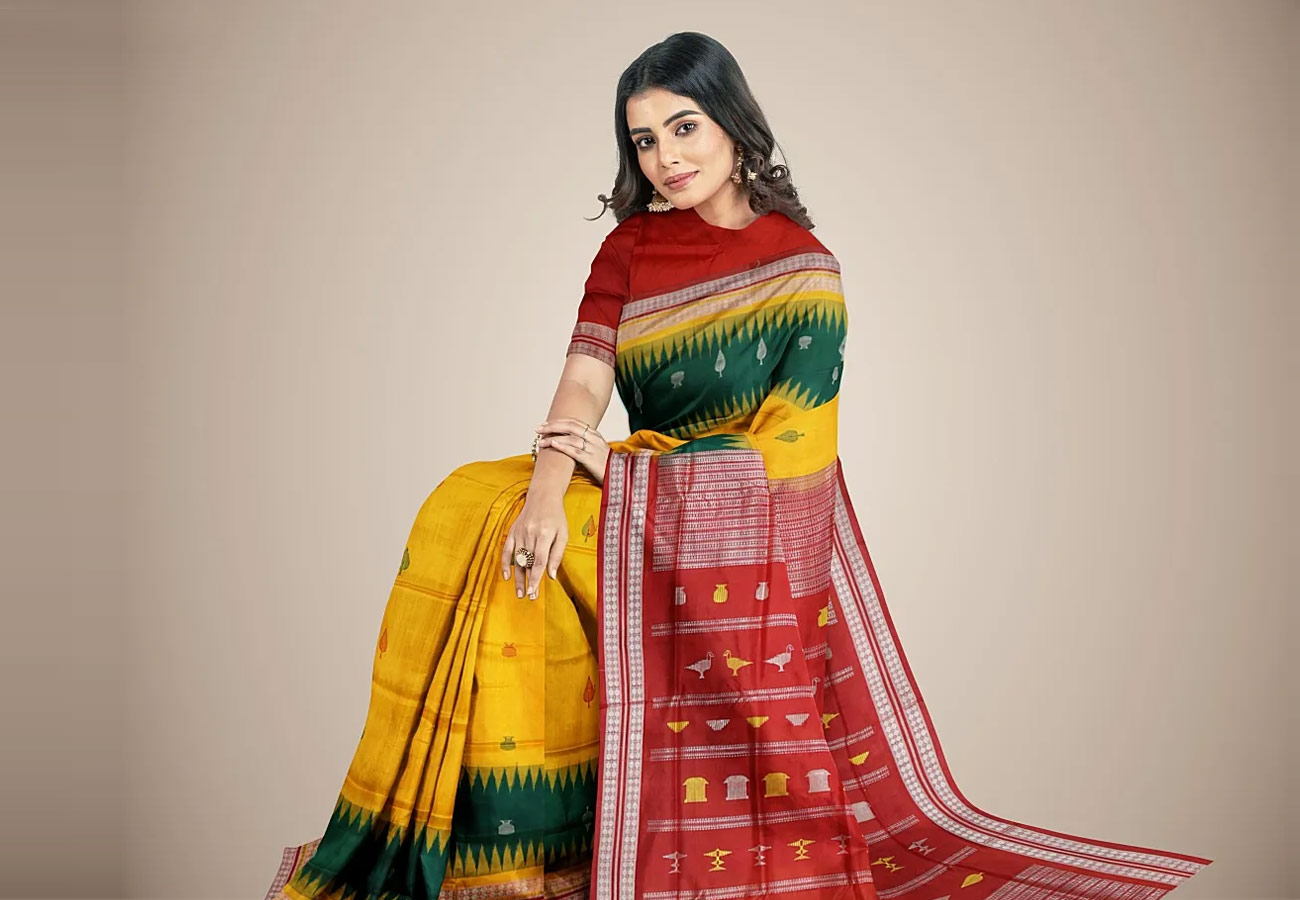
Bomkai is a special handloom sari originated in the village of Bomkai in Ganjam district of Odisha. Coarse cotton, vivid colours, and high -contrast borders and pallus are the main features of these saris.  The essence of the traditional Bomkai sari lies in the stepping and shaft formula of weaving, and regular motifs remain the same in any composition. The Uniqueness of this sari is that there is no fixed layout for the anchal, extra wefts bring out panels in various colours. These saris combine Ikat and embroidery interweave with each other, the borders are normally in contrasting colours, with intricate thread work marking the pallus. Now bomkai saris are available in cotton as well as in silk fabrics. Bomkai cotton saris are mostly used for casual wear and the silk saris are for weddings and special occasions. The Bomkai sari and its fabrics received a Geographical Indications tag in 2010.

Suggested Story: Dhalapathara Parda –The Ethnic Fabric of Odisha

Traditional Bomkai Saris

Traditional-Bomkai-Saris
Image – Wikimedia

The Bomkai sari originates from a village called “Bomkai” woven by the Patra and Nayak communities in the Ganjam district of Odisha, and that is why the brand is popularly known as “Bomkai sari.” The stepping and shaft formula to weave regular patterns remains the same in any composition; it is a distinctive trait of traditional Bomkai weaving. The main motifs are Kanthiphula, the bitter gourd blossom, the Atasi flower (linumusitatissimum), flies, birds, fish, and lotus. The looms were narrow, and the weavers wove 12-foot-long and 36-inch-wide cotton saris. Another feature is that the anchal panels have no set arrangement, so even his work cannot be replicated by a weaver from memory unless it is copied. The yarn with 10 to 40 counts was available in the market at that time, and the weavers purchased yarn for weaving with the money they received from selling their handmade saris at the local market. Yarn was mostly dyed using vegetable dye since chemical dyes were not available. The colour spectrum of vegetable dye was restricted to very few colours such as yellow (derived from turmeric), maroon (derived from the bark of Aal trees/ Morindacitrifolia), blue (derived from nile), and black (derived from hakda and hirakasi.) 

Modern Day Bomkai

Modern-Day-Bomkai-Saree
Image Courtesy – Utkalikaodisha.com

The Sonepur handloom industry had several developments in the middle of the 1960s. To embrace the innovation, weavers received training, loom widths were increased to 48 to 50 inches, and finer-quality mercerized yarns (60 counts) were introduced. In the 1970s and early 1980s, the making of these saris declined severely. Chemical dyes were also introduced by the well-known weaver in the region, Shri Kruthartha Acharya. As a result, there was a revolutionary change in Bomkai tradition, and a paradigm shift from Ganjam district to Sonepur district took place.

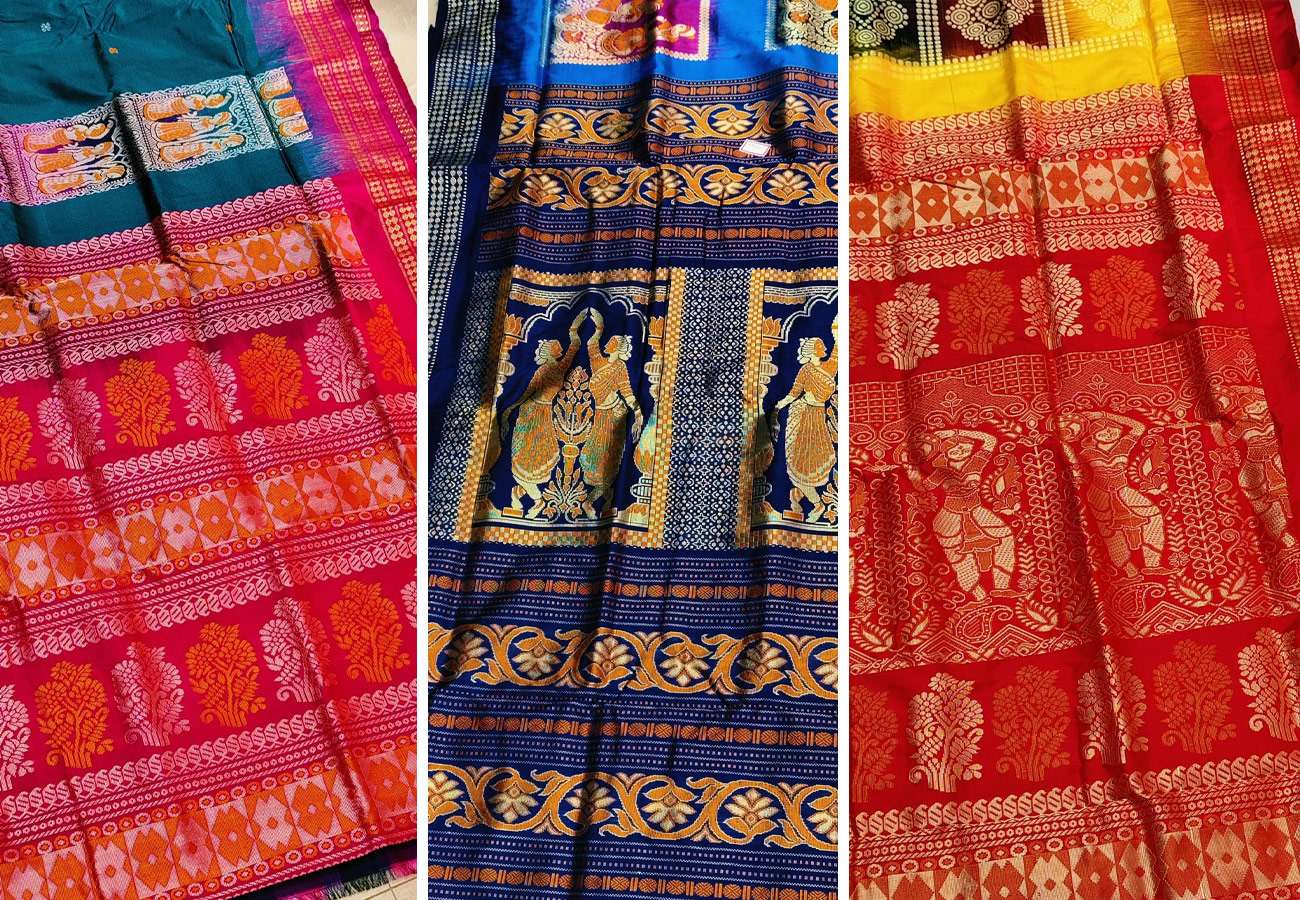
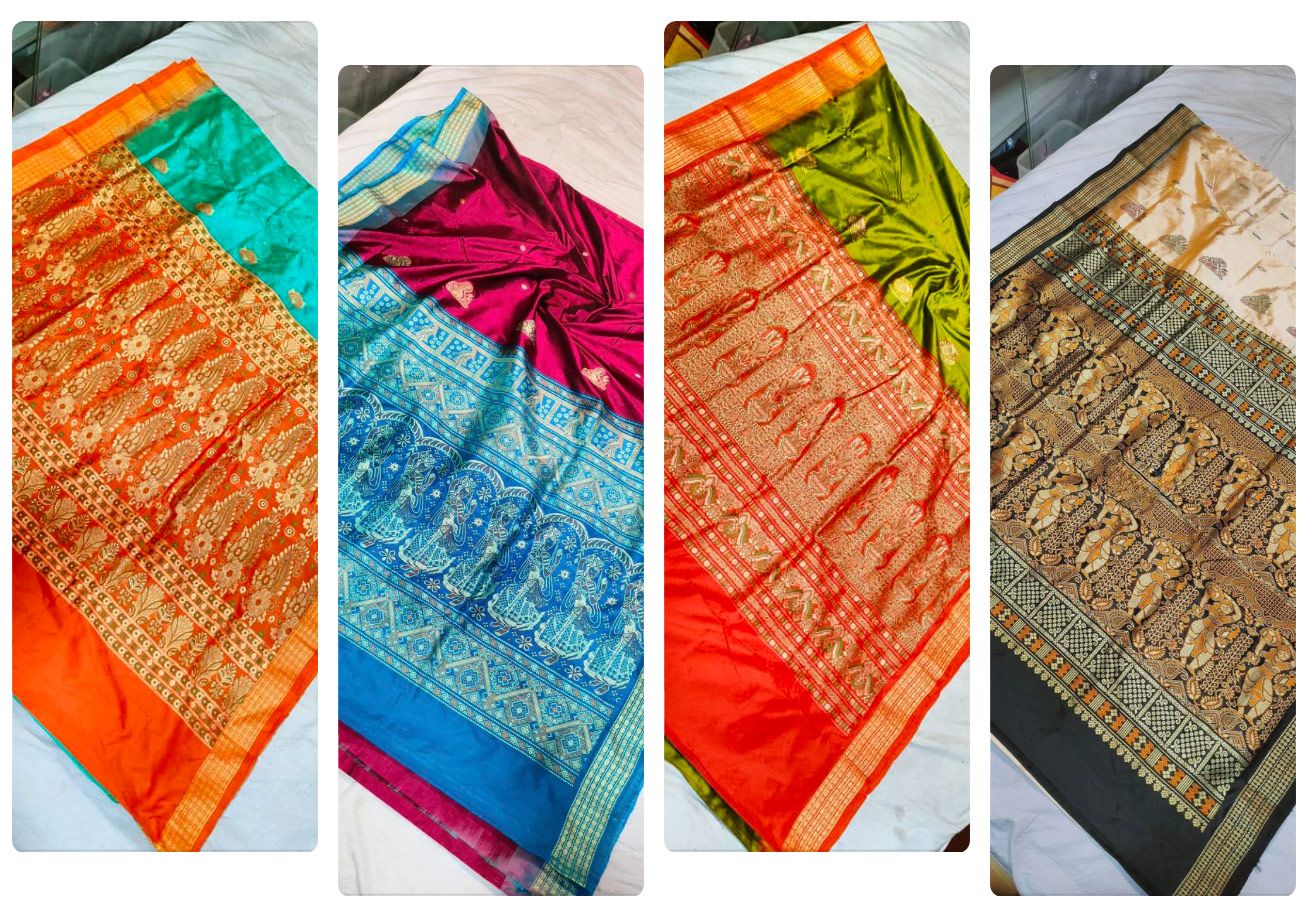
 The Vishwakarma series and the Festival of India exhibitions helped to revive the textile and expand its production to the Sonepur (now Subarnapur) – Bargarh region in western Odisha, which is well known for Ikat weaving, and many weavers were ready and trained to adopt the change. The availability of chemical dyes expanded the colour spectrum, enabling weavers to create a wider choice of designs for their textiles. Dr.Kruthartha Acharya, for the promotion of Sonepur products, encourages the weavers to explore wider markets in other States through participation in fairs and exhibitions organized by the State and central Government, and the handloom department of the Government of India. In addition to this, he used to buy woven saris from weavers and provide them with raw materials and designs. This made it easier for the weavers to focus only on manufacturing the product, rather than marketing and product promotion. The other significant improvement is the introduction of silk yarn in the early 1980s.  In these clusters, ikat is often combined with the traditional Bomkai design and is woven using finer cotton and silks. The jaala is parallel to the jacquard    and dobby attachment in the production process. The design of Bomkai was created at the Sonepur cluster at the beginning of the 1990s, and since then, has been experimenting the permutation and combination of designs incorporating with Bomkai, Jala, tie-dye, etc. Now the weavers are using zari, and the body designs are also enhanced to make the saris more appealing to the consumers. Besides the traditional bandha pattern of the Anchal, recently the weavers started producing Jala designs, as the flower patterns and animal characters are more prominent, and appealing in this Jala design process.  The weavers use the graph to guide them while working on the loom to create this pattern. These stylish saris are embodied with captivating colours to give a gracious look. 

Colours in Bomkai

Colours-in-Bomkai
Image Source

The Bomkai weavers use conventional foundation colours like jet black, blood red, orange, yellow, and green. Traditionally, yarn was mostly dyed using colours derived from natural sources, since there were no chemical dyes available, and the weavers’ ancestors, are responsible for their keen sense of colour. So the colours of natural dye were restricted to very few colours. Yellow is derived from turmeric, blood red/ maroon from the bark of the Aal tree or lac, and black is derived from hakda and hirakasi seeds, acacia skin for chrome orange.  For them, the colour red represents life and blood. Green is a symbol of agriculture, which gives life. Yellow comes from mustard blossoms, and orange from the arid, reddish ground.  Earlier even  in the  Sonepur and Bargarh regions yarn was  dyed by  using naturally extracted colours from leaves, fruits, stems, roots, mud, the  and outer cover of the tree, and a few examples are, mud for Brown colour, Teak wood- Red colour, and mango nut for Black colour. But after the synthetic dyes became available to them in the market, they adopted the synthetic dyes.

 With the introduction of synthetic dyes, the colour spectrum of the textile expanded.  However, in the past few decades, weavers have bought dyed yarn, which is commonly chemical dyed.

Motifs in Bomkai Weaving

Motifs-in-Bomkai-Weaving
Image Source

In the bomkai saris, the weavers create panels of contrasting motifs in the anchal or pallu, on a bright background. Motifs drew inspiration from the surroundings, religious themes, and natural elements. The common motifs are karela (bitter gourd), the atasi flower, the kanthi phula (small flower), macha, (carp-fish), koincha (tortoise), padma (lotus), mayura (peacock), and charai (bird). The background was common black, red, or white and included motifs such as butas are freely composed. With the expansion of production clusters, new products such as dress materials and furnishings have also been introduced, in cotton and silk in the Bomkai style. 

However, today you will find the sari in several designs and multiple colours while retaining their originality. The warps are suitably woven to produce multi-coloured fabrics. Some of the designs especially include- Lotus, Temple (Mandir), Square type of patterns, Tortoise, etc.

The main motifs used originally are the bitter guard, Atasi flower, fish, bird, peacock, tortoise, lotus, temple, wooden lamp stand, and dambaru (instrument of lord Shiva). Some of the saris’ border motifs are inspired by tribal art. Nowadays, this is woven in both silk and cotton with a very fine texture associated with modern ikat and extra weft motifs. Traditionally, these are distinct in their use of heavily plied cotton, with floral and geometrical patterns in the borders and contrast colour border and pallu. Generally, colours are very bright like red, black, dark green, dark blue, white, etc. Designs have small dots within, which is not seen in other textiles. The body and pallu warp are joined to get a contrasting colour effect.

Conclusions

One of the oldest textiles of Odisha, “Bomkai” represents the rich tradition and innovation. The most striking features of the Bomkai sari are vibrant colours, the borders are often in contrast colours, and the pallus are marked by intricate thread work design. From their vibrant colors to intricate weaving techniques, each sari depicts a story of cultural heritage and craftsmanship. However, Bomkai doesn’t ignore the inspirations that nature offers to everyone completely free of cost. Despite challenges, Bomkai Saris continues to adapt to modern markets with changing consumer preferences while preserving its roots. Bomkai saris are not just garments but symbols of artistic excellence and the cultural heritage and tradition of Odisha.

Few Lines about Bomkai Saris

  • The most beautiful part is its threadwork in the designs of the border and the pallu.
  • In most of the saris fish motif is seen on the border as it is believed to be a sign of success and affluence.    
  • Three shuttle techniques are used to get a solid border effect.
  • Extra warp design in border and extra weft design in body and pallu are woven with the help of dobby/jacquard/jala.
  •  The designs are limited to geometric shapes and sizes, the design can also be flowery, ornate, and visually appealing.
  • Only a few traditional Bomkai sari-weaving families remain in the Ganjam district.
  • The “Bhulia” or “Meher” community’s primary activity was weaving in the Sonepur district.

Reference

  1. http://en.wikipedia.org/wiki/sonepuri_sari
  2. http://madanneha.hubpages.com/hub/traditional-weaves-of-orissa-sari
  3. http://www.craftrevival.org 
  4. http://www.indiansilk.kar.nic.in 
  5. http://www.indianfibre.com 
  6. Dr. Sasmita Behera homesciencejournal.com (ISSN: 2395-7476, IJHS 2024; 10(1): 219-224, © 2024 IJHS)
  7. Mitali dalai & kullolIi (e ISSN-0976-8351, www.researchjournal.co.inAsian Journal of Home Science Volume 12 | Issue 1 | June, 2017 | 193-200)

Basavanna’s Anubhava Mantapa: The First Parliament of the World

0
Anubhava Mantapa
Image Source

The most impressive landmark in the chronology of Indian spiritual and social reform is the Anubhava Mantapa, or “Hall of Spiritual Experience.” Founded by philosopher and social reformer Basavanna in the 12th century in the small town of Basavakalyan, Karnataka, it acted as a forum for intellectual discussions and innovations. This open forum, named Anubhava Mantapa, invited everyone to publicly discuss spirituality and morality along with social justice, breaking up traditional roles in society and demanding an equal society. Often considered the first democratic assembly, or “parliament,” Anubhava Mantapa is a precursor to modern movements of social reform, and one can say that it is a precursor to Indian philosophy and the Lingayat community.

Founding Vision of Anubhava Mantapa

Basavanna Anubhava Mantapa
Basavanna

Anubhava Mantapa was the vision born out of a desire to have a spiritually enriched society with equality, clarity of ethics, and compassion. Born as both a statesman and devout philosopher, Basavanna wished to create an arena for all walks of human beings to share their spiritual and social ideas without restrictions. His revolutionary ideals challenged the then-existing societal rigidity of caste, gender, and socioeconomic divisions. For Basavanna, true spirituality was accessible to everybody; ritualistic traditions were secondary, while directness between human beings and divinity formed the essence.

In creating Anubhava Mantapa, Basavanna made a space where thoughts would be nurtured. His philosophy, a concept called “Kayaka,” lay at the center of the very aim of the gathering. Kayaka said that every person’s work, in whatever form it manifests, is godly. Believing that self-respect was to be found in a commitment to one’s work helped Anubhava Mantapa merge into the group of people who treasured deeds more than names. It made the space where freethinkers, philosophers, poets, and prophets congregated to share experiential knowledge.

Role of Anubhava Mantapa in Social Reform

Role-of-Anubhava-Mantapa-in-Social-Reform
Image Source

Anubhava Mantapa was the radical institution that went about its best job in confronting the issues that were brought forward in the name of social discrimination and oppression based upon caste and birthright. Challenging inequality, Basavanna’s Anubhava Mantapa promoted an ideology that challenged the hierarchy of society. Among the most extreme practices this organization promoted was “Dasoha,” or the practice of service and giving to fulfill one’s needs. This methodology concentrated on removing inequality, as it proved that each human deserves dignity and respect irrespective of caste or work profession.

Anubhava Mantapa is especially noteworthy in having women participate actively in the discussions. Famous women styles like Akka Mahadevi, a female mystic poet, had towering personalities and possessed deeper insights into spiritual and social freedom. The Mantapa then provided an unequaled opportunity for women and ensured that they were not marginalized. With great revolutions set on the slogan of inter-dining, inter-marriage, and fellowship across caste lines, members were united in pursuing their pursuit of ethical living and community welfare.

Philosophical Contributions of Anubhava Mantapa

Anubhava-Mantapa-The-First-Parliament-of-the-World
Image Source

One of the most significant intellectual contributions of Anubhava Mantapa was creating Vachana literature. Vachanas are short, poetic verses comprising accessible language. They were meant for the oral communication of deep philosophical thought expressed in simple terminology. Mystic saints and scholars like Basavanna, Allama Prabhu, and Channabasavanna made important contributions to this literature. Inner wisdom was over external rituals and allowed the individual to directly experience divinity.

Vachanas spoke of concepts including Bhakti, morality, and denial of idol worship and oppression by the concept of caste. It ushered in a personal relationship with God and sounded a call for spiritualism not mediated through priests and other intermediaries, emphasizing each seeking divine experience personally within one’s own life. 

Anubhava Mantapa Legacy and the Lingayat Faith

Anubhava-Mantapa-Legacy-and-the-Lingayat-Faith
Image Source

This was the reason why Anubhava Mantapa formed the basis of the new faith of Lingayatism started by Basavanna as a new religious way of life based on personal worship towards the formless god, Shiva, represented by the “Ishtalinga” or a small symbolic linga worn by the Lingayats. They held to and strove for a social cause, with ideas like women empowerment, equal status to all the devotees, and service to society.

Lingayats’ movement was able to cut across age boundaries, and his vision of a just society honored labor and moral accountability. Lingayatism did eventually take the shape of an important cultural and religious force in Karnataka as well as other regions in South India, and its influence can still be found in mainstream lingayat communities today. Anubhava Mantapa was thus further sealed as the epitome icon of philosophical invention and social reform.

Anubhava Mantapa Relevance Today

Anubhava-Mantapa-Relevance-Today
Basavanna Statue – Albert Embankment – Mark/Flickr

The essence of Anubhava Mantapa contains teachings relevant to this modern epoch, with issues concerning social inequality, discrimination, and gender bias yet to be fully eradicated. Ideas on equality, mutual respect, and dignity towards all professions espoused by Basavanna are yet adequate in countering the challenge of social justice and economic disparity characteristic of modern times. “Work is worship”-the philosophy raised by Basavanna promotes the appreciation of every profession over the sort of labor that has been ruled by modern times.

The inclusiveness of Anubhava Mantapa reminds us of the emergent need for dialogue and empathy among people to build a coherent and fair society. Educational institutions, NGOs, and spiritual organizations get motivation from the preachings of Basavanna and propagate atmospheres of inclusiveness, compassion, and growth.

Conclusion

Basavanna’s Anubhava Mantapa was a very important chapter in spirituality and social reform. Here, Basavanna provided a place where people could find an answer to life’s great questions by celebrating compassion, the value of living ethically, and egalitarianism as people thronged for it. The principles that arose from Anubhava Mantapa remain an inspiration for all walks of life even today.

FAQs on Anubhava Mantapa

What is the significance of Anubhava Mantapa?

Anubhava Mantapa was the precursor body of the 12th century that allowed for open discussion about social and spiritual affairs, ensuring equal opportunities so that experience could provide a better understanding of spirituality.

Why is Anubhava Mantapa referred to as the “First Parliament of the World”?

It is called the “First Parliament” because it stood as an initial prototype of democratic dialogue, where people belonging to all sectors of life would gather for the discussion of social and spiritual issues and ethical concerns.

Who were the main members of Anubhava Mantapa?

Prominent personalities who feature in the list are Basavanna, Akka Mahadevi, Allama Prabhu, and Channabasavanna. They contributed to the process of reformation that led to the philosophy and literature connected with the Lingayat faith.

What is the relevance of Vachana Literature?

Vachana literature was composed by sages in Anubhava Mantapa where spiritual thoughts were expressed in plain poems so that divine knowledge becomes accessible to man.

What was the core philosophy of Anubhava Mantapa?

The teachings of the movement included values such as social equality, dignity of labor, and direct experience of the divine but rejected ritualism and any divisions based on caste.

Few Liners about Basavanna’s Anubhava Mantapa

  1. Anubhava Mantapa was the first recorded spiritual congregation in the world.
  2. It adopted the principles of social levelness and regard for other human beings.
  3. Established by Basavanna it was situated in Kalyana, which is now known as Basavakalyan. 
  4. Some of the notable thinkers here were luminaries like Akka Mahadevi and Allama Prabhu.
  5. It fostered Vachana literature: which includes simple poetic expressions of spiritual wisdom.
  6. The congregation propounded the thesis of “work as worship.”
  7. Anubhava Mantapa remains a timeless model of spiritual democracy.

How to Plan a Personalized Luxury Travel Experience

0

Personalized Luxury Travel Experience

Creating a personalized luxury travel experience isn’t just about the destination—it’s about curating every detail to suit your preferences. Whether you’re embarking on a dream holiday, celebrating a milestone, or just seeking some well-deserved indulgence, luxury travel is all about making it truly yours. If you’ve ever thought about how to make every moment unforgettable, here’s how to craft an experience that feels tailor-made.

Step 1: Start with the Ultimate Travel Experience – Book a Private Jet

Why settle for long airport lines and crowded terminals when you can fly in style and comfort with Jettly? Booking a private jet sets the tone for your trip from the moment you leave. Imagine stepping straight into your aircraft, skipping the chaos of commercial airports, and relaxing in a cabin designed just for you.

Private jets are not just about convenience; they’re also about personalization. You can choose everything from the type of aircraft to the onboard amenities. Love champagne? Want a curated playlist or gourmet meals? It’s all possible. Many services even allow you to specify your departure and arrival times, giving you total control over your schedule.

If it’s your first time booking, start by researching reputable charter services or concierge companies. Look for those that specialize in luxury travel to ensure they understand your needs. Always ask about safety certifications, onboard services, and flexible cancellation policies.

Step 2: Choose Accommodations That Feel Like Home—Only Better

Where you stay can make or break your trip. For a personalized luxury experience, skip the generic five-star hotel and opt for something unique. Think private villas, boutique hotels, or even renting a fully staffed estate. The key is finding accommodations that align with your style, whether that’s modern opulence or rustic charm.

When booking, consider what makes you feel at home. Do you need a private chef? A pool with a view? A spa on-site? Many luxury properties allow you to tailor your experience, from pillow preferences to personalized itineraries. Don’t hesitate to ask for extras like a dedicated butler or exclusive access to nearby attractions.

Step 3: Curate a Custom Itinerary

Your itinerary should reflect your passions, not just popular tourist spots. Think about what excites you—are you a foodie? Do you love art, adventure, or relaxation? A personalized luxury trip gives you the freedom to mix it all, ensuring every day feels like it was planned just for you.

For example, food lovers can arrange private dining experiences with world-class chefs, while adventurers might charter a yacht for a day of ocean exploration. Art enthusiasts could book private gallery tours or behind-the-scenes museum visits.

Don’t forget downtime. Luxury travel is as much about the moments of relaxation as it is about activities. Include spa days, poolside lounging, or even private yoga sessions to balance your schedule.

Step 4: Travel in Style Everywhere

Your mode of transport doesn’t stop at the flight. To truly elevate your trip, consider how you’ll get around once you arrive. Limousines, classic cars, or even helicopters can add a touch of glamour.

For something truly unique, arrange transport that matches your destination. In Paris, cruise the Seine on a private boat. In the Alps, arrive at your chalet by snowcat. These details create unforgettable moments and help you fully immerse yourself in the luxury experience.

Step 5: Add Personal Touches to Every Detail

What sets personalized luxury travel apart is attention to detail. This is where you can truly make your trip stand out. Work with a concierge or travel planner to weave in surprises and custom elements.

Consider adding:

  • Special meals – Have your favourite dishes prepared or enjoy a themed dinner based on the location.
  • Unique gifts – Surprise your travel companions with personalized keepsakes like monogrammed luggage tags or a curated welcome basket in your room.
  • Tailored experiences – Think private concerts, a stargazing night with an astronomer, or a helicopter ride over scenic landscapes.

These small details can transform your trip from memorable to magical.

Step 6: Prioritize Privacy

Luxury travel is often about escaping the crowds and enjoying some peace. Look for destinations and experiences that offer privacy. This could mean a secluded island resort, a private safari lodge, or a chartered yacht that keeps you away from bustling ports.

Even in busier destinations, privacy is achievable. Exclusive-access tours, private drivers, and discreet accommodations ensure you can enjoy the best of a location without sacrificing tranquillity.

Step 7: Stay Flexible

The beauty of personalized luxury travel is its adaptability. Unlike group tours or pre-packaged holidays, your trip can be as fluid as you like. Want to extend your stay in a place you love? Add a spontaneous experience? Change your schedule to fit your mood? It’s all possible.

Work with a travel concierge or agent who can adjust plans on the go, ensuring your experience remains stress-free and enjoyable.

Making Luxury Travel Truly Yours

The magic of luxury travel lies in the details. From the moment you book your private jet to the curated experiences that await, every element should feel designed with you in mind. Personalization is the thread that ties it all together—because at the heart of a truly luxurious experience is you.

Ready to start planning your next adventure? All it takes is a clear vision of what you want, and the world is yours to explore, your way.