The Ethics of Making in Eastern and North-Eastern India
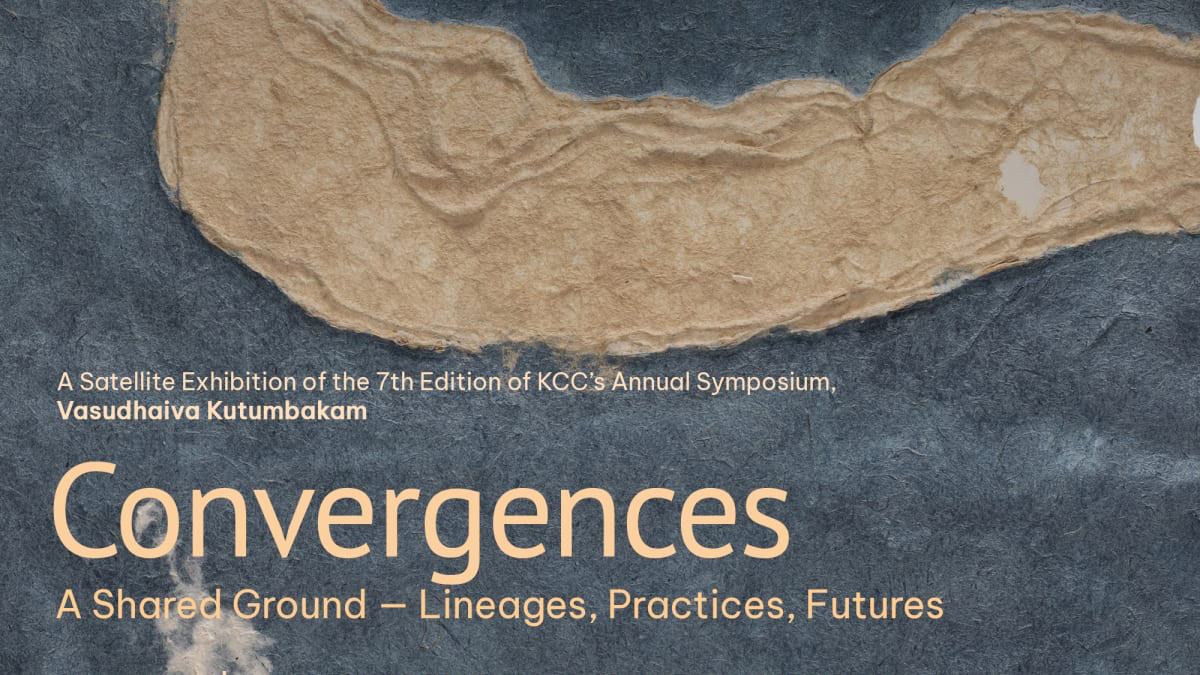
The city of Joy is known for its excellence in art and its relentless pursuit of the “new.” In search of the new, the Kolkata Centre for Creativity (KCC) has inaugurated a new satellite exhibition titled Convergences: A Shared Ground — Lineages, Practices, Futures as a part of their 7th Annual Symposium, Vasudhaiva Kutumbakam (The World is One Family). This exhibition is scheduled to be on view from January 9 to February 14, 2026. This exhibition presents a dedicated view into contemporary debates on sustainability, community knowledge, and decolonial practices of making. Most importantly, the entry is free for everyone, making art accessible to all.
This exhibition probes into how artistic, craft, and architectural practices from Eastern and North-Eastern India serve as a continuum of embodied knowledge and ecological conscience. Today, as many indigenous and vernacular practices face erosion, KCC steps ahead in extending a helping hand to preserve and represent those in a proper, curated way. Convergences moves beyond the traditional displaying of exhibits and proposes a different approach that allows heterogeneous lineages to be represented under one roof.
The Method of Convergence
The curatorial psyche emphasizes the “framework of production” itself. It detaches the act of making art from being a solitary event and frames it amidst its relationship with the land and communities of people who are producing it. The basic notion propounded by this exhibition is that “convergence” does not appear only in the sense of a stylistic arrangement but as a systematized approach too.
The organizers are bringing numerous artists and collectives to the same plane. Anshu Kumari; ARTISANS’ Sustainable Development Foundation X Leshemi Origins; Dulair Devi, Malo Devi, Putli Ganju, Rudhan Devi, Sajhwa Devi (supported by Sanskriti Museum & Art Gallery, Hazaribagh); Ruma Choudhury; Silpinwita Das; Simi Deka; Ujjal Dey; and Ujjal Sinha, collectively articulate a material language shaped by bamboo, earth, fibre, thread, natural pigments, and organic waste. Thus, the exhibition forges a shared ground where distinct lineages seamlessly overlap.
About The Vasudeva Kutumbakam Series
KCC’s Vasudeva Kutumbakam symposium series synchronizes with a broader movement in Indian art that challenges Eurocentric notions of progress and innovation. Instead, subscribe to the approaches of repair, reuse, and remembrance as radical acts. Repair stems from ethics, reuse aims to extend the lifecycles of materials, and remembrance ensures the continuity of intangible heritage. Together, they craft a counter-statement that propounds resilience over lavishness.
One of the most significant developments in this exhibition is the inclusion of the eastern and the north-eastern regions of India. These regions have been historically marginalized and treated as “separate” elements, away from the mainstream cultural narratives. This exhibition wishes to bring their everyday practices of weaving, building, dyeing, and foraging, etc., into light and aims to reveal the system of knowledge framework that eventually arises from these communities.
Therefore, convergences also probe into institutional hierarchies that make distinctions between “fine art,” “folk,” and “craft.” Thus, it fuels scholarly discourses that fit the lens of artisanal and community-based practices. The exhibition does not aestheticise tradition; rather, it situates tradition as an active, evolving force capable of shaping contemporary life-worlds.
Important Points of the Exhibition
| Aspects | Details |
|---|---|
| Exhibition Title | Convergences: A Shared Ground — Lineages, Practices, Futures |
| Associated Event | Satellite Exhibition of the 7th Edition of KCC’s Annual Symposium Vasudhaiva Kutumbakam |
| Dates | 9 January – 14 February 2026 |
| Entry | Free |
| Regional Focus | Eastern and North-Eastern India |
| Key Themes | Convergence, sustainability, embodied knowledge, repair, reuse, remembrance |
| Materials Used | Bamboo, earth, fibre, thread, natural dyes |
| Participating Artists | Anshu Kumari; ARTISANS’ SDF X Leshemi Origins; Dulair Devi et al.; Ruma Choudhury; Silpinwita Das; Simi Deka; Ujjal Dey; Ujjal Sinha |
| Core Philosophy | Practice as a “Shared Ground” where continuity is valued over novelty. |
| Materiality | Use of bamboo, earth, and natural fibers as ethical and cosmological choices. |
| Participant Mix | A blend of individual contemporary artists and traditional craft collectives. |
Key Highlights
- Brings together indigenous, artisanal, and contemporary practices on a shared ethical platform.
- Reframes convergence as a methodology rather than a visual style.
- Focuses on sustainability, ecological consciousness, and community knowledge systems.
- Challenges rigid distinctions between art, craft, and architecture.
- Advocates repair, reuse, and remembrance as cultural and environmental imperatives.
- Provides free public access to critical artistic discourse.
- The works challenge the “flattened” progress of modernity by foregrounding transmission and care.
- Knowledge is presented as something absorbed through seasonal rhythms and lived experience.
- The exhibition asks viewers to find value in the mended and the persistent rather than just the “whole” or the “new.”
Tracing the Event and Its Philosophical Roots
View this post on Instagram
The curatorial purview rejects the “throwaway culture” of the 21st century and builds something meaningful to shape a better tomorrow. While the symposium features global scholars discussing interconnectedness, Convergences provides the tangible, material evidence of this philosophy. It moves the abstract idea of “one family” into the physical realm of shared craft and architecture. This exhibition also looks forward to framing ethnographic tales by showcasing how innovation in these regions emerges from accumulated experience rather than sudden rupture.
This interdisciplinary approach mirrors a global trend in “slow art” movements that aim to recalibrate the nature of viewing human labour in symphony with ecological awareness.
“Convergences” emphasizes “sustainability.” It does not perceive the concept as a hollow buzzword. The most striking feature of the exhibition is that it embraces fragility like a concrete form. It reminds us that our “shared ground” is not a solid, immovable slab, but a living, breathing, and occasionally wounded landscape that requires constant tending.
Takeaway
“Convergences” doesn’t just show us art; it teaches us a way of staying with the world. By privileging continuity over consumption and care over novelty, it offers a model for future art practices that are ethically rooted, socially accountable, and ecologically sensitive. It showcases the brilliance of an institutionally backed initiative in showcasing sustainable forms in an impactful way. It reminds us that the most radical futures may not lie in technological acceleration, but in the slow, patient wisdom of communities that have long known how to live with, rather than against, the world.