A Cultural Retrospective
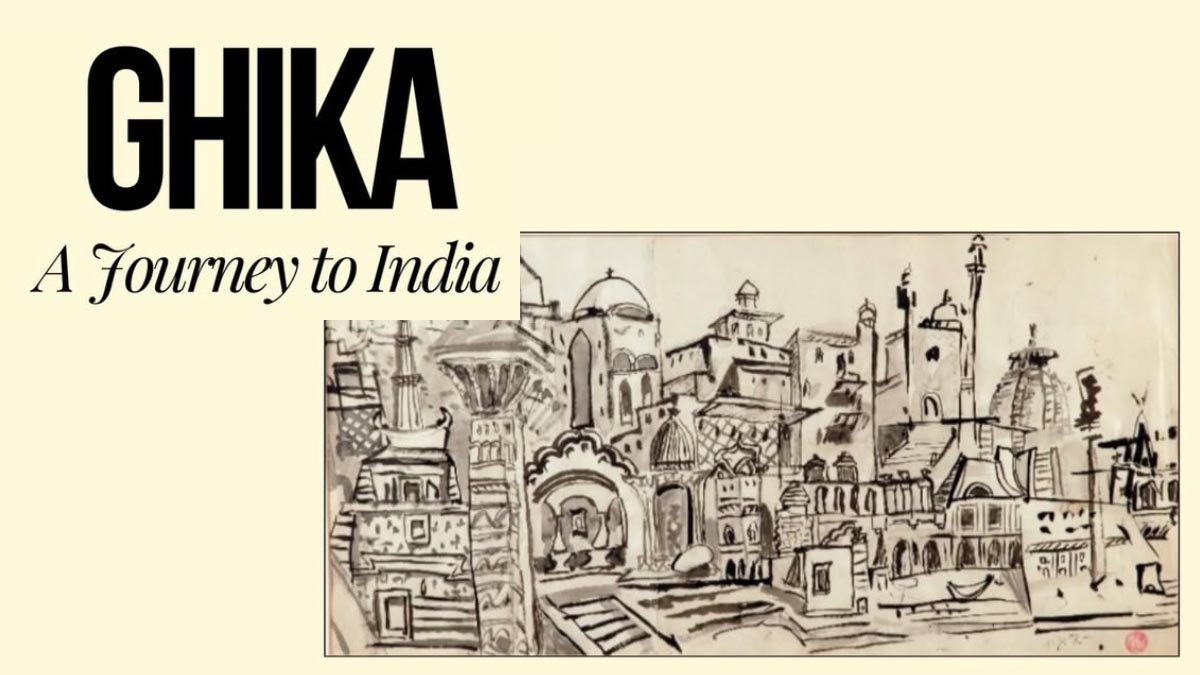
The ancient ties between Greece and India date back to around the 6th century BCE. This relationship has got a new makeover at the Jaipur House in the National Gallery of Modern Art (NGMA) in New Delhi. An exhibition titled “Ghika: A Journey to India” is celebrating the artistic impressions of the celebrated Greek modernist painter Nikos Hadjikyriakos-Ghika from his month-long visit to India in 1958. This presentation goes beyond the showcase of historical artwork and is a tangible marker of cultural diplomacy spanning several decades.
The showcase of his paintings is happening 67 years after the original journey, and it showcases the corpus of sketches, writings, and paintings that serve as a travelogue of the artist’s encounters with Indian life, rituals, architecture, people, and everyday scenes. The exhibition is scheduled to run through February 12, 2026. This exhibition is a celebration of the Indo-Greek relationship, marking 75 years of diplomatic relations between the two. The formal diplomatic ties with Greece were established in May 1950. This exhibition plays a crucial role in re-viewing the nascent years of Post-Independent India from a foreign gaze.
A Cubist’s Vision of the Subcontinent
Nikos Hadjikyriakos-Ghika was a decisive figure in the “Generation of the 1930s,” a Greek artistic movement acknowledged for synthesizing Cubist and Constructivist formulations with traditional Hellenic aesthetics. Ghika was sponsored by the American Government in 1958 for an international educational exchange, which led him from the West to the East. Ghika initially halted at New York and Hawaii, but his long-term fascination lay in the oriental world. This curiosity led him to circumnavigate the globe. He chose to return to Greece via Asia. This allowed him to visit Japan, Hong Kong, Thailand, Cambodia, and finally, spend a month in India. Ghika was not venturing alone; he was accompanied by his future partner, Barbara Warner.
View this post on Instagram
The Benaki Museum and the Embassy of Greece preserved the Indian part of his global travelogue. The paintings disclose an overwhelming intensity of hues and diversity of landscapes. Ghika’s Indian itinerary included Delhi, Calcutta, Bombay, and Jaipur. He captured the diversities of Indian life and its minutiae. His 39 India-inspired artworks, primarily black-and-white drawings in pen, ink, charcoal, and pencil, focus on the energetic chaos of the bustling streets, the spiritual serenity of the ghats of Banaras (Varanasi), and the delicate beauty of the local population.
The Themes of Ghika’s Indian Paintings
Ghika’s artworks on India particularly highlight the apothesis of the aesthetics of Indian women. He captured their flowing drapes, jewellery, etc, in an intricate manner. To him, the plurality of India’s religious festivals became a huge source of inspiration. The central themes of his paintings revolved around temple architecture, animal motifs, and the figures of the Indian woman. These motifs were perceived as an embodiment of the divine. His distinct technique of applying cubist sensibilities, meaning moving away from traditional realism, to depict multiple perspectives simultaneously, produced unique prints that were seldom produced by other Western artists. In his eyes, the Indian culture stood not only as a continuum of ancient roots, but a constant explosion of modern syncretism.
The present exhibition is the result of the collaborative effort of the NGMA, the Benaki Museum in Athens, and the Greek Embassy in New Delhi. The symbolic weightage of this collaboration is huge, as stated by the Ambassador of Greece to India, who remarked that the exhibition beautifully reflects the “enduring artistic and philosophical bonds” between the two nations. The return of these masterpieces to their land of origin, 67 years after they were crafted, is a rare opportunity to take a glimpse at them.
The curator Lonna Moraiti of the Ghika Gallery Archive noted that the artist was particularly intrigued and invigorated by India’s religious diversity and feminine aesthetics. Therefore, this exhibition not only celebrates the Indo-Greek ties but also bridges the personal artistic expression of the painter with a common cultural recollection.
The Exhibition At A Glance
| Aspect | Details |
|---|---|
| Exhibition Title | Ghika: A Journey to India |
| Artist | Nikos Hadjikyriakos-Ghika |
| Venue | National Gallery of Modern Art, New Delhi |
| Duration | Open until February 12, 2026 |
| Collaboration | NGMA, Benaki Museum, Athens, Embassy of Greece |
| Diplomatic Significance | Commemorates 75 years of India-Greece relations |
| Artistic Focus | Indian rituals, architecture, daily life, and feminine form |
| Historical Context | 1958 visit across India, including New Delhi, Calcutta, Jaipur |
Key Highlights
- The exhibition revives Hadjikyriakos-Ghika’s artistic impressions of India, portrayed through delicate sketches and vibrant paintings that capture both the simplicity and grandeur of Indian life.
- Works include silhouettes of daily life, detailed portrayals of religious ceremonies, architectural studies of temples, and nuanced depictions of Indian women, interpreted with a modernist sensibility.
- The original journey occurred in 1958, during which Ghika visited various cities such as New Delhi, then Calcutta (now Kolkata), and Jaipur, compiling his first-hand experiences in art and writing.
- The exhibition underscores the enduring artistic and philosophical bonds between India and Greece, set against the backdrop of historical intercultural exchange.
- Senior Indian cultural officials, the Greek ambassador, and art experts attended the inauguration, emphasizing the importance of cultural diplomacy.
Historical Background of Indo-Greek Relationship
Preceding the invasion of Alexander, the Indo-Greek relations were limited and largely concentrated around the Achaemenid Empire. After the invasion of Alexander in the 4th century BCE, Greek presence and exchange took hold in the subcontinent. Since then, India has been influenced by Greek art, philosophy, and commerce. Historical accounts such as Indica by Megasthenes play a very crucial role in uncovering ancient Indian history.
The cultural interactions continued with art and iconographical influences, such as Gnadhara art. In philosophy, early Greek and Indian thought processes resonated with each other in the fields of metaphysics and existential properties.
In the modern era, scholars like Greek Indologist Dimitrios Galanos spent decades in India translating Sanskrit texts into Greek. These instances support the view of long-lasting and deeply entrenched ties between the two civilizations.
Takeaway
The artworks of Ghika are undeniably valuable given their immense artistic merit. The revival of Nikos Ghika’s journey in India and showcasing it in the national capital is a high point in the cross-cultural engagement. “Ghika: A Journey to India” reflects the potential of art to create shared spaces of understanding. Ghika’s choice to travel in India was highly driven by his desire to establish a connection between Western modernism and Eastern traditions. It is a marker of successful cultural merger.
While NGMA is hosting this exhibition, it is establishing itself as an agency that represents India as an eternal source of inspiration for the world. This exhibition re-establishes the strong hold of culture as the most effluent ambassador of any identity and its role in strengthening the bilateral ties between the two nations. Thus, cultural exchange continues as an essential pillar of Internal Relations.