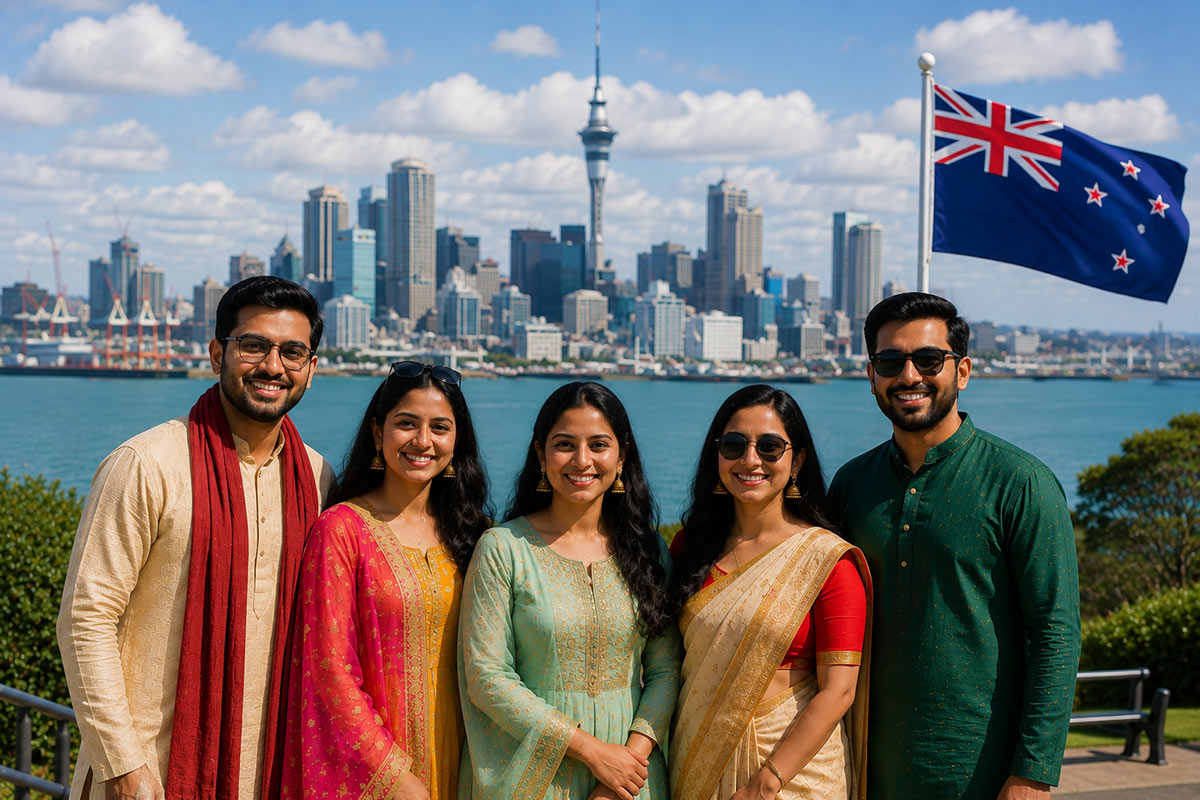
New Zealand wasn’t exactly on India’s radar two centuries ago. And yet, here we are in 2026, with nearly 300,000 ethnic Indians calling Aotearoa home making them the third-largest ethnic group in a country of five million people.
That’s a 128% increase since 2006. Not a typo.
This isn’t just a migration story. It’s a story about ambition, identity, and what happens when two vastly different cultures find they have more in common than anyone expected. From the first lascars who jumped ship in 1769 to today’s tech founders navigating Auckland’s startup scene, the Indian community in New Zealand has quietly become one of its most transformative forces.
How It All Started: A History That Doesn’t Get Enough Credit
Most people assume Indian migration to New Zealand is a recent phenomenon a product of 1990s globalization and the tech boom. The real story starts much earlier.
The first recorded Indians arrived aboard East India Company ships, some deserting to settle among Māori communities in the late 18th century. By the 1890s, steadier waves from Gujarat and Punjab were arriving, drawn by economic opportunity in a young, resource-rich country.
Then came the walls. The 1899 Immigration Restriction Act and the broader “White New Zealand” policy effectively shut the door for decades. Indian migration didn’t truly resume momentum until the 1960s and 1970s, when those discriminatory policies were finally dismantled.
Two more events reshaped the community significantly. The 1987 Fijian coups sent waves of Indo-Fijians to New Zealand families who’d spent generations in the Pacific and brought a distinctly different cultural blend with them. Then India’s own economic liberalization in 1991 accelerated skilled migration, as engineers, doctors, and IT professionals began looking beyond India’s borders for opportunity.
By 2014, Indians were recording net permanent long-term gains of 7,565 people in a single year a number that would have seemed unthinkable to those early Gujarati settlers navigating a hostile immigration system.
The Numbers Behind the Community
The 2023 Census tells a clear story: 292,092 ethnic Indians now live in New Zealand, representing 5.8% of the total population. That’s up 54% from 2018 alone.
Auckland dominates, as it does for most migrant communities. About 64.7% of Indian New Zealanders live in the Auckland region nearly 176,000 people. Papatoetoe has earned its nickname “Little India” with a 26.2% Indian concentration. Hamilton is the next significant hub outside Auckland, followed by Wellington and Christchurch at lower concentrations.
The community skews young, with a median age below the national average. Family structures remain strong. Sectors like retail (14.5% of employment), healthcare (10.5%), and professional services dominate occupational profiles and median incomes exceed national averages across the board.
Work and student visas account for around 44% of recent arrivals, with 29,598 work visas approved in 2025 alone. The India-New Zealand Free Trade Agreement negotiations since 2025 are set to ease pathways further, particularly in IT, healthcare, and engineering.
Culture That Didn’t Stay Quietly in the Background
One of the most striking things about Indian cultural influence in New Zealand is how thoroughly it’s moved from “ethnic enclave” to mainstream.
Diwali in Auckland is no longer a community hall gathering. It’s a city-wide event with council support, light installations, and thousands of non-Indian New Zealanders attending. The same shift has happened with Holi. What began as private celebrations have become part of New Zealand’s cultural calendar.
The Swaminarayan Complex in Auckland stands as a landmark, not just for the Hindu community but architecturally within the city itself. The Auckland Indian Association, operating since 1920, runs language schools, media outlets, and cultural programs and has increasingly found ways to weave Bollywood aesthetics with Māori elements, creating hybrid cultural expressions you won’t find anywhere else on earth.
Food has followed a similar trajectory. Indian restaurants and grocery stores anchor neighbourhoods like Ōtara. Spice aisles in mainstream supermarkets have expanded beyond recognition compared to two decades ago. Women’s associations have played an outsized role here quietly and consistently preserving culinary heritage across generations.
Economic Footprint: More Than Just Numbers
Indian New Zealanders punch well above their demographic weight economically. The community has become a cornerstone of the IT, healthcare, engineering, and education sectors. Thousands of Indian-founded businesses now contribute an estimated NZ$10 billion-plus to GDP.
University campuses have benefited enormously from Indian students, both in tuition revenue and in the talent pipeline they represent. Property ownership rates within the community are strong. Executive-level representation, while still growing, is visible across major industries.
Then there’s the investor category. Since 2025, the Active Investor Plus Visa has seen 491 applications totalling NZ$3 billion in committed investment, with 129 approvals granted. Indians represent a significant portion of this group a reflection of both the community’s financial capacity and New Zealand’s appeal as an investment destination.
For high-net-worth Indian families exploring investing for NZ residency, the Active Investor Plus Visa offers two clear tracks: a Growth category requiring NZ$5 million over three years with just 21 days of physical presence, and a Balanced category requiring NZ$10 million over five years. Processing averages around 31 days, and the pathway leads to citizenship eligibility after five years. Global Residence Index, a specialist investment migration consultancy with direct government relationships, is one of the more experienced advisors in this space for Indian applicants navigating these options.
Integration: Honest About the Challenges
It would be too easy to frame the Indian experience in New Zealand as uniformly positive. The community itself wouldn’t accept that framing.
South Asians consistently rank among the top hate crime victims in New Zealand data from 2022 to 2025. Housing and employment discrimination are reported regularly. These aren’t abstract statistics they represent real experiences within families who came here specifically for safety and opportunity.
The community’s response has been largely through advocacy organizations, interfaith dialogue, and direct engagement with Human Rights Commission processes. Health access has improved notably post-COVID. Mental health support, once almost entirely informal within community networks, has become more structured.
Youth integration happens faster and sometimes creates its own tensions. Second-generation Indians navigate between two cultural expectations simultaneously, often developing a “Kiwi-Indian” identity that doesn’t map neatly onto either parent culture. This tension, it turns out, is also a source of creativity. The most interesting cultural expressions emerging from the community tend to come from this generation.
Why New Zealand Still Wins the Quality-of-Life Argument
Ask Indian migrants why they chose New Zealand over Australia, Canada, or the UK, and the answers cluster around a few consistent themes: safety, natural environment, work-life balance, and education quality.
New Zealand consistently scores near the top of Numbeo and Mercer quality-of-life indices. Healthcare access is strong. The school system has a good reputation. And there’s something about the scale of New Zealand cities large enough to have everything, small enough to feel human that resonates strongly with families who’ve escaped the density of Indian megacities.
Housing costs are the main friction point, particularly in Auckland. But community networks have historically helped new arrivals navigate this informal knowledge-sharing about neighbourhoods, property agents, and mortgage brokers flows remarkably efficiently within Indian professional circles.
The Second Generation and What Comes Next
Around 46% of Indian New Zealanders are now New Zealand-born, a figure that has been rising steadily since 1981. This shift matters because it changes the nature of the community itself from primarily migrant to genuinely bicultural, in the New Zealand sense of that word.
Second-generation leaders are emerging across politics, medicine, law, and technology. Their relationship with India is affectionate but not nostalgic in the way their parents’ generation is. They view the India-New Zealand bilateral relationship strengthened by a defence pact in 2025 and a Free Trade Agreement bringing NZ$1.1 to 1.3 billion in projected export gains as an opportunity rather than a symbol of cultural identity.
Population projections suggest the Indian community in New Zealand could surpass 300,000 by 2043. Technology and healthcare sectors will continue to be the dominant professional pathways. The FTA easing skilled worker flows means the growth trajectory shows no signs of levelling off.
What the next chapter looks like depends partly on how well New Zealand addresses housing pressure and integration challenges and partly on how confidently the community itself continues to shape the narrative. Based on the last 250 years of evidence, betting against them seems unwise.