Solah Shringar: The Science Behind Traditional Bridal Adornments

4

list of solah shringar

In Indian culture, the vibrancy of decorations, diamonds, pearls and gems has always been captivating especially as part of the ancient tradition of Solah Shringar. It’s not just about admiring their brilliance; there is a belief that it is wise to adorning oneself with jewelry through the ages. Historical evidence indicates that early men and women wore jewelry, marking the beginning of this rich cultural practice.

In Indian literature, women are often depicted with adornments, while in all Indian classical dances; Shringar Rasa is a major motif. Tagore’s Radha in Bhanushinger Padavali beautifully portrays how she adorned herself to approach Krishna.

“Dress me with pearls and jewels
Decorate my forehead with mang tika
My hair is spilling to the ground
Bind it with garlands of champak”

What is the Story of 16 Shringar?

The story of 16 Shringar is deeply rooted in Hindu mythology, it is believed that Rati a woman with examplary beauty performaed intense penance to impress Goddess Lakshmi, who blessed her with 16 divine adornments which helped her to win Kamdev’s love and marry him. These 16 embellishments, which became symbol of beauty and grace, are now known as Solah Shringar, representing the physical and spiritual embodiment of a woman’s energy and charm.

Ancient Vedic literature references Solah Shringar, where a woman must adorn herself with sixteen embellishments, that include the bindi, collars, earrings, hair flowers and finger rings, armlets, tails, ankle bands, kajal, rings of the toe, henna, fragrance, paste of sandalwood, upper clothing, lower clothing and the list of solah shringar goes on.

What are the Benefits of Solah Shringar?
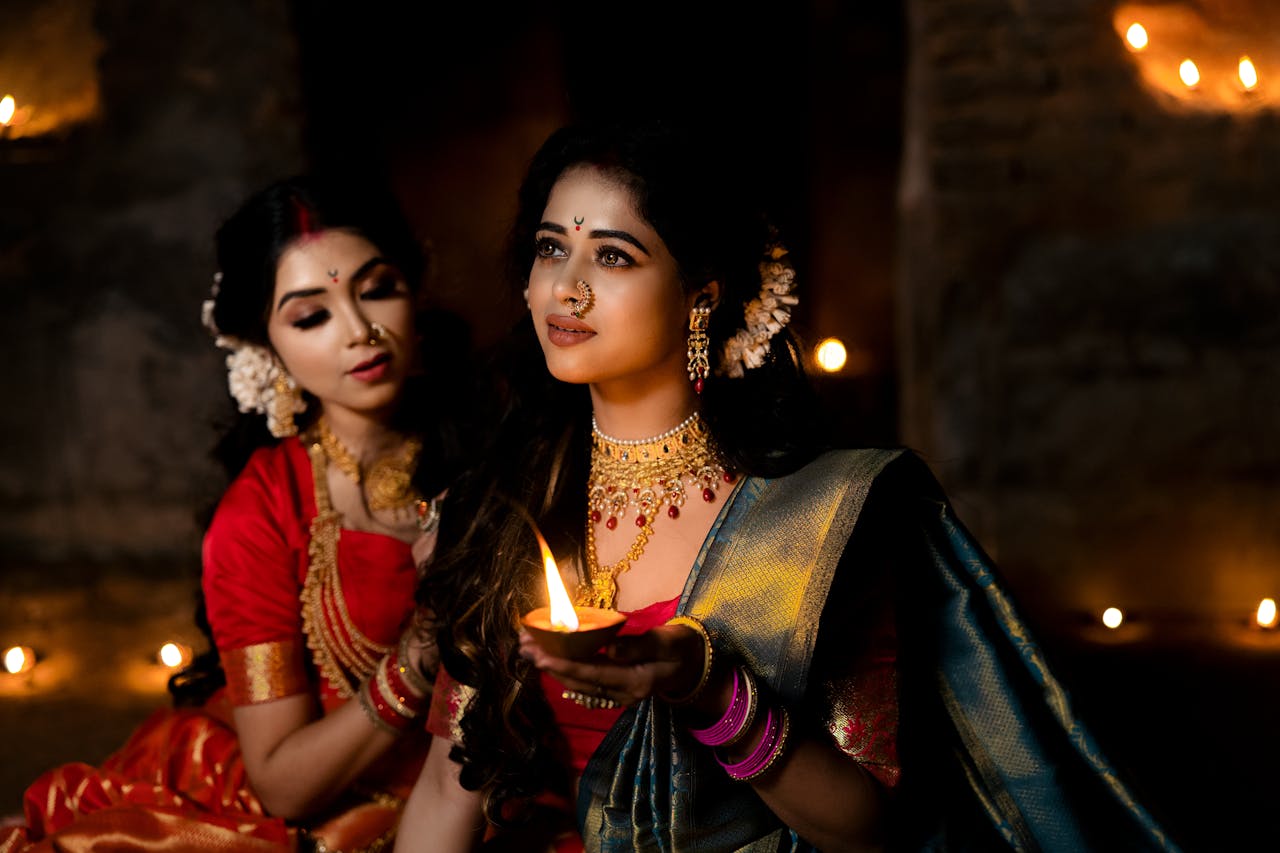
Benefits of Solah Shringar

“The scriptures also insist that there is a scientific reason for practicing Solah Shringar. While apparel is meant for modesty and accessories like perfumes are used to enhance attractiveness, the concept is that the 16 adornments contribute to good health and well-being. For Hindus, women are considered incarnations of Shakti. Ornaments, therefore, are traditionally used to protect orifices and limbs, and to control the power emanating from these parts of the body.”

Click here to view List of Solah Shringar and its Usage
+
Solah Shringar Usage & Scientific Reason
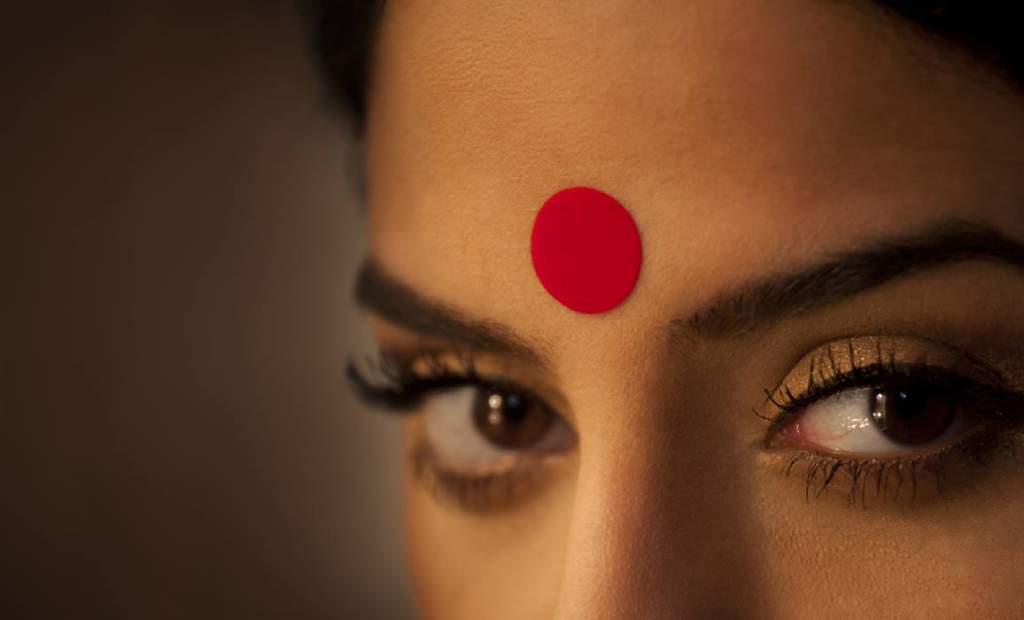
1. Bindi Represents the third eye; enhances perception and spiritual awareness. Scientifically, it stimulates the pineal gland and reduces stress.
2. Nath – Nose Ring Worn for health benefits related to the female reproductive system; believed to ease childbirth discomfort due to nerve stimulation.
3. Bangels Stimulate blood circulation and activate cosmic energy. The sound produced creates an aura that protects the wearer from negative energy.
4. Bichhiya – Toe Ring Regulates menstrual cycles and is believed to alleviate period pain. It connects to the uterus and helps heal reproductive organs.
5. Haar – Necklaces Control blood pressure and improve blood circulation. Necklaces like mangalsutra symbolize marital status and are believed to protect health.
6. Kamarbandh – Waistband Prevents fat saturation around the waist and accentuates body shape. Helps to maintain posture and stability in traditional wear.
7. Kajal Enhances eye appearance and protects them from sunlight and dust. It is said to relieve eye strain and improve vision.
8. Ear Ornaments Enhance femininity and are believed to help with menstrual issues, kidney health, and overall well-being due to acupressure effects.
9. Mehendi Henna applied to hands and feet has cooling properties, reduces stress, and promotes relaxation. It signifies love and prosperity.
10. Payal – Anklet Improve circulation and reduce swelling in the feet. Anklets are also believed to provide relief from sciatica and other leg-related issues.
11. Angoothee – Rings Improve the activity of the brain and benefit the health of the fingers and the hands because of the constant movement and energy transfer.
12. Mahur A red dye, applied to hands and feet, symbolizing life and fertility. It is also a cooling oil and used during prosperity rituals.
13. Bajuband – Armlets Armlets help improve blood circulation in the arms while offering support, and they also enhance the aesthetic appeal of the wearer.
14. Sindoor Symbolizes a married woman. It is made from turmeric and lime and is believed to protect and calm the person wearing it by reducing stress.
15. Aarsi A thumb ring with a mirror, used in traditional rituals to view oneself and also as a symbol of self-awareness and reflection.
16. Keshapasha Rachana A hair accessory that symbolizes beauty and is traditionally used to adorn braids or buns with flowers and gold decorations.

1. Bindi

Solah Shringar -Bindi
Image – Ancient Origins

The bindi, a decorative spot between the eyebrows, represents the mystical third eye, the two eyes are considered to be the sun and the moon, perceiving the past and the present. The symbolic third eye is light with the power of perception to see forward. 

2. Nath – Nose Ring
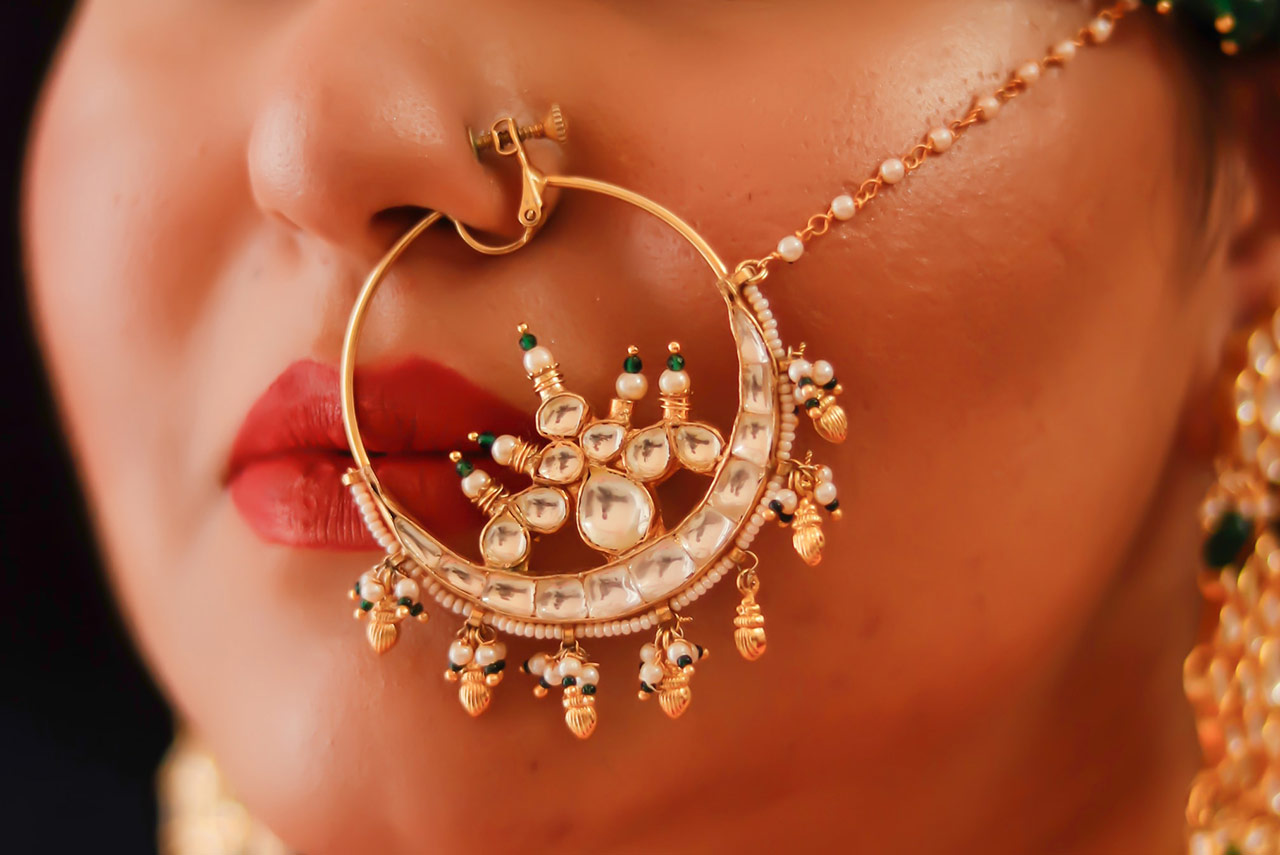
Solah-Shringar-Nath

Most married Hindu women choose to wear the Nath on the left nose, as the nerves leading from the left nostril are associated with the female reproductive organs. It is believed, Women who get their noses pierced by the ring of the nose had less distress and ache during birth. Some argue it does not hypnotise women, as the wavelength of the brain is curbed.

3. Bangles
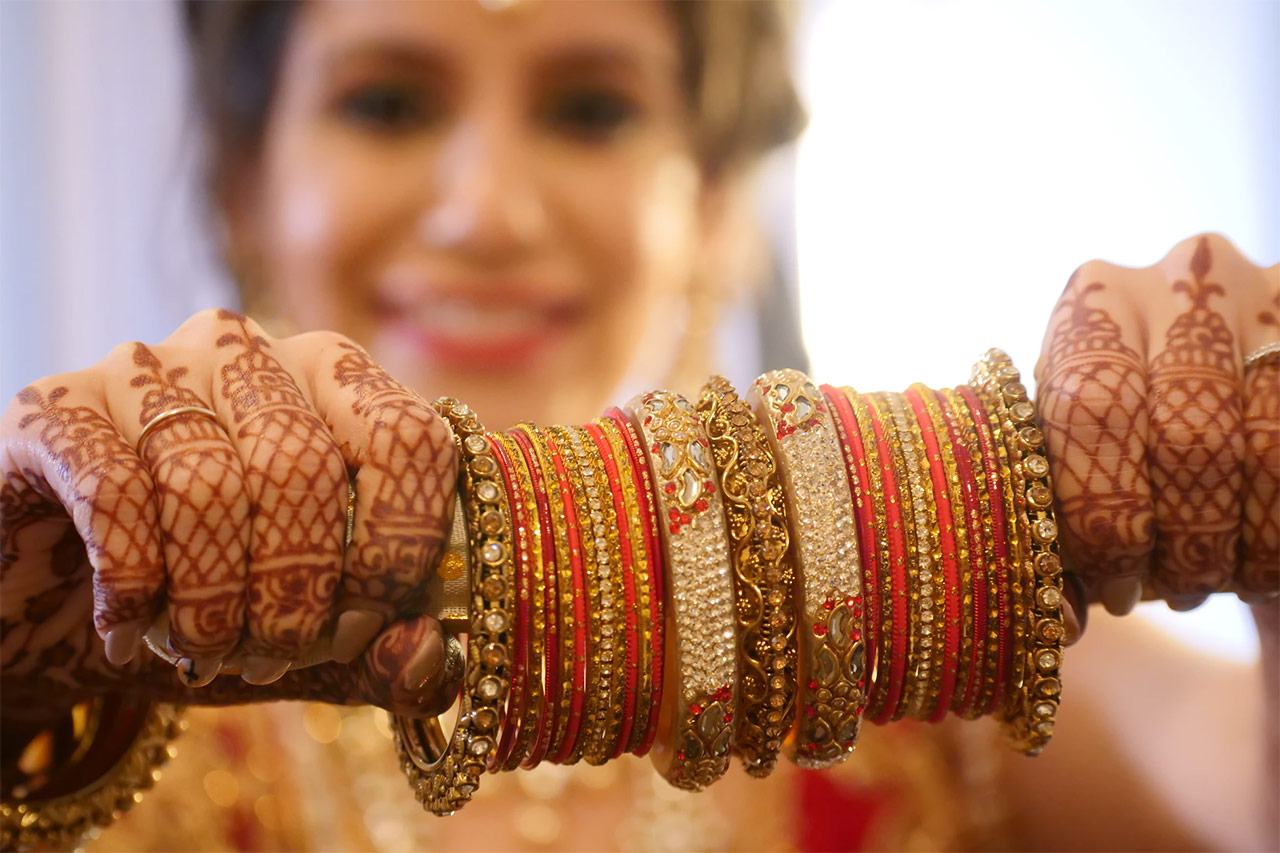
Solah-Shringar-Bangles

The word bangle comes from the traditional phrase ‘Bangri’ which in Sanskrit means ‘the adorning of the arm. Due to their round shape, the bracelets are supposed to stimulate a woman’s blood circulation and guide the cosmic energy coursing through her body back to her. The sound generates an aura around the body of women that protects them against all threats and evil spells. In various Hindu scriptures, this fact is presented quite discreetly. At the time when the bangles clash against each other, the Kriya Shakti (action waves) activate women’s Surya Nadi (sun channel). These waves spread over the female body and defend her against harmful atmospheric forces.

4. Bichhiya – Toe Ring
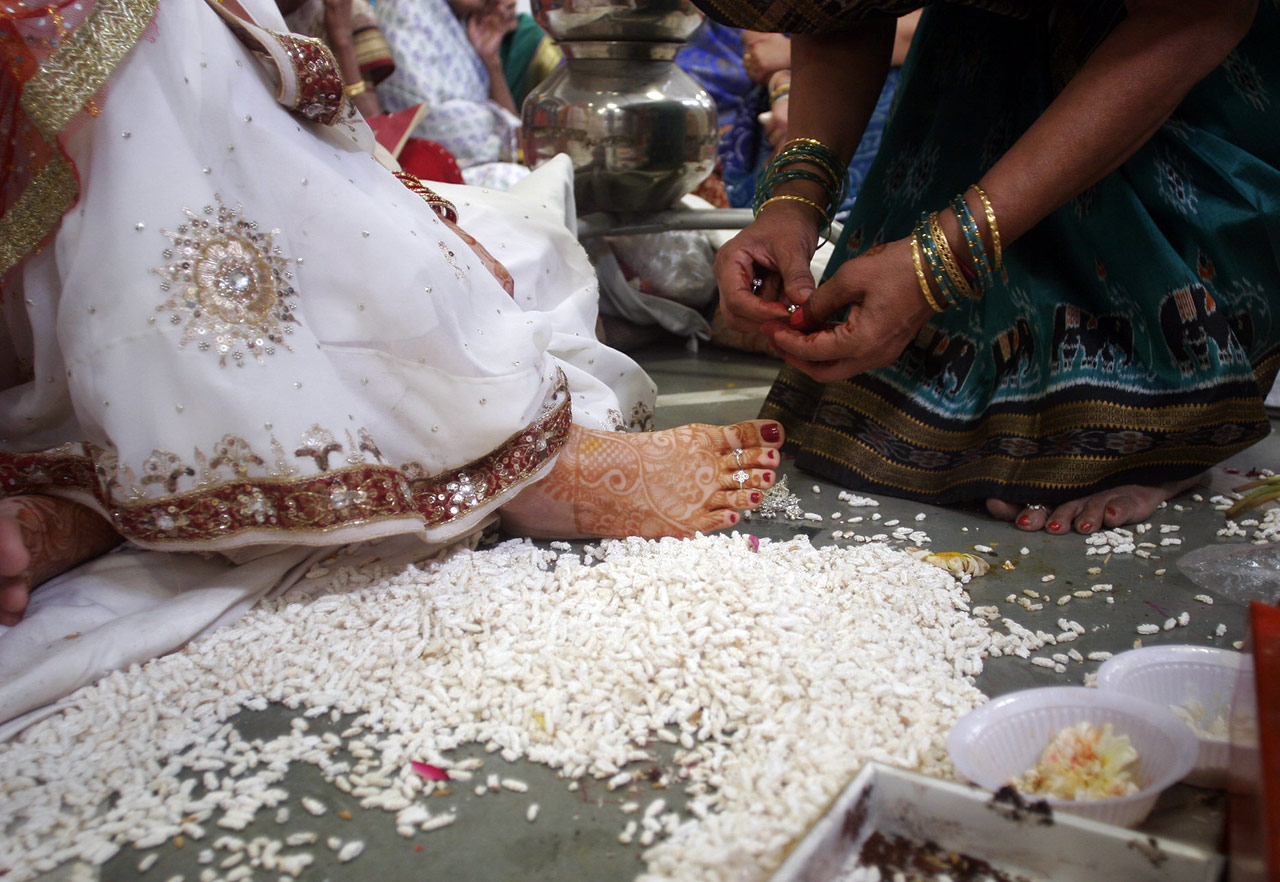
Solah-Shringar-Toe-Ring
Image – Anique/Flickr

Toe rings are said to regularise the menstrual cycle of the woman. The nerves of the second toe are attached to the uterus and friction and when the rings are worn, the rings help the reproductive organ to heal. The bicchiya or toe ring is traditionally adorned on the second toe of a married woman’s feet, whereas unmarried women wear it on the third toe. Donning a silver toe ring on the third toe by unmarried women is alleged to aid them to evade or at least reduce period pain.

For women who wear toe rings on the fourth finger, the nerve that runs through this finger is connected with brain neuron cells and Wearers’ health benefits from repeated metallic friction, which allows them to approach life with ease and confidence.

5. Haar – Necklaces

Solah-Shringar-Necklaces

Necklaces of various lengths, some arranged in the shape of a collar or choker, are strung with pearls, armband designs for Indian brides in gold pieces, and gold beads. The bride also wears necklaces crafted from floral garlands. The mangalsutra is the most traditional necklace, presented by the husband on the wedding day. It’s crafted with black beads. It is believed that blood pressure is controlled and blood circulation is improved by wearing necklaces like the mangalsutra.

6. Kamarbandh – Waistbands
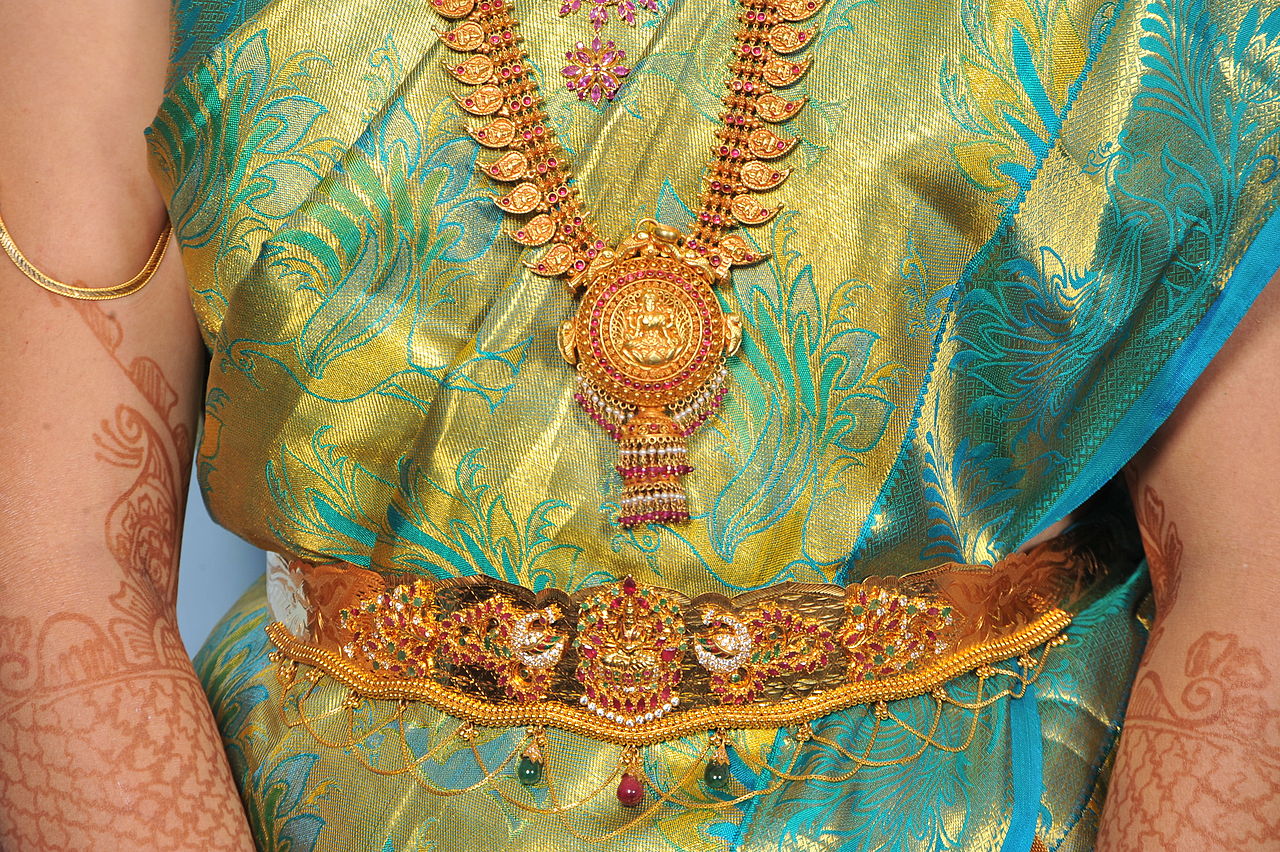
Solah-Shringar-Vaddanam
Image – Wikimedia

Waistbands are not commonly used these days, yet they help to keep a woman’s body by preventing fat saturation in the waist. Kamarbandhs are used to accentuate females’ elegant shapes. The waistband is composed of gold and silver and is embellished with gems. It is used to keep the sari in place.

7. Kajal

Solah-Shringar-Kajal

Kajal is solely used to highlight the size and appearance of the eyes. After all, the eyes are known as the soul’s windows because they express heartfelt emotions. Natural kohl or kajal can be made at home by collecting soot in a silver dish balanced above a candle burning in mustard oil. Camphor is sometimes added to the oil. This combination is applied to the outer rims of the eyes with a silver stick. It is stated that when it combines with natural tears, it protects the eyes from strong sunlight and dust.

8. Ear Ornaments
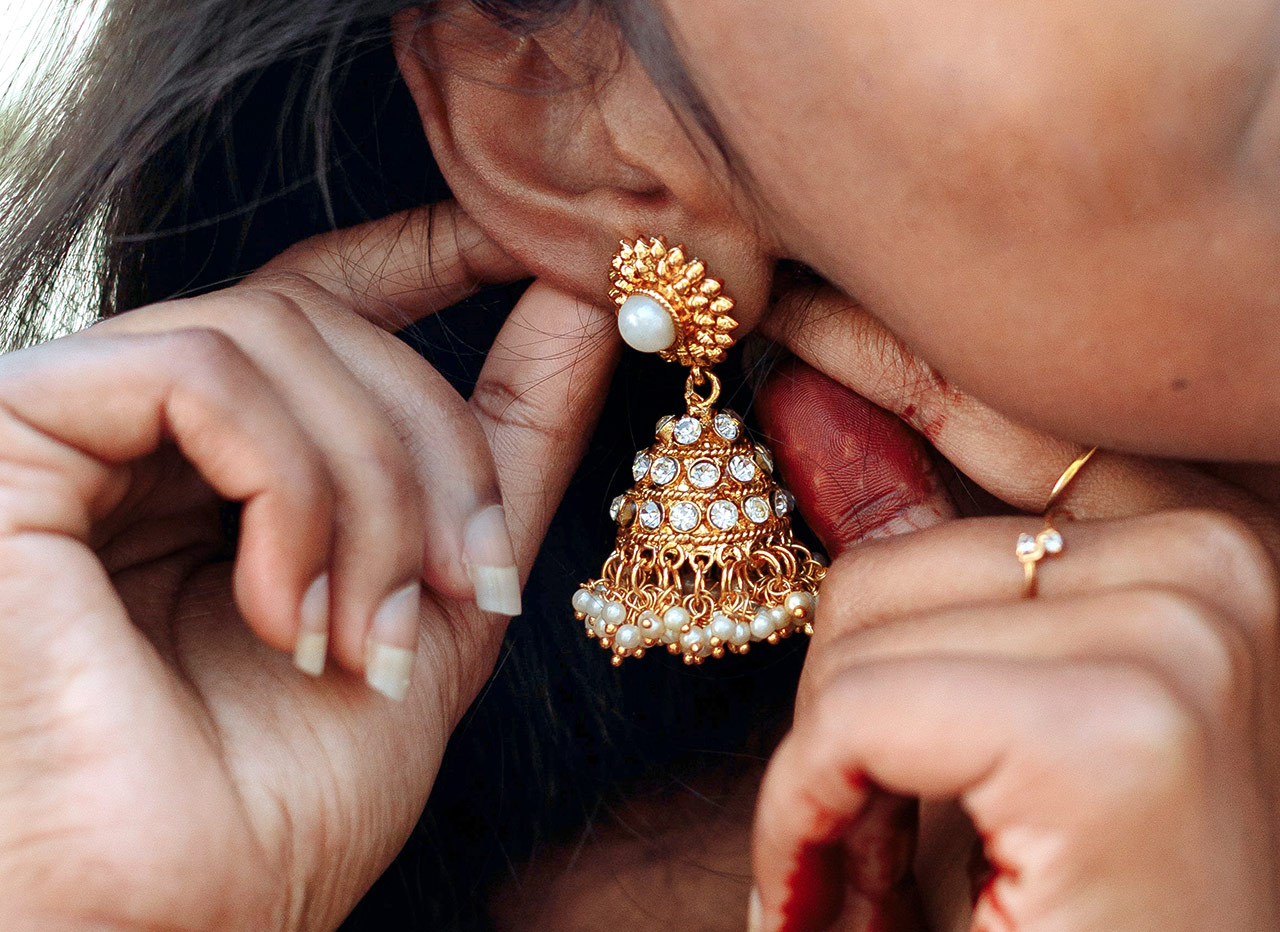
Solah-Shringar-Earrings

Earrings, such as Jhumkas, Danglers, Karn Phool, and Chandbalis, are a woman’s must-have beauty accessory. Earrings are ornately adorned pieces of jewellery made of gold or silver that are set with diamonds, Kundan, and other precious gemstones. Earrings with intricate ear cuffs and chains that hang from the lobe and ending with an adorned pendant are common. Karn Phool is thought to enhance the essential traits of the female form such as kindness and spiritual perfection. 

An acupressure point is located on the outer region of the ear where the earring is worn. Wearing an earring has an acupuncture effect and aids in the treatment of menstruation difficulties and aids in the health of the kidneys and bladder.

9. Mehendi

Solah-Shringar-Mehendi

Henna is an indigenous herb that is ground into a fine paste and applied to the bride’s hands and feet. The intricate mehndi designs create a deep crimson hue that signifies love, luck, prosperity, and fertility. Mehendi has a cooling effect and helps to relax the nerves. It cools the body and heals injuries and wounds.

10. Payal – Anklet
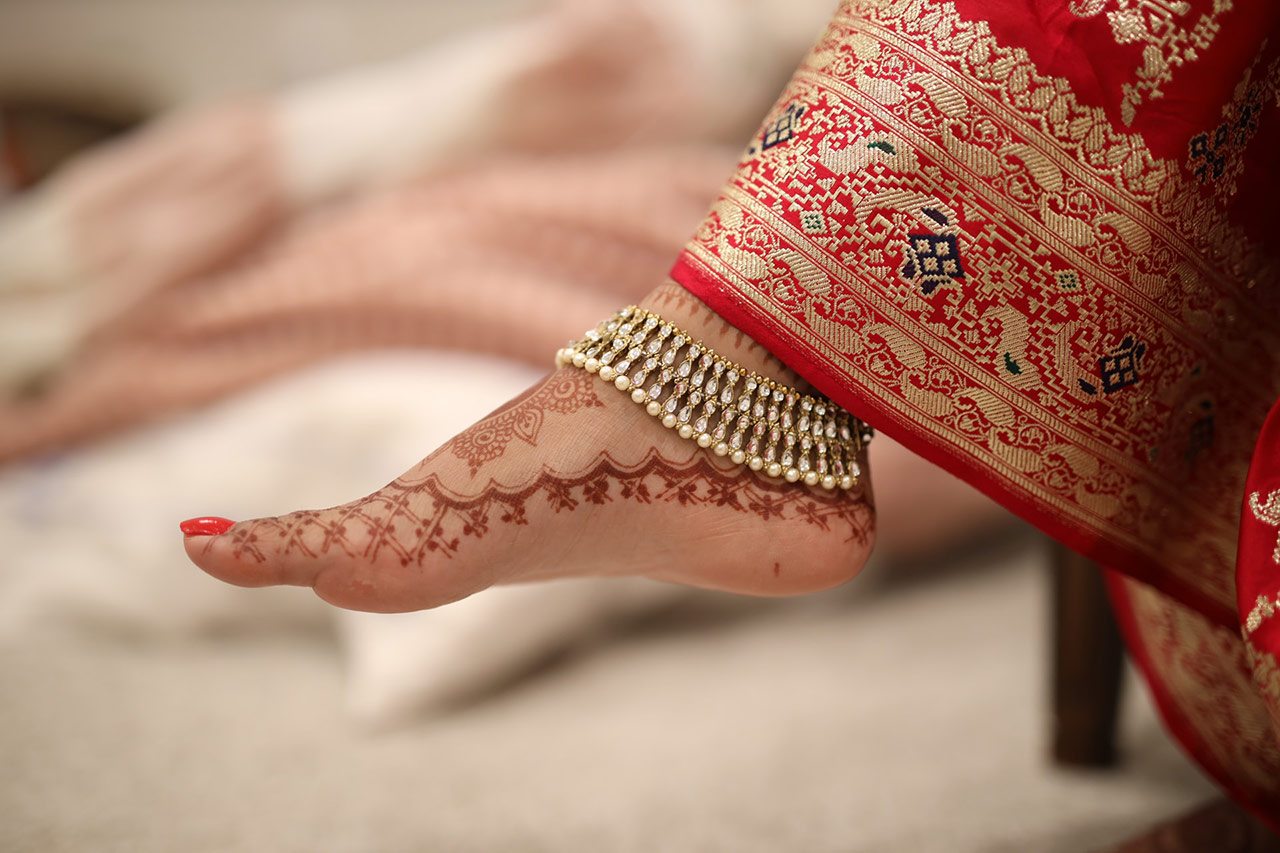
Solah-Shringar-Anklet

Anklets are typically made of silver and have a thin chain or a thick multi-layered pattern. A bride who wears anklets is deemed to be an incarnation of the goddess Lakshmi. Anklets cannot be made of gold since wearing gold on one’s feet is not considered good. Anklets provide relief from Sciatica, which is a discomfort caused by leg weakness. It is also supposed to aid with blood circulation and the treatment of swollen heels. Wearing anklets also improves immunity and aids in the treatment of menstruation disorders, hormone imbalance, infertility, and obstetrics.

Suggested Read – Anklets in Indian Culture – The Art and Science Behind Wearing It

11. Angoothee – Rings and Hathphool
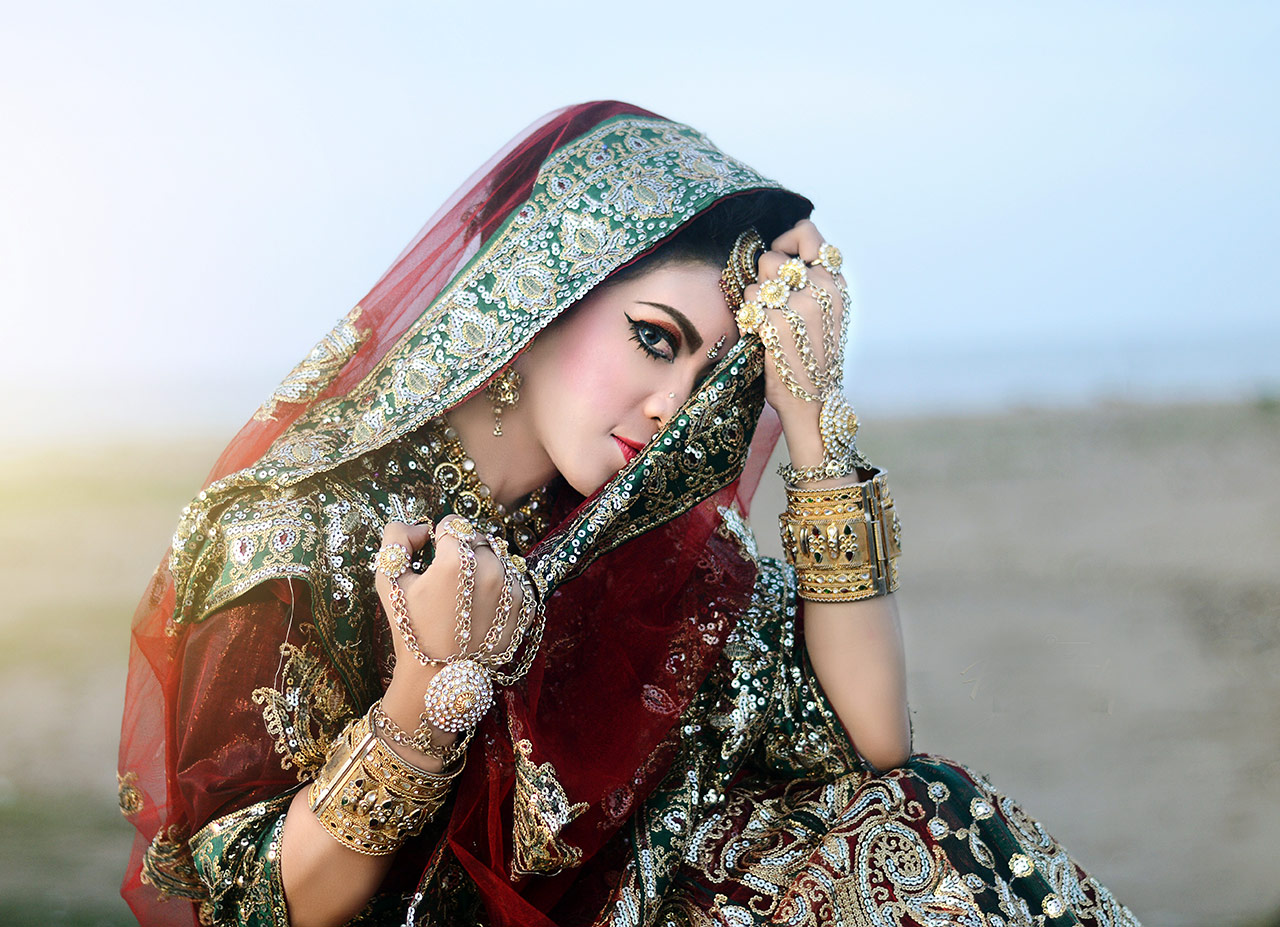
Solah-Shringar-Hathphool

On her hands, the bride wears eight rings, each with a focal floral or medallion pattern that covers her palmer side. This is referred to as Hathphool. Three of the Hathphool’s chains join to a bracelet, and five to each of the fingers, and they are connected to finger rings. The rings on your fingers stimulate brain activity and are hence beneficial to your health.

12. Mahur

Solah Shringar - Mahur
Image – Bengali Wedding

Just like Mehendi, the evident use of mahur, which is a red dye, used by women to adorn their hands and feet, can be seen in the Hindu Upanishads. The red of the alta symbolises life, fertility and prosperity. Alta was traditionally produced from the juice of beetle leaves. At times, kumkum (powder) in liquid forms were used to paint the hands and feet red. Alta is also known as Mahur. The vibrant shade of alta is an essential feature of Bengali and Odissi celebrations. The Bengalis’ most prominent celebration, Durga Puja, would be unfinished without the use of alta by married women. Not just the women, but even the idols of Goddess Durga’s feet and hands are gorgeously outlined with the alta’s rich colour. In Bengali weddings, the alta becomes the centre of a significant ritual after the wedding.

13. Bajuband – Armbends, Armlets

Solah-Shringar-Bajuband

In Rajasthani, Mughal, and Jaipuri weddings, the Baaju-band is commonly observed. Armlets are constructed out of pearls or diamonds set in gold and wrapped on the upper arm. The Armband aids in the regulation of blood circulation in the arms and provides just enough resistance to keep your arm relaxed.

14. Sindoor

Solah-Shringar-Sindoor
Image – Wikimedia

Sindoor is a red-coloured powder that is applied to the centre parting of a bride’s hair. This is a sacred symbol of a married woman (Suhaag) in the country, just like rings are in western countries. Young girls do not put Sindoor ahead of marriage. For the first time, the groom places vermillion on the bride’s head during wedding rites. In certain Hindu cultures, it is necessary to have Sindoor on a married woman’s forehead all the time. Sindoor, which is made from turmeric, lime, and a trace of mercury metal, cools the body and relaxes the bride. As the wife’s obligations grow, the stress on her body might be detrimental. Wearing a sindoor keeps her emotionally calm and in control.

15. Aarsi
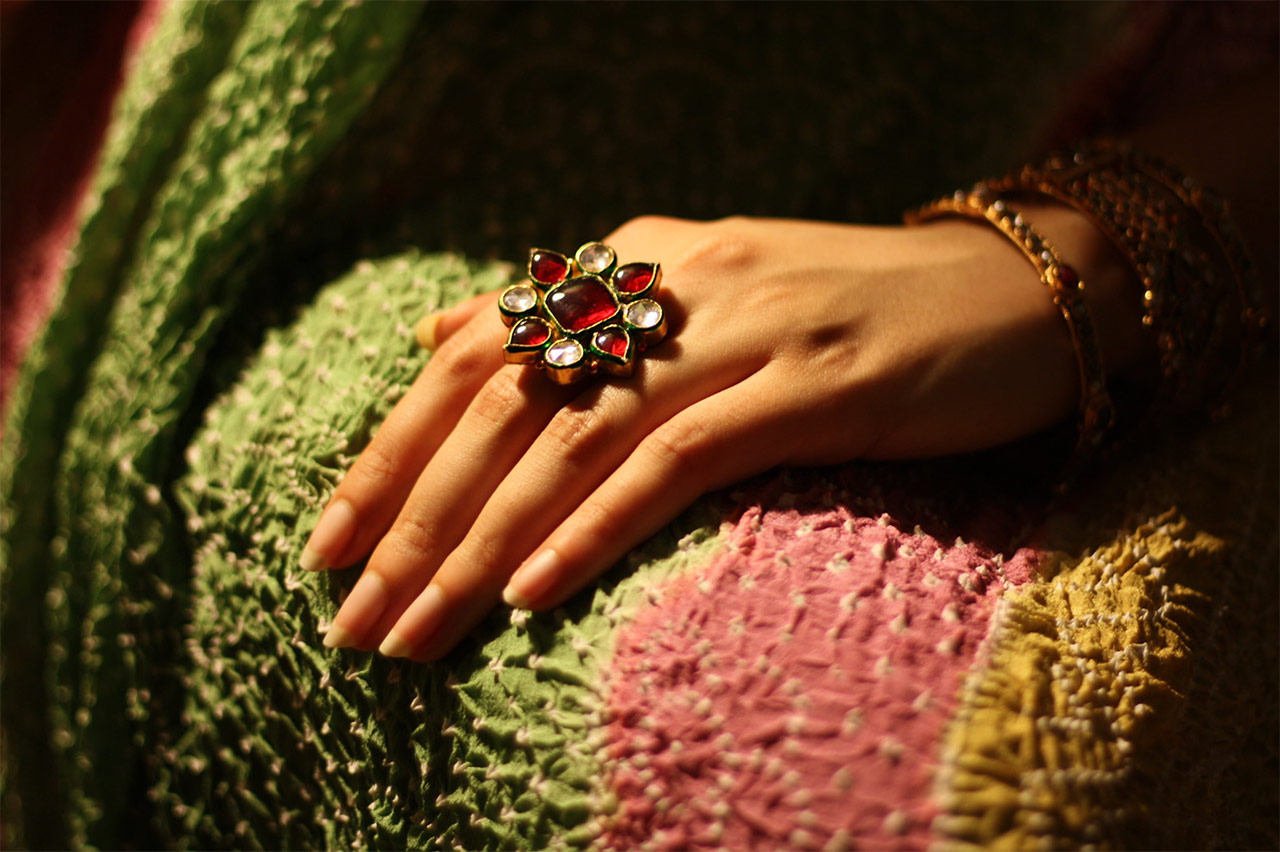
Solah-Shringar-Aarsi
Image – s_afzal/Flickr

The bride also wears an aarsi, which is a thumb ring. It usually has a stunning type of mirror work incorporated in it that allows the bride to see herself. It was also used to catch a glimpse of her future life partner because during wedding rites the woman wears a veil and cannot see the groom’s face.

16. Keshapasha Rachana – Hair Accessories
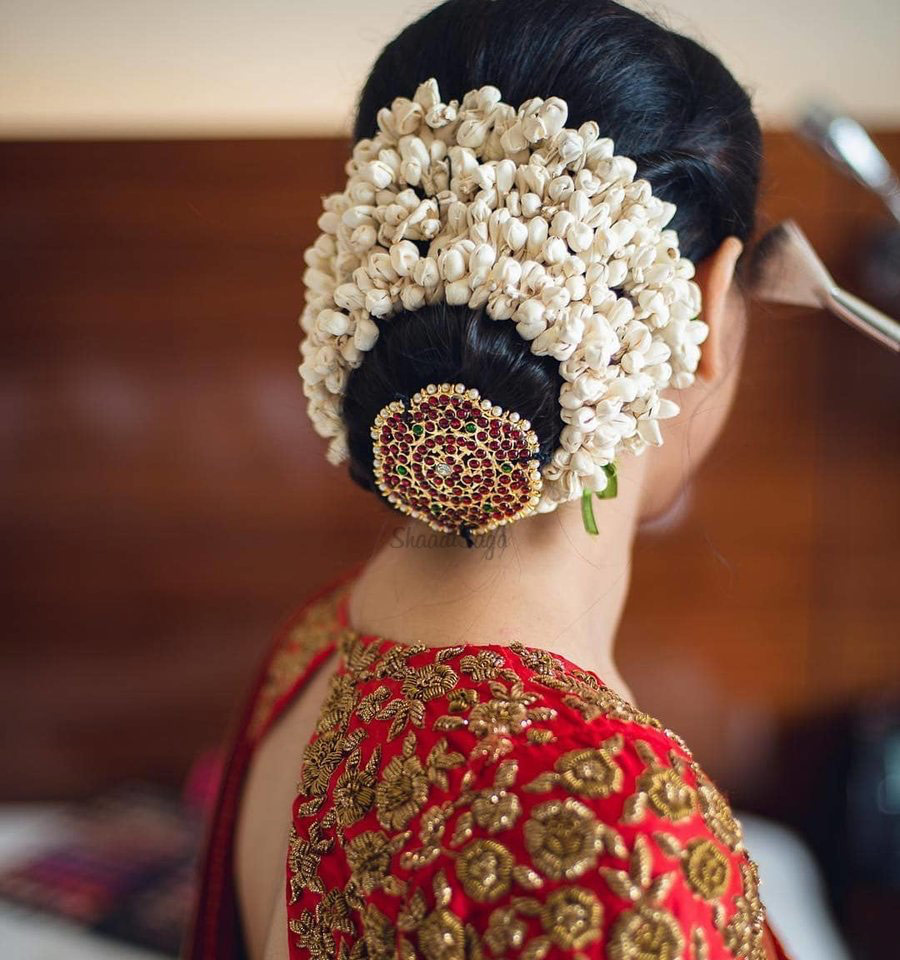
Keshapasha-Rachana
Image – Shaadisaga

Wedding hair accessories come in a number of styles and designs. Each culture has its own style in which hair is decorated. While Gajra, a few meters long, is utilized for some cultures, Keshapasharachana is one of the famous hair accessories to the south. The bride usually knots her hair into a traditional braid or bun, which is adorned especially with gold and floral decorations. Because of their long-lasting smell, jasmine flowers have been historically employed.

Final Thoughts

India is the land of numerous cultures, rituals and customs. The rituals are beliefs that have been passed down to us from our ancestors and our societal practices have developed around these ideas. It is a very usual custom to bless a newborn or a new bride by presenting gold jewellery of good fortune on them. Even kids and babies are made to wear jewellery to protect themselves from diseases. Despite traditionalists’ claims, the medical evidence does not support claims that ornaments improve the health of those who wear them.
FAQs About Solah Shringar

Question: What are the 16 Shringars?

Answer: The 16 Shringars are traditional adornments including bindi, earrings, bangles, necklaces, and more, symbolizing beauty, grace, and spiritual energy in women.

Question: What are the benefits of Solah Shringar?

Answer: The benefits of Solah Shringar include enhancing physical beauty, improving health through symbolic adornments, and promoting spiritual well-being by balancing cosmic energy.

Question: What are the items of Solah Shringar?

Answer: The 16 items of Solah Shringar include bindi, nath (nose ring), bangles, bichhiya (toe rings), haar (necklaces), kamarbandh (waistband), kajal, ear ornaments, mehendi (henna), payal (anklet), angothi (rings), mahur (alta), bajuband (armlets), sindoor, aarsi (thumb ring), and keshapasha rachana (hair accessories).

Question: What is the meaning of Sola Singar?

Answer: Solah Singar refers to the traditional 16 adornments that symbolize a woman’s beauty, grace, and spiritual energy in Indian culture.

Weekend Getaways in Kerala: 7 Scenic Destinations You Can’t Miss

1

Places-To-Visit-in-Kerala-for-Weekend-Getaways-02

Kerala, also known as God’s own country, is where nature and culture coexist—surrounded by serene backwaters, misty hills, beautiful beaches, and vibrant traditions. Kerala is sure to give some memorable travel experiences in India. So if you want to escape the city life, Kerala can be the best option for weekend getaways. The beautiful places promise peace, adventure or a mix of both. Here is a list of seven places to visit in Kerala for weekend getaways. 

Munnar

Places To Visit in Kerala for Weekend Getaways-Munnar

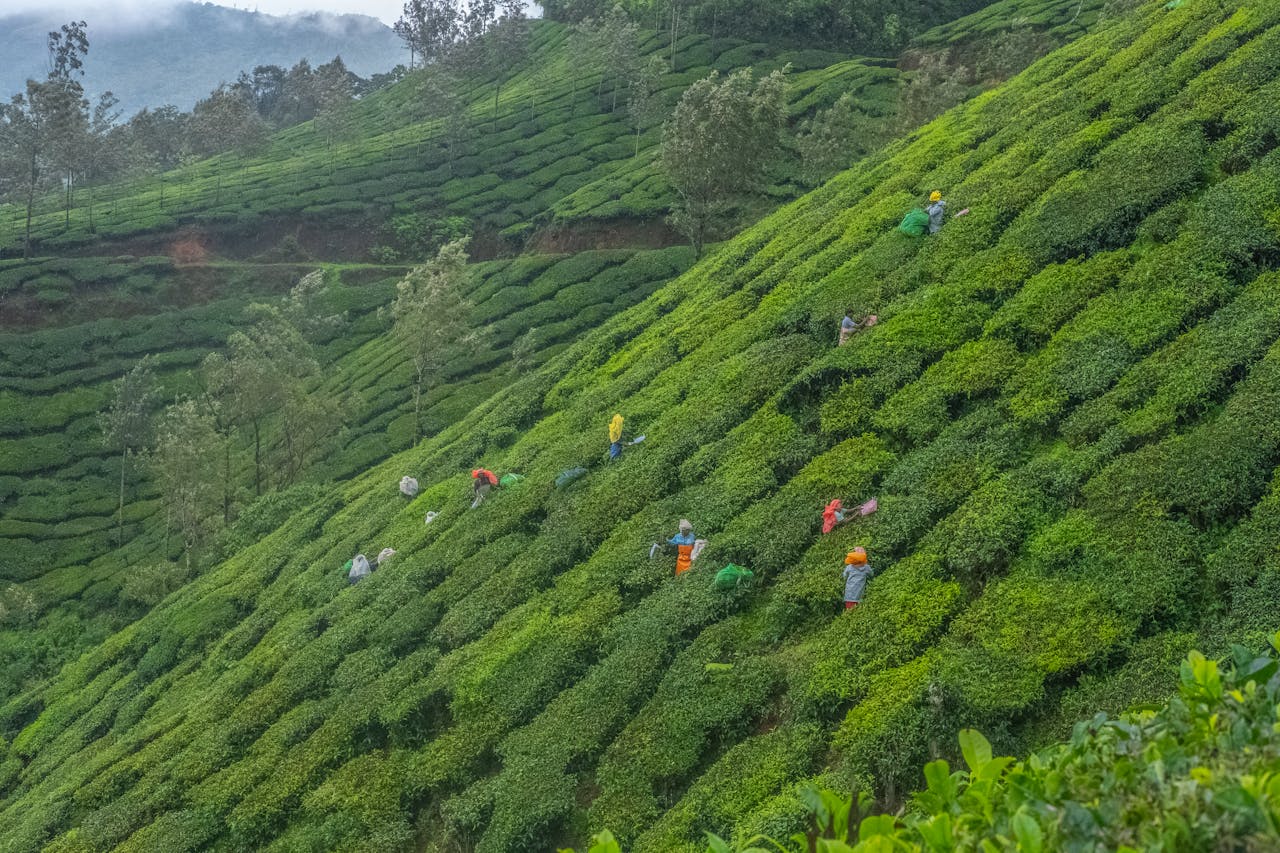
Munnar is a beautiful hill station in the Western Ghats, popular for its tea gardens, cool climate, and beautiful scenery. Just a few hours from Kochi, this is a lovely place for those seeking a peaceful retreat amid nature. Walk through the sprawling tea estates, even visit the Tea Museum to learn about the region’s heritage, or go hiking or trek to the viewpoints, Top Station, and get those panoramic views for your eyes.

And when you are there, don’t miss the Ervaikulam National Park, home to the endangered Nilgiri Tahr, and a beautiful Mattupetty Dam, where you can enjoy a peaceful boat ride. This is the best place for couples and even solo travellers, just wanting to unwind in the lap of nature. 

Alleppey

Alleppey-Dream
Source

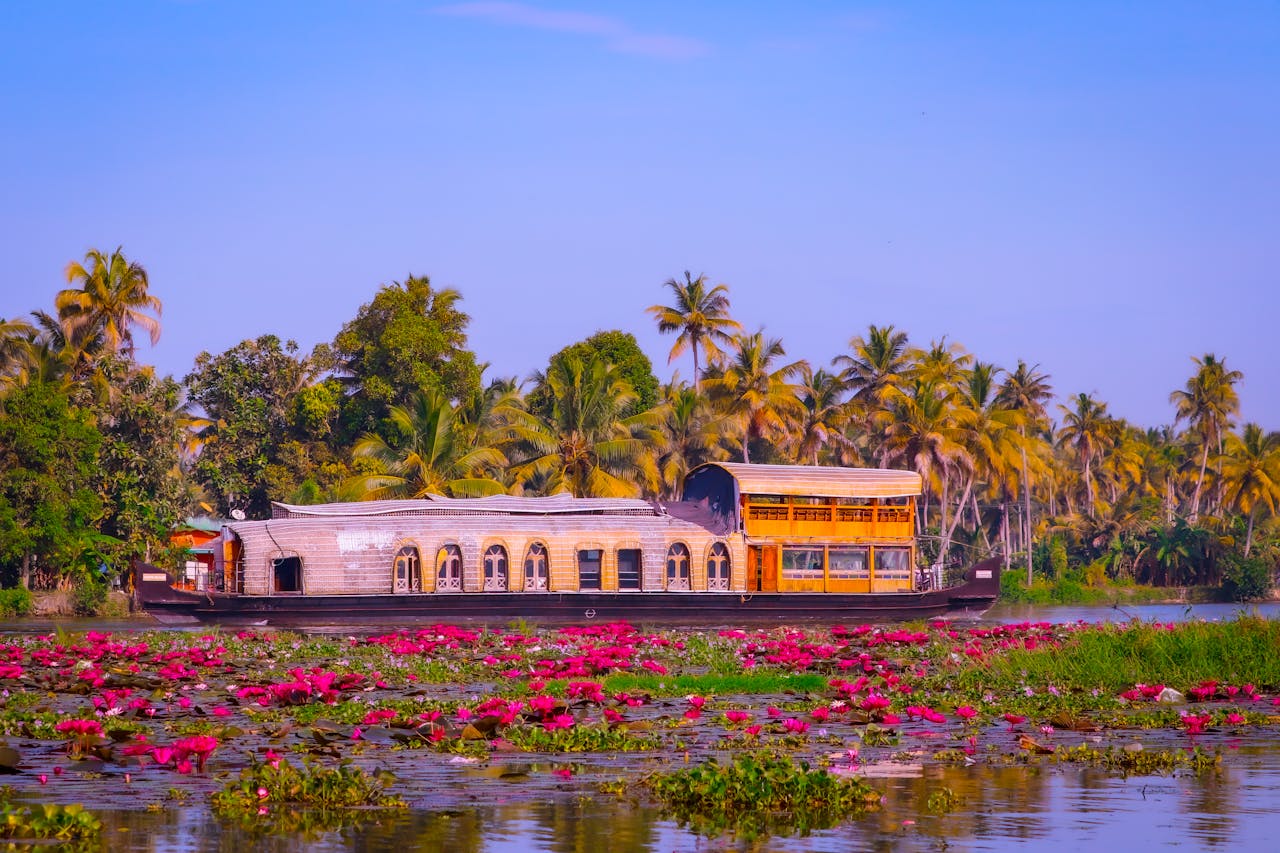
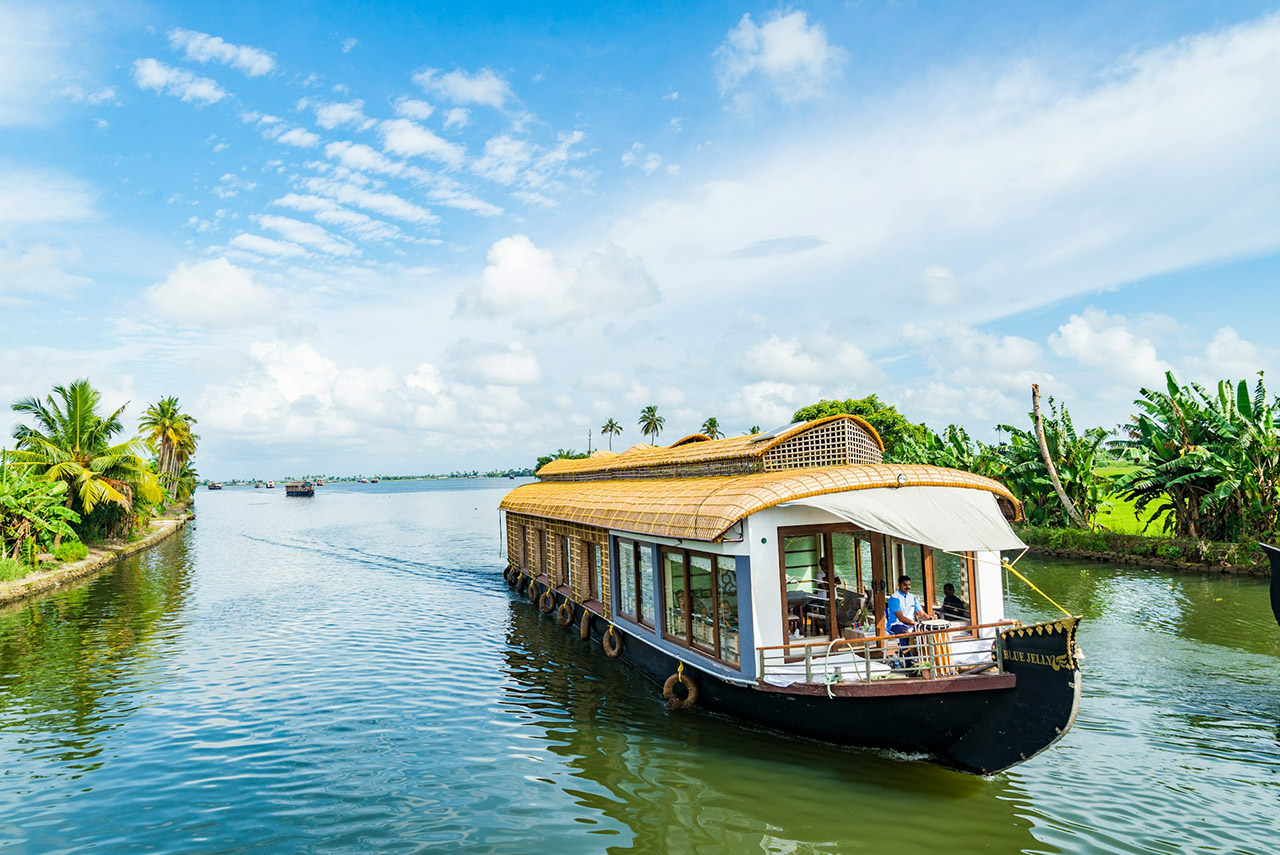
Ever wondered or dreamt of gliding through tranquil waters on houseboats? Well, Alleppey is the place where this dream can come true. It is famous for the vast network of backwaters, which is lined with coconut palms and lush paddy fields. You can opt to spend a weekend on the traditional kettuvallam, which is a houseboat, you can experience the rural heritage, fishermen at work, try the authentic Kerala dishes, no matter who you are travelling with or even if solo, Alleppey offers a true escape. 

Wayanad

Places-To-Visit-in-Kerala-for-Weekend-Getaways-Wayanad

For those nature seekers who like adventure wrapped in nature, this can be your best weekend getaway, mainly due to the thick forests, stunning waterfalls, spice plantation and the wildlife. 

While here, you can trek to Chembra Peak, quite popular for its heart-shaped lake, and explore the Edakal Caves with the stunning rock engravings. The Soochipara and Meenmutty waterfalls are the best places to dip after the hike. Hence, this can be perfect for outdoor enthusiasts. 

Varkala

Places-To-Visit-in-Kerala-for-Weekend-Getaways-Varkala

If beaches are your thing, Varkala offers beautiful beaches with its unique coastal experience in a cliffside setting. The cliffs overlook the Arabian Sea and have various cafes, yoga retreats and small shops. 

The Varakala beach, also known as the Papanasm Beach, has holy water that is known to wash away sins. You can relax on the beach, watch the sunsets, and visit the 2000-year-old Janardanaswamy Temple if you like. Varakala is perfect for solo travellers who are on a spiritual journey.

Thekkady

Places-To-Visit-in-Kerala-for-Weekend-Getaways-Thekkady

Thakkady is located in the Idukki district and is also home to the Periyar Wildlife Sanctuary. For anyone looking for wildlife, this is the best place to spend your weekend in Kerala. The best part about this place is the boat ride at Periyar Lake, where you can spot elephants, deer, and different species of birds in their natural habitat. But that’s not it; you can even explore spice plantations, take up bamboo rafting, or go on a guided jungle trek. Thekkady is a perfect escape from the wifi to wildlife and nature. Suppose you are planning your trip during the rainy season. In that case, you can also check out the best places to visit during monsoon season in Karnataka for travel inspiration. Both locations offer stunning landscapes and a unique experience during the monsoon.

Kumarokam

Places-To-Visit-in-Kerala-for-Weekend-Getaways-Kumarokam

Kumarokam is another gem in Kerala’s backwaters. It is situated on the banks of the Vembanad Lake and is mainly famous amongst the bird watchers. The bird sanctuary also hosts migratory species like Siberian cranes and herons. You can experience your life by kayaking through the canals and enjoying the lakeside resorts’ seafood, or just relaxing in the peaceful surroundings. Kumarokam is an ideal place to visit if you want a more slowed-down, backwater experience. 

Kovalam

Places-To-Visit-in-Kerala-for-Weekend-Getaways-Kovalam

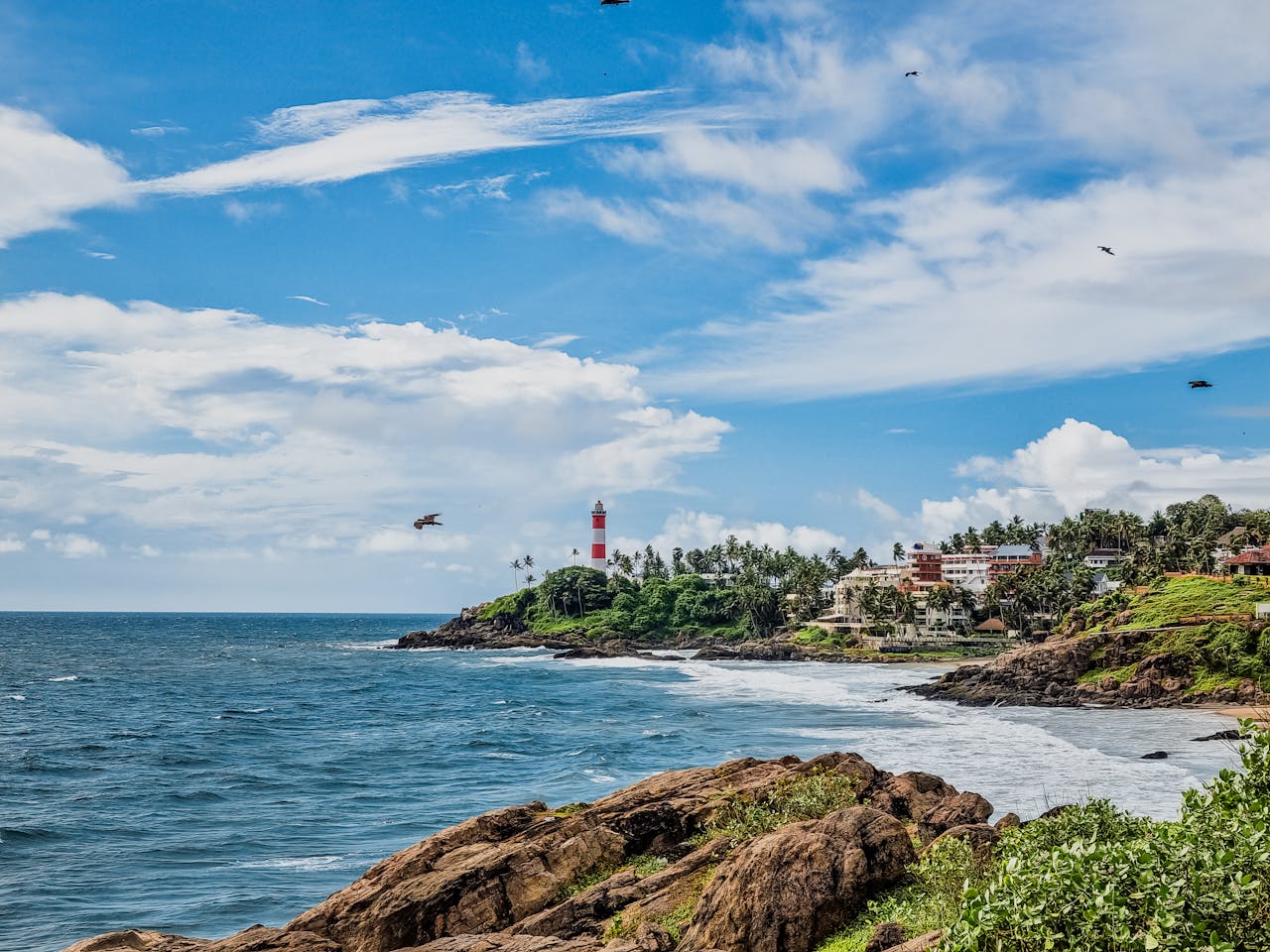
Last but not least, Kovalam is just 16km away from Thiruvananthapuram for a more coastal vibe. The beach destination is famous for its crescent-shaped coastline, lighthouses, and water sports.  Every place, including Lighthouse Beach, Hawa Beach, or Samudra Beach, has its beauty. No matter what you are looking for, surf, swim, or relax by the shore. These beachside restaurants serve delicious seafood, and the Ayurvedic Spas can be a great way to relax and unwind during your weekend here. Kovalam is an excellent place for family trips, groups of friends and even solo travellers. 

Final Thoughts

Kerala has something for everyone: serene backwaters of Alleppey, cool hills with vibrant views of Munnar, and beautiful beaches in Kovalam. As you explore these destinations, you will see how rich and diverse South India. While planning your trip, don’t be disheartened if it is expensive; these places are within budget for a weekend getaway, and you can also check popular travel booking websites like Agoda, MakeMyTrip etc. You can get exclusive discounts and coupons on hotel and flight bookings through platforms like CouponzGuru. Comparing various travel sites can help you save more while enjoying a weekend getaway.

Best Places to Visit in Karnataka During Monsoon

0

Best-Places-to-Visit-in-Karnataka-During-Monsoon-01

Why Karnataka is best for monsoon travel?

Located in the southern part of India, Karnataka is one of the most culturally diverse and physiographically beautiful states. However, as for the touristic attractiveness the state has a constant flow of tourists all the year round; the monsoon which falls from June up to September turns the territory into the green zone. Owing to the rains which bathe the whole region with considerable waterfalls, forests with dogs which make it a darling of tourists, trekkers, and photographers. Today’s article will focus on top attractions to explore in Karnataka during the monsoon, with the combination of scenic and historic spots and extraordinary activities that are opened with the beginning of the rainy season.

List of Top 10 Monsoon Destinations in Karnataka

Monsoon Destinations Key Attractions
Coorg (Kodagu) Misty coffee plantations, Abbey Falls, and lush green hills.
Agumbe Rainforests, waterfalls, and one of the highest rainfalls in India.
Jog Falls India’s second highest plunge waterfall at its full monsoon glory.
Chikmagalur Verdant coffee estates, trekking trails, and soothing weather.
Dandeli Wildlife sanctuary, river rafting, and scenic forest drives.
Sakleshpur Green hills, ancient forts, and the misty charm of the Western Ghats.
Hampi Ruins and boulders drenched in monsoon greenery; a serene heritage spot.
Nandi Hills Cool, foggy mornings and panoramic views near Bengaluru.
Kudremukh Breathtaking mountain peaks, lush meadows, and monsoon trekking trails.
Kabini Monsoon wildlife safaris, river backwaters, and luxury nature resorts.

1. Coorg (Kodagu)

Best-Places-to-Visit-in-Karnataka-During-Monsoon-Coorg
Abbey Falls, Coorg
Located in the Western Ghats, Coorg or Kodagu as it is locally referred to, is widely regarded as the ‘Scotland of India’ because of its terrain marked by hills and greenery. This coffee producing area takes on added beauty during the monsoon season. The sprawling green coffee gardens especially those that are interspersed with pepper vines and cardamom give a rich feast to the eyes.
Key Attractions
Abbey Falls One of the most picturesque waterfalls, especially during monsoons, nestled in lush forests.
Talacauvery The sacred origin of the Cauvery River, surrounded by mist-covered hills in monsoon season.
Dubare Elephant Camp Visitors can interact with elephants and assist in bathing them in the overflowing river.
Raja’s Seat Offers panoramic views of misty valleys and is a popular sunset viewpoint during rains.
Activities
Nature Walks Explore green forests and aromatic spice gardens filled with monsoon vitality.
Kayaking on Barapole Thrilling white-water kayaking when the river swells during peak rains.
Coffee Tourism Take guided tours through estates to learn how coffee is grown, processed, and brewed.

2. Chikmagalur

Best-Places-to-Visit-in-Karnataka-During-Monsoon Chikmagalur

Subsequently, another town located in the Western Ghats of the country is Chikmagalur which is recognized for coffee plantation, hilly terrain and fine climate. The monsoon brings out the beauty of this hill station; the clouds that envelope the top of the hills and the falling water streams.

Key Attractions
Mullayanagiri Peak Karnataka’s tallest peak with spectacular views, especially after a light shower.
Baba Budangiri Sacred hill range surrounded by greenery, ideal for peaceful hiking experiences.
Hebbe Falls Twin waterfalls that gush vividly during monsoon; requires a slightly challenging trek.
Kemmangundi Scenic hill station famed for its rose garden and trekking paths — lush in the rains.
Activities
Jeep Tours Ride through sprawling coffee plantations for a rugged monsoon adventure.
Bird Watching Explore Bhadra Wildlife Sanctuary to spot exotic birds among the monsoon greenery.
Architectural Visits Admire Hoysala architecture at Halebidu’s iconic Hoysaleswara Temple nearby.

3. Agumbe

Best-Places-to-Visit-in-Karnataka-During-Monsoon-Agumbe
Image/Wikimedia
Also referred to as the Cherrapunji of the South because of its rainfall, Agumbe is a much-sought-after destination for, both, researchers and nature enthusiasts. This village is located in the region called Malnad and it is known for its Biodiversity and presence of this most magnificent reptile called the King Cobra!
Key Attractions
Sunset View Point Offers a breathtaking view of the sun dipping into the Arabian Sea on clear evenings.
Kundadri Hill A monolithic hill with a Jain temple and panoramic views of lush green valleys.
Jogigundi Falls A tranquil waterfall near the main trail — best visited during the monsoon season.
Sita River Swells during monsoons to create thrilling rapids and scenic mini waterfalls.
Activities
Rainforest Walks Explore dense rainforests teeming with life during the monsoon mist.
Chameleon Tracking Visit the Agumbe Rainforest Research Station to observe unique reptile species.
Kudremukh National Park Visit Take a guided trip to the nearby park — a biodiversity hotspot during monsoon.

4. Jog Falls

Best-Places-to-Visit-in-Karnataka-During-Monsoon-Jog-Falls

Jog Falls, the second highest plunge waterfall in India,looks more magnificent during the monsoon season. The four different drops Raja, Rani, Roarer, and Rocket make a breathtaking view as they fall 253 meters into the Sharavathi river.
Key Attractions
Waterview Point Offers a panoramic view of Jog Falls in its full might and monsoon glory.
Linganamakki Dam Source of the Sharavathi River; majestic sight during peak rainfall season.
Sharavathi Valley Lush green valley near the falls, ideal for nature walks and birdwatching.
Activities
Waterfall Trek Trek down to the base of Jog Falls when trails are safe and accessible.
Photography Capture dramatic views of cascading water and misty cliffs.
Honnemaradu Visit Take a detour to the peaceful Honnemaradu Reservoir for a scenic break.

5. Gokarna

Best-Places-to-Visit-in-Karnataka-During-Monsoon-Gokarna
Om Beach – Well-Bred Kannan/Flickr
Although Gokarna is famous for its beaches, the town transforms during the monsoon. Due to the high rate of rainfall, there are few people on the shores, the acting skies, and the abundance of greenery give guests a worthy atmosphere.
Key Attractions
Om Beach Om-shaped beach, peaceful and less crowded during monsoons — ideal for solitude and reflection.
Mahabaleshwar Temple This ancient Shiva temple looks serene and spiritually vibrant amidst the seasonal rains.
Paradise Beach Accessible only by boat or trail, it becomes a lush, monsoon-symphonic tropical escape.
Mirjan Fort A 16th-century fort shrouded in greenery — echoes with tales of the region’s rich history.
Activities
Beach Walks & Sightseeing Enjoy long scenic strolls along misty shores and capture the coastal charm.
Cultural Visits Explore ancient temples and soak in the spiritual ambiance of monsoon Gokarna.
Ayurveda & Yoga Experience monsoon rejuvenation with traditional Ayurvedic therapies and peaceful yoga retreats.

6. Dandeli

Best-Places-to-Visit-in-Karnataka-During-Monsoon-Dandeli

Dandeli is situated in the Western Ghats which is arguably one of the best places for adventure and wildlife lovers. Due to the heavier inflow of rainfall, the season of monsoon even boosts the number of activities possible here.
Key Attractions
Dandeli Wildlife Sanctuary Home to black panthers, elephants, and exotic birds — comes vibrantly alive during monsoons.
Syntheri Rocks Towering 300-ft tall rock formations carved by the Kaneri River — best viewed in the rainy season.
Kavala Caves A geological marvel with limestone formations — great for explorers and history buffs.
Activities
Trekking & Rafting Trek through lush trails or go white-water rafting in the Kali River during optimal water levels.
Kayaking & Canoeing Paddle through calm waters while enjoying the scenic monsoon landscape.
Nature Walks & Birding Spot unique birds and flora on serene forest trails under the monsoon canopy.
Tribal Village Tours Connect with indigenous communities to experience their culture and lifestyle firsthand.

7. Hampi

Best-Places-to-Visit-in-Karnataka-During-Monsoon-Hampi

Hampi is famous for history and architecture mostly focusing on its rich architectural heritage, and things change completely during monsoon. That is why watching the ancient stone structures in the context of dramatic skies and the fascinating background of the greenery becomes rather mesmerizing.
Key Attractions
Virupaksha Temple Rain-washed temple stones gleam with age-old carvings; a serene and sacred monsoon sight.
Vittala Temple Famed for its stone chariot and musical pillars — enhanced beautifully during the rainy season.
Matanga Hill Offers a misty bird’s eye view of Hampi’s boulders and terrain, best seen post-rain.
Tungabhadra River Meanders through bouldered valleys, creating dramatic monsoon visuals around ancient ruins.
Activities
Temple Visits Explore ancient shrines soaked in monsoon charm, history, and spirituality.
Coracle Ride Float across calm stretches of the Tungabhadra River in traditional round boats.
Monument Photography Capture dramatic landscapes and temple silhouettes against rainy-season skies.
Daroji Bear Sanctuary Take a short trip to spot sloth bears in their monsoon-active habitat nearby.

8. Nandi Hills

Best-Places-to-Visit-in-Karnataka-During-Monsoon-Nandi-Hills

Nandi Hills, a summer resort near Bangalore is a perfect Holiday destination during the monsoon season. It has nice clear weather conditions, rich historical backgrounds and views of terrains.
Key Attractions
Tipu’s Drop A mist-covered cliff with panoramic views of the landscape — breathtaking during monsoons.
Nandi Temple Home to iconic Nandi statues and peaceful surroundings, enhanced by seasonal greenery.
Amrita Sarovar A tranquil lake framed by lush trees, offering serenity during the rainy season.
Tipu Sultan’s Summer Palace Historic site that offers insight into Tipu’s reign, rich with heritage and rain-soaked charm.
Activities
Nature Walks Enjoy forest trails and misty paths ideal for peaceful strolls in monsoon air.
Paragliding Soar above the hills — weather permitting — for a thrilling aerial view of the landscape.
Hill Rides Ride through winding hill roads surrounded by lush rain-fed greenery.
Birdwatching & Photography Spot local avian species and capture the misty vistas through your lens.


9. Kudremukh

Best-Places-to-Visit-in-Karnataka-During-Monsoon-Kudremukh

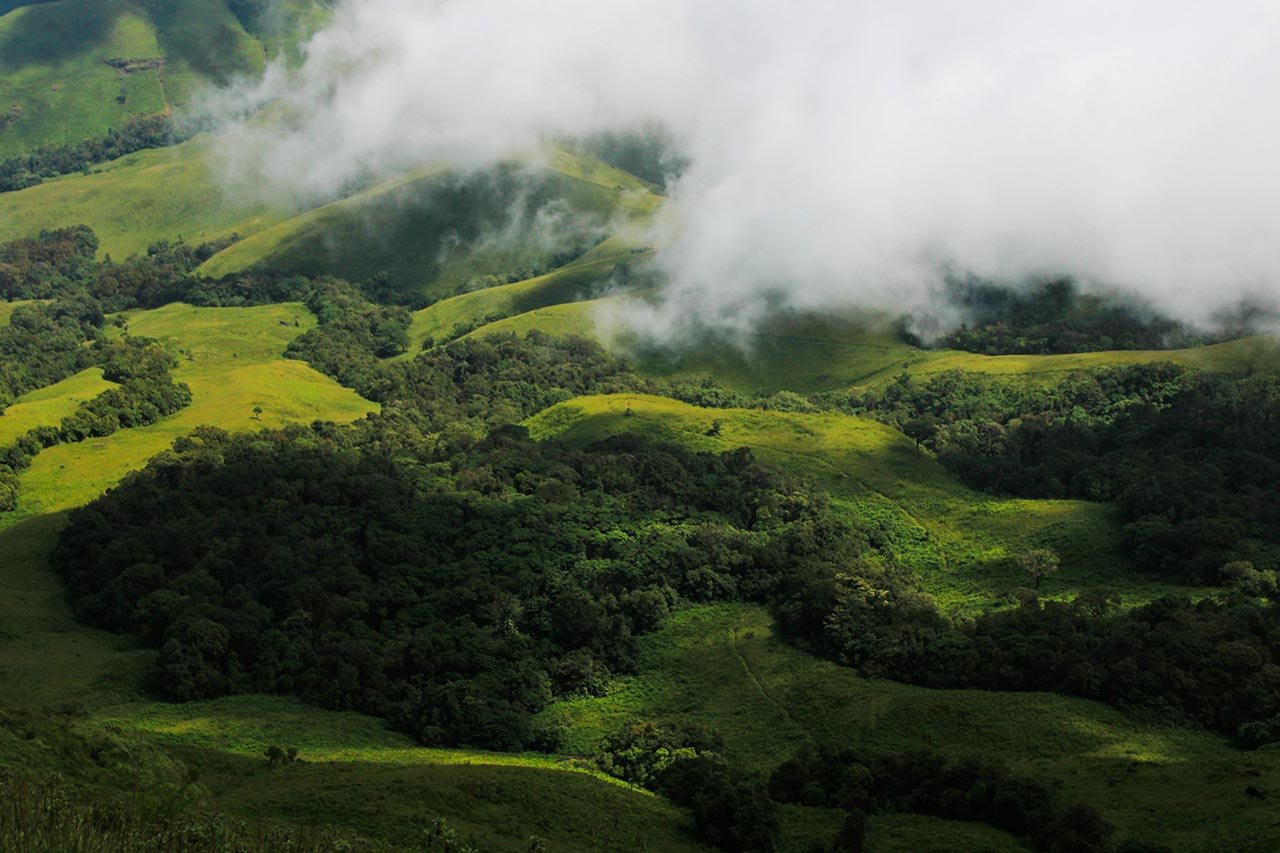
“Kudremukh” the word literally means the face of a horse, is a beautiful hill station situated deep in the western ghats in Chikmagalur district of Karnataka. Characterized by its rolling green hills and stunning cloud-caressed mountains, Kudremukh is a paradise for trekkers and nature lovers. It’s the monsoon blowing life back into the area, with color painted into the vegetation, mist on the trails, and the roar of waterfalls. One of Karnataka’s favourite trekking destination, the place is known for a memorable forest walk that takes you through the thickest of the jungle, over green hillocks and deep passes and watching all this from the hills and was man made during hunting trips by the king. Whether it is your trek along the Shola grasslands or enjoy the stunning view from the Kudremukh Peak, this is one of the best places to visit in Karnataka in monsoons.

Key Attractions
Hanumanagundi Falls A beautiful waterfall surrounded by lush greenery, ideal for photography and nature walks.
Bandaje Falls A stunning waterfall offering a tranquil escape, with excellent trekking routes through the forest.
Kudremukh Peak A challenging trek that leads to a scenic peak offering panoramic views of the Western Ghats.
Shola Grasslands A biodiversity hotspot, perfect for wildlife spotting and birdwatching during the monsoon.
Activities
Trekking Explore the lush forests and enjoy the thrill of trekking through challenging terrain.
Photography Capture the scenic beauty of waterfalls, wildlife, and the mist-covered hills.
Birdwatching Spot various species of birds in their natural habitat, particularly during the rainy season.
Nature Walks Walk through dense forests, breathing in fresh monsoon air and experiencing the rich biodiversity.

For those planning for a peaceful wildlife-monsoon getaway, Kabini serves it right. Situated in South Karnataka, Kabini is famous for its serene environs as the Kabini River and green forests come alive during rainy season. Monsoon adds to the allure of Kabini and the river is swollen and forests luxuriant, providing an ideal setting for game drives. It’s a great place for bird watching, wildlife photography, or just sitting by the river and listening to the melodic cacophony of the outdoors. The diversity of its Nagarahole National Park flora and fauna garden of Kabini reservoir that offers eyeballs and relaxation is the beauty and reason behind this place occupying a space in the list of monsoon destinations of Karnataka.

10. Kabini

Best-Places-to-Visit-in-Karnataka-During-Monsoon-Kabini

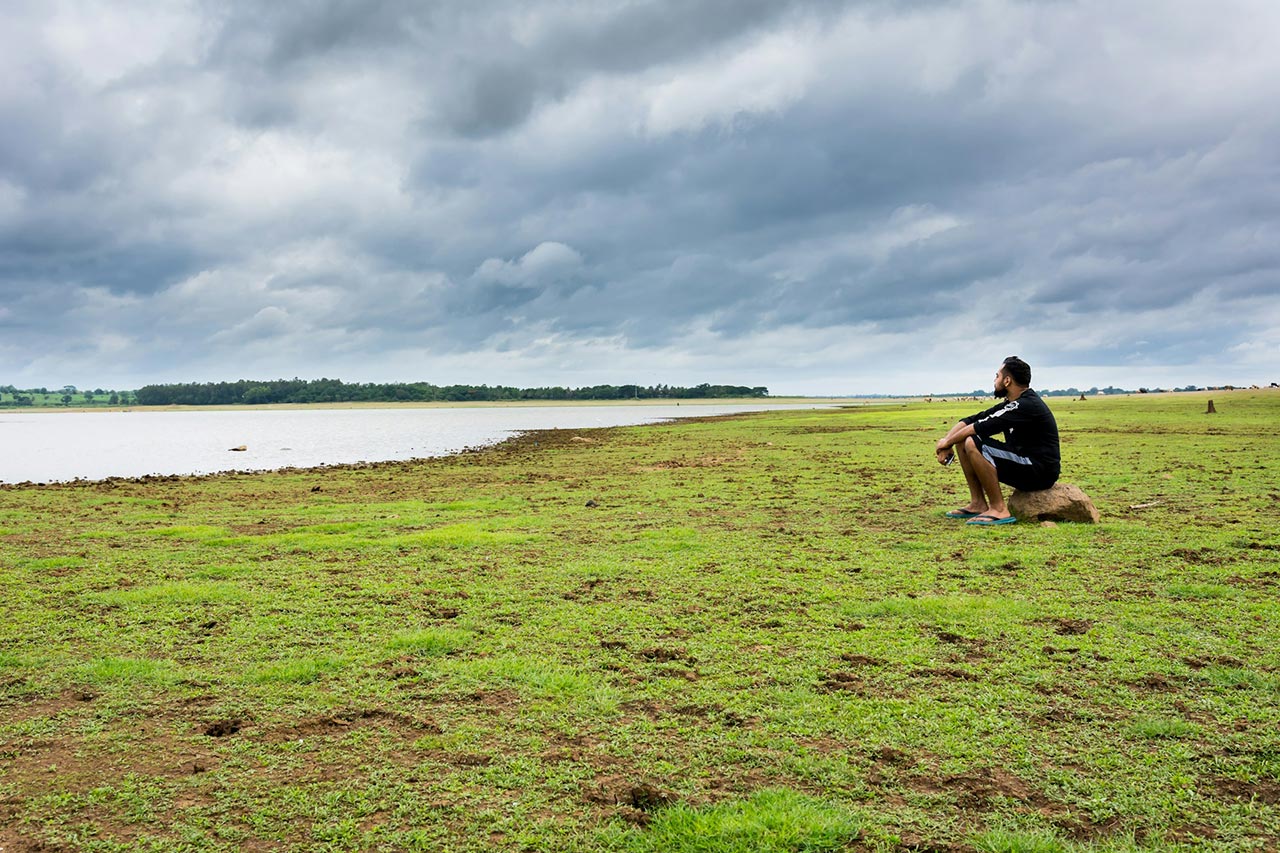
For those planning for a peaceful wildlife-monsoon getaway, Kabini serves it right. Situated in South Karnataka, Kabini is famous for its serene environs as the Kabini River and green forests come alive during rainy season. Monsoon adds to the allure of Kabini and the river is swollen and forests luxuriant, providing an ideal setting for game drives. It’s a great place for bird watching, wildlife photography, or just sitting by the river and listening to the melodic cacophony of the outdoors. The diversity of its Nagarahole National Park flora and fauna garden of Kabini reservoir that offers eyeballs and relaxation is the beauty and reason behind this place occupying a space in the list of monsoon destinations of Karnataka.

Key Attractions
Kabini River A picturesque river that offers boat safaris, providing a peaceful way to observe wildlife.
Nagarhole National Park A wildlife sanctuary rich in flora and fauna, ideal for safaris and spotting tigers and elephants.
Jungle Trails Explore the dense forests with guided walks to witness the beauty of the rain-soaked wilderness.
Riverside Camping Camp along the Kabini River, offering a serene experience under the monsoon skies.
Activities
Boat Safari Sail down the Kabini River for a relaxing experience and view wildlife up close.
Wildlife Safari Go on a thrilling safari through Nagarhole National Park to spot animals like tigers, elephants, and leopards.
Birdwatching Observe a wide variety of birds, especially during the monsoon when the area is full of life.
Nature Walks Take guided walks through the forest trails, absorbing the beauty of the lush, monsoon-fed wilderness.

Conclusion

Karnataka looks splendid during the monsoon and hence should be on the list of places to visit during the rainy season. From the coffee estates of Coorg to the roaring Jog Falls, from the historic ruins of the city of Hampi to the decibel-reverberating Agumbe-the wildlife and nature’s abode, the state changes its color to green. Pleasant weather is a sign of brilliant change of scenery, therefore, Karnataka has the affinity for lovers of nature and drama, adrenalin freaks as well as the culture and history aficionado in a different light.
I have heard an overwhelming response from the travelers who have chosen traveling during monsoons as it brings a lot of excitement. Since there are few people around due to cold weather, green vegetation, and the beat of the rain, it lends a fairytale-like ambiance, which cannot be found during the other seasons of the year. Be that as it may, adventure, leisure, spiritual tourism, rejuvenation or discovering nature, travel to any monsoon destination in Karnataka and consider it done.
Therefore, when visiting Karnataka during monsoon, ensure you check for the weather, carry a waterproof outfit, and be safety conscious especially when doing activities like trekking or visiting a waterfall. Preparation of monsoon journey in Karnataka can be incredibly special if done with proper planning and arrangements, one can be assured to have a lifetime of memories.

FAQs on Monsoon Destinations in Karnataka

Question: What are the top destinations to visit in Karnataka during the monsoon?

Answer: Top destinations include Coorg, Chikmagalur, Gokarna, and Kabini, known for their lush landscapes and pleasant weather during the monsoon.

Question: Why is Coorg a popular monsoon destination in Karnataka?

Answer: Coorg is famous for its coffee plantations, scenic hills, and waterfalls that come alive during the monsoon, offering a serene getaway.

Question: What makes Chikmagalur a great monsoon spot?

Answer: Chikmagalur’s misty hills, coffee estates, and tranquil atmosphere make it a perfect monsoon retreat for nature lovers.

Question: Is Gokarna a good place to visit during the monsoon?

Answer: Yes, Gokarna’s serene beaches and the lush green landscapes make it an excellent destination during the monsoon, perfect for relaxation and solitude.

Question: What can I do in Kabini during the monsoon?

Answer: Kabini offers wildlife safaris, bird watching, and boat rides along the Kabini River, making it a great spot to experience nature during the monsoon.

INTACH’s ‘Kan-Kan Mein Ram’ to Showcase Cultural Diversity of the Ramayana

0
INTACH-kan-kan-mein-ram-documentary-release-1
Image Courtesy – Sphoorthi Theatre

New Delhi, 22 July 2025 – The Indian National Trust for Art and Cultural Heritage (INTACH), will premiere the documentary film “Kan-Kan Mein Ram” scheduled for 23rd July 2025 that takes us through the fascinating cultural and spiritual landscape of the Ramayana in India. The Honorable Minister of Culture & Tourism Shri Gajendra Singh Shekhawat is going to officially launch the film his presence at the event for such a special occasion.

The new documentary to be launched at 12:00 PM on 23rd July, will be screened at Multi-purpose Hall, INTACH, Lodhi Estate, New Delhi.

A Journey Through India’s Diverse Ramayana Traditions

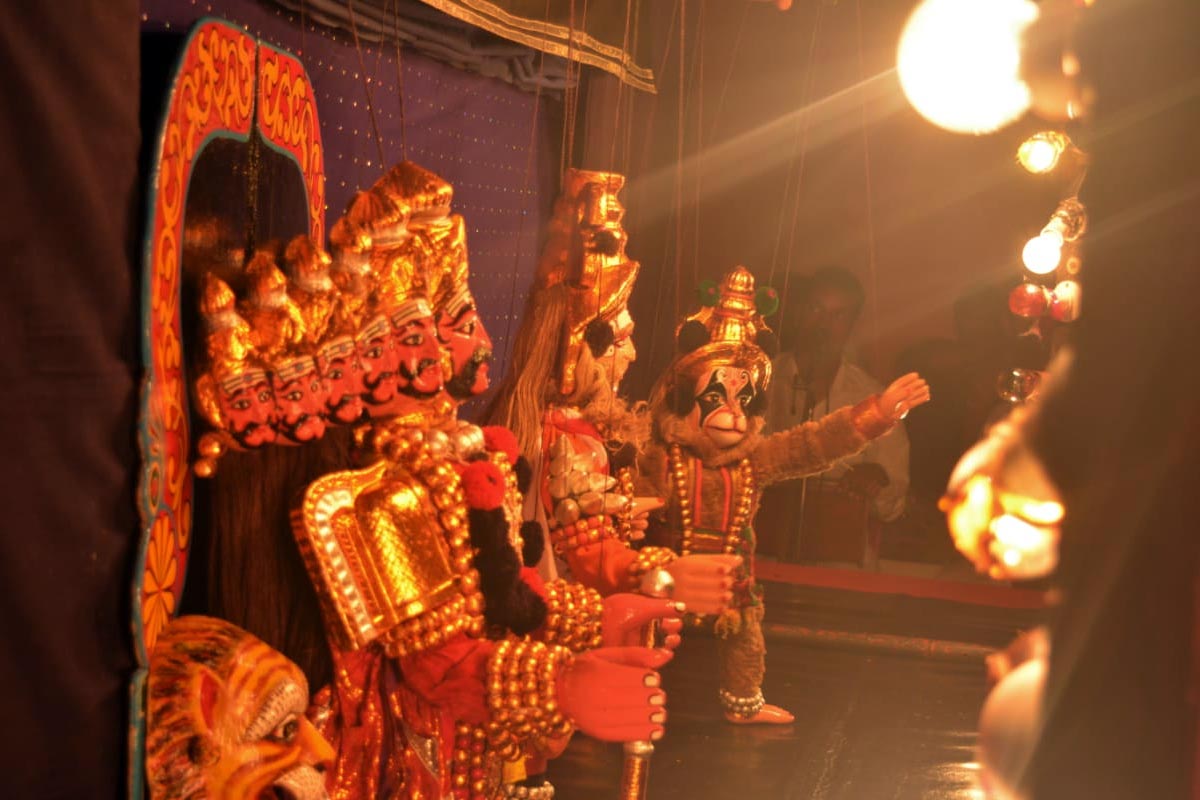
“Kan-Kan Mein Ram” is a thought provoking journey into the Ramayana, one of India’s most powerful and revered epics and its immediate reflection on the cultural history of India. The film exposes the many art forms which the Ramayana has inspired in regions across the country. Whether it is through ritualistic performances, dance-dramas or puppetry, the film emphasises the different ways of storytelling through the traditional art featuring Lord Ram’s journey and lessons.

Region Featured Traditions
Karnataka Yakshgana and Uppinikudru Puppetry
Odisha Lanka Podi Yatra and Ravan Chaya
Assam Sattriya Traditions
Mewat Mewati Bhapang Performance
Chhattisgarh Ramnami Samaj

Through these art forms, the documentary captures the universal presence of Lord Ram, whose stories resonate across cultures and transcend religious boundaries, forming a collective cultural consciousness.

Message of Unity and Spiritual Presence

The documentary highlights the timeless cultural and spiritual heritage of Lord Ram in the minds and heart of people across the spectrum. The underlying message of the film — “Kan-Kan Mein Ram” — is an ethos of the divine that Lord Ram’s collective mortal form represents: what makes humanity whole and how His teachings have not just influenced religious beliefs, but woven Indian culture.

INTACH’s initiative is a step towards showcasing the varied and vibrant ways in which the Ramayana continues to inspire and influence the arts, rituals, and daily lives of people across the country. The film aims to celebrate the collective consciousness of Lord Ram, reinforcing the idea that His presence is ever-present, whether through performance or the collective memory of His teachings.

Event Details:

Event Detail Information
Event Name Documentary Film Launch: “Kan-Kan Mein Ram”
Date 23rd July 2025
Time 12:00 PM
Venue Multi-purpose Hall, INTACH, Lodhi Estate, New Delhi
Official Launch Shri Gajendra Singh Shekhawat, Minister of Culture & Tourism

Join the Celebration of India’s Cultural Heritage

INTACH extends a warm welcome to culture lovers, heritage scholars and the general public for this event of rare importance. Kan-Kan Mein Ram [Inside every grain exists Ram] will commemorate the diversity of India’s cultural expressions while paying tribute to legacy of the Ramayana as reflected in Indian performing arts.

This event is a momentous occasion to recognize the rich tapestry of cultural and spiritual traditions that continue to define the soul of India.

National Flag Day: A Tribute to India’s Pride and Heritage

0

National Flag Day-01

Do you know when our national flag celebrates its birthday?

India’s national flag–“Tricolor” is not just a flag or simple piece of fabric, it is the pride of every Indian citizen. To understand its significance deeply, we celebrate the birthday of our national flag on July 22, as National Flag Day. This year this day will be celebrated on Tuesday.

History of National Flag Day?

In 1906, at the National Convention of the Indian National Congress, Pingali Venkayya, the creator behind India’s national flag, strongly asserted that India should have its own national flag. His passionate call for a symbol of unity and identity deeply resonated with Mahatma Gandhi, the father of the nation, who wholeheartedly supported the idea.

Subsequently, Venkayya took the task of preparing the design of the public flag, for which he first observed and studied the flags of 30 different countries. Based on that, he initially created a flag in which Red color was included for Hindus and green color for Muslims. But, that flag did not get the acceptance of the panel.

Later, Gandhiji recommended that Venkayya include the white color in the flag. Hansraj, a prominent leader of Punjab, suggested adding a chakra[wheel] as a symbol in the flag. 

Eventually, in 1931, the Indian National Congress unanimously accepted that flag made of saffron, white and green colors at the All India Conference of Karachi. Originally, there was a spinning wheel in the center of the flag, which was later replaced by the Ashoka Chakra.

Meaning of Colors in the Flag

  1. Saffron indicates strength and courage.
  2. White symbolizes peace and truth.
  3. Green depicts evolution and serenity. 
  4. The blue-colored circular wheel “Ashoka Chakra”, also known as Dharma Chakra has 24 spokes that represent the virtues or principles not the religion[Dharma].

Why is July 22 is Celebrated?

On this day in 1947, the Constituent Assembly accepted the current tricolor as India’s national flag, and this decision declared by former Prime Minister Pandit Jawaharlal Nehru himself. This important event happened just a few weeks before India got independence from British colonial rule on August 15, 1947. It marks a historic milestone in India’s history.

Objective of National Flag Day

National Flag Day is about honoring its spirit. It’s main objectives are:

  • Boost the sense of national togetherness and integration.
  • Teach the public, students and younger generation about the legacy, importance, value and symbolism of the national flag.
  • Cultivate a sense of nationalism, respect and pride towards the national flag.
  • Inspire future generations to maintain the values of the national flag, secularism, which the tricolor represents.

How is National Flag Day Celebrated?

Schools and colleges across the country arrange various programs to highlight the glory and history of our national flag:

  • The Tiranga is hoisted with at most respect.
  • The national anthem is sung. 
  • Students give speeches and raise slogans in honor of the flag. 
  • Cultural programs and competitions like flag-making are also organized.

Takeaway

Instilling the value of the national flag from a young age ensures that tomorrow’s leaders carry forward its legacy with pride. But in order to do this, it is crucial to comprehend the significance of National Flag Day, as it will strengthen patriotism and honor, and admire the thousands of people who gave their lives to protect the nation’s independence.

Banavasi: Exploring Karnataka’s First City and Must-Visit Attractions

0
Banavasi-first-city-in-karnataka-00
Image Courtesy – Unexplored India

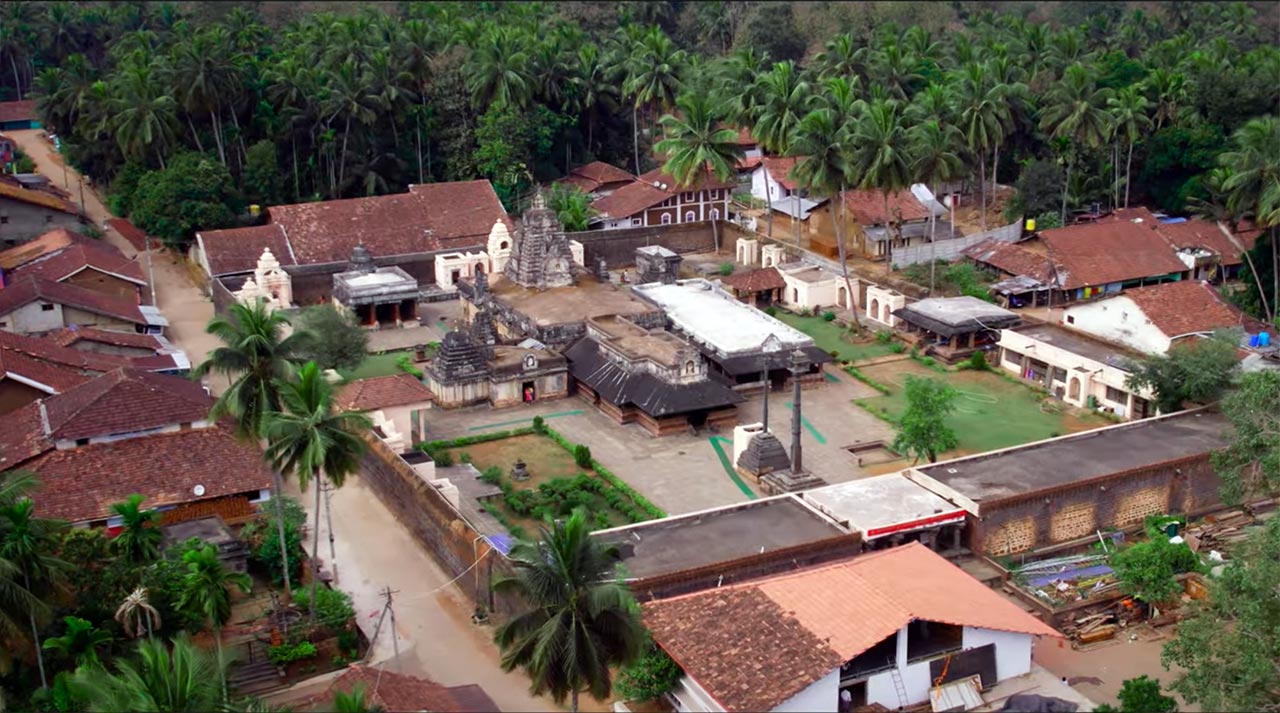
When you think of Karnataka, chances are Banavasi may not cross your mind. A small town situated near Sirsi, most people often miss its historical and cultural significance. But Banavasi is one of the oldest towns of the state, estimated to be in existence since 4000 BC. It is called ‘Vanavasaka’ in the Mahabharata, however, it came to prominence during the rule of the Kadamba dynasty. It was the capital of the kingdom and hence also owns the distinction of being the first capital of ancient Karnataka. 

Banavasi Location and History

Location-and-History-of-Banavasi
Kadamba Dynasty Map – Wikimedia

ಆರಂಕುಸವಿಟ್ಟೊಡಂ ನೆನೆವುದೆನ್ನ ಮನಂ ಬನವಾಸಿ ದೇಶಮಂ – ಆದಿ ಕವಿ ಪಂಪ

“Amidst the pain of a lance, his heart still beats for Banaasi, as if it were the only solace”. Above line is derived from Aadi Kavi Pampa’s “Papma Bharata” written during 10th century which explains the poets love for Banavasi.

Banavasi, located on the banks of River Varadha is 24 km from Sirsi and can be reached while driving on SH 77. Local buses ply regularly from Sirsi to Banavasi. Sirsi is well connected to Bengaluru through public transport. Banavasi is 100 km from the district center, Karwar and around 350 km from Bengaluru. Haveri, 70 km away is the nearest railway station. 

Ruled by the Kadamba dynasty from the 4th to 6th century AD, the town is tucked in the beautiful Western Ghats. However, Banavasi exudes an aura of old-world charm and is a divine abode of some of the most ancient temples of south India. The Madhukeshwara Temple is the main religious hub, manifesting the intricate and detailed sculpting and architecture of earlier times. Besides, the calming natural beauty, rustic ambiance and culture of the town, make it an interesting and unique destination. 

List of Banavasi Attractions 

Though Madhukeshwara Temple is the main attraction of Banavasi, Jain and Buddhists religious temples are also found here. Besides, the natural landscape also offers some great tourist spots to visit. 

Attractions near Banavasi Details
Madhukeshwara Temple A 9th-century Shiva temple with a honey-colored lingam, 7-feet Nandi bull, and stunning stone pillars. Famous for its historical and architectural significance.
Pampa Vana A forest dedicated to Adikavi Pampa, Karnataka’s first poet. The temple here is believed to be the original site of the Madhukeshwara temple.
Gudnapur An archaeological site 5 km from Banavasi with a pillar detailing the origins of the Kadamba dynasty and a temple built by King Ravivarma.
Sahasralinga A unique site 15 km from Banavasi across the River Shalmala, featuring hundreds of Shiv lingas carved into rocks, offering a picturesque and serene experience.
Gudavi Bird Sanctuary A 25 km drive from Banavasi, home to over 190 bird species, including migratory birds that visit in winter.
Unchalli Waterfalls Located 35 km from Banavasi, these waterfalls can be accessed by a thrilling trek through steep paths.
Treks & Trails Explore Banavasi’s surroundings through various trekking routes such as the Banavasi to Yana Trail and Kadamba Trails.

Madhukeshwara Temple

Banavasi-first-city-in-karnataka-01
Image – Rajeev Rajagopalan/Flickr

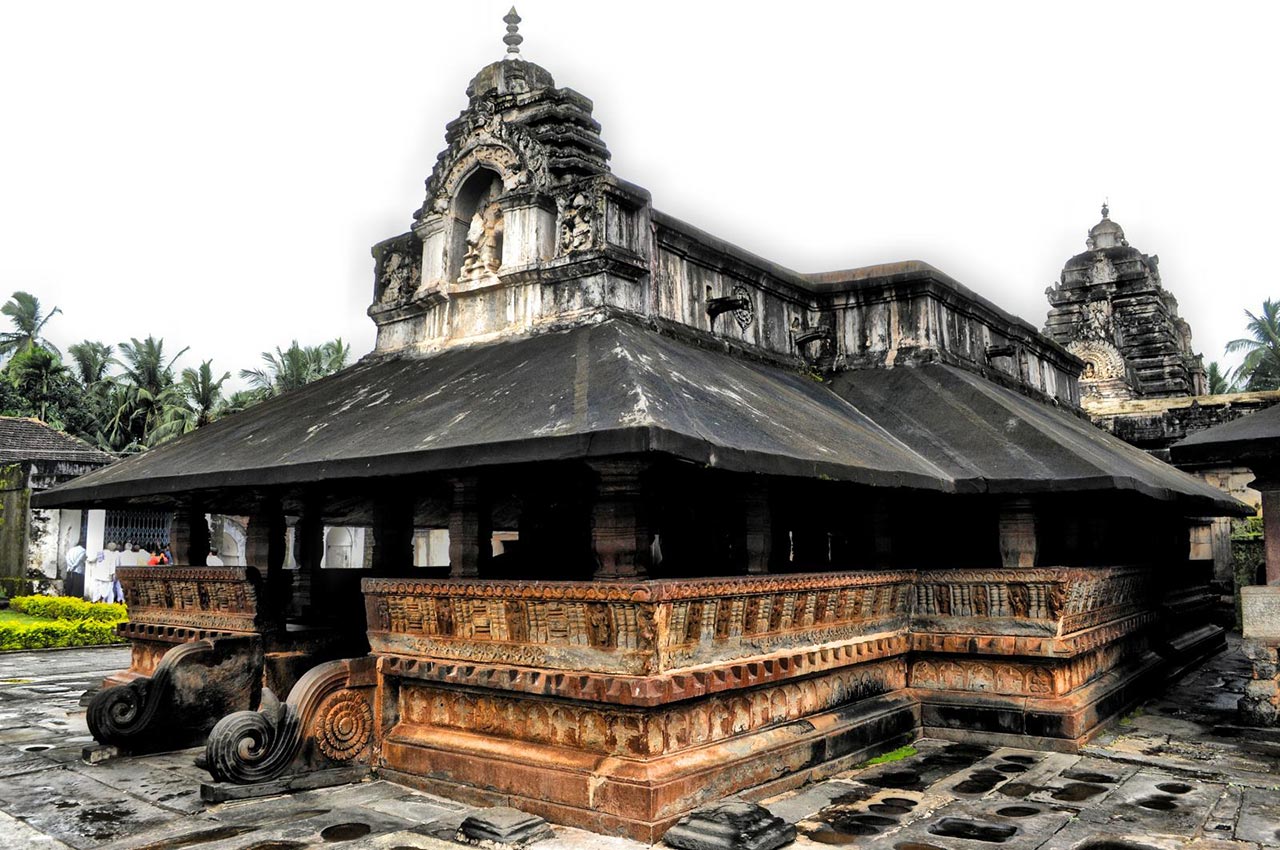
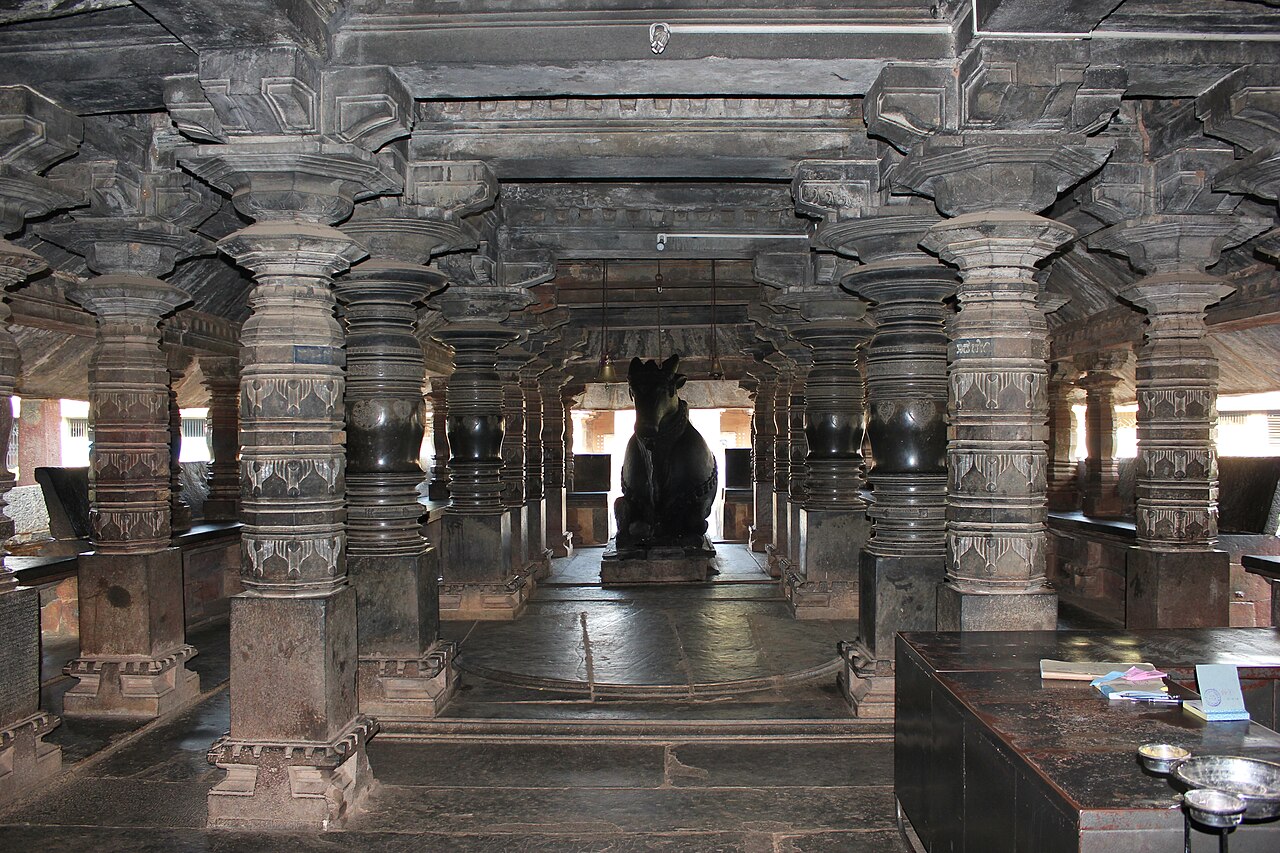
Madhukeshwara Temple is the main attraction of Banavasi. Dedicated to Lord Shiva this temple was built in the 9th century CE. Its most fascinating features are the honey colored lingam, the 7 feet tall Nandi bull, the stunning stone pillars and more. In fact, the color of the lingam is what gives the temple its name. The uniqueness of the temple lies in not only the larger structure, but also in the little details. For instance, the statue of the Nandi Bull has its head tilted where one eye is looking at the garba griha where the lingam is located. The other eye seems to be looking at the Parvati Temple, situated adjacent to Madhukeshwara Temple. 

The temple also houses the statue of the Adi-Madhava which several people believe was the original or first deity of the temple. Till date devotees worship this statue first before heading into the Shiva lingam. The Madhukeshwara temple was commissioned by Mayura Sharma, a Kadamba King. However, several renovations, additions and extensions have been made to the temple complex over the years, during the Chola, Chalukyas, Hoysalas, Sonda dynasties. The navranga, polished pillars, stone cot in the temple courtyard, sandalwood chariot and half Narasimha and Ganapati statues are features that might have been added in the later years. 

Madhukeshvara_temple_at_Banavasi-2
Madhukeshwara Temple – Wikimedia

The kalyana mantapa or triloka mantapa is architecturally splendid. The other mantapas or mandapas worth seeing include the Nritya Mandapa, the Darshana Mandapa and the Astana Mandapa. The sandalwood chariot or rakta chandana is believed to have been donated by Ramachandra Nayak in the 17th century. It till date is one of the tallest temple chariots in Karnataka. 

During the Kadambotsava Festival, several devotees make their way to the temple. 

Pampa Vana

Adikavi Pampa is considered as the first Kannada poet in Karnataka. He is credited with writing epics, such as Vikramarjuna Vijaya, Adi Purana and Pampa Bharata. This renowned poet was the court poet of Vemulavada Chalukya who wrote his most famous works in Banavasi. The Pampa Vana is a forest dedicated to the great poet. Inside this small forested area, that also houses a children’s park, there is another ancient temple called Adi Madhukeshwara. Though there is a single lingam inside the temple, devotees believe that the Madhukeshwara temple was first built here. However, it was shifted to its current location later. There is a navranga, shikhara and pillars in different architectural styles that can be seen in this temple. It is local belief that during drought or low rainfall, devotees pray here and within a week they are blessed with rainfall. 

Gudnapur

5 km from the town of Banavasi is the village of Gudnapur. Gudnapur is an archeological site that once held the origins of the Kadamba dynasty. There is a pillar also called stambha shasana, that stands here with inscriptions that bring to light the genealogy and origins of the dynasty. Built by King Ravivarma, the pillar also bears documentation about the temple, harem, and dancing halls that once stood here. However, besides the pillar, there are a few Jain Tirthankar statues and a large lake or tank constructed by the king for agriculture. The Bangareshwar Temple is located in the middle of this water body. 

Sahasralinga

Sahasralinga-near-Banavasi

15 km from Banavasi, one can find an interesting site across the River Shalmala. There are hundreds of Shiv lingas, beautifully carved into the rocks on the river. These stunning carvings might have been done by different kings across the years as acts of devotion. The captivating carvings along with the serenity of the river and surroundings, makes it a popular attraction of Banavasi. This is a great spot for photography too. 

Other Tourist Sites near Banavasi

Besides temples and religious structures, Banavasi also has natural attractions. 

Gudavi Bird Sanctuary

25 km from Banavasi, lies the quiet Gudavi Bird Sanctuary. The forest cover and wetlands provide the perfect shelters for birds of different species. Around 190 avian species are found here including egrets, cormorants, herons and more. Migratory birds also come here in large numbers during the winters. 

Unchalli Waterfalls

Also known as the Lushington Falls, the Unchalli waterfalls are 35 km from Banavasi. The fall can be accessed after an adventurous trek that trails on steep and narrow pathways. 

Treks & Trails

Travelers can embark on thrilling trekking routes to explore the surrounding areas of Banavasi. The Banavasi Trail starts from Madhukeshwara Temple to Gudavi Bird Sanctuary. En route watch the local artisans at work, visit Pampa Vana and the pineapple farms. 

The Banavasi to Yana Trail takes travelers to the splendid Yana caves. They can explore the Unchalli Falls, Sahasra Linga and Marikhamba Temple.

The Kadamba Trails takes visitors on a cultural and historical route of the dynasty while to enjoy the rushing waters the Jof Falls Trail is popular.

Agriculture and Culture

Agriculture and Culture Banavasi

Banavasi is essentially an agricultural town. The famous pineapple farms steal the limelight. However, there are many other crops grown here including bananas, areca nuts, rice and more. Also, an art gallery called Varnaloka in the town displays exquisite arts and crafts of the region. One can buy sandalwood creations, Yakshagana masks, baskets, sculptors, carved items, temple requirements etc. 

Autumn, winter and spring are the best months to visit Banavasi. Besides, there are a few eco-friendly guesthouses and places of stay. The ‘khanavalis’ are little eateries that serve authentic delicious local cuisines, which have a generous serving of chutneys and powders. 

Takeaway

Banavasi is not the fast-paced tourist destination that is packed with world-class tourist attractions to visit. On the other hand, it is steeped in natural beauty, biodiversity and a rich history and culture. For a bit of quiet, peace and soulful endeavours, Banavasi is a uniquely good choice.

FAQs about Banavasi

Question: What is Banavasi famous for?

Answer: Banavasi is famous for the Madhukeshwara Temple, a historical 9th-century Shiva temple known for its beautiful architecture and cultural significance.

Question: Where is Banavasi located?

Answer: Banavasi is located in the northern part of the state of Karnataka, India, in the Uttara Kannada district.

Question: What is the historical importance of Banavasi?

Answer: Banavasi was the capital of the Kadamba dynasty in the 4th century CE and has significant archaeological and historical landmarks.

Question: What can tourists do in Banavasi?

Answer: Tourists can visit the Madhukeshwara Temple, explore ancient temples, enjoy scenic landscapes, and learn about the history of the Kadamba dynasty.

Question: How can I reach Banavasi?

Answer: Banavasi can be reached by road from the nearby towns of Sirsi and Karwar, with good connectivity through buses and private vehicles.

CBSE Introduces Mandatory Art Projects for Classes I–X Starting 2025–26

0

CBSE Introduces Mandatory Art Projects for Classes I–X Starting 2025–26-A

In a significant shift towards holistic education, the Central Board of Secondary Education (CBSE) has mandated a rule for all students from class 1 to class 10 from the academic year 2025-26. As per the new circular, all students from class 1 to 10 will have to do art-integrated projects, and the students of class 10 who will not follow this protocol, will not be able to receive their admit cards.

Currently, everyone is surprised due to this new norm, but now schools will have to upload their art-integrated project details on the “Kala Setu Portal” compulsory.

By implementing this rule, the board does not want to put any pressure on the children in any way. Rather, the purpose of bringing this rule is to ensure that students should get acquainted with Indian art and culture and all schools should promote art, culture and creativity. Students will have to showcase their innovation and originality by adding their Indian art to this.

The art-integrated project will be given to the students of 9th and 10th with the goal of enhancing their understanding of the subject. Along with this, the rule has been implemented with the motive of making the students studying in the junior section understand what an art-integrated project is. 

“Ek-Bharat, Shreshtha-Bharat” ideology:

The art-integrated project should be based on the art and culture of the state or union territory that CBSE has paired with the school under “Ek Bharat, Shreshtha Bharat” Abhiyan. For example, Sikkim has been paired with Maharashtra, so students from Sikkim are expected to develop their projects based on the art and cultural tradition of Maharashtra. 

Guidelines and Important Considerations:

  1. All schools will have to keep in mind that whatever projects they do, should not harm the environment. They should be environment friendly. 
  2. It is very important to take special care that locally available resources should be utilised in the projects. 
  3. No additional financial pressure will be put on any child. Children can use low-cost and recyclable materials.
  4. Detailed research and cultural connections are compulsory. Textbook content should not be repeated in decorative form. 
Aspect Details
Mandatory for Classes I to X (2025–26 session)
Submission Platform Kala Setu Portal 
Requirement for Admit Card Completion and upload of the project are prerequisites for Class X students
Environmental Guidelines Use eco-friendly, locally available, and recyclable materials
Financial Considerations No additional financial burden on students or parents
Cultural Integration Projects must incorporate detailed research and cultural connections
Objective Enhance understanding through creative expression and cultural engagement
“Ek Bharat Shreshtha Bharat” Pairing States paired for cultural exchange (e.g., Maharashtra with Sikkim)

Reaction from Educators:

About the art integration program, the Principal of Delhi Public School commented, “Such a rule aims to boost cultural awareness. We have already built a couple of theme-centered topics and are currently working on project collaborations with Telangana schools.”

Overall, this step taken by the CBSE board will teach today’s younger generation and the coming generation to think, visualize and feel, and this will bring a revolution in the educational sector and will also boost both the interest and imagination power of the students.

Bhawnao ka Backpack: A Story of Emotional Discovery – Book Review

0
Bhawnao-ka-Backpack-01
Image courtesy – Bhawnao Ka Backpack

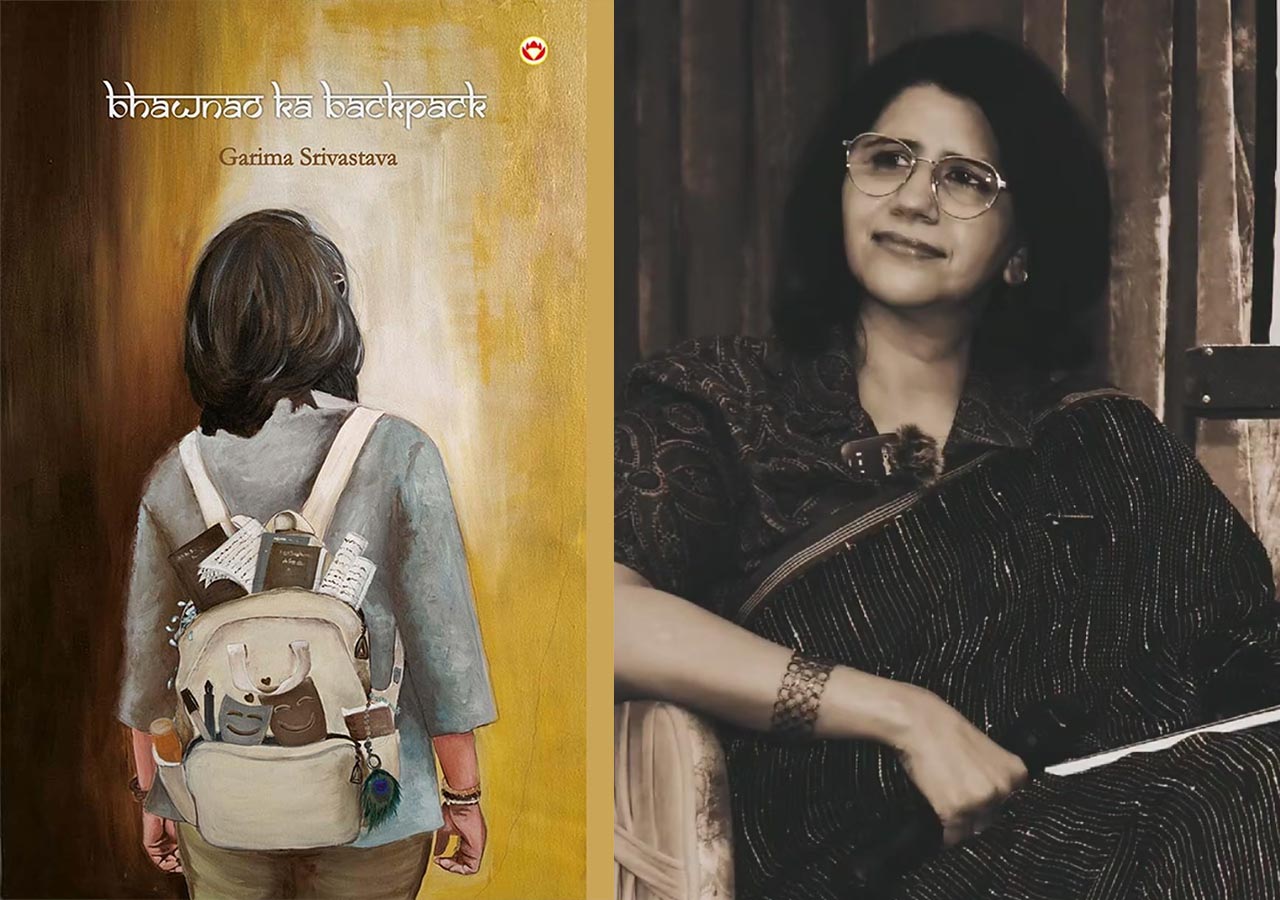
The universe is harmonious. Its synchronicity is unfailing and boundless. Since the past some time, we humans have learnt to celebrate our privilege of concurrently flowing in the ocean of our culture, our heritage of countless centuries; and of swimming in the sea of knowledge and opportunities the entire world offers. And bingo…here comes a book of poetry with some prose-content, written bilingually in Hindi and English. The pages (even Kindle ones!) are sprayed with saundhi mitti ki khushboo (the fragrance of soil after rain) – uncompromisingly Indian – but also transport you to forever horizons of emotions, convictions and desires which belong to Everyheart. 

This was my first thought while I was reading bhawnao ka backpack (the backpack of emotions), by Garima Srivastava, a few days back. Garima is a Delhi-based poet with a background in education and library services. She has been writing passionately for many years for different platforms and purposes. She published this book now to reiterate that “Passion is for Purpose” (pg. 11), as she describes in the Introduction. Passion is a trait she has inherited from her parents, both of whom are well-known poets and also authors. They, other family members, and friends, encouraged her to fulfill its purpose after she had filed away numerous of her writings neatly into her “backpack”. But, as she puts it, the writings shook her awake and demanded the right to be seen and heard (pg. 9-10). She decided to give them all the hearing they deserved. The result is this full-blooded book in Hindi and English. 

Each of the poems has a “prologue” or a prose-introduction which discusses its genesis; thus inextricably connecting the poetess and her readers. And as Pratap Somvanshi, the Managing Editor of Hindustan Hindi Daily, puts it in the Foreword, connecting one’s self to that of others in the world around one – this is perhaps the loftiest objective of poetry. This observation of the eminent poet, Octavio Paz, he feels, is the litmus test of any poetry. And Garima’s poems, he finds, are now passing that test with flying colours. Because the saga of each poem is the saga of life for all of us. In another Foreword, Naresh Shandilya, the famous poet, dramatist, critic and editor, finds the following lines to be representative of Garima’s connection to the secrets lurking inside all human souls. “The sea is just an illusion/Indeed it is our life./ Engulfed in dubious pleasures/Where nothing is for sure” (pg. 107-108; quoted on pg. 8).  

This is what I also found endearing about her book. It speaks very matter-of-factly about the heart and its passions, desires, fears, losses and everything else between heaven and hell. It makes you feel relieved about being human; and caring about things no one else seems to give a penny for. It points out with a compassionate finger the masks all of us feel compelled to wear. For instance, some of us reading this may be authors. In her very first poem of the collection: Lekhak (writer), Garima says: “Teri abhivyakti to padkar/Kuchh bojh mera bhi halka hai/Aur bad jaate hain kadam mere…Kyun paakar teri rachna ko/Main khud se hi mil jaata hoon” (After I have read what you express in your writings/My burden has got a little lighter/And my steps move forward…After I have got to know your creation/Why do I get to meet myself?) (pg. 18).

Similarly, the poetess has got under many skins such as that of an all-consuming love which is not necessarily romantic; a woman in her “Soft, Gentle, Kind” incarnation and a woman in her Shakti incarnation; sublime but unrequited relationships; loneliness behind perfect pink-and-white faces; one-sided passion; and also passion which is shared; the sea battered by continuous environmental degradation; mother-daughter relationship; and so many others. In the same vein, amidst the aftermath of what has taken place in our country recently, the poem: Wait for Me strikes a deeply heartfelt reverberation. It is in the form of a soldier’s letter to his wife. This soldier was called for duty on the war-front just a little after his marriage. “For you, I risk scorching sand/For you, I’ll brave the borders/for you I’ll wait/for me you’ll crave/but we will be together” (pg. 73-74). I doubt if any eye will remain dry after reading this expression of love which is so duty-bound and so enduring. However, my personal favourite is Krishna whom the poetess invokes as the savior of all the Kurukshetras of past, present and future; not just of the Dwapar yug

This collection of prose-poetry is for all of us whose emotions and expressions are not bound by language. For all of us who want to listen to our heart and talk about it too. The book is available in both print and digital formats. Sized and priced moderately, it is Garima’s first book-offering to the world, spanning 31 poems. The easy switch between the Hindi and English languages throughout the book may frazzle some readers, but not the bravehearts! As Garima says in Words: “feel your words so they can love/wrap them on your soul/hoity-toity mindless lash/thrust a piercing hole” (pg. 45). Nothing else matters.

By the way, Garima is also a content-creator, who transmutes her poetry to words and visuals on @bhawnao_ka_backpack (Instagram), thus carving another way to connect with the world around her. 

Note: The image of the book-cover has been downloaded from: Amazon Website

Kochi-Muziris Biennale 2025: The Sixth Edition Unveiled – Save the Date!

0

Kochi-Muziris-Biennale-2025

Kochi-Muziris Biennale 2025

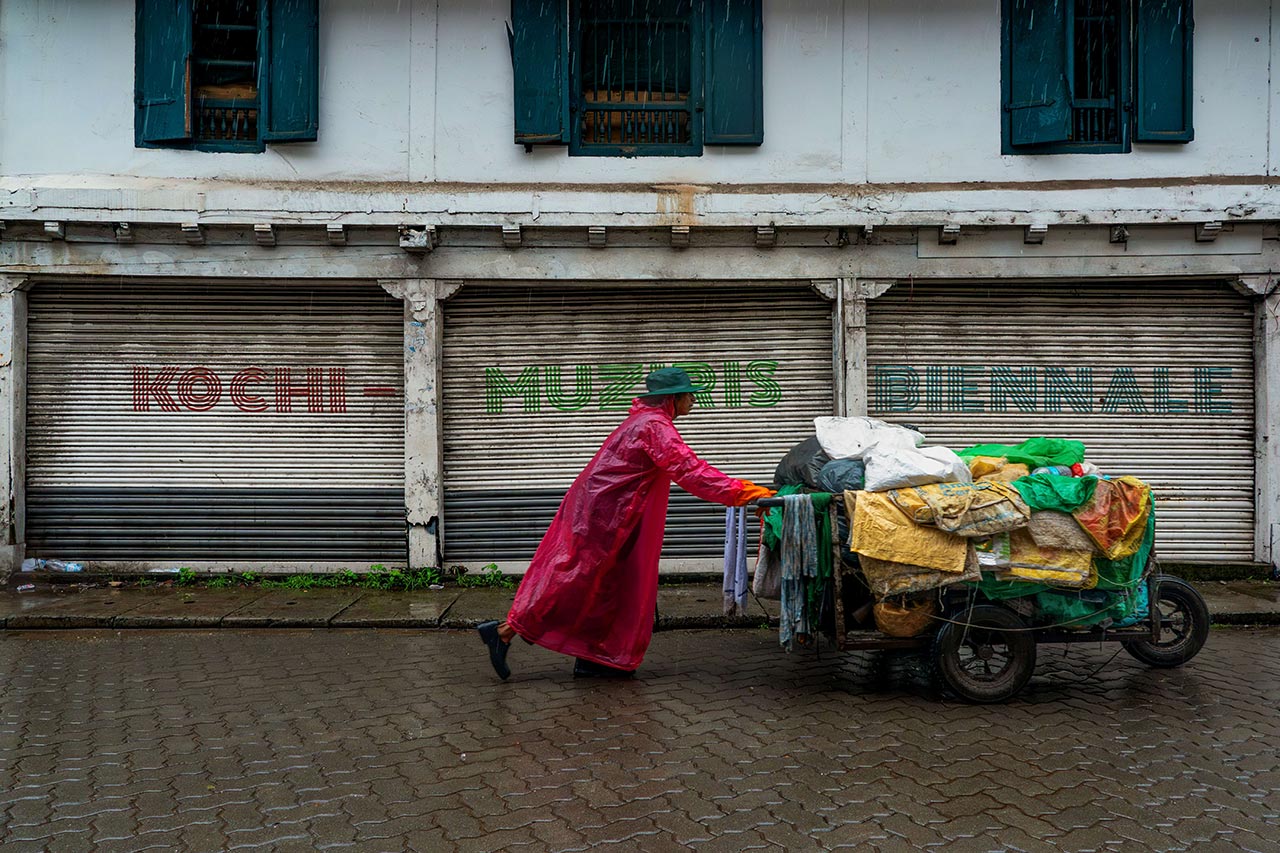
Kochi-Muziris Biennale (KMB), South Asia’s longest-running continuously organized contemporary art biennale, is set to open its sixth edition, ‘For the Time Being’. Now under the management of the Kochi Biennale Foundation (KBF), the highly anticipated event will be open for 110 days from December 12, 2025, to March 31, 2026, offering a huge and thrilling experience to art lovers as well as the general public. 

The new iteration will reinterpret the experience of the biennale, moving beyond the traditional model of an exhibition to provoke a more networked and activated discursive practice among artists. With emphasis on process and mutual “friendship economies,” Kochi-Muziris Biennale ’25 will create a living space where art, artists, and publics interact intensively and deeply. Guests can be assured of an experience that brings together modern art and the Kochi high culture, in a city in which global and indigenous elements coexist in harmony.

Things to Know Information
Event Kochi-Muziris Biennale 2025 – 6th Edition
Theme “For the Time Being”
Dates December 12, 2025 – March 31, 2026 (110 days)
Location ndian Chamber of Commerce Building Mattanchery, Kochi, Keraleeya-682002 India.
Organizer Kochi Biennale Foundation (KBF)
Tickets Students & Children: ₹50
Senior Citizen: ₹100
Adult: ₹150
Weekly Pass: ₹1,000
Monthly Pass: ₹4,000
Tickets available online & at Aspinwall House
Website communications@kochimuzirisbiennale.org, 
kochimuzirisbiennale.org

A New Curatorial Vision

This edition of the KMB will be guest-curated by prominent multi-disciplinary artist Nikhil Chopra, with HH Art Spaces, which is an artist group based in Goa. Rather than repetition of the same old biennale routine, something new is being experimented with by Chopra. He is building the concept of collaboration and exchange. His work is founded on the idea that art could grow when individuals share as well as assist one another.

The sixth edition is conceived as a “living ecosystem” where each component, ranging from performances to artworks, resides, shares space and time, and resources that increase by being in dialogue with each other. This approach seeks to move away from the idea of a singular, central exhibition event, fostering an evolving, responsive, and alive experience.

Embracing the Body and Embodied Histories

KMB-2025-4-Nikhil-Chopra,-Curator,-Kochi-Muziris-Biennale-2025

Chopra’s curatorial note emphasizes an inquiry that begins with the body – “chemical, tender, marked by memory and intimacy.” Here, the body is understood as a terrain of time, an organ of labour, pleasure, and grief. From these bodies, things get processed and become other extensions, meaningful and refiguring reality. This stance asks for more presence of being and attempts to plant seeds towards a more awakened and compassionate future.

Biennale will also explore histories transmitted by the previous generations of human beings. These histories reside within and concurrent with our bodies, in memory, and in our mode of living. It is a project of establishing a deep connection among individuals, places, and moments. It asks us to remember, listen to, and acknowledge each other more through experience.

Beyond the Exhibition: A Diverse Programme

Besides the international exhibition, the KMB ’25 will also feature a rich programme aimed at fostering a diverse cross-section of people. The main verticals are:

Initiative Purpose
Students’ Biennale Providing space for nascent artists.
Invitations Joint collaborations and solo shows.
Children’s Art Stimulating thought patterns in young minds.
Residency Programme Facilitating artistic growth and exchange.
Collateral A series of solo events and exhibitions held in Kochi.

The Biennale will also include a complete schedule of performances, screenings, lectures, workshops, and films that are going to be taking place at some of the Kochi locations, an ancient seaport with a history of confluence of local and universal cultures.

A Dynamic and Immersive Experience

Nikhil-Chopra,-Curator,-Kochi-Muziris-Biennale-2025-with-Bose-Krishnamachari,-President,-Kochi-Muziris-Biennale
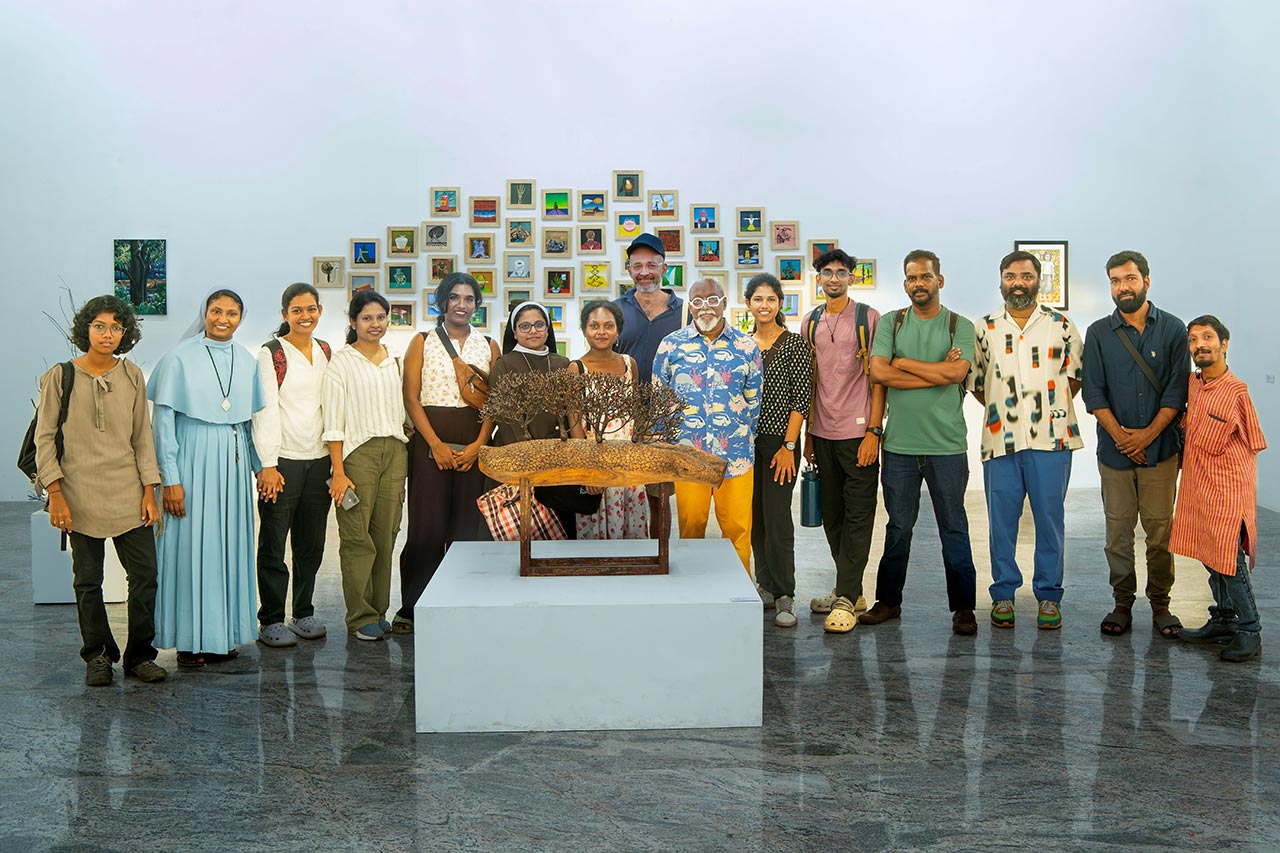
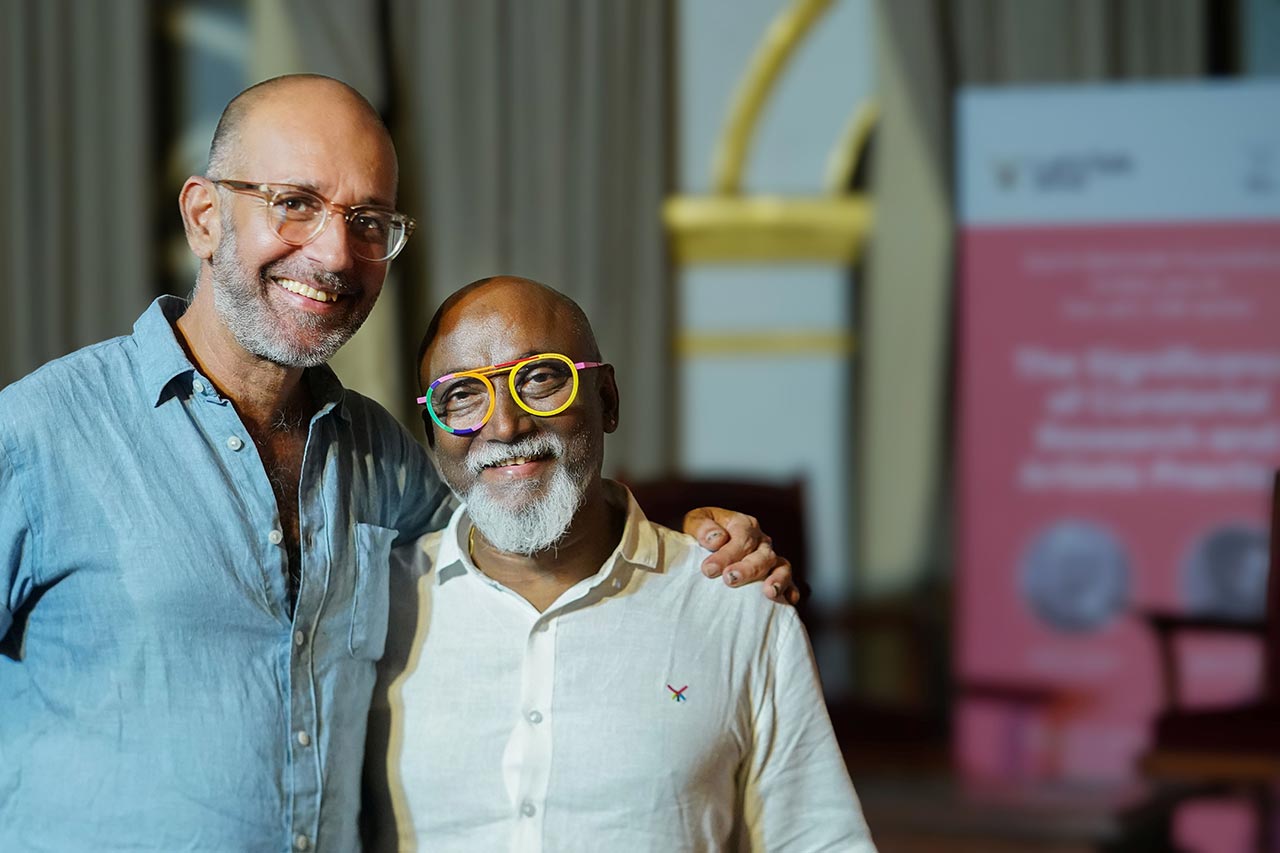
Nikhil Chopra, Curator, Kochi-Muziris Biennale 2025 with Bose Krishnamachari, President, Kochi-Muziris Biennale

KBF Chairperson Dr. Venu V had anticipated that the planning and organizational changes incorporated would help the event turn out to be a success in this edition. In his opinion, the Biennale would enable the commoner as much as the connoisseur to have a “dynamic experience.”

Nikhil Chopra’s performance and durational exhibitions were the focal point, stated Bose Krishnamachari, President, Kochi-Muziris Biennale. The audience is going to experience an immersive journey with breathtaking works of art, site-specific interventions, and more than sufficient space to interact with artists and other art lovers.

Takeaway

The KMB ’25 situates itself to take up the contradictions and weaknesses of our times, assuming that although art in itself cannot alter the world, cultural collisions can perhaps initiate a conversation and shatter tough silences, if only momentarily. Amidst an era overburdened with digital knowledge and marked by global uncertainty, the Biennale longs to confirm the dominance of liveness, being-there, and communion. 

Numerous live events, gestures, and debates will enliven the 110 days of the Biennale, engaging spectators in bodily, participatory experiences that confound a grid-based system of exhibition. The full list of artists for Kochi-Muziris Biennale’s sixth edition will be announced in October 2025.

FAQs on Kochi‑Muziris Biennale 2025

Question: When will the 2025 Biennale take place?

Answer: It runs from December 12, 2025 to March 31, 2026.

Question: What is the theme of Kochi Biennale 2025?

Answer: Titled “For the Time Being,” it envisions the Biennale as a living ecosystem.

Question: Who is curating this edition?

Answer: Multidisciplinary artist Nikhil Chopra with HH Art Spaces are the curators.

Question: What programs will the Biennale feature?

Answer: Expect exhibitions, talks, performances, workshops, film screenings, plus Students’, Children’s, Invitations, and Residency programmes.

Question: Is Aspinwall House confirmed as a venue?

Answer: The Kerala government is acquiring Aspinwall House to secure it as a heritage venue for the Biennale.

Hyderabadi – Hum Aiseich Bolte! [Infographic]

35
Hyderabadi-Language
Photo by Shiv Prasad

Hyderabadi Language

Hyderabad city holds a unique position in India as a melting pot of Hindu, Muslim, Andhra and Telangana cultures. Evidently, “Hyderabadi Hindi” gains its unique flavor from the amalgamation of Urdu, Hindi and Telugu. The best part about being a Hyderabadi is to experience a lifetime of hilarious hindi conversations.  Over the years, the language has gained such significance that it becomes difficult to relate to the place without it. We have our own Johnny here, who is called ‘Haula’ (dumb-head or stupid). Anybody who reflects this ‘haula’ quotient in a conversation is believed to be suffering with ‘haulapan’! “Haulepane ki baatan mat karo yaaron!” (Don’t be stupid or don’t talk stupidly). Note, ‘yaaron’ can be applied for both singular and plural!

India Infographics - hyderabadi-hindi

Understanding the Hyderabadi Slang

The concept of singular-plural is completely different in Hyderabad. Here there is no need to put an ‘s’ suffix at the end of the word to make it a plural. The conventional ‘s’ is replaced by ‘aan’, for example – bottlaan, phoneaan or logaan. “Uno pani ke bottlaan leke araa!” Ironic part is, once you stay here for a few days, you feel out of place if you have to refer to plurals with an ‘s’ especially when you are talking in Hindi.

Hyderabadi hindi

If you go to a store in Hyderabad, you would be addressed with a blunt, “Kya Hona?” meaning, what do you want? Here ‘chahiye’ is conveniently replaced with ‘hona’; a hyderabadi invention used invariably in all sorts of conversations. A yes or a no here, cannot be expressed in a simple ‘haan’ or ‘naa’, it has to be conveyed through a ‘hau’ or a ‘nakko’ with a typical accent!

What Makes Hyderabadi Slang Special?

Hyderabadi-People

The universal time continuum does not apply to you when you are in Hyderabad; if you hear a Hyderabadi saying, ‘Haan main parson vahaan gaya tha’ (I went there, day before yesterday). Don’t be surprised to know that the same sentence can either mean he had been there the day before yesterday or probably a decade ago! Never believe a Hyderabadi if he says that he’ll be there by sharp 9, he will not leave for his destination until it is 9:15. However this attitude is changing, as people finally have to!

How Hyderabadis use the Slang

Hyderabadis don’t possess a great sense of direction either. According to them, all places are either situated on a straight road or involve a million gullys to turn into. If you have lost your way in the city, it’s not a bright idea to ask for the route, all you would come across is ‘seedha jayo ekich road hai’ irrespective of the fact that your destination is completely in the opposite direction! I remember a conversation with a passerby, he directed me by saying, “Aap sidha jayo, left mein do turna aathi, wo nakko lo, uske baad ka right maro!” (Go straight, you’ll come across two left turns, don’t take them, take the right turn after that!)

hyderabadi dialogues - The Angrez Movie

Asking a question in Hyderabadi Hindi is not as simple as saying a ‘kyun?’; the right terminology is ‘kaiku?’ Most of the people here possess a take it easy attitude. If you forget to do a certain thing, you would be consoled by your friends with a “lite le yaaron!”. If you remember, there was a Govinda song which went, “Mein poti pataunga magar hallu hallu”. It is a famous slang used for slow in Hyderabad.

How Non-Hyderabadis Cherish the Slang?

Despite its absurdity, this dialect is cherished by people of all walks living in Hyderabad. It gained immense prominence after the release of the comedy film, ‘The Angrez’ where all the characters spoke in a Hyderabadi dialect. It was followed by numerous other films like, ‘Hyderabad Nawabs’, ‘Hungama in Dubai’, ‘Well Done Abba’ etc. Once you get acquainted with this unique Hindi dialect, you would stand to realize that it is humorous in it’s own way. However, the dialect is dying due to the establishment of various corporate offices around the city. It is being influenced by American culture to a large extent. Yet, Hyderabadis always have and always will enjoy a conversation in Hyderabadi Hindi over any other language!

Words and phrases that you need to know to survive in Hyderabad:

List of Famous Hyderabadi Slang

Hyderabad Slang Meaning in English
Hau Yes
Nakko No
Kaiku? Why?
Mereku Me
Tereku You
Potti Girl
Potta Boy
Mama Dude/Bro
Zara Hallu chalo Go slow
Hona bolke On purpose
Uno kya kathe? What did he say?
Kya hona? What do you want?
Kya mein haula dikrhoon tereku? Do I look like a fool to you?
Khali Peeli Simply / just
Dimakh Kharab mat karo! Don’t irritate me
Lite lo yaaron! Take it easy
Bawa ki road samjhe? Have you lost control?
Chindi chor Small-time thief/cheapskate
Over kar dere Acting too smart

Takeaway

Hyderabadi slangs are not just words it’s the emotion of the people in the form of verbal expression, the language pokes a pinch of humour in its accent and kindles a funny emotion within. Though the language has its roots in Urdu, Telugu and Marati it have created its own blend that reflect the deep culture of Hydrabadies. Learning some words from the list will empower you with readymade punch to your chit-chat with friend and family.

Check out our story on Hyderabadi Haleem
Wiki The Angrez
Lazybug Akhil

FAQs on Hyderabadi Slang

Hyderabad-Old-City

Question: What is haula Hyderabadi slang?

Answer: In Hyderabadi slang, Haula refers to someone who is foolish, silly, or acting crazy.

Question: What is awesome in Hyderabadi slang?

Answer: Some of the awesome Hyderabadi slangs are haula, Mama, Khali Peeli, Chindi chor, Zara Hallu chalo, and Dimakh Kharab.

Question: What does “Nakko” mean in Hyderabadi slang?

Answer:It means “No” or “Don’t want”—a common way to refuse something.

Question: What does “Mereku” and “Tereku” mean?

Answer:“Mereku” means “to me” and “Tereku” means “to you”, used casually in everyday talk.

Question: What does “Lite lo” mean in Hyderabad slang?

Answer: “Lite lo” means “take it easy” or “don’t stress about it”.