Education, which should be a basic right, is unfortunately a luxury for a few. Near a slum in Noida runs a school that functions in a unique way and aims to impart knowledge and teach co-curricular skills to kids of that area.
Students starting from the age of five come to attend classes on weekends. They learn paintings, dances, and co-curricular skills, which are hardly taught in the conventional schools they attend. Every weekend, they learn good habits in a session conducted by a team of volunteers of the organisation. More than 500 such volunteers across India are part of a NGO named Pehchaan that runs 10 such centres across the Delhi-NCR region. The initiative was started by a bunch of college-going students’ way back in 2015 who were into social work and activism.
The Beginning
“When I was in college, I used to do social work, so I started with basic environmental work; it went on to corruption, and there were a lot of other moments. It was after 4-5 years working on the ground that I realised that whatever we are doing, it’s of no use, says Akash Tandon, the co-founder of this initiative.
He says they decided to start this initiative because they believe “the knowledge that will be shared, the knowledge that you share with the students, will always stay. It will only grow with time.”
The purpose of making this centre is not just to teach math, science, and english and other conventional subjects like other schools, but rather to make them learn varied soft skills that would help them stand out in the future.
Recently, the organisation has started physiological classes in all 10 centres for senior students. “We can’t teach them like other schools as all volunteers here are working professionals and college going students.” said Akash.More than 1500 students are part of 10 centres. All these centres run mostly on community centres. These centres are either a temple, a mosque, or even a Gurudwara in one case.
Social Impact
Describing one such incident, Akash explains, “We were running one of their centres near a mosque, and one day a ‘Maulabi’ came and asked to use the mosque. They gave us the whole mosque where we were running the school now.”
The Noida centre runs in a school on weekends. Ruhi (changed name), who comes to the centre to attend classes, expresses her pleasure coming into the school, saying she loves to come to this school as she learns drawing here.
The interesting part is that the whole initiative runs on crowd funding and donations. The NGO more often organises crowdfunding drives.
Akash pointed out that seeking funds from others would mean losing control over the functioning of the schools.
“We never tried to reach out to government organisations; the basic reason is there were no full-time people here who can go to meetings and they can follow. Right now it’s working fine. People who constantly contribute,” Akash says.
Humble Volunteering
As mentioned earlier, the initiative was the brainchild of a bunch of social activists and college students. Leejo, Sam, Monica, and Akash were stunned when they witnessed children swimming in a drain near a slum in the heart of Delhi. The slum was a few kilometres away from the residents of parliamentarians and the headquarters of WHO.
“We did the whole set up, and we started teaching. Within the next 6 months we have more than 150 students there, because all the children came to know that there were groups of Didi and Bhaiya who came every weekend and taught us free.” Akash explained about his experience establishing the first centre.
The initiative, which started with a group of didi and bhaiyas, is soon going to complete its decadal journey with its wings spread across India. The students who were once part of the initiative have now entered into reputed colleges; even a few have joined the professional workforce.
Akash says that the parents have developed a sense of faith that their children will succeed from here. “These students have learnt from the years and developed a faith that if this student can do this by associating with the institution, then we can also do it.”
Final Thoughts
Volunteers are the source of energy behind running this initiative. One such volunteer, Bhaskar, who joined 6 months ago, says, “The motivation to come here is children. I come here for children. They gave me the power to come on the weekends. We had a lot of fun. We did a lot of activities.”
These centres are bringing a much-needed change among the kids of slums, to inspire them to take the path of knowledge and education.
For the first time in Kannada literary history, 77-year-old lawyer, social worker, and pioneering writer Banu Mushtaq from Karnataka has won the 2025 International Booker Prize for her gripping collection of short stories Heart Lamp. Translated into English from Kannada by Deepa Bhasthi, it is the first collection of short stories and the first Kannada novel in history to have won the coveted prize.
Mushtaq’s Heart Lamp is a set of 12 richly personal and politically provocative short stories, each revealing the lives of common Muslim women in South India. Written over three decades between 1990-2023, the stories bear witness to underground rebellions, internal agonies, and voiceless resistance of women enduring patriarchal burdens, religious conservatism, and socio-political exclusion.
“No Story Is Ever Small”
Gracing the occasion with her presence at London’s Tate Modern, Mushtaq, dresses in a red sari, delivered a passionate acceptance speech:
“This book was born from the belief that no story is ever small; that in the tapestry of human experience, every thread holds the weight of the whole.”
She added, “In a world that often tries to divide us, literature remains one of the last sacred spaces where we can live inside each other’s minds, if only for a few pages.”
A Voice from the Margins
Mushtaq’s own journey to literary glory is as engaging as her own writing. She was born in 1948 in Hassan, Karnataka, and studied the Quran in Urdu until her father enrolled her in a convent school, where she first encountered the Kannada language that would serve as the medium of her social criticism and revolt.
As a member of the Bandaya Sahitya movement—a post-Emergency wave of protest literature—Mushtaq infused her writing with the raw urgency of grassroots activism. A practising lawyer since 1990 and a former reporter for the now-defunct Lankesh Patrike, she has long spoken truth to power, even surviving a violent attack in 2002 for defending Muslim women’s right to enter mosques.
Her son, Taher, recounted: “She never minced her words. The truth is the truth—and she always said and did what is right.”
A Radical Translation
The Booker judges praised Heart Lamp for its literary courage. Chair Max Porter described it as a “radical translation” that expands our understanding of the form.
“These beautiful, busy, life-affirming stories rise from Kannada, interspersed with the extraordinary socio-political richness of other languages and dialects.”
Deepa Bhasthi, a co-recipient of the prize along with her translator’s award, is the first Indian translator to win the International Booker. Her method of working was intuitive but rigorous:
“With Banu’s stories, I read all her fiction before selecting the ones in Heart Lamp. I had a free hand, and Banu trusted my chaotic method.”
Bhasthi has previously translated Kota Shivarama Karanth and Kodagina Gouramma’s books and won the English Translate PEN Award in 2024 for Heart Lamp.
From Hassan to the World
Mushtaq’s stories are not just fiction; they are reflections of her lived experience and the world around her. Her inspiration struck during a depressive episode in 1981, when her husband brought home newspapers and books. One of them—Lankesh Patrike—changed her life. From there, she plunged into Dalit movements, Kisan rallies, and feminist collectives, shaping a literary career defined by empathy and rebellion.
“I do not engage in extensive research,” she once said. “My heart itself is my field of study.”
Heart Lamp has ignited more than a literary milestone—it has become a beacon for women’s voices, regional languages, and untold truths.
As the world celebrates Banu Mushtaq’s triumph, it also confronts a vital question: Whose stories have we been ignoring, and what does it cost us to continue doing so?
National Anti-Terrorism Day 2025, celebrated on Wednesday, May 21, marks the 34th death anniversary of the former Prime Minister Rajiv Gandhi, who was brutally assassinated in a suicide blast at Sriperumbudur, Tamil Nadu, in 1991. The suicide blast perpetrated by a terrorist of the Sri Lankan terror group Liberation Tigers of Tamil Eelam (LTTE) killed not only one of the youngest Prime Ministers of India but also jolted the nation’s conscience.
In response to this disastrous incident, the Indian Government, in the leadership of then Prime Minister V.P. Singh officially declared May 21st as National Anti-Terrorism Day to raise public awareness against terrorism and promote national harmony.
Significance of the National Anti-Terrorism Day Campaign
Spread awareness of the ramifications of terrorism to citizens, especially to the youth and encourage the promotion of peace, non-violence, and humanitarian actions towards fellow humans. The day marks progress towards and strength in strategies used by terrorist groups. The elevation in technology combined with radical ideologies fosters an environment where teenagers can become easy targets for cyber terrorism.
The day also honors the attacks perpetrated by terrorists on our security personnel, civilians, and patriots who died serving our great nation. It marks a day to express how India is united against all violence and terror.
National Anti-Terrorism Day 2025: Brief Details
Particulars
Details
Name of Observance
National Anti-Terrorism Day 2025
Date
21st May 2025
Day
Wednesday
First Observed
1991
Historical Significance
Assassination of Rajiv Gandhi
Purpose
To raise awareness about terrorism and promote peace
Activities
Pledge ceremonies, debates, awareness drives
Observed By
Government institutions, schools, private organisations
Associated Laws
UAPA, NIA Act, AFSPA, PMLA, IPC, IT Act
A National Call to Action: Activities and Celebrations
As part of Anti-terrorism Day observance, the Indian citizens participate in various campaigns and activities organized from grassroots to national level.
Pledge Ceremonies: National and state government offices open their doors each day with a dedication to anti-terrorism professionally pledging and committing to respect human life and national integrity.
Educational Events: Schools and colleges conduct seminars, debates, and essays competitions to get students to actively participate in contemplating the effects of terrorism.
Civic Engagement: Social media conveys a united message of peace as the Non-Government Organizations, community groups, and volunteer citizens rally and organize peace marches.
Tribute Events: Floral tributes and memorial services are held in honour of Rajiv Gandhi and all those who have lost their lives in terror-related violence.
The Ministry of Home Affairs (MHA) also urges states and organisations to carry out innovative digital campaigns, using videos, posters, and social media storytelling to raise awareness across age groups.
Legal Backbone: India’s Anti-Terrorism Framework
In a bid to counter terrorism, India has put in place a meticulous integrated legal and investigative system as well as other supporting frameworks. Some of these important laws and constitutions include:
Gives the government authority to prescribe organisations and people dealing with terrorist activities, arrest individuals suspected of terror, and take property pertaining to terror funding.
2. National Investigation Agency (NIA) Act, 2008
Set up the NIA as a top-notch counter terrorism task force that is the principal agency to investigate crimes of terrorism in India. NIA is mandated to investigate crime within the country and even abroad under specified conditions.
3. Armed Forces (Special Powers) Act (AFSPA) 1958
Gives special powers to armed forces in areas which are termed as disturbed for quick intervention in volatile areas that are highly prone to terrorism like Jammu & Kashmir and some part of Northeast region.
4. Prevention Of Money Laundering Act (PMLA) 2002
Targets the funding aspect by monitoring suspicious transactions and restraining properties obtained through terrorism.
5. Information Technology Act, 2000
Section 66F of the IT Act pertains to cyber terrorism which is an advancing area of concern involving digital propaganda, digital hacking, social media, and data stealing.
Alongside other provisions of the IPC and the Code of Criminal Procedure (CrPC), these laws provide a multi-dimensional approach for addressing terrorism –whether it be physical, virtual, ideological, or financial.
Themes and Anticipations for 2025
Until now, the officially selected theme has not yet been made public. However, in previous years, we have seen a focus on “United Against Terror.” “Peace is the Path Forward,” and “Say No to Violence” are some examples. The primary direction of the themes revolves around unity, watchfulness, and proactive efforts against extremism.
Due to ongoing clashes around the world, cyberattacks, and increasing polarization, it can be expected that the theme for 2025 will resonate with contemporary issues and encourage participation from the youth.
Reasons Why This Day is More Important than Ever
Terrorism has evolved beyond physical violence—it now takes the form of ideological manipulation, cyber-terrorism, and economic sabotage. Events like the 26/11 Mumbai Attacks, Pulwama bombing, and global terror incidents highlight that no country is immune.
As the world becomes more interconnected, so do the threats. That is why India’s stance on terrorism must be firm, collective, and founded on values that prioritize human life and national harmony above anything else.
Conclusion
National Anti-Terrorism Day 2025 is not simply a celebration; it is a call to awareness and a united effort throughout the nation to respond and show fortitude. The day not only wishes to remember Rajiv Gandhi, but also all victims of terrorism.
Above all, it states that every citizen must remember that the war against terror shouldn’t just be fought on battlegrounds or in the legal system– it starts from schools, neighborhoods, and interactions.
Did you know that long before the Bengal School of Art became well known as a new movement in Indian Art history, there existed a school of miniature painting of illustrating religious manuscripts under the Pala kings of Bengal more than 1000 years ago? This school flourished during the 11th/12th century, mostly illustrating religious texts. Pala (ruled 8th to 12th century) style paintings are often found in the form of illustrations within Buddhist palm-leaf manuscripts. The Pala empire extended to Nepal, Bihar and Bangladesh and manuscript writing with paintings happened there too which now are housed across many museums in the world. Let us see some Prajnaparamaita manuscripts especially Aṣṭasahasrika Prajnapāramita and understand this unique forgotten school of painting.
Prajnaparamita – A way of seeing
Prajnaparamita represents an elevated understanding of the nature of reality and also refers to a specific set of Mahayana Buddhist scriptures known as the Prajnaparamita sutras, which include important texts like the Heart Sutra and the Diamond Sutra. The term is derived from the Sanskrit words prajna, meaning ‘wisdom’ or ‘knowledge,’ and paramita, which conveys ‘excellence,’ ‘perfection,’ or ‘noble character quality,’ as well as the idea of having transcended or reached a higher state. This concept is central to Mahayana Buddhism and is often associated with ideas such as emptiness (shunyata), the lack of inherent essence (svabhava), the illusory nature of existence (maya), and the description of all phenomena as ‘non-arising’ (anutpada) or unborn, as explained in Nagarjuna’s Madhyamaka philosophy. Understanding and engaging with Prajnaparamita is deemed crucial for those on the Bodhisattva path.
Prajnaparamita Sutras – A perfection of wisdom
According to Edward Conze, the Prajnaparamita Sutras are “a collection of about forty texts … composed somewhere on the Indian subcontinent between approximately 100 BC and AD 600.” Some Prajnaparamita sutras are thought to be among the earliest Mahayana sutras.
The Prajnaparamita Sutras are a compilation of texts rather than the work of a single author, with origins tracing back to around 100 BCE. They are recognized as some of the earliest Mahayana Sutras. Although certain commentaries and translations are linked to individual scholars and monks, the original texts remain anonymous. The foundational sutra known as ‘The Perfection of Wisdom in Eight Thousand Lines’ (Aṣṭasahasrika Prajnaparamita) developed over a span of approximately two centuries, from the first century BCE to the first century CE. This sutra, part of the Prajnaparamita genre within Mahayana Buddhist literature, has manuscript evidence dating from around 184 BCE to 46 BCE, making it one of the oldest known Buddhist manuscripts. It plays a crucial role in the development of Prajnaparamita literature, addressing various themes, particularly the conduct of a bodhisattva, the realization of the Perfection of Wisdom as one of the Six Perfections, the comprehension of thusness (tathata), the achievement of irreversibility on the path to buddha-hood (avaivartika), along with concepts of non-conceptualization and renunciation.
Where Bodhisattvas stand
He does not stand in form, perception or in feeling,
In will or consciousness, in any skandhas whatsoever.
In Dharmas true nature alone he is standing.
Then that is his practice of wisdom, the highest perfection.
Change and no change, suffering and ease, the self and not-self,
The lovely and repulsive — just one Suchness in this Emptiness they are.
And so he takes not his stand on the fruit which he won, which is threefold—
That of an Arhat, a Single Buddha,
a Buddha fully enlightened…..…translated from the Aṣṭasāhasrikā Prajñāpāramitā.
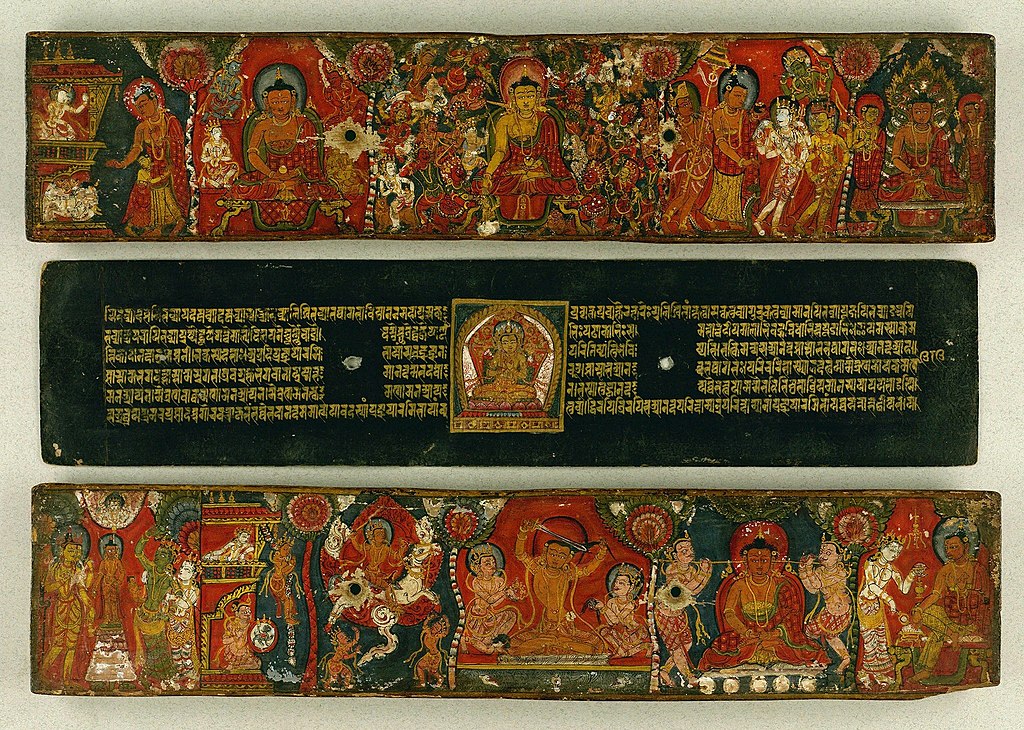
Painted wooden cover with bodhisattvas from the manuscript containing Prajñāpāramitāstotra, Aṣṭasāhasrikā Prajñāpāramitā and Vajradhvajapariṇāmanā. palm-leaf, written by scribe Sujatabhadra, 1015 CE in Hlaṃ vihara, Nepal, collection of Cambridge University Library, U K. Image: Wikimedia
Aṣṭasahasrika Prajnaparamita – An illustrated text
The Aṣṭasāhasrika Prajñāpāramitā was a prominent Buddhist manuscript richly illustrated between the eleventh and thirteenth centuries in South Asia. It underwent multiple translations from the first to the tenth centuries, reflecting the evolving practices of Buddhism in the area. Most surviving illustrated manuscripts of the Ashtasahasrika Prajnaparamita were produced in Bihar and Bengal, now part of India, during the Pala period, as well as in regions of present-day Nepal. These manuscripts were created by scribes and artists, including monks from major Buddhist monastic centers such as Nalanda, Uddandapura, known today as Odantapuri and Vikramshila in Bihar, India. The manuscripts were crafted from palm leaves, bound with wooden or ivory covers, and secured with strings threaded through holes in the folios. Each folio featured one or more panels for illustrations, with decorative bands along the edges showcasing motifs like stupas, floral patterns, or images of yogis and deities. The inner covers were also intricately illustrated. While the manuscripts did not credit the artists, the names of some scribes were noted in the colophon. These works were commissioned by both lay donors and monks, with the act of copying, illustrating, and venerating the manuscript seen as a means of accruing religious merit, as suggested in the text. The philosophical themes of the Ashtasahasrika Prajnaparamita meant that its iconographic elements were largely independent of the manuscript’s textual content.
Painted covers and single folio –
Painted covers and single folio from the Aṣṭasahasrika Prajnaparamita, manuscript from Nepal, dated 1511, Royal Library, Denmark. Image: Wikimedia
This manuscript’s covers are illustrated with scenes of the life of the Buddha. The artist has included Prince Siddhartha’s departure from the palace, the cutting of his hair, and the offering of food by the maiden Sujata.
Nothing real is meant by the word ‘Bodhisattva.’ Because a Bodhisattva trains oneself in non-attachment to all dharmas. For the Bodhisattva, the ‘great being’, awakes in non-attachment to full enlightenment in the sense that one understands all dharmas. Because one has enlightenment as his aim, an ‘enlightenment-being’’ [Bodhisattva], a great being’, is so called…………………………..translated from the Aṣṭasahasrika Prajnaparamita.
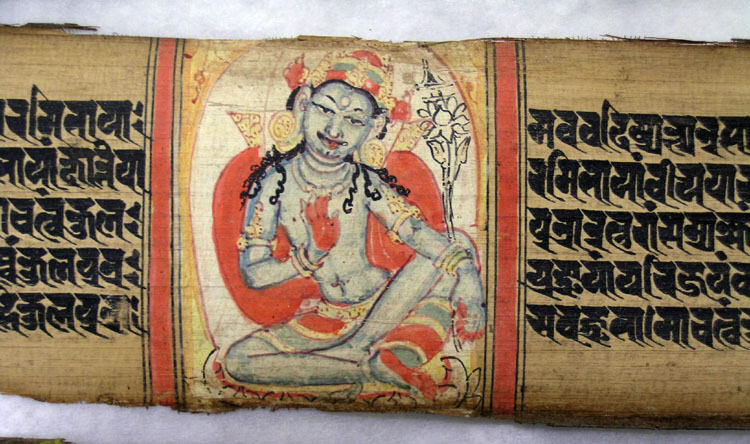
Padmapani – Symbol of purity and compassion
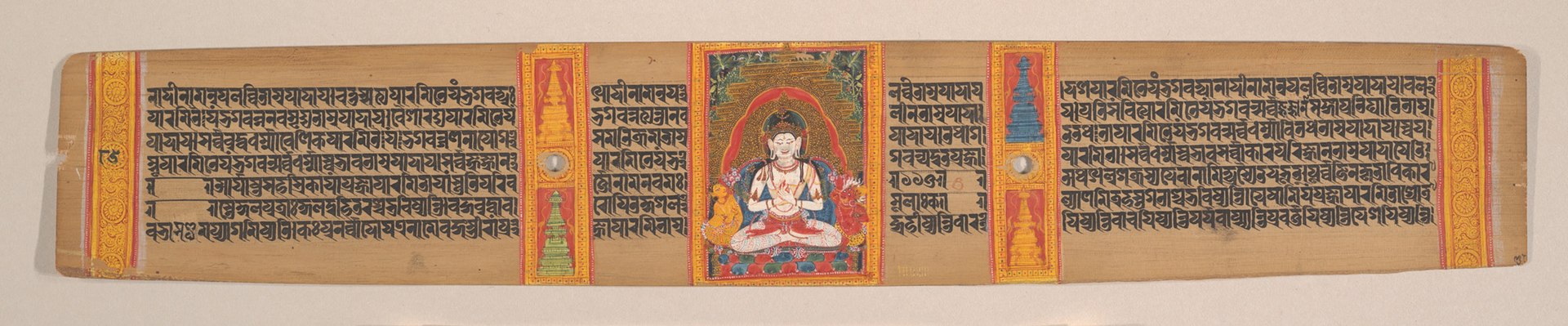
Bodhisattva Padmapani, also known as Avalokiteshvara, is a significant figure in Buddhism, particularly in the Mahayana tradition. He is revered as the embodiment of compassion and is often depicted with a lotus flower in one hand, symbolizing purity. The verse associated with Padmapani, a Bodhisattva in Mahayana Buddhism, is “Om Mani Padme Hum”. This six-syllable mantra is widely chanted and is understood to represent compassion, wisdom, and the path to enlightenment.
Bodhisattva Padmapani, leaf from a dispersed Ashtasahasrika Prajnaparamita manuscript, Bihar or Bengal, 12th century, The MET, New York, U S A. Image: Wikimedia
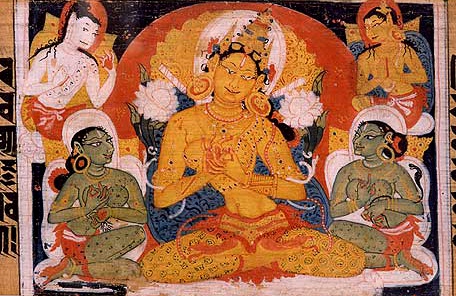
Prajnaparamita Devi, known as the ‘Goddess of the Perfection of Wisdom’, represents the embodiment of Prajnaparamita, which signifies the ultimate form of transcendent wisdom. This wisdom is regarded as the pinnacle in Mahayana and Vajrayana traditions, guiding practitioners towards Buddhahood and serving as its inherent source. From the 9th to the 12th centuries, Prajnaparamita Devi was prominently featured in Indian Buddhist art, especially during the Pala Empire period. Her image is also prevalent in Buddhist art across various regions, including Java, Cambodia, Tibet, and the Himalayas. In Himalayan and Tibetan artistic representations, she may be portrayed as either a bodhisattva or a Buddha. The painting shown here illustrates her seated in padmasana with a halo, performing the dharmachakra mudra, surrounded by white lotuses and devotees seeking her guidance for enlightenment and wisdom.
Prajnaparamita personified as devi or goddess. Astasahasrika Prajnaparamita Sutra Sanskrit manuscript, circa 700-1100 CE, from Nalanda, Bihar, India, Asia Society Museum, Houston, U S A. Image: Wikimedia
Avalokiteswara on his throne – imparting wisdom
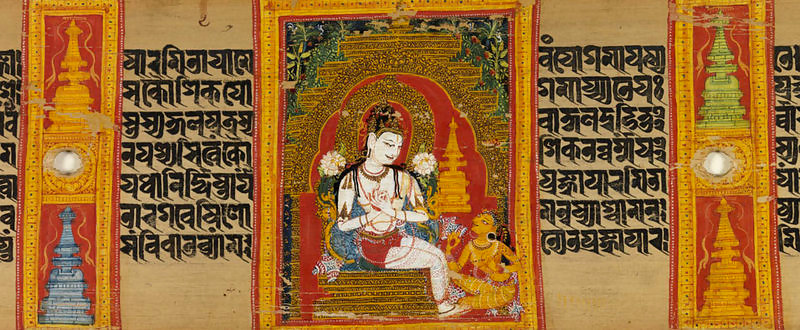
The seated Avalokiteshvara, a bodhisattva symbolizing compassion, is depicted wearing a crown and jewels, flanked by two white lotus flowers, within a temple shrine featuring the bhadra-style superstructure typical of the Pala tradition. His hands are arranged in the double vitarkamudra as he shares the Perfection of Wisdom sutra with a lady devotee, who looks up at him with admiration. He represents compassion, kindness, and the potential for spiritual development, even in difficult situations. This scene expresses a deep humanist sentiment, mirroring the psychological principles found in texts that guide devotees on how to engage with the deity. The essence of the Buddha, dhatu is represented by a stupa, symbolizing the presence of both the Buddha’s relics and teachings.
Avalokiteswara on his throne, Sanskrit Astasahasrika Prajnaparamita Sutra manuscript written in the Ranjana script. India, early 12th century, The Met, New York, U S A. Image: Wikimedia
Maitreya – The future Buddha
Maitreya is an esteemed bodhisattva in Buddhism, regarded as the future Buddha of our world. It is anticipated that he will be reborn in the future to impart the dharma when the teachings of the present Buddha, Shakyamuni, have been lost. Maitreya is expected to eventually come to Earth, be born as a human, and attain enlightenment. The name Maitreya originates from the Sanskrit term ‘maitrī,’ which translates to loving-kindness or friendliness.
Bodhisattva Maitreya, Folio from a dispersed Ashtasahasrika Prajnaparamita (Perfection of Wisdom) Manuscript – India (Bengal) or Bangladesh India (Bengal) or Bangladesh, early 12th century, The Met, U S A. Image: Wikimedia
Green Tara – A compassionate deity
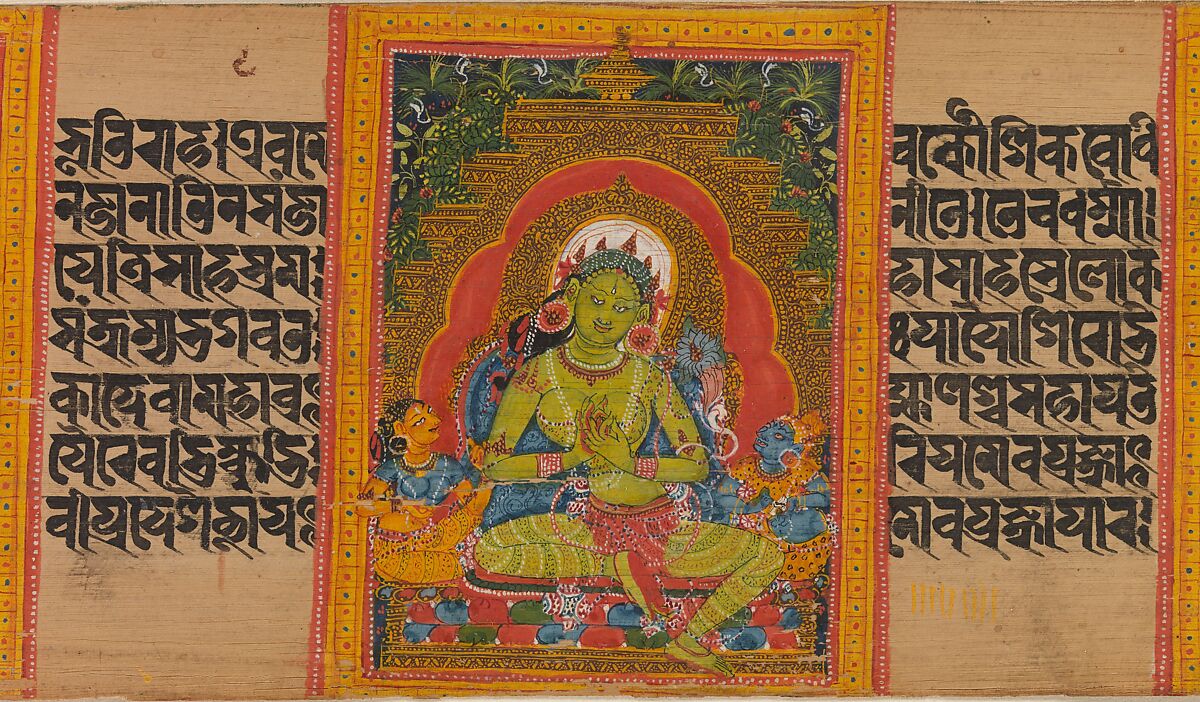
Green Tara is a benevolent figure who facilitates freedom by eliminating barriers that hinder devotees from achieving their aspirations. In this aspect, she is regarded as a protector within the Buddhist tradition. A revered representation of Green Tara features her with a pendant leg and a blue lotus, accompanied by two female attendants—one wielding a vajra and the other, Mahakali, holding a flaying knife and a skull-cup or kapala.
Enshrined image of Green Tara, Mahavihara Master, early 12th century. Image – The MET, New York, U S A
Mara – A demon against enlightenment
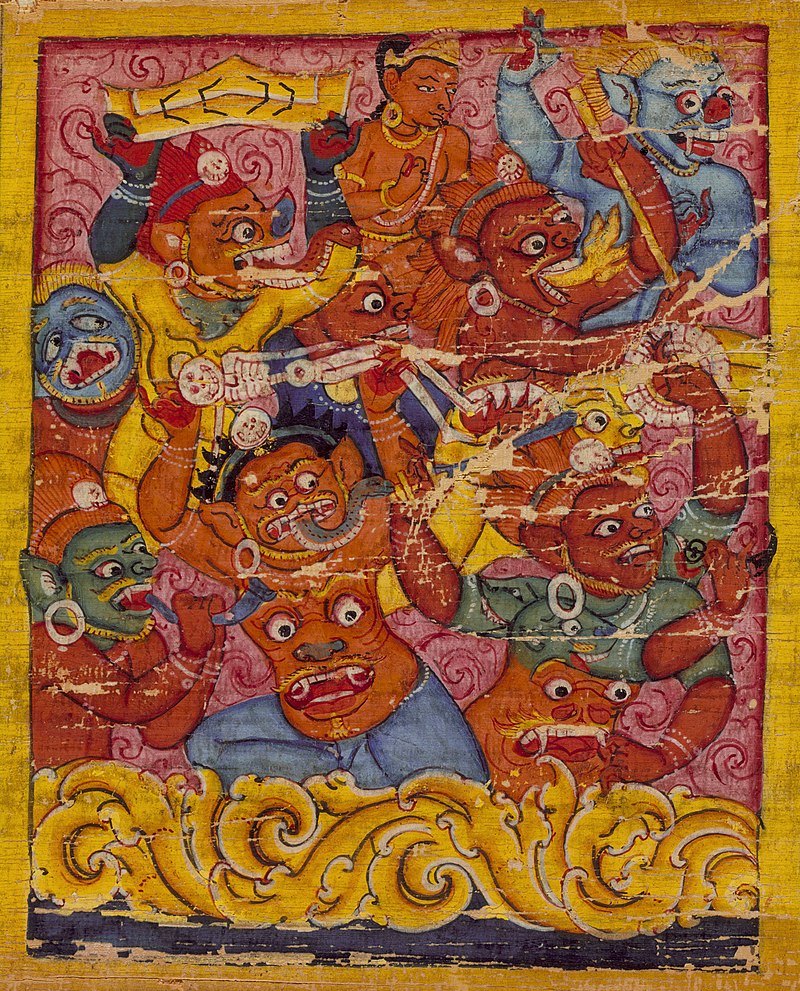
Mara represents not merely a singular being, but a manifestation of the collective forces that resist enlightenment. Associated with life’s transience and the dread of mortality, Mara complicates the process of detaching from earthly attachments. Employing various tactics, Mara entices individuals with worldly pleasures, fame, power, and material wealth, diverting them from their spiritual journeys. The ultimate aim of Mara is to obstruct individuals from pursuing enlightenment by generating distractions and impeding their spiritual advancement. In Buddhist tradition, Mara is depicted as a malevolent celestial Asura king who attempted to prevent Prince Siddhartha from achieving ‘Awakening’ by alluring him with his celestial army and visions of enchanting women, often referred to as Mara’s daughters in various legends. In this artwork, he is portrayed alongside his demonic forces.
Mara’s Retinue, Folio from an Astasahasrika Prajnaparamita (The Perfection of Wisdom in 8,000 Verses), 11th century Book/manuscript, Nepal, Himalayas. LACMA, Los Angeles, U S A. Image: Wikimedia
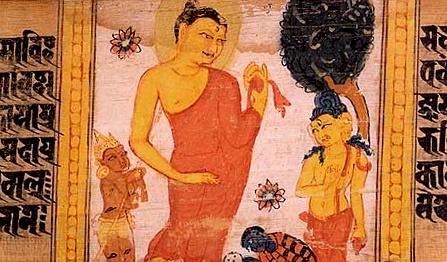
Gautama Buddha – Descent from the Trayastrimsa Heaven
The descent of Gautama Buddha from the Trayastrimsa Heaven, also referred to as Tavatimsa or the Heaven of the Thirty-Three Gods, holds great significance in Buddhist tradition. After imparting teachings to his mother, Mayadevi, and the deities residing there, Buddha returned to earth at Sankisa. This event is illustrated in various forms of art and literature, showcasing a celestial staircase with Brahma and Indra aiding his return. Buddha ascended to Trayastrimsa Heaven to deliver the Abhidharma teachings to his mother, who had passed away shortly after his birth. Legend states that a three-tiered staircase made of precious materials—gold, silver, and jewels—manifested to assist in his descent. Artistic representations of Buddha’s descent from heaven can be found at Sanchi, Bharhut, Sankisa, and other locations, often depicting him with Brahma and Indra positioned on either side.
Gautama Buddha descends from Trayatrimsa Heaven, attended by devas, Brahma and Indra. Sanskrit Astasahasrika Prajnaparamita Sutra manuscript written in the Ranjana script, Nalanda, Bihar, India. Circa 700-1100 CE, Asia Society Museum, Houston, U S A. Image: Wikimedia
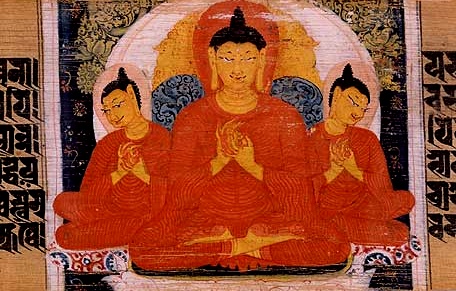
Buddha’s supernatural powers – Miracle at Shravasti
The Miracle at Shravasti, also known as the Twin Miracle, is an important occurrence in Buddhist tradition where the Buddha showcased his extraordinary powers in the historic city of Shravasti. He performed feats such as levitation, producing fire and water from his body, and creating multiple images of himself. This event was a reaction to a challenge posed by six non-believers and served to illustrate the Buddha’s miraculous capabilities to both his followers and sceptics. The accompanying illustration depicts the Buddha as he multiplies into numerous images.
Gautama Buddha descends from Trayatrimsa Heaven, attended by devas, Brahma and Indra. Sanskrit Astasahasrika Prajnaparamita Sutra manuscript written in the Ranjana script, Nalanda, Bihar, India. Circa 700-1100 CE, Asia Society Museum, Houston, U S A. Image: Wikimedia
International Museum Day is a call to celebrate as India presents the world with a new cultural wonder: the Abhay Prabhavana Museum, the globe’s largest private museum and Knowledge Centre devoted to India’s spiritual and philosophical heritage. Unveiled in November 2024, the museum is more than an amalgamation of culture. It is a living, breathing testament to India’s Shraman and Jain traditions, inspired by visionary philanthropist Dr. Abhay Firodia.
A Vision Rooted in Cultural Revival
We all know Abhay Firodia for so many reasons- industrialist, leader, innovator, defender of culture. Now he is also the mind behind the Abhay Prabhavana Museum, which attempts to frame an ancient Indian heritage for the contemporary world. Overall rooted in Jain values of compassion, non-violence, and peace, the museum is not simply a collection of the bygone days. It is a space filled with knowledge that fosters deep thinking, learning, and international dialogue.
This International Museum Day, the museum stands as a tribute to timeless ideals and a bridge between ancient wisdom and the digital age. As Dr. Firodia shared, “India’s legacy cannot live in textbooks alone. It must be experienced, questioned, internalized — and that’s what Abhay Prabhavana aims to do.”
Architecture That Inspires Awe and Inquiry
The Abhay Prabhavana Museum is strategically located on the banks of Indrayani River, which runs parallel to the Pune-Mumbai Highway. Its expansive campus houses:
30 Thematic Digital Galleries which has more than 350 unique commissioned artworks, narrative installations, and digital storytelling areas.
Digital Jainism which includes virtual reality rooms, touch screen tables, and interactive Jain Philosophy artifacts.
Thoughtfully designed landmarks such as:
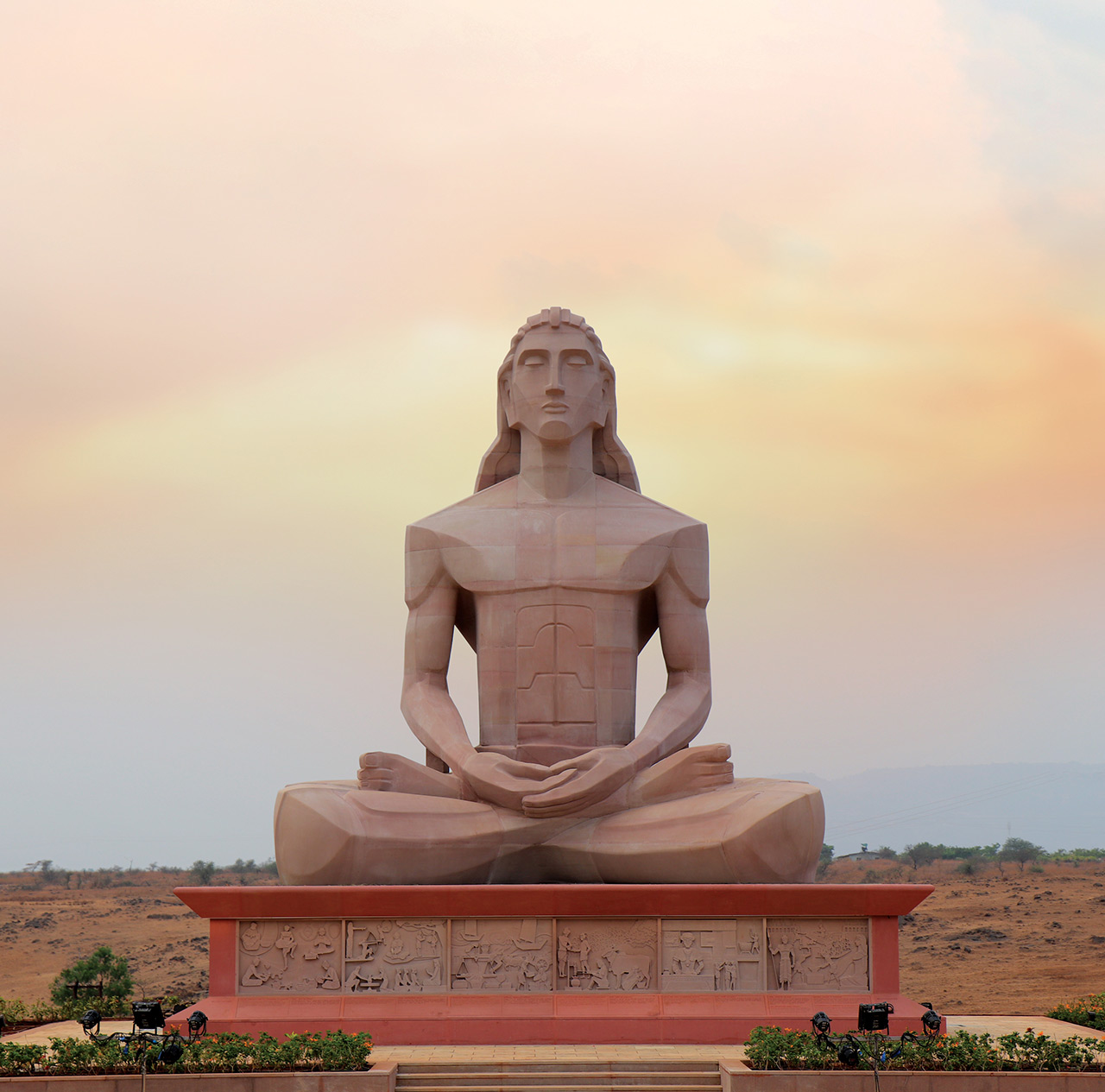
Rishabhdev Statue: A 13.2-meter Art-Deco style depiction of the first Tirthankar, surrounded by murals that trace the civilizational backbone of India.
Manstambh: A 30.5-meter tower carved in marble celebrating enlightened human conduct.
Plaza of Equanimity: A four-facing temple designed for introspection and spiritual calm
A Museum Unlike Any Other
What makes Abhay Prabhavana unique is its departure from conventional museum experiences. There are no antiques on display because the museum doesn’t romanticize the past. Instead, it focuses on the scientific rationality and ethical considerations of ancient Jain values in the contemporary world.
Every exhibit narrates a chapter not only of religions but also of human history depicting advancement through Jain values like nonviolence, ethical politics, ecology, and even self-regulation. Tourists do not just observe; they are engaged in a lively cultural discussion, sensing themselves at the hub of international conversations.
Educational Excellence and Intellectual Rigor
As a Knowledge Centre, this museum fulfills its identity by directly supporting scholarly work through primary research, education and intellectual exploration with:
Taxila Library: It holds precious Jain manuscripts, scholarly works from the world’s peripheries, and digitized treasures.
Kundanmal Firodia Auditorium: It is a 170-seat multipurpose auditorium, used for seminars, lectures, and community functions.
Baijabai and Jamnabai Firodia Galleries: These include national and international touring exhibitions and exhibitions of private collectors.
Child museum, play area, and amphitheater designs are underway, making the museum desirable to every generation — from curious young minds to seasoned researchers.
A Beacon of Cultural Tourism and Global Engagement
Abhay Prabhavana not only serves as an educational facility, but also functions as a cultural tourism center. This museum is culturally further enriched by its proximity to the ancient Jain caves, which are over 2,200 years old and were important landmarks along trade routes. The museum is ready to:
Welcome international scholars, students, and tourists.
Represent and project India’s spiritual and intellectual heritage to the world.
Develop sustainable tourism and economic opportunities in the city of Pune.
With India in the midst of a Museum Renaissance, it is the Abhay Prabhavana Museum that spearheads this shift by transforming how history is kept and showcased. It is part of a new wave of next-gen museums which incorporate technology, traditions, and community activities in unprecedented ways.
Sustainability and Innovation at its Core
Innovation is deeply embedded in Abhay Prabhavana’s blueprint. The infrastructure follows LEED certification standards, making it one of the few green museums in the world. Its use of digital storytelling tools and virtual spaces optimizes the availability of spiritual knowledge to modern audiences.
Each gallery is designed to question, provoke emotional reactions, and stimulate intellectual curiosity, providing a 10-minute window of immersion into philosophical concepts presented in contemporary formats.
Conclusion
The Abhay Prabhavana Museum glows as a beacon of hope, not just for India, but for the world in a life that is starved of moral paradigms and spiritual direction. It encourages introspection, creates curiosity, and rekindles a sense of pride in a heritage that is not just old, but deeply human.
As we celebrate International Museum Day, Abhay Prabhavana reminds us that museums are no longer silent halls of memory — they are vibrant platforms for education, transformation, and legacy-building.
They say, God cannot be present in all the places, that’s the reason he created “Mother”, a soul that care us from the beginning till the end. She is the greatest emotional anchor to clense ourself to be better ones. As children we too do our best to keep her happy in all the possible ways, we care for her health, we pray for her long life. We make sure she look her best in all the ways, there are many ways you can make your mother happy. Here is a best one she would love to have. Jewellery, the best gift of artisans to a woman. Here are jewellers that cake bring in good health, happiness along with good looks. Giving these jewellery to your mother can not only express your filial piety, but also have a good meaning and health benefits.
1. Pearls
Image – Pixabay
Meaning auspicious well-being and completed. Diana once said that if a woman can only have a piece of Jewellery, it must be a pearl. Pearl not only has good meaning, but also looks dignified. Pearl can also calm, regulate endocrine, long-term wear can have a certain health care effect on the body. The pearls exude a warm luster and reflect the gentleness of the mothers. Fashionable moms can choose simple styles, while luxury moms can buy pearls with diamonds. Ordinary freshwater pearl necklaces cost around 500 to 1000 yuan. Seawater pearls range from a few thousand to tens of thousands yuan. The bigger and rounder the pearl, the better its luster and the more expensive it is.
2. Agate
Image – Pixabay
Activated internal organs, improve intestines and stomach. Agate is cryptocrystalline silica, translucent and glassy. The main effect can strengthen blood circulation, promote metabolism, and have a beauty effect on the skin. Because agate contains a variety of micro-elements such as iron, zinc, nickel, chromium, cobalt, manganese, etc., it is very healthy for mothers to wear agate monogrammed bracelets getnamenecklace.com for a long time.
3. Garnet
Image -Pixabay
Nourishing beauty and enhance blood circulation. It is better to send mothers garnet Jewellery than tonic! For women, blood circulation is very important. Because of the particularity of gender, women are prone to loss of vital energy and blood. A woman with insufficient blood, not only looks pale, has no spirit, but has a lower resistance. If you want a good spirit, you must have enough blood. In addition to the usual food supplement, you can also use Jewellery to help supplement your blood. The most common thing is garnet. Wearing garnet for a long time can enhance the vitality of the cells and improve blood circulation, thus playing the role of enhancing blood circulation, so that the overall look of the mother looks better! It is best to choose garnet bracelets and wear them in the left hand. As the saying goes, “Left in and right exit”, good things go from the left hand, bad things come out from the right hand. To garnet jewels that enhance blood circulation, of course, it need to be worn in the left hand.
4. Coral
Image – Pixabay
Meaning love precipitation. Coral is a beautiful creature of the sea, which with a very long life span, and its beauty is more directly displayed in front of the public when it is used as a jewel. It is one of the few jewels that has been alive for thousands of years. Corals represent unparalleled rarity and preciousness. The conditions for coral formation are very demanding. They often accumulate over thousands of years under conditions such as temperature, location, and seawater salinity. Therefore, having this treasure not only represents their own strong financial and strength, but also has the opportunity to let love settle.
5. Green Tourmaline
Image – Pixabay
Symbolizes hope, life and lucky. Green tourmaline represents freshness, health, hope and the symbol of life, it has a sense of safety, calm and comfort. It is like in the land with distinct four seasons, seeing the tree of spring and green tender leaf will make the person has the feeling of new life. Green tourmaline is also a kind of gemstone that attracts wealth. Therefore, many people make green tourmaline into bracelets, or put them together with wallets and cash boxes.
Symbolizes the auspicious eternal. Turquoise has the reputation of “stone of success” and “stone of luck.” It represents warmth and symbolizes auspiciousness, eternality and success. Wearing turquoise mothers bracelets www.getnamenecklace.com will make your mother’s life full of love, avoiding all the unfortunate accidents and bringing good luck to her. It also has magical effects such as promoting cell regeneration, strengthening the immune system, strengthening the body, stabilizing the mood and increasing the reactivity of the brain.
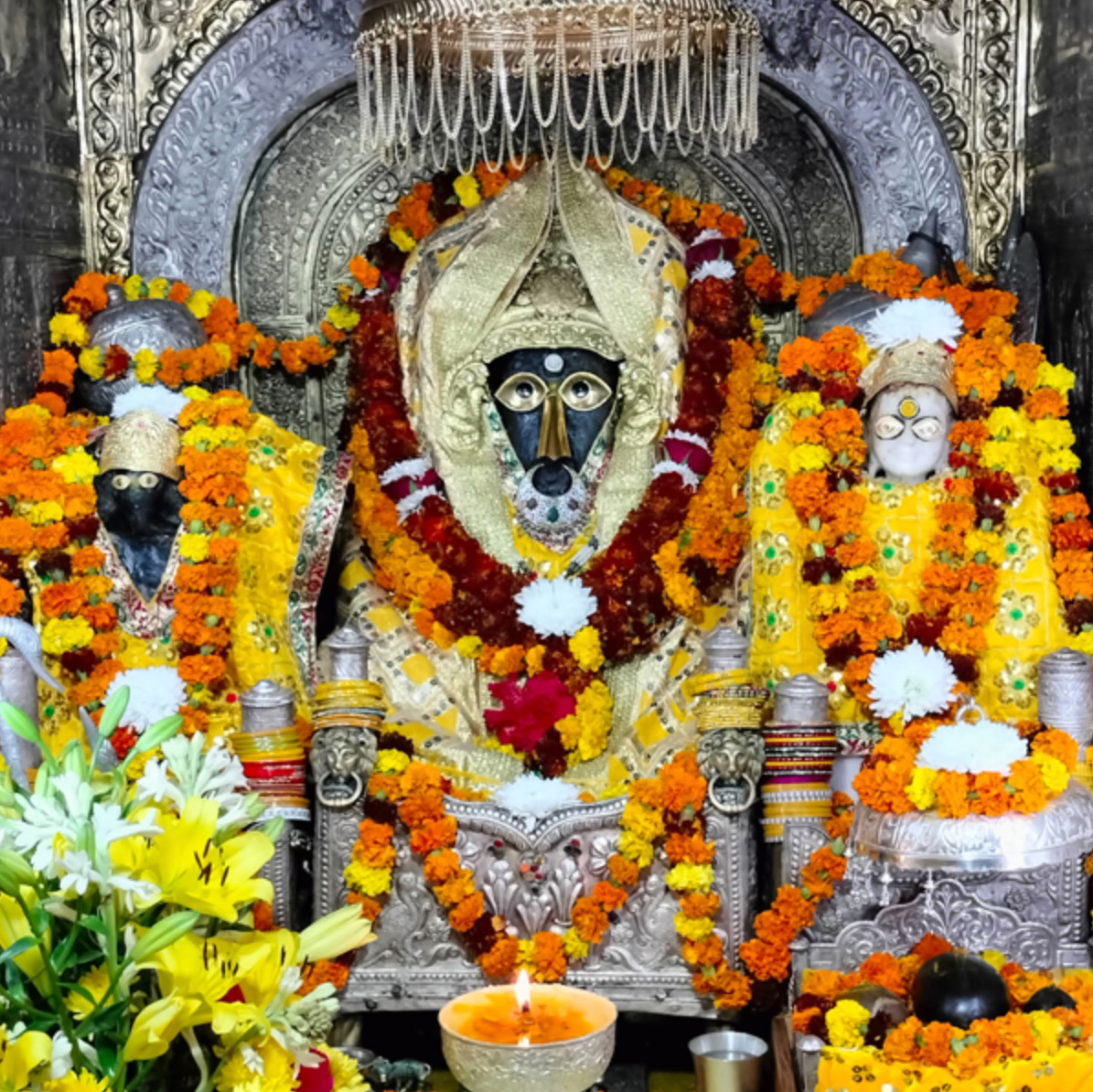
Within the Hindus’ huge universe of gods and goddesses, Maa Baglamukhi is the quietly powerful drumbeats — the energy that makes words irrelevant and enemies powerless. She is part of the group of ten Mahavidyas known for her ability to stambhan — muffle ill wishes, damp bad vibes, and triumph over wrong. She sparkles like the tranquil eye of the hurricane.
Reciting the Maa Baglamukhi Stotram with devotion and discipline will bring protection, success, and spiritual development. But just as any musical performance takes rhythm, any calling upon the divine takes timing, technique, and intention.
Why Chant Maa Baglamukhi Stotram?
The Maa Baglamukhi Stotram is not a mere hymn; it’s a spiritual armour. Famed for eradicating ill will and black magic, the stotram plays an immense role in tantric as well as devotional practice.
Perks of reciting the stotram:
Eliminates the activities of the enemy and evil plans
Supports legal war or litigation
Safeguards from evil glances and psychic attacks
Sharpening intellect and improving speech
Offering mental clarity and emotional courage
Imagine it like your spiritual armour — subtle yet impenetrable.
The Right Time to Chant
Timing in devotion is like sunlight to a blooming flower. Certain times increase the energy of Maa Baglamukhi and your outcome for Maa Baglamukhi.
Auspicious times to chant:
Brahma Muhurat (4:00 a.m. to 6:00 a.m.): for spiritual progress
Night hours on Tuesdays and Thursdays: for protection and power
During Navratri and especially Baglamukhi Jayanti (which falls on the eighth day of Vaishakh Shukla Paksha, usually in May)
For 2025, Baglamukhi Jayanti falls on 4th May, a perfect day to invoke her energy with full dedication.
Rituals to Follow for Maximum Benefits
Reciting the Maa Baglamukhi Stotram is similar to sailing a spiritual river. You need to understand where to begin, when to turn, and when to let go.
Preparation Before Recitation:
Have a bath and wear clean yellow attire (yellow is Maa’s favorite color).
Sit in the direction of east or north.
Light a ghee lamp and offer yellow flowers.
Remain silent and concentrate mentally.
Mantra Count and Frequency:
Recite 108 times a day for 11, 21, or 40 days to bring about profound change.
Practice using a turmeric mala to ensure the sacredness of the practice.
Allegories of Divine Intervention
Imagine Maa Baglamukhi as the golden sun cutting through thick fog. When adversaries surface like tidal waves, her stotram serves as a dam, holding off harm and paving the way for peace. Invoking her name is like greasing the gears of justice — silent, needed, and strong. On the battlefield of life, she is the war strategist murmuring the right steps in your ears and causing you to emerge victorious without strife.
When You Can’t Be at the Temple: Utsav is There
Not all devotees have the time to stand in line or journey long distances for the ideal puja. For most, the demands of life conflict with religious intentions. It is here that Utsav becomes the silent priest — ubiquitous, always available.
Utsav is India’s favorite Hindu dharmik app, which brings devotees closer to sacred rituals through online pooja booking at holy temples such as Shaktipeeths and Jyotirlingas. Whether you want to recite the Maa Baglamukhi Stotram or get a puja done on her Jayanti, Utsav makes it easy:
Book rituals at powerful temples from anywhere
Get holy prasad delivered to your doorstep
Receive live instructions and mantra guides
Participate in live darshan from as far as hundreds of miles away
Utsav is not just an app — it’s a heavenly facilitator for today’s devotees, particularly when distance, time, or physical limitations complicate temple visits.
Conclusion: Your Path to Peace is Just a Click Away
In this age of technology, when the pace of life tends to overlook spirituality, chanting the Maa Baglamukhi Stotram is your anchor. It’s a reminder that power doesn’t always bellow — at times, it whispers in couplets and prayers.
And if work, distance, or time constraints keep you away from visiting temples on auspicious dates like Baglamukhi Jayanti or Navratri, the answer is at your fingertips. With Utsav’s simple online pooja booking, expert-led rituals, and live darshan, your piety never has to stop. Log on to Utsav today through their official website or download their app from the Play Store — and let your bhakti flow unbroken.
Let your voice echo with the strength of Maa Baglamukhi’s name. Let your devotion meet divine timing. And let Utsav be the invisible thread that ties it all together.
There was a time when Sunday mornings meant stepping out with a cloth bag and heading straight to a nearby bookshop selling old books at the corner of the lane. There was no AC inside or sleek counters but only tall wooden shelves leaning under the weight of hundreds of forgotten stories. The shopkeeper, always with a kind smile, somehow remembered what you read last time and would have a few hand-picked titles waiting for you. You didn’t just buy books there. You built a relationship with reading.
Such bookshops were quiet little escapes in a noisy world for many of us who grew up in the ’90s or early 2000s. Comics, used school books, second-hand encyclopedias, and even the odd Mills & Boon or Hardy Boys copy – something are there for everyone.
But they started to disappear somewhere along the way. Malls came in, online shopping took over, and those quiet little corners slowly shut their doors. It’s rare to find such places still standing, making many of us feel like a part of childhood has faded with such shops.
Yet, not all is lost. The love for old books hasn’t gone anywhere. It has found new ways to survive. This post is about remembering the charm of old bookshops, the role they played in shaping who we are, and how that spirit might still be alive in a new form.
Old Bookshops: The First Step Into Storytelling
Modern bookstores have everything polished, categorised, and sometimes even intimidating. On the other hand, old bookshops had an imperfect charm. They gave us the freedom to explore without pressure. No sales counters were watching us. No algorithms were suggesting what to read next. All we had was shelves stacked with stories waiting to be found. These spaces became quiet companions in our growing-up years.
Whether it was preparing for an exam, chasing a hobby, or spending pocket money on an Amar Chitra Katha, the bookshop was always there. Many of us learned the joy of ownership there, be it buying our first book, getting a second-hand edition at half price, or finding a rare out-of-print gem in a corner.
It wasn’t just about buying books there. These shops taught us to be patient and curious. We’d spend hours digging through piles, not knowing what we’d walk out with. That surprise was half the fun. Some of us even struck up mini-friendships with the shop uncle, who’d slip in a free bookmark or knock off five rupees if he liked us enough.
In many ways, these bookshops were the offline version of discovery before the Internet came along. They shaped our choices, reading habits, and even the way we saw the world growing up.
The Fade-Out of Bookshops From Lanes to Online Links
There wasn’t one big moment when old bookshops vanished. It was more like a slow fade that most of us didn’t even notice until it was too late. One day the shop was there, with its familiar stack of comics and paperbacks. The next day, it had turned into a mobile store or café.
Several things contributed to this quiet exit:
Small bookshop owners couldn’t keep up with increasing property costs or rent, especially in busy city areas.
Online platforms started offering steep discounts, convenience, and home delivery, which is hard for local shops to match.
The slow act of browsing shelves became rare with phones, tablets, and the availability of endless content online.
As malls and multiplexes grew, fewer people wandered down quiet lanes looking for old or new books.
Fewer parents take their children to book bazaars or encourage the culture of owning used books.
We started spending more time on screens than in the company of books. Even libraries became places for Wi-Fi and study sessions rather than casual reading. Yet, people never stopped loving stories.
The Magic of Old Bookshops That Algorithms Can’t Replace
Old bookshops were never just about buying books. They offered a sense of belonging. It was the kind of space where time slowed down, no one rushed you, and every corner held the promise of discovery. Even today, the memories of those afternoons spent flipping through yellowed pages linger in our minds.
Wondering why these spaces still matter in a world driven by screens and next-day delivery? Here are a few possible reasons:
They nurtured reading habits naturally. You didn’t need a reading app or a reading goal. You wandered in, picked up what caught your eye, and reading became second nature before you knew it.
They created a personal connection with books. Finding a handwritten name inside the cover or a forgotten bookmark felt like a silent conversation with someone from another time.
They made books accessible. Second-hand book pricing meant more books for less, especially for students or young readers building their collections on pocket money.
Without algorithms suggesting titles, we discovered authors and genres we might have never clicked on online.
Whether it was the shopkeeper’s recommendation or a random chat with a fellow reader, these spaces sparked conversations.
While the format may be fading, the spirit of passing on a well-read book or the thrill of finding a hidden gem still lives on.
Modern Ways to Keep the Pages Turning
While the cosy bookshops of our childhood have become harder to find, it doesn’t mean their spirit has disappeared. If anything, it has adapted and found new spaces/communities that still cherish the joy of second-hand books and the stories they carry.
Today, many readers rediscover that same warmth through online platforms that make buying and selling old books easier than ever. Take the case of BookMandee. This portal has become a sort of digital version of those beloved shops, where old books can find new homes, and treasured finds are only a message away. It’s a different setup, but the feelings are familiar – stumbling upon a rare title, passing along a well-loved book, or connecting with someone who shares the same reading tastes.
Beyond the online world, there’s also a growing trend of pop-up book fairs and community-led book exchanges popping up in neighbourhoods and cafes. These small events recreate that nostalgic experience of browsing through stacks of books, striking up conversations with fellow readers, and walking away with a story you didn’t know you needed.
At its core, it’s still about the same simple joy of letting stories travel from one reader to another. The shelves may have changed, but the love for books and the memories tied to them remain just as strong.
The Story Doesn’t End Here
Old bookshops may not line our streets the way they once did. However, their influence is still very much a part of us. They were the quiet backdrop to our growing-up years for many of us – a place where we learned to love stories, found comfort in silence, and our imaginations first began to stretch beyond the ordinary.
We may now click and scroll more than we browse and bend spines. But the feeling of holding a well-read book, knowing it has passed through other hands and other homes, still carries a quiet magic. Readers can buy old books online or pass their old treasures down to younger siblings. The form has changed but not the intention. It’s still about sharing, discovering, and keeping the joy of reading alive.
What matters most is that we continue to honour those charming little spaces by carrying forward the habit they gave us: the habit of reading, of caring for books, and of finding a little bit of ourselves in the pages of another.
We focus a great deal on the facial skincare stuff—cleansers, serum, sunscreen—and we should remember that the other parts of our body need loving too. Flaky skin on the elbows and knees, or scratchy areas on the limbs, are uncomfortable, and tend to indicate your skin is demanding a little added TLC. That’s where Vaseline Body Lotions step in. With their long-standing reputation, these lotions provide an easy and effective solution to moisturise, restore, and shield your skin, making it feel smooth and silky every day—without the fuss.
What Sets Vaseline Body Lotions Apart?
It is so easy to be lost in today’s market and the variety of body lotions available. However, Vaseline Body Lotions are different from the rest because they are the only ones that actually deliver what your skin needs—hydrate, heal, protect—without further hassle. The core of each Vaseline formula is made up of carefully chosen ingredients such as glycerin that keeps your skin hydrated, and microdroplets of Vaseline Jelly, which locks in the moisture so that your skin stays moisturized for a longer time.
Thick lotions tend to be sticky and heavy for the most part, leaving your skin feeling uncomfortably. But Vaseline Lotions always give you the freedom of a light, non-greasy feel, so you don’t even need to wait for them to dry out to go on. Vaseline is also renowned for being the most dependable, lowest priced, and most effective brand. It’s not for a moment; it’s for every day. Also, its widespread availability makes it easily accessible to people. Vaseline Body Lotion is the ultimate example of how skincare is no longer related to complexity or exorbitance.
Types Of Vaseline Body Lotions
Different Types Of Vaseline Body Lotions Available And Advantages Of Each Product Variant:
Vaseline offers a wonderful range of lotions for different skin types and concerns. Below is the list of top Vaseline body lotions, along with the features that make each unique:
1. Vaseline Intensive Care Deep Restore
Suitable for: Extremely dry, dehydrated skin
This is a favourite of those who have very dry skin. The lotion is also known as an excellent day moisturiser, especially in colder months or if you live in a dry area.
2. Vaseline Intensive Care Cocoa Glow
Perfect for: Dry, dull skin that needs a healthy glow
This product includes raw cocoa butter and shea butter. Apart from giving a lot of moisture, it also gives your skin a glow. In addition to this, this product smells like chocolate.
3. Vaseline Intensive Care Aloe Soothe
Best for: Sun-exposed or sensitive skin
This product contains aloe vera, the wonder plant that has the capability to perform the double function—cooling and offering instant relief from heat. It is lightweight in texture and is easily absorbed by the skin, thus becoming a favorite among people who belong to tropical areas.
4. Vaseline Intensive Care Advanced Repair (Unscented)
Best for: Very dry or rough skin, including sensitive skin
The product has been developed to ensure that it is free from fragrances in whatever form. Moreover, it has been tested vigorously to make sure that it is gentle on the kin. It has richly nourishing moisturising properties which not only impart instant healing to the bumpy patches of skin like the elbows, knees or heels but also leave a soothing touch.
5. Vaseline Healthy Bright (with Vitamin B3)
Best for: Dull skin or uneven tone
It has niacinamide, which is a Vitamin B3 variant that works like a sunscreen, and therefore is not only able to enhance the skin tone but also prevent sun damage. It is for those wanting something more than moisture.
6. Vaseline Gluta-Hya Serum-In-Lotion
Best for: Deep hydration and brightening
This product not only hydrates the skin but also is able to give a perfect summer tan. It contains (Niacinamide), and moisture (Hyaluronic Acid), to destroy the spots. This is a lotion as well as a serum.
Summary
Vaseline offers a series of body lotions in India, each aimed to take care of specific skin problems. From rich moisturizing with Deep Restore to soothing comfort with Aloe Soothe and glow benefits from Healthy Bright and Gluta-Hya, there’s a product for all skin tones. Ingredients like cocoa butter, aloe vera, hyaluronic acid, and Vitamin B3 make these lotions not only effective but also nurturing. Affordable, convenient, and dependable for years, Vaseline body lotions are a smart addition to any regimen.
On 2nd May 2025 at precisely 7:00 AM the gates for Kedarnath Dham were opened for devotees which marks the start of Char Dham Yatra for the year 2025. The highly anticipated opening drew thousands of pilgrims, who came to witness the Vedic pujas early in the morning on that day.
A Sacred and Majestic Opening Ceremony
The day started with a strong feeling of worship as more than 15,000 pilgrims rushed to Kedarnath. Many had arrived as early as 3:00 AM, eager to witness the opening of the temple. By 5:00 AM, the air was filled with the chants of “Har Har Mahadev,” as anticipation reached its peak. The religious songs sung by a military band added to the atmosphere, signaling that the temple was opening once again.
Traditional Rituals and Ceremonial Processions
The opening ceremony started with the auspicious arrival of the Panchmukhi palanquin, a symbol of Kedarnath’s idol, representing divine supremacy. Bhimashankar Linga Rawal Bhimashankar, the head priest, along with Chief Priest Bagesh Ling, performed the kula sathak rituals to confirm the temple’s dome will remain spiritually active for the forthcoming months. He added that the process of the Dev Chhadi — divine staffs that temples used to bear during the processions before 1964 — also chanted before the sanctum.
At exactly 7:00am the doors of the temple were opened with a serpent shaped key which has always been used, signifying the merging of the physical and spiritual world. As the gates were slowly opened, the ground was resonating with the chanting, and the temple reverberated with a divine presence, sharing its spiritual aura with the entire valley of Kedarnath.
CM Pushkar Singh Dhami Grace the Opening
The ceremony was graced by the presence of Chief Minister Pushkar Singh Dhami and his wife, who spent time with the other guests. The CM offered a holy garland of cloves to Lord Kedarnath, adding greater significance to the occasion. District Collector Dr. Saurabh Gaharwar and SP Akshay Prahlad Konde, from the local police, were present in the large congregation of devotees and participated in the sacred moment.
The Start of Char Dham Yatra 2025
The opening of Kedarnath marked the beginning of the Char Dham Yatra, one of India’s most revered pilgrimages. Every year, lakhs of devotees journey to these high-altitude shrines, seeking blessings from the divine. The Char Dham Yatra includes visits to Yamunotri, Gangotri, Kedarnath, and Badrinath, each offering unique spiritual experiences.
Set at a height of 3,583 meters, Kedarnath is well known for its association with lord shiva, who is considered to reside there in jyotirlinga form. The temple’s awe-inspiring location between the Meru-Sumeru mountain ranges makes it one of the holiest sites in Hinduism.
Spiritual Significance and Rituals
Following the temple’s opening, the rituals continued with the revival of After the temple was opened, rituals continued with the revival of the Lord Kedarnath Idol by Chief Priest Bagesh Ling. The Shodashopachara Pooja and Aarti was performed in reverence to Lord Shiva setting the spiritual sentiment for the next six months. At 8:30 AM, the temple was officially opened for public darshan, with devotees eagerly entering the sanctum to seek blessings from Lord Shiva.
A Six-Month Pilgrimage Begins
The opening of the doors for Kedarnath signifies that the temple will be open for darshan for the next six months.The peak pilgrimage months are anticipated to bring in hundreds of devotees who intend to receive blessings and feel the spiritual impact of the temple. The Kedarnath Dham is expected to continue playing a pivotal role in India’s spiritual landscape as the Char Dham Yatra 2025 unfolds.
Throughout the Char Dham Yatra, Kedarnath will continue to shine as a source of hope for travelers from all over looking for a shift in their spiritual state.