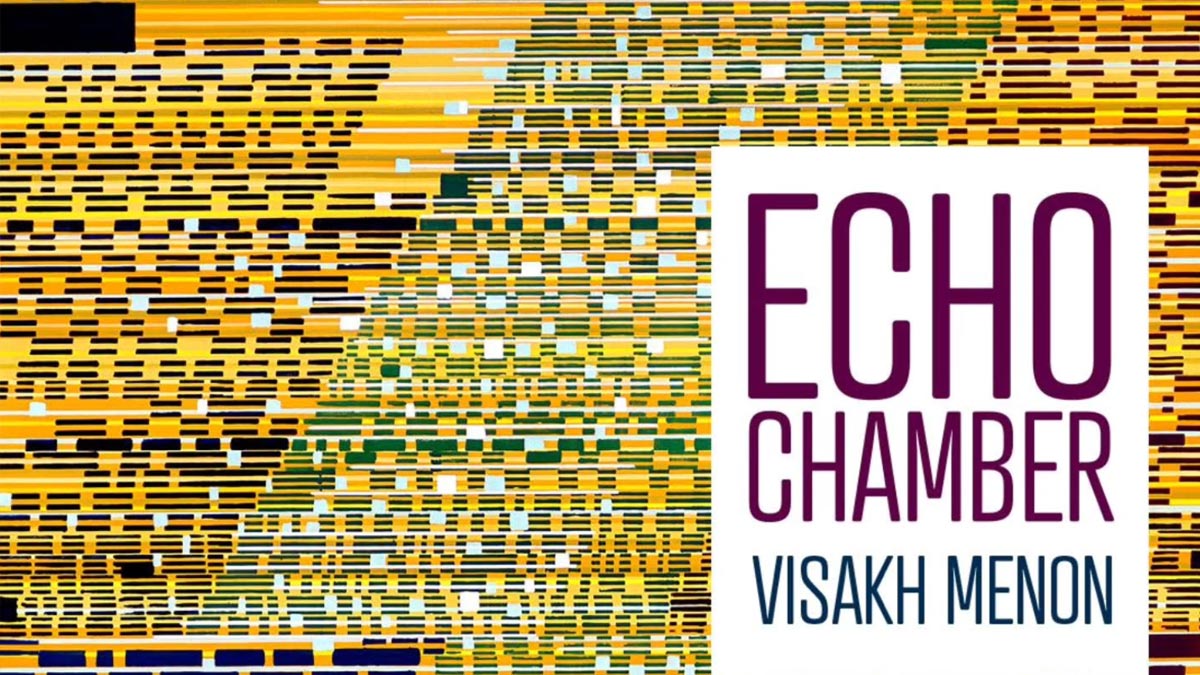
New Delhi’s Blueprint12 in Anand Niketan is currently hosting a solo exhibition by Visakh Menon, titled Echo Chamber. This solo exhibition is a visual take on contemporary visual culture. The exhibition is running from December 5, 2025, to January 15, 2026. The focused area of the exhibition is the display of the New York-based artist’s new paintings. The exhibition is established at the intersection of contemporary abstractions, complemented by technological consciousness. By amalgamating components from both domains, this show aims to reassert the authority of the human hand in the creation of art. Visakh Menon’s artwork displays a range of modern elements, such as algorithms, screens, and artificial intelligence. His work resists instant legibility and instead insists on duration, patience, and embodied looking.
Between Glitch and Gesture
On the first go, Visakh Menon’s acrylic and ink compositions appear to reiterate the screen static, digital noise, or a momentary glitch frozen in time. The heterogeneity in the use of colours serves as the image of disorientation. This rendezvous produces an effect that is immersive and composite. However, as the proximity between the viewer and the painting decreases, the spectator realizes that the paintings are deceptively rudimentary. Actually, there are dense works on the surface of the paintings etched using thousands of fine, linear marks. These are minutely executed by hand.
This sense of duality of view is central to the theme of the Echo Chamber. Menon reconfigures his paintings through varied hues and geometric abstracts. He executes the artistic traditions that are linked to artists such as Mark Rothko, Barnett Newman, and later minimalist practitioners. Menon’s surfaces are restless and granular. It appears that the paintings of Visakh Menon tune in to a “white noise,” reflecting the constant sound of notifications and data streams.
Art critics often describe his artwork as possessing the ability to frequently engage the digital themes without undermining artistic relevance. The works mimic the aesthetics of machine-generated imagery while simultaneously undermining it through visible human effort. The title Echo Chamber refers to closed systems of information where ideas are endlessly repeated and reinforced.
The Aesthetics of Digital Disquiet
View this post on Instagram
Menon has previously spoken of his interest in the “collapse of expectation.” This refers ro a phenomenon when an expected process malfunctions, especially in human-machine interaction. The philosophical label of this exhibition is tied to teh concept of “aesthetics of Failure.” The repetitive function of drawing a multitude of linear lines instantaneously is a labour-intensive process. This is described as an act of “meditation” by him. The paintings reimagine the traditions of colour field painting and geometric abstraction for the era of Artificial Intelligence. Artists like Agnes Martin or Nasreen Mohammedi used repetitive lines to explore interiority, silence, and minimalist structure. Menon introduces the “noise” of the digital age into this lineage.
Menon also executes a unique vertical scroll-like format, which was previously used for traditional calligraphy and ink paintings. He delineates many depictions, such as soundwaves and more, that ensure that his artwork encompasses the involvement of modern-day “screen culture.”
Important Points at a Glance
| Aspect | Details |
|---|---|
| Exhibition Title | Echo Chamber |
| Artist | Visakh Menon |
| Medium | Acrylic and ink on canvas |
| Venue | Blueprint12, Anand Niketan, New Delhi |
| Exhibition Dates | 5 December 2025 – 15 January 2026 |
| Core Themes | Digital overload, tactility, abstraction, AI-era aesthetics |
| Tension: Digital vs. Manual | The work first appears like a “digital glitch” but reveals thousands of hand-drawn linear marks, highlighting the value of human labor in a post-digital world. |
| Abstraction and Data | Uses abstract art language to represent data streams, noise patterns, and diagrammatic systems of contemporary electronic and social networks. |
| Process as Meditation | Repetitive mark-making acts as a meditative practice, inviting stillness amid digital-era chaos. |
Key Highlights
- Reimagines colour field painting and geometric abstraction for the digital age
- Surfaces that shift from apparent digital glitches to hand-worked textures
- Explores the tension between algorithmic aesthetics and human labour
- Encourages slow, immersive viewing in contrast to screen-based consumption
- Conceptually engages with ideas of repetition, resonance, and information loops
- Dense compositions of acrylic and ink on wood panels and paper. The technique emphasizes meticulous, repetitive, linear mark-making.
- Blueprint12 is an established, artist-centric contemporary art gallery in New Delhi known for its focus on experimental, process-driven abstraction from the South Asian region.
Takeaway
The Echo Chamber is one of the most radical exhibitions. The speciality of this exhibition is that it neither refutes technology completely, nor surrenders to it. Visakh Menon’s works propose a new mode of analysis and thought-provoking conversations between the paintings and the viewers. His paintings are indeed a beautiful enigma. He uses non-conventional, painstaking methods to represent machine-generated noise in the most “humane” way possible. In a moment where much of what we consume is authored, generated, or filtered by algorithms, Menon forces a necessary confrontation with the human element. He establishes the centrality of the human hand and its role in creating what human beings call “art.”
View this post on Instagram
This exhibition at Blueprint12 is a must-see because it is a pause button in our digitally-accelerated lives. It drags us to reality with a subtle force and nudges us to draw a line between the digital and reality. It ultimately argues that the most potent art of the AI era might be that which is most viscerally, painstakingly human.