The Ultimate Taste of Nostalgia: Recreating Grandma’s Festival Recipes

0

Festivals are never complete without the aroma of sweets, frying in ghee, wafting through the house. For most of you, festival memories start with Grandma’s recipes—the ones that tasted like heaven whenever she used to cook them. Among her absolute favourites were two party snacks that were a regular at every celebration: shankarpali and Bombay mixture.

Shankarpali: Sweet, Simple, and Full of Love

Shankarpali--Sweet,-Simple,-and-Full-of-Love

No celebration was ever quite complete without Grandma hiding a jar of shankarpali in the cupboard. Those little golden triangles, crunchy outside and softly sweet within, never lasted more than a day. Someone would snatch a handful, another, and before long, the jar would be empty. Grandma always insisted that the dough had to be the right consistency—too stiff and they’d become hard, too soft and they’d soak up the oil. That was her secret for the perfect crunchiness.

As kids, we would gather around the kitchen, waiting for the first batch to come out of the wok, never able to resist but to “steal” some before they had a chance to cool off. Even today, that initial crunchy bite brings with it the memories of the beaming smiles of those holiday mornings.

Bombay Mixture: Crunch in Every Handful

Bombay-Mixture-Crunch-in-Every-Handful

If Shankarpali was the delicate sweetness of the season, Bombay mixture was the ideal contrast. Spicy, tart, and textured, it was a snack that felt every bit festive. Fried gram flour noodles, poha, peanuts, and a combination of spices, each handful slightly different yet always familiar.

Grandma never used a measure when seasoning it—she used instinct, a pinch of this, a sprinkle of that. For some reason, it was always perfectly done. Great steel tins of Bombay mixture would be circulated around while everyone sat gossiping, hearing about family business. It was never a snack; it was part of the occasion itself.

More Than Just Food

What distinguished these recipes was not merely their taste but the manner in which they brought people together. Rolling shankarpali dough turned into a family affair, with kids proudly cutting unbalanced shapes while Grandma grinned over their handiwork. Preparing bowls of Bombay mixture was an excuse for everyone to linger at the table longer, swapping gossip among bites. These snacks weren’t accompaniments; they were the pulse of celebratory gatherings.

Bringing the Past into the Present

Of course, not all houses have time to make these recipes from scratch anymore. Life moves quicker, kitchens are more hectic, and yet the yearning for these flavours remains. The beauty is that such festive favourites remain within reach. Thanks to Swiggy Instamart, your favourite shankarpali jars and Bombay mixture packets can be home-delivered in an instant to be portioned out just like they used to be.

Festival food is not just a list of recipes; it’s memory, warmth, and tradition in a bite. Shankarpali and Bombay mixture can be simple, yet combined, they embody decades of tales and celebrations. Prepared lovingly at home or ordered conveniently through Swiggy Instamart, they still keep festive tables set, reminding us that some traditions are too precious to be let go.

In-Between Dreams: Solo Exhibition by Pema ‘Tintin’ Tshering in New Delhi

0

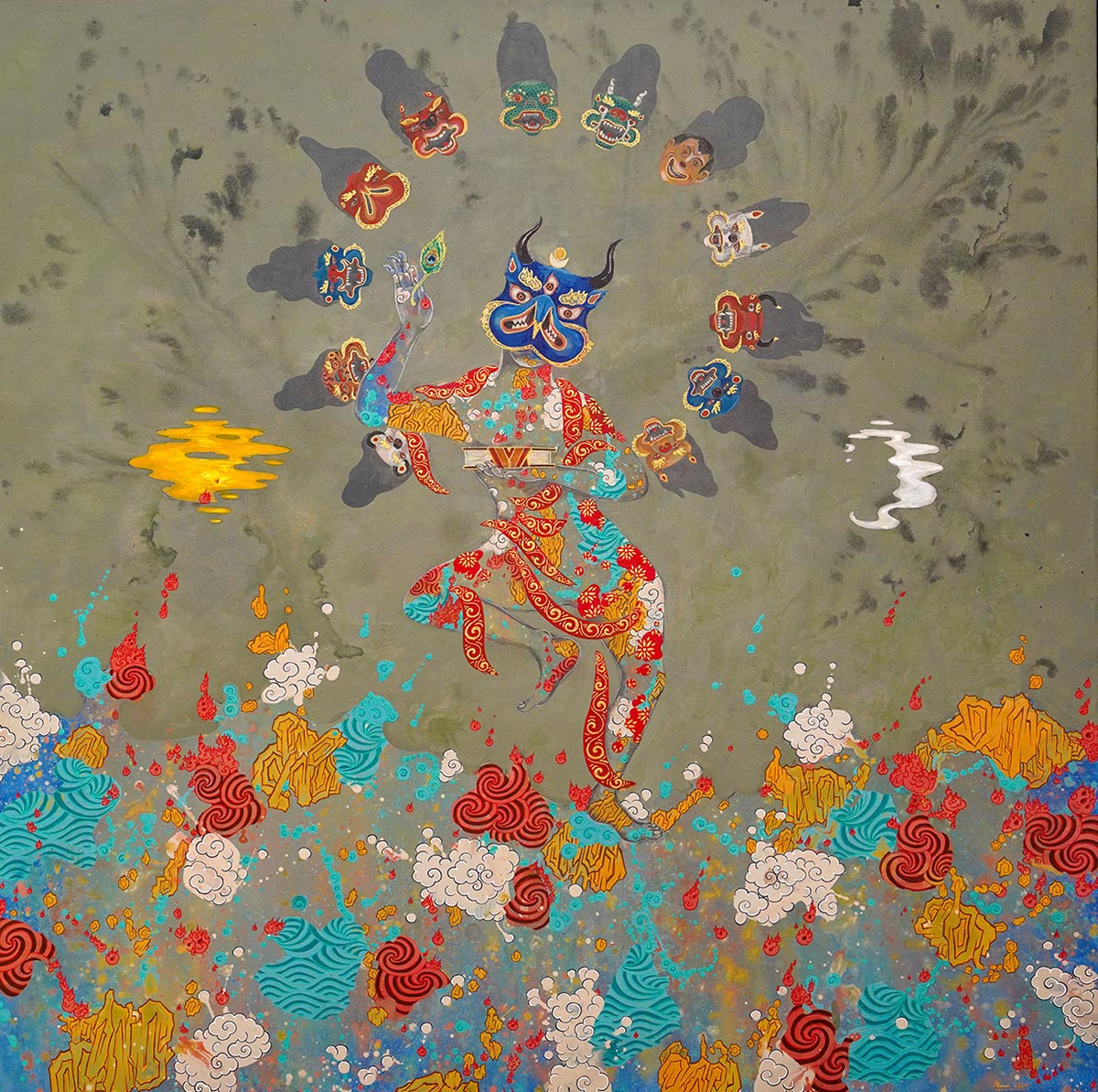
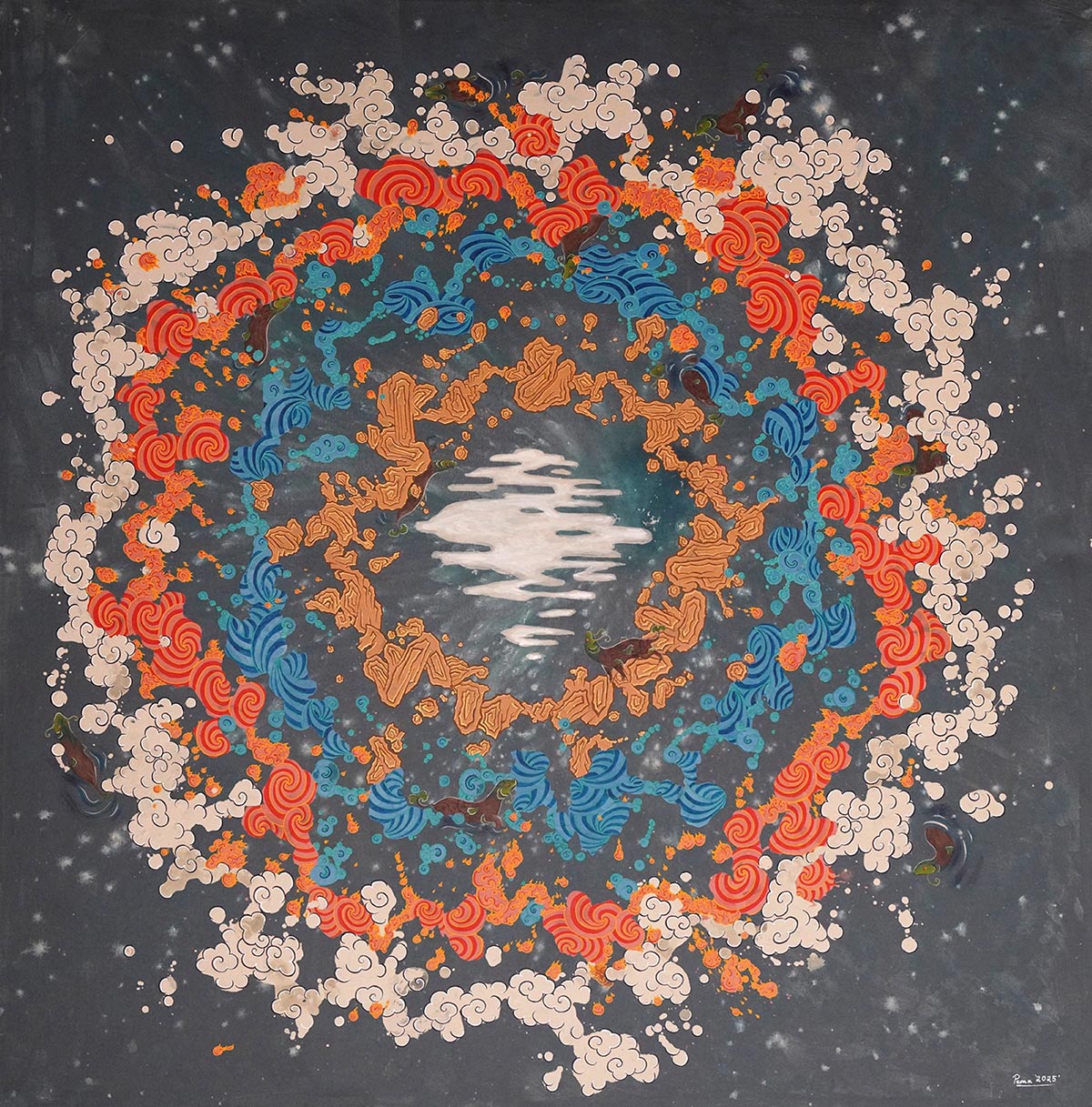
Bardo-Transit,-Acrylic-on-Canvas,4-x-4-ft

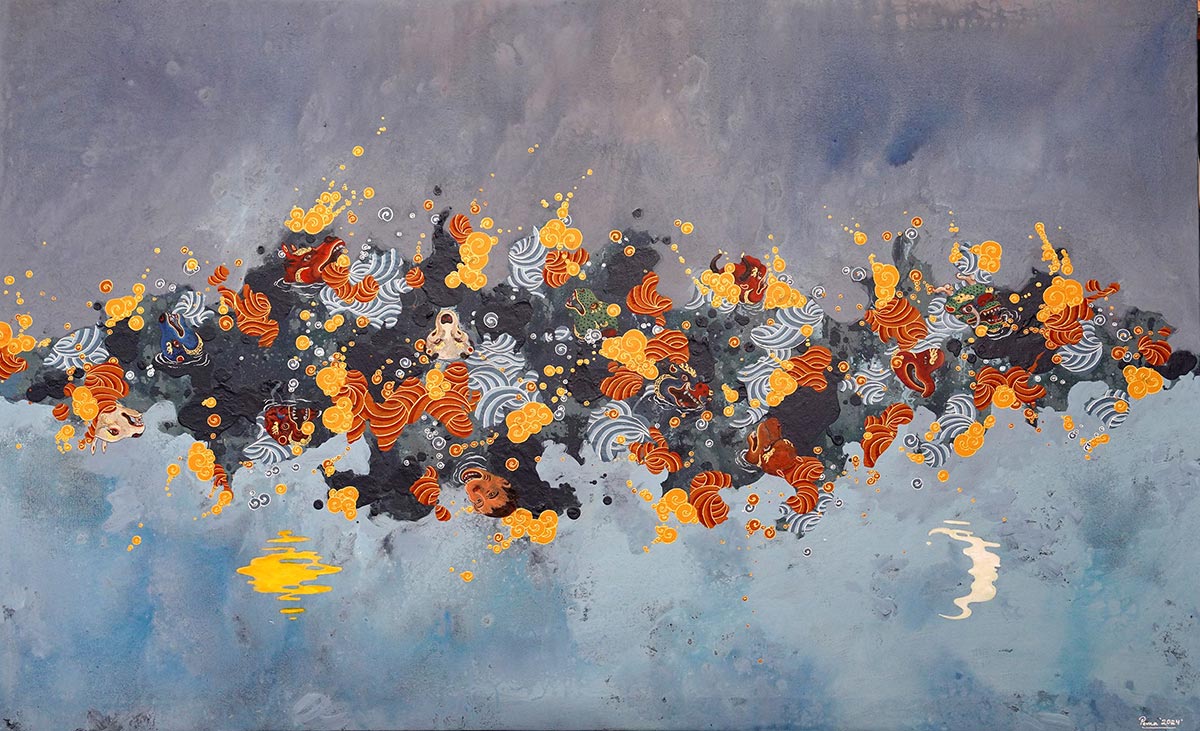
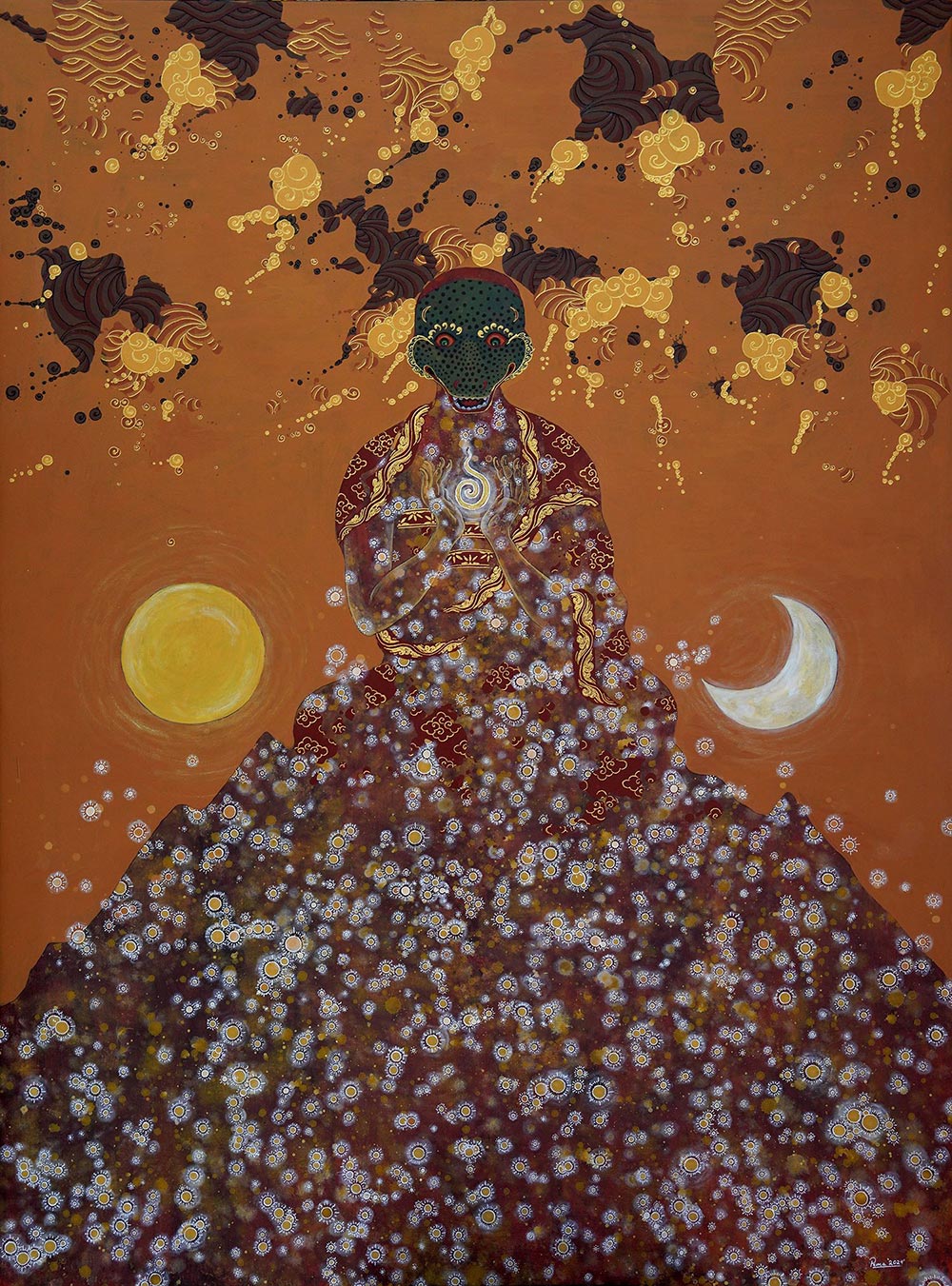
Threshold Art Gallery in New Delhi is ready to open its doors to share a powerful exhibition this fall with In-Between Dreams, the inaugural solo show of Bhutanese artist Pema “Tintin” Tshering. Make sure to be a part of it from September 19 to October 18, 2025. In-Between Dreams isn’t just a visual journey but a spiritual experience based on Buddhism’s bardo, the state between death and rebirth.

Highlights of the Exhibition

Exhibition Details Information
Artist Pema “Tintin” Teshering
Venue Threshold Art Gallery, C-221 Sarvodaya Enclave, New Delhi
Dates 19th September to 18th October 2025
Visiting Hours Monday to Saturday, 11:00 AM to 7:00 PM (Sunday by appointment)
Curatorial Focus Rooted in Bardo, exploring impermanence and transformation
Signature Motifs Masks, Mythical beasts, Elemental Patterns, Garuda

About the Artist

Pema “Tintin” Tshering is a prominent figure in Bhutan, known for his contributions to contemporary art in the country. He is famous for his creative and insightful interpretation and presentation of Buddhist philosophy and Bhutanese spirituality. 

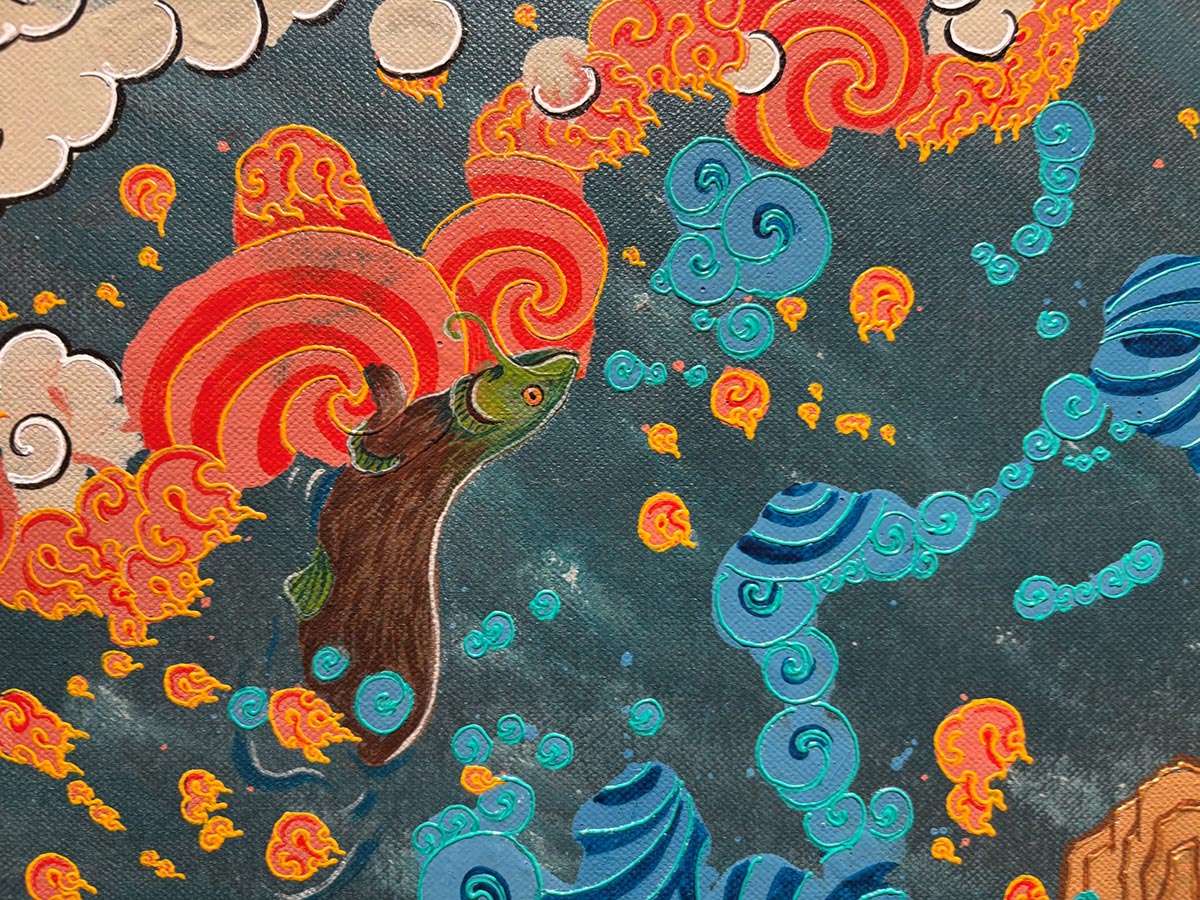
Detail-Life's-Illusion,-Acrylic-on-Canvas,-4-x-4-ft-(2)

Tintin was born in 1985, and his childhood was spent mostly in Thimpu. His journey as an artist is not limited to painting. He is well known for painting, sculpture, film, and design. The most astonishing aspect of his creativity is his engagement with Buddhist symbols and the amalgamation of traditions with modernity. He uses these ancient symbols to produce affirmative compositions that consider important aspects of selfhood, impermanence, and awakening. 

In his most recent exhibition, In-Between Dreams, Tintin takes us into the unfamiliar and transformative space of bardo, the space in Buddhism between life and rebirth. Through layering of visual textures, colour, masks, and mythic symbols, Tintin expresses rhythms of disintegration and regeneration that are felt within the body. For Tintin, it is all life on canvas; it is not an artefact, but a living and breathing artistic practice defined by tradition and innovation, an invitation to soften your eye and engage with the transformation and resilient nature of life.

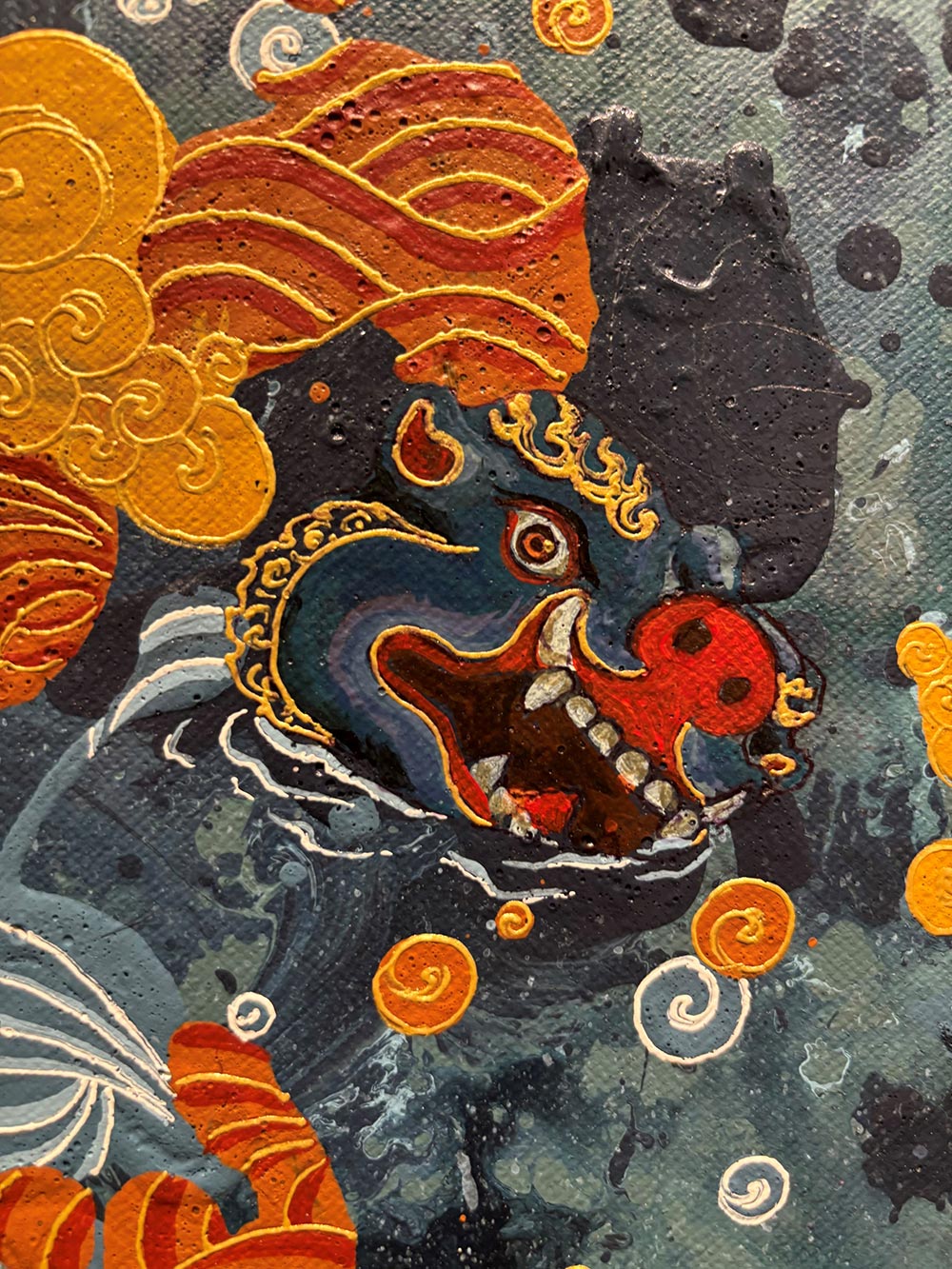
Detail-Samsara,-Acrylic-on-Canvas,-2.7-X-4.2-ft-(3)

For Tintin, art is a way of life, and an embodied and harmonising practice of softening perception, and in this softening, the unfolding of becoming can be witnessed with compassion and curiosity. His work reminds us that transformation is as poignant, human, and spiritual as an experience, serpenting towards another pathway to sense-making beyond certainty.             

A Journey Through Bardo                                                   

The holistic approach does not just honour Bhutan’s cultural legacy grounded in Vajrayana Buddhism, but it weaves and sustains it for the audience’s navigation. In-Between Dreams proves to be an intriguing invitation to observe and reimagine being created. Tintin invokes Himalayan cosmology, vernacular crafts, and personal memory; she weaves and paints with a voice that feels at once ancestral and contemporary. 

Samsara,-Acrylic-on-Canvas,-2.7-X-4.2-ft

We find recurring elements in the work:

  • Masks represent the multiple layers of human identity.
  • Mythical beasts signify power, transformation, and our greatest primal fears. 
  • Simple shapes and elemental patterns lead the viewer to meditative states. 

Of particular interest is Tintin’s invocation of the Garuda- a fierce protector and a symbol of freedom. The Garuda’s presence in this body of work parallels the journey of transcending mortal duality and invites the viewer towards personal flight and a resilient spirit. Embodying such profound symbols of cultural identity, Tintin condenses Buddhist metaphysics into highly visual, emotional ways of storytelling.

Artist’s Voice

Primordial-Presence,-Acrylic-on-Canvas,-3-x-4-ft

Tintin describes his purpose with remarkable clarity, stating that “We cannot understand life without understanding death. In painting the stages of dissolution, I am searching for clarity more than confidence. This work is not about answers, but about creating a space where perception might soften something within us—where we might glimpse the truth in  impermanence.” 

These words by Tintin not only frame the exhibition, but also act as sole points for situating morality at the centre of his artistic endeavour. 

Bhutanese Origins and Present-Day Language

Life's-Illusion,-Acrylic-on-Canvas,-4-x-4-ft

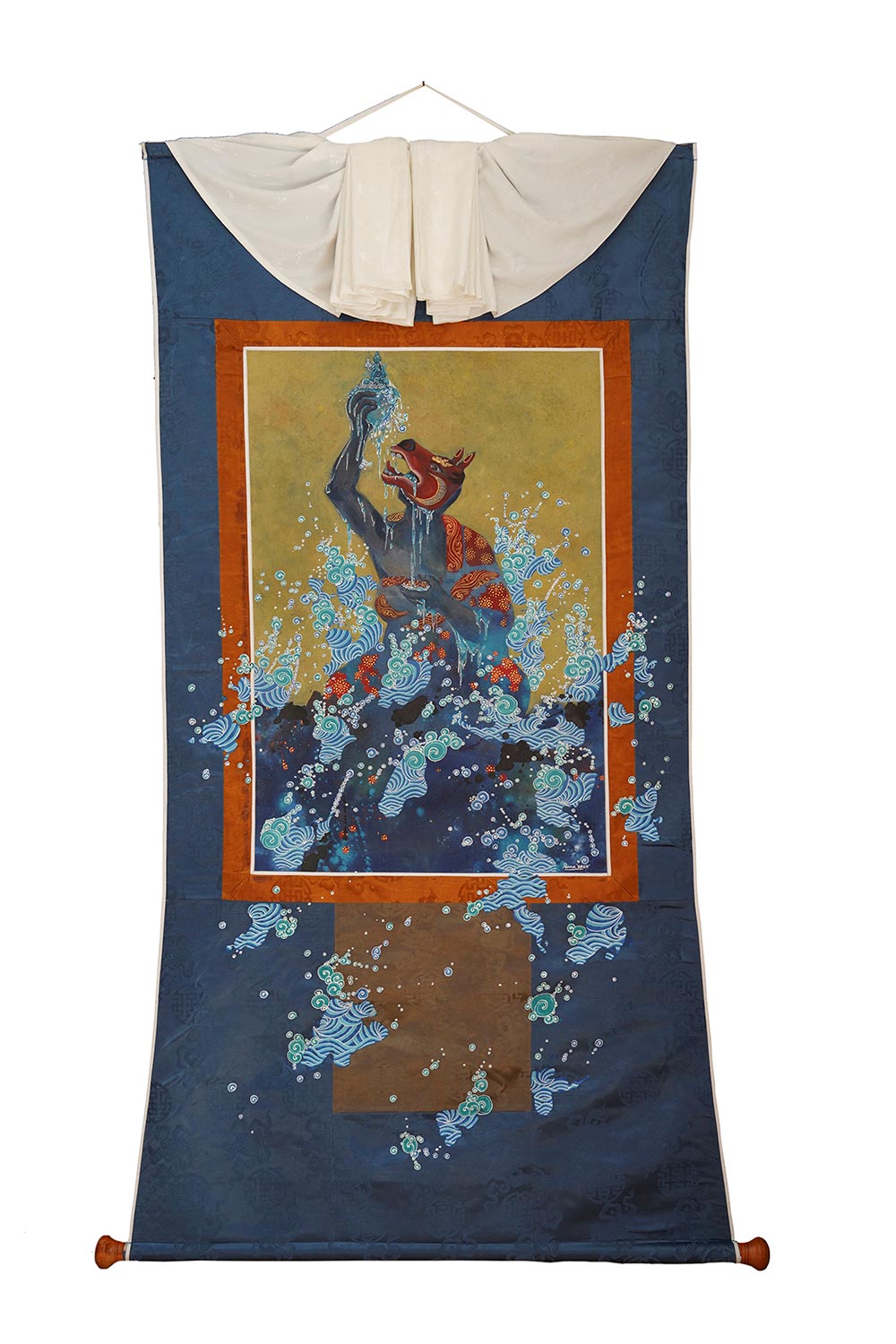
As Buddhism and spirituality are entrenched in Bhutan, it is fitting for Tintin to be practising in this context. However, he is not merely reproducing thangka to “preserve” a tradition, but rather he is re-contextualising the tradition in present-day terms. His style intentionally incorporates aspects of classical iconography, ritual precision, symmetry, intense colours, etc., with the openness of modern abstract work

This space between tradition and experimentation allows Tintin’s work to be deeply personal, while simultaneously being widely meaningful and relevant. Despite its ties to local cosmology, the questions he is asking about endings, impermanence, and transformation are universal.

Themes That Resonate

Tintin’s In-Between Dreams touches upon philosophical questions that appeal to people across cultures. Some of the central themes include:

  • Human vulnerability in the face of change
  • The cycles of death, rebirth, and renewal
  • Spiritual resilience and transformation
  • The quiet beauty of impermanence
  • Interplay of fear, light, and perception

Through his artworks, Tintin invites not just spectatorship, but introspection. Each canvas serves as a contemplative threshold, a space where the external world dissolves so that inner truths may surface.

Entering In-Between Dreams is to enter a space of stillness and depth. This is not your regular exhibition about technical virtuosity or literal narrative. Rather, Tintin’s work is more about engaging the audience with transition. That we “see,” or witness, in this case, is a witness to “not seeing.” The exhibition’s sole motive is not only to make the art enthusiasts appreciate the work, but to compel them to think about impermanence and to create a space for the acceptance of this idea. 

Significance of This Exhibit

Thirst,-Acrylic-on-Canvas-(framed-in-traditional--thangka-style),-3-x-6.2-ft-

This exhibition is more than simply a solo exhibition of a Bhutanese artist in New Delhi; it is:

  • A cultural connector from Bhutanese spirituality to an Indian audience.
  • An approach to rethinking the sacred ontologies of art for contemporary life.
  • A reminder that impermanence, often a cause of fear, can be nurtured as a natural cadence of existence.
  • An inquiry into the use of art as a practice of meditation, where imagery becomes a vehicle towards awakening.

Conclusion

At its core, In-Between Dreams is an invitation to participate in the conversation between dying and renewed life. Tintin’s paintings ask us to approach impermanence not with trepidation, but with compassionate awareness. 

The exhibit at the Threshold Gallery speaks far beyond the realms of the art world, in any lives led in transition – in relation to identity, loss or discovery of self.

Through his work, Tintin reminds us that rebirth occurs, not after endings, but within them. Between a breath, between loss and hope, and at the cusp of dying and awakenings – there, with the true metanoia occurs.

VAMA – The Strength Within: Art Tree Exhibition at Bikaner House, Delhi

0
Amodini-1-Manisha-Jha-Madhubani
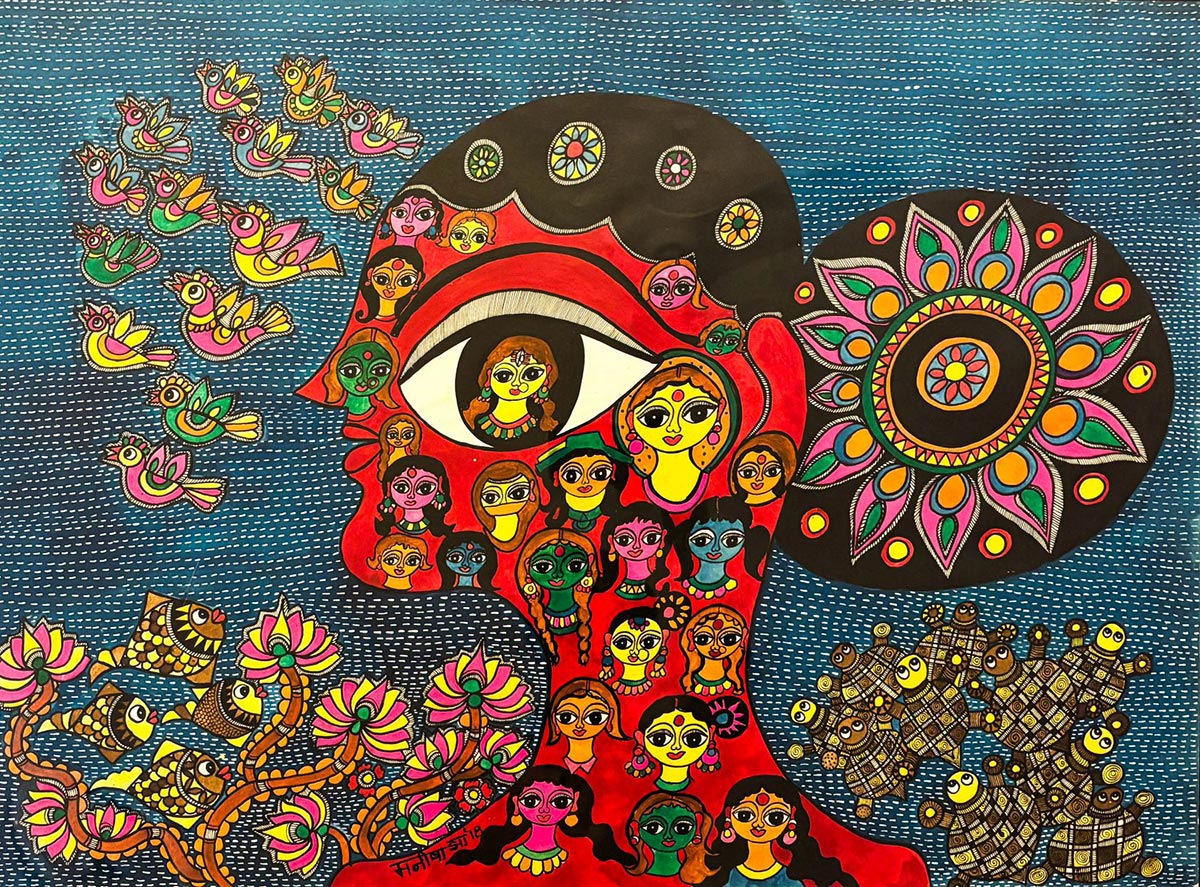
Amodini – Madhubani, Manisha Jha

Delhi is all set to witness another mindblowing exhibition at the Main Art Gallery, Bikaner House, New Delhi. This time it’s the Art Tree’s groundbreaking exhibition “VAMA – The Strength Within”. From September 27 to October 1, 2025, this exhibition will be available for the public and art enthusiasts alike. It is going to be in line with the auspicious period of Navratri, while providing an ode to Stree Shakti, or the divine feminine power, through some of India’s most beloved folk and tribal art traditions.

Kalpana-Chitrakar-Bengal-Pathachitra
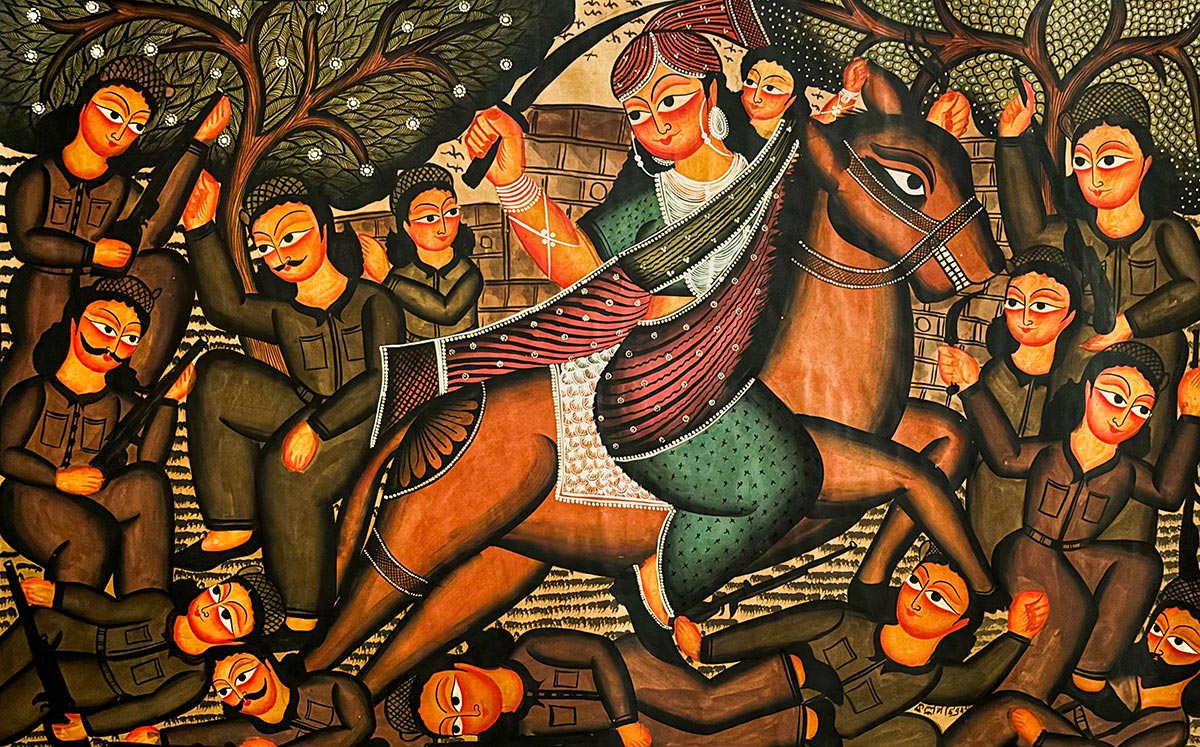
Bengal Pathachitra – Kalpana Chitrakar

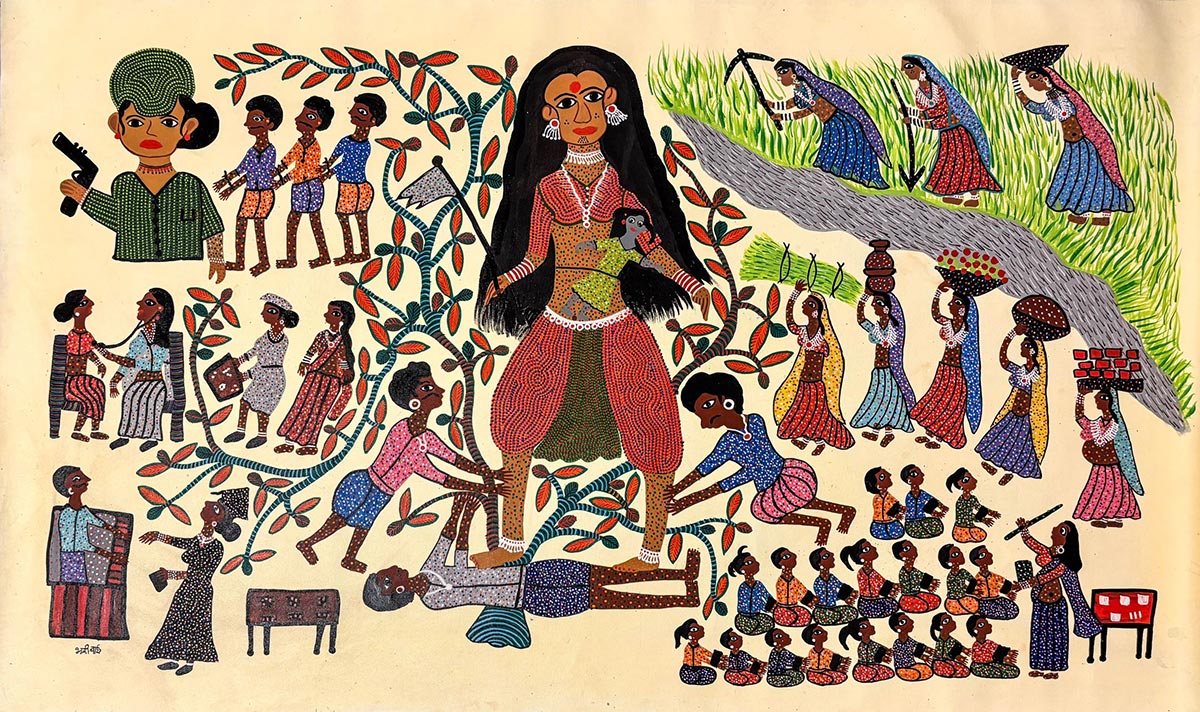
Eighteen women artists will be featured, showcasing more than 10 traditional art forms, including Madhubani, Warli, Gond, Chamba Rumaal, Sohrai, Pattachitra, Cheriyal, Mandana, Bhil and Phulkari. These artists are masters of their craft, the majority having been recognised with Padma Shri and National Awards. They are guardians and innovators of India’s cultural heritage.

Event Highlights Details
Exhibition Title VAMA – The Strength Within
Dates 27 September to 1 October 2025
Timings 11:00 AM to 7:00 PM daily
Venue The Main Art Gallery, Bikaner House, New Delhi
Theme Celebrating Stree Shakti during Navratri
Format All-women exhibition showcasing works of 18 artists
Art Styles Gond, Madhubani, Warli, Cheriyal, Bhil, Chamba Rumaal, Sohrai, Pattachitra, Mandana, Phulkari
Presented by Art Tree

The Significance of Stree Shakti in Indian Culture

A-Farmer's-Life-D-Vanja-Cherial-Painting
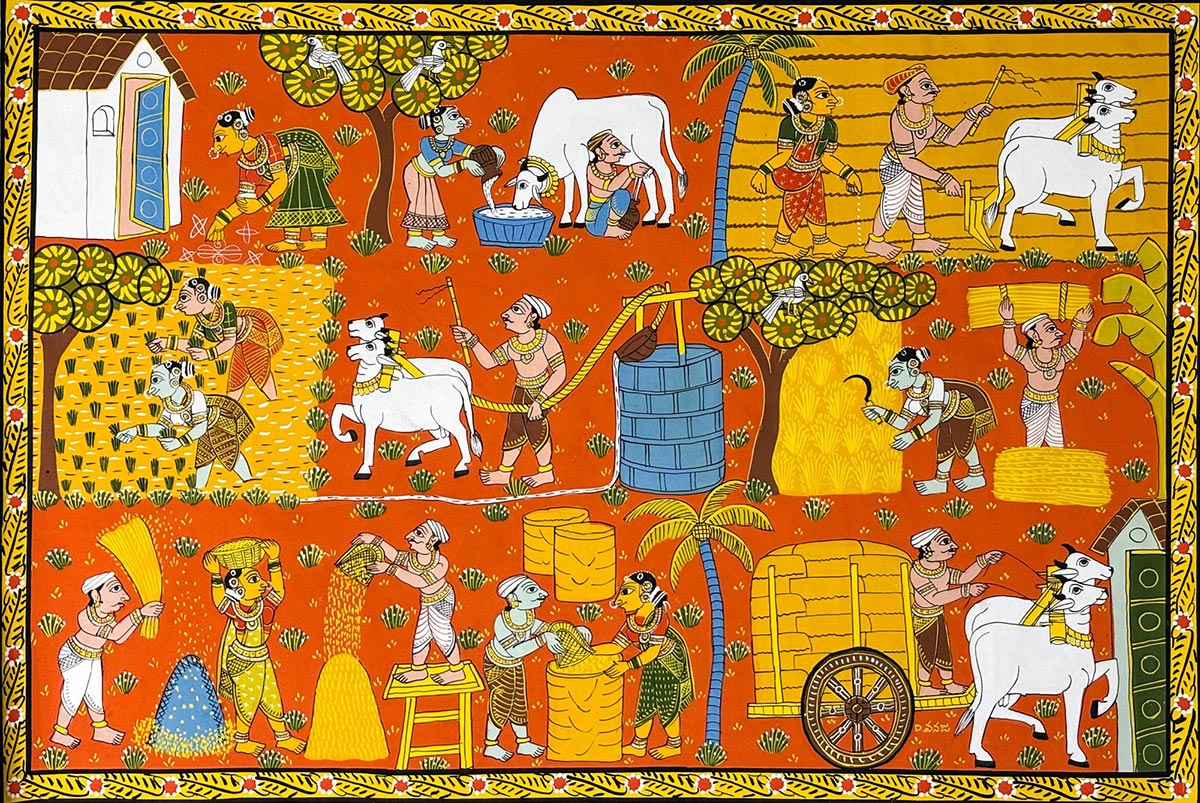
A-Farmer’s Life – Cherial-Painting, D Vanja

The idea of Stree Shakti is beautifully revered in the Indian philosophy and culture. ‘Shakti’ is described as the feminine divine energy that forms the basis of and sustains all existence. The exhibition is centred around this theme.

As Ms Pragati Agarwal, Founding and Managing Director of Art Tree, eloquently expresses this connection by saying, “Women have long been the silent torchbearers of indigenous art in India—transmitting knowledge, techniques, and stories through generations. Their contributions, though foundational, often remain overlooked. Through VAMA, we celebrate their talent, resilience, and artistic integrity. Many of these women have overcome deep socio-cultural barriers to emerge as pioneers in their fields. This exhibition is our tribute to their journeys, their triumphs, and the vibrant spirit of Shakti that they embody.”

Celebrating National Award Winners and Master Artists

Nari-Swarup-Bhuri-Bai-Bhil
Nari – Bhil, Swarup Bhuri Bai

The artists that are a part of this exhibition include several Padma Shri and National Award-winning artists engaging with narratives about resilience, change, and divine feminine energy. Some of these highly regarded artists are featured in the show, including:

Artist Name Art Form Recognition
Durga Bai & Nankusia Bai Gond National Award Winners
Gangu Bai, Lado Bai & Bhuri Bai Bhil Padma Shri Recipients
Anita Kumari Chamba Rumaal Master Artist
Juliet (Hazari Bagh Trust) Sohrai-Ledra Traditional Specialist
Swarna & Kalpana Chitrakar Pattachitra Heritage Artists
Vidya Devi Mandana Folk Art Expert
Manisha Jha, Urmila Devi & Chandrakala Devi Madhubani National Recognition
Mamta & Shushti Bongya Warli Tribal Art Masters
D. Vanaja & D. Padma Cheriyal Traditional Scrolls
Kiran & Veerpal Phulkari Embroidery Specialists

The Variety of Indian Folk Art Forms

Ghosla-Gangu-Bai-Bhil
Ghosla – Bhil, Gangu Bai

The folk art forms represented in VAMA encompass a very broad range of India’s cultural heritage, each with its own meaning and telling stories:

  • Madhubani painting of Bihar: natural dyes and pigments are used to create complex designs that depict different mythological stories and scenes from everyday life. Madhubani painting has distinctive thick lines and bright colours.
  • Warli art of Maharashtra: simple geometric shapes are employed to represent humans and animals. Warli art of Maharashtra is applied on mud walls using traditional rice paste. 
  • Gond art of Madhya Pradesh: presents tribal cosmology through complex dot presentations, with intricate colours and details derived from folklore and tribal myths. 
  • Pattachittra tradition of Odisha: it is a family tradition of collaborative art with a continuous line of practice for over a 1000 years. In this tradition, women prepare large pieces of reversible canvas and colored paints while master artists do the chaukhandis and drawings.
  • Sohrai art in Jharkhand: it is predominantly created by women. It is produced with natural pigments painted on mud walls to commemorate harvest festivals. The imagery in Sohrai art represents particular animals of the region. 
  • The Cheriyal scroll painting from Telangana: it is known to be storytelling-based, highlighting the distinctive use of bright colours blended with the specific art form to engage in narratives through visuals.
  • The Mandana painting from Rajasthan: it is usually created by women with this natural pigment in twig brushes, and is done for decorating a courtyard for certain seasonal festivals.
  • The Phulkari type of embroidery from Punjab: it shows traditions of needlework where floral designs and patterns are stylised by women.
  • Chamba Rumaal: it shows the types of fine embroidery from Himachal Pradesh.
  • Bhil art: it represents unique, tribal painting traditions, steeped in culture.

These art forms demonstrate that women have been the principal custodians of cultural knowledge because, with their creativity and imagination, they can retain and communicate traditional details, spiritual beliefs, and community values for generations.

The Cultural Context of Navratri and Women Artists

Shakti-Swarna-Chitrakar-Pattichitra
Shakti – Pattichitra, Swarna-Chitrakar

The emphasis on Stree Shakti of Navratri is in direct relationship with the mission of this exhibition, which is to elevate woman artists who exhibit that energy and strength in their artwork. Just as Navratri honours the divine feminine as it is described by its different forms of goddess, VAMA is a celebration of the earthly forms of that power through the artwork of these strong women artists. Observers of this holy time will celebrate different characteristics of the goddess:

  • Shailputri (strength and stability)
  • Brahmacharini (devotion and penance)
  • Chandraghanta (courage and serenity)
  • Kushmanda (universal energy)
  • Skandamata (motherhood and protection)
  • Katyayani (fierce power)
  • Kalaratri (protection and fearlessness)
  • Mahagauri (purity and grace)
  • Siddhidatri (wisdom and spiritual fulfilment)

Mission and Vision of Art Tree

Krishna-Leela-Anita-Kumari-Chamba-Rumaal
Krishna Leela – Chamba Rumaal, Anita Kumari

Art Tree has been a committed space for the advancement and celebration of traditional and contemporary art of India for more than a decade. The organisation promotes awareness of India’s artistic traditions through curated exhibitions, educational workshops, symposiums, and other community engagement sources, availing itself as an opportunity for the development of new artists and exhibiting established artists.

The second exciting reason, as noted before, is the venue itself, Bikaner House – Delhi’s historical landmark, which is now one of the leading venues for cultural exhibitions and showcases of the arts. The Main Art Gallery of the space is an ideal setting for viewers to engage with the immersive stories created by each of the women artists in response to ‘engagements’ with the rich heritage of folk traditions in India.

The Contemporary Relevance of Traditional Art

Udd-Chalein-Vidya-Devi-Mandana
Udd Chalein – Mandana, Vidya-Devi

VAMA – The Strength Within goes beyond an art exhibit. It goes beyond to serve as a connection between India’s traditional art history and modern cultural awareness. The exhibition is set to illustrate the women artists from around the country, working for both women’s empowerment as well as the promotion of traditional and folk art. As visitors take a walk through the exhibition, they will find themselves surrounded not only by beautiful artworks but also by cultural stories of creativity, resilience, and preservation of culture. VAMA – The Strength Within pays tribute to the exercise of the enduring power of women’s conceptual thinking with art, and a recognition of women’s role in sustaining India’s rich cultural vibrancy.

The exhibition will be open daily from 11 AM to 7 PM during the exhibition so that art lovers, art scholars, and the general public have ample opportunity to experience these traditions, and to mark our place of strength as part of India’s artistic heritage.

Ranjan Kaul’s Solo Exhibition ‘Within Without’ at LTC, Bikaner House, New Delhi

0

Ranjan-Kaul’s-Solo-Exhibition-ArtworkA-new-identity_oiloncanvas-39inx50in-2025-lores

New Delhi will soon present the sixth solo exhibition by the famous socially engaged artist Ranjan Kaul, “Within, Without: Tales of Evanescence.” The exhibition will be first presented at LTC, Bikaner House between 19th and 23rd September 2025; then it will move to Urban Fringe, Okhla Phase I between 27th September and 5th October 2025. The exhibition is not only a presentation of an artist’s work but more importantly an investigation into humanitarian issues and identity, and the tenuous boundary of visibility and disappearance. 

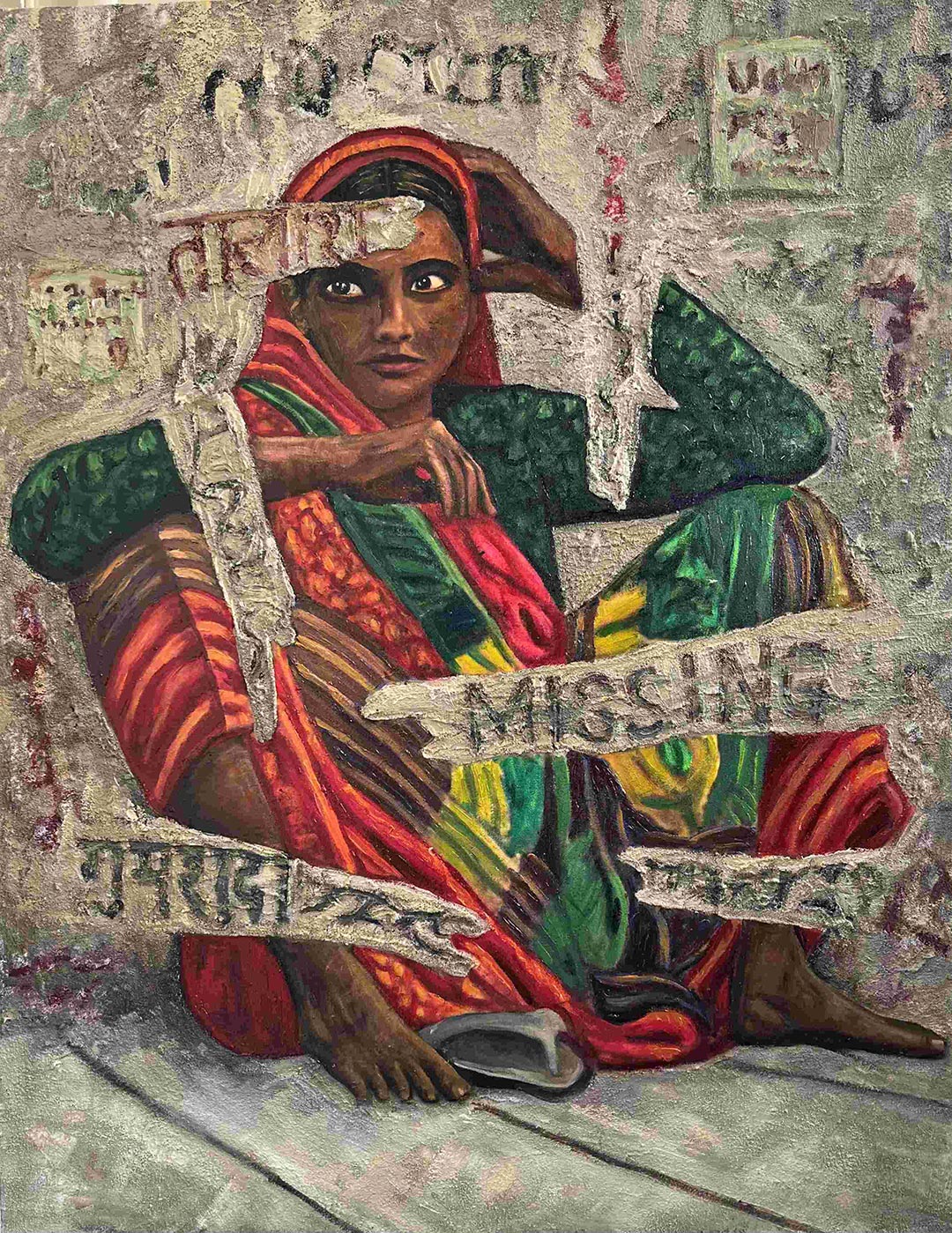
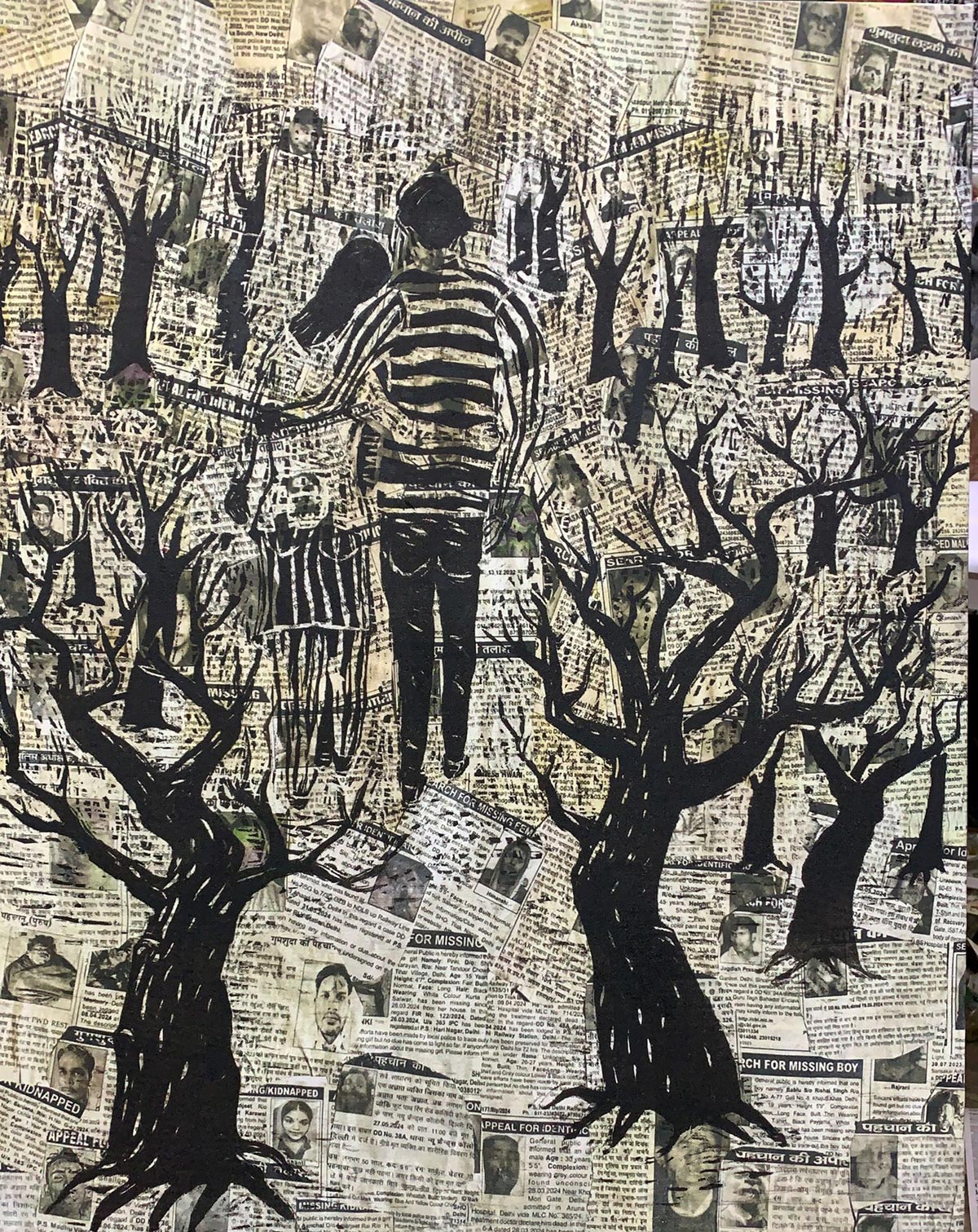
Building from all things social, psychological, criminal and political, Ranjan Kaul creates visual narratives that starkly reflect truths about society. Ultimately, the exhibition draws from newspaper ads of missing people and actual stories of disappeared people, both enforced and voluntary. The exhibition is a commitment from Kaul to present the voices of the silenced and to make the absent visible.

Key Details of the Exhibition

Event Details
Exhibition Title Within, Without: Tales of Evanescence
Artist Ranjan Kaul
Mediums Oil and acrylic paintings, woodcut prints, collages, sculptures, installations
Curatorial Advisor Ina Puri
Venue 1 LTC, Bikaner House, Pandara Road, New Delhi
Dates at Venue 1 19–23 September 2025 (11 am – 7 pm)
Venue 2 Urban Fringe (Basement F-15), Okhla Phase I, New Delhi
Dates at Venue 2 27 September – 5 October 2025

Curatorial Perspective

Ranjan-Kaul’s-Solo-Exhibition-Woman-on-Street-Mixed-Media-on-Linen

Curatorial advisor Ina Puri captures the spirit of Kaul’s vision when she remarks:

“Pouring over newspaper reports and data gleaned from news agencies, Kaul has made missing people his subject for some years now. He has gathered yet more reason to express his deep empathy and helplessness for the plight of the victims who have had to face the harshest trials and tribulations for no fault of theirs.”

She further emphasises the symbolic dimension of his work:

“By layering his compositions with symbolism, metaphor and allegory, Kaul pays homage to the many who have gone missing but remain unforgotten by those they have left behind, especially the artist himself. Resonating with issues that remain without closure or justice, Kaul’s art is both a heart-filled tribute and a lament.”

Humanitarian Concerns in Art

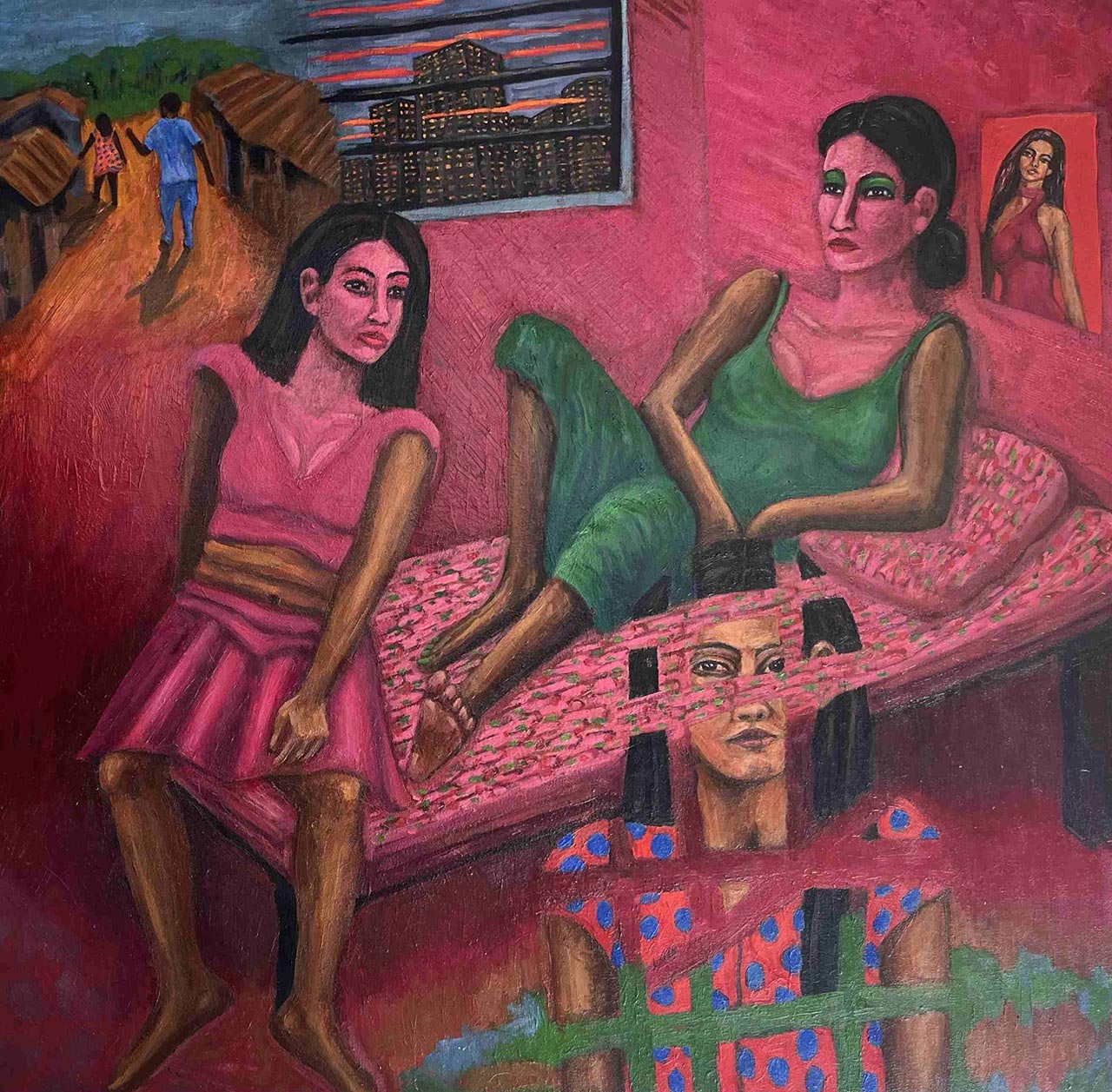
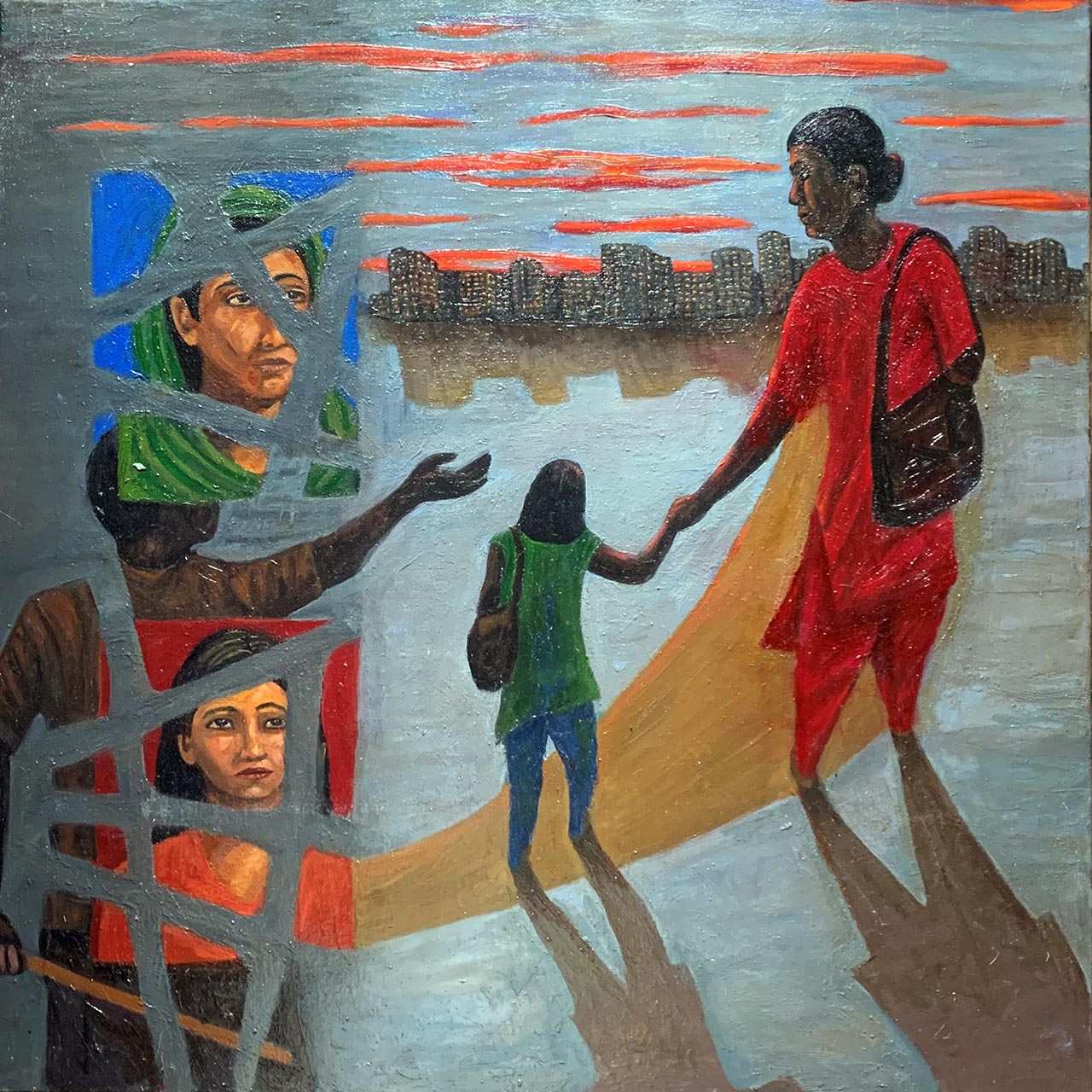
Kaul has created the pieces in this exhibition from a deep concern for humanitarian matters. He is addressing the suffering of those we have lost to sex trafficking, organ trafficking, migration crises, voluntary disappearances, and conflicts, which have rendered entire populations vulnerable and untethered. Each painting, collage, print, or sculpture has been born from his sympathetic, nuanced, engaged gaze. 

Ranjan-Kaul’s-Solo-Exhibition-Equus-seige-woodcutprint_on_canvas_46inx60in-2025-

Some of the works are more pronounced in their emotional charge: 

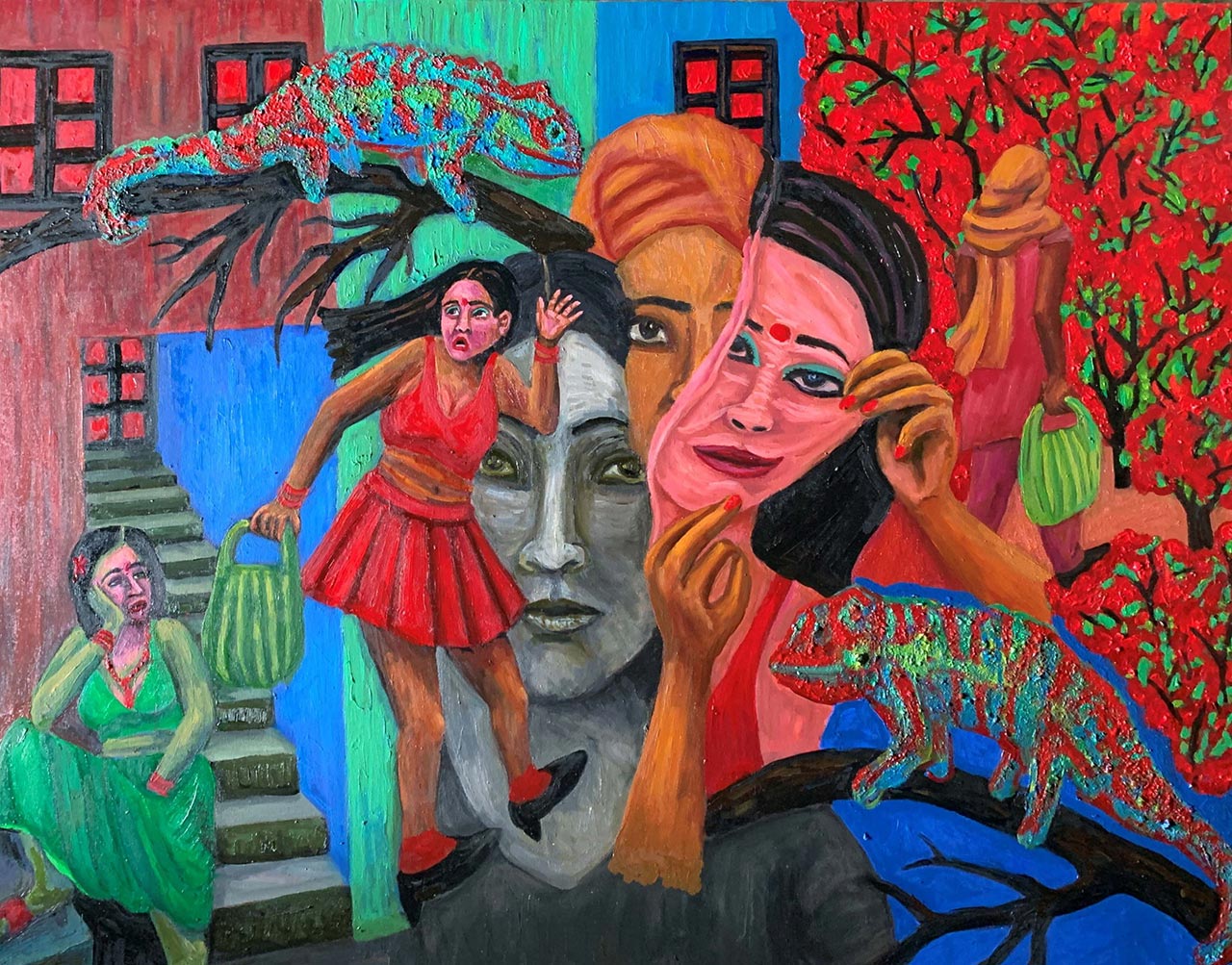
  • Leaving Home: It depicts a mother and daughter leaving an abusive husband, quietly and painfully telling their story of survival. 
  • The Red Room: An attention-catching collage that depicts a girl being abducted and exploited. 
  • A New Identity: It illustrates the tortured but resolute portrait of a sex worker who is trying to escape and renew her life. 
  • Cataclysm in Sudan: It is a portrayal of survival in the midst of extreme civil war and women driven to dire desperation. 
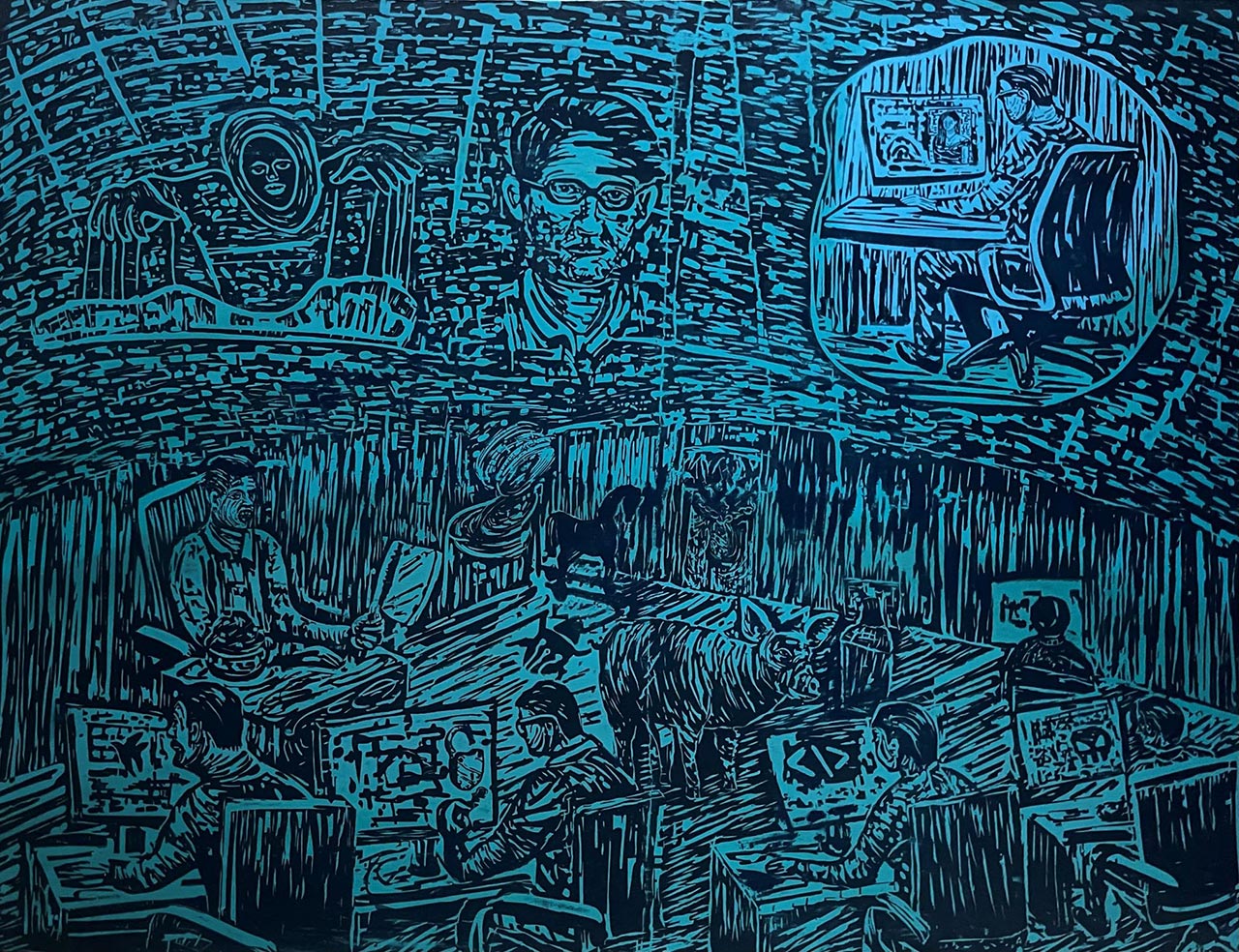
  • Equus Siege: A woodcut engraving that explores themes of cybercrime, deceit, and mental anguish.   

All of Kaul’s work is at once testimonial and allegorical, pulling us from the private to the public and the symbolic to the visceral.

Symbolism and Visual Language

Ranjan-Kaul’s-Solo-Exhibition-Sex_Workers_oil-on-canvas_-36x36in_2024

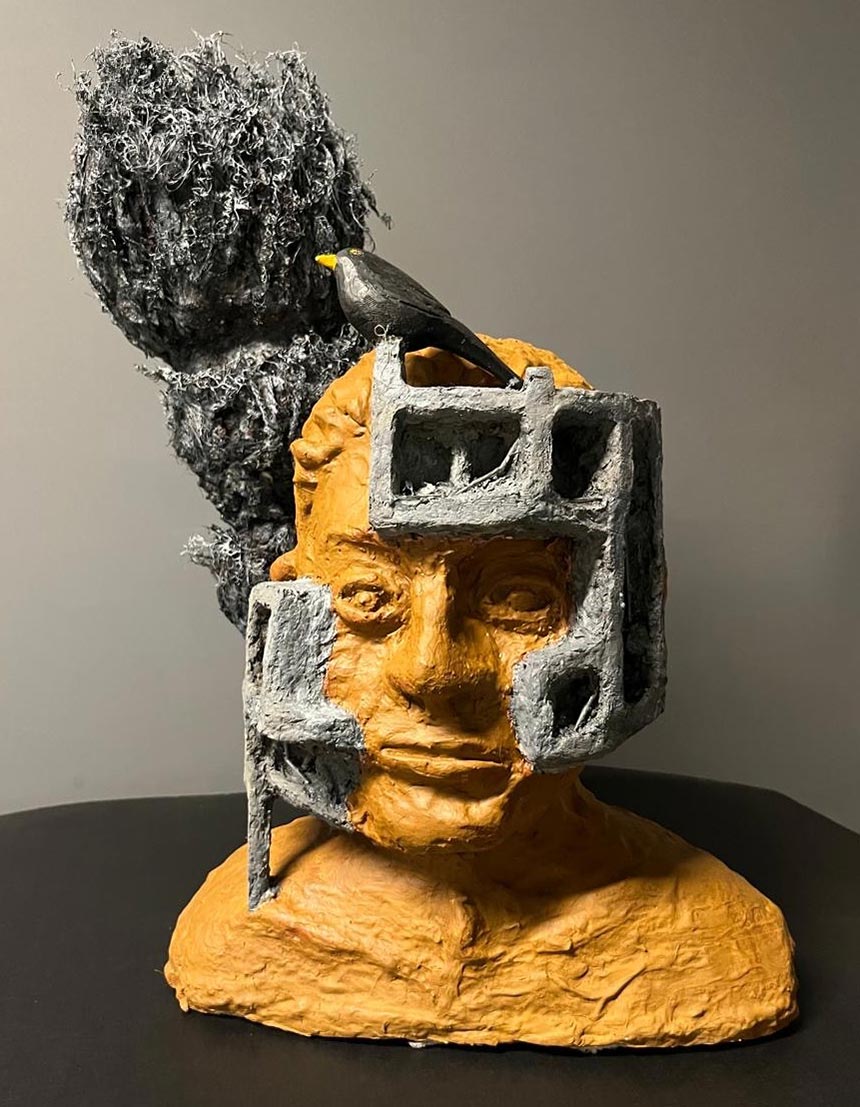
Kaul’s pieces use a restrained colour palette; they capture the weight of absence and the precariousness of being. He conceives metaphors that convert invisibility into being. Animals and birds arise as potent devices in the work as well. In pieces such as Blackbird, a sculpture, they become tacit witnesses to survival, disappearance, and imagined reclamation. 

This commitment to allegory allows the work to transcend documentation. What begins as documenting experience, while infused with research and observation, becomes layered art, expressing emotional capacity and poetic truth. The muted palette, perhaps, emphasises dignity, gravity, and empathy rather than drama.

Artist’s Own Reflections

Ranjan-Kaul’s-Solo-Exhibition-Evansescence-wooscutprintoncollageofnewspaperads-on-canvas-2025-

In his practice, Kaul states:

“As in all my work, this exhibition reflects my intense engagement with humanitarian themes that touch my sensibilities. Revolving primarily around missing persons, the visual narratives and portraits in the show explore the many facets of existence, identity and obscurity. While there is diversity in my art, there is an underlying singular, personalised aesthetics in relation to the use of form, texture and the colour palette”

This observation is restorative of the oneness of media and subjects in difference. While these works reflect narratives of domestic violence, sex trafficking, conflict in Sudan, and cybercrime, what holds them together is Kaul’s unique quality of aesthetic constraint with emotional richness.

Themes in Focus

  • Missing persons and the disappearance of people, both enforced and voluntary.
  • Sex and organ trafficking and the silencing of exploited lives. 
  • Domestic violence as a recurring theme of displacement and courage. 
  • Migrant persons and children caught in active conflict. 
  • Civil wars erasing identities at scale. 

All of these issues are made richer by Kaul’s capacity to amplify the invisible stories without making them mere numbers. These themes are under a broader theme, resonating with the humanitarian concerns around the world. 

A Collective Act of Remembrance

Ranjan-Kaul’s-Solo-Exhibition-Leaving-ho_oil_on_canvas_35inx37in_2024

What Within, Without: Tales of Evanescence does, beyond its art, is an act of collective remembrance. By taking loss and making it a visible presence, Kaul actively resists the disappearance of lives from social memory. His art makes space for both mourning and commemoration – loured for people who never recovered and were never celebrated in their existence, or even in absence.

Curator Ina Puri’s statement about Kaul’s work as “resonating with the issues of inadequacy and the absence of closure or justice” feels particularly noteworthy in this context. Audiences discern that while the exhibition is a representation of myriad painful realities, it also insists on a shared sense of empathy. Each piece engages the viewer in existential questions about what it means to vanish. How does society cope with the notion of invisibility? And could even remembering be an act of justice? 

Form, Texture, and Aesthetic Restraint

Ranjan-Kaul’s-Solo-Exhibition-blackbird

Kaul’s quiet palette is never by chance. The muted tones and balanced forms used don’t distract from each other; instead, they contribute to an overall sense of restraint and provide the viewer with a reminder of the gravity of the narratives. The textural surfaces beckon the viewer to engage slowly and with consideration, as if even the piece and forms ask for a meditative reading. This treatment elevates significance and promotes a focus on humanitarian depths rather than on a decorative display.

Conclusion

Within, Without: Tales of Evanescence carries significance not only as Kaul’s sixth major solo exhibition but also, and more importantly, as an art event that engages with the various humanitarian crises of our time. It unfolds stories of suffering trauma, disappearance, and conflict, with dignity and compassion. It brings together the spaces of individual suffering and collective trauma, art-making and moral responsibility. 

It presents absence as presence, silence as witness, and invisibility as memory, giving us an exhibition that will be seared in the public memory of deep importance. People visiting Bikaner House and Urban Fringe will not only come across a series of multi-layered art objects but also be invited to think about their role as witnesses to the unstable, and often unbearable, state of being human.

How to Get Help Without Putting Your Entire Life on Hold

0

How to Get Help Without Putting Your Entire Life on Hold-01

The biggest barrier to getting help for addiction, mental health issues, or other serious problems isn’t usually money or insurance. It’s the fear that seeking treatment means everything else in your life will fall apart. People worry about losing their job, missing too much work, disappointing their family, or having to explain a long absence to everyone they know.

This fear keeps a lot of people stuck in situations that are slowly getting worse, because they can’t see a way to get the help they need without destroying the stability they’ve worked so hard to build. The good news is that getting serious help doesn’t have to mean disappearing from your life for months or giving up everything you’ve accomplished.

The Reality of Different Treatment Options

Not all addiction or mental health treatment requires you to pack a bag and move into a facility for 30 to 90 days. While residential treatment can be life-saving for some people, there are other approaches that provide intensive support while allowing you to sleep in your own bed and maintain your daily responsibilities.

These middle-ground options have become much more common as treatment centers recognize that many people need substantial help but can’t afford to step away from their lives completely. You can get professional medical care, therapy, group support, and all the tools you need for recovery while still showing up for work and being present for your family.

The key is finding the right level of care for your specific situation. Some people do need the complete immersion of residential treatment, especially if they’re dealing with severe addiction, have tried other approaches without success, or don’t have a stable living environment. But many others can make significant progress with intensive programs that work around their existing commitments.

Programs such as the i o p program by Legacy Healing offer comprehensive treatment that includes multiple therapy sessions per week, medical monitoring, and peer support while allowing participants to maintain their work and family responsibilities. This approach recognizes that recovery often works better when it integrates with real life rather than replacing it entirely.

Making Treatment Work With Your Job

One of the biggest concerns people have about seeking help is how it will affect their employment. The reality is that many employers are more understanding and accommodating than you might expect, especially when you approach the situation proactively and professionally.

You don’t necessarily have to share detailed information about your treatment with your employer. Many people successfully attend intensive outpatient programs by adjusting their work schedule, using flexible hours if available, or taking advantage of programs that offer evening or weekend sessions.

Some treatment programs are specifically designed around working schedules, with sessions available before work, during lunch hours, or in the evenings. Weekend intensive sessions can also provide substantial support without interfering with weekday work commitments.

If you do need to make schedule adjustments at work, consider framing it in terms of medical appointments or health management rather than providing specific details about addiction treatment. Under the Family and Medical Leave Act, you may be entitled to job protection for certain types of medical treatment, including addiction recovery programs.

Keeping Your Family Relationships Stable

Family relationships often improve when someone gets help for addiction or mental health issues, but the treatment process itself can create temporary stress and logistical challenges. The advantage of outpatient treatment is that you remain present and available to your family while working on your recovery.

This approach allows you to practice new coping skills and communication patterns in your actual home environment rather than in an artificial treatment setting. You can apply what you learn in therapy immediately to real situations with your spouse, children, or other family members.

Children especially benefit when a parent gets help without disappearing from their daily life. They can see positive changes happening gradually rather than experiencing the confusion and anxiety that can come with a parent’s sudden absence for residential treatment.

Family therapy sessions can be incorporated into intensive outpatient programs, allowing everyone to work together on healing relationships and building healthier communication patterns. This integrated approach often leads to better long-term outcomes than treatment that happens in isolation from family dynamics.

Financial Considerations That Make Sense

Intensive outpatient treatment is typically much less expensive than residential programs because you’re not paying for housing, meals, and 24-hour supervision. This makes comprehensive treatment accessible to more people and reduces the financial stress that can interfere with recovery.

Most insurance plans cover intensive outpatient treatment, and many programs accept various insurance types. Because you can continue working during treatment, you maintain your income and health benefits rather than facing the financial strain of extended time off work.

The cost-effectiveness extends beyond just the treatment fees. You avoid the indirect costs of residential treatment such as lost wages, childcare arrangements, pet care, and maintaining your home while you’re away. These hidden expenses can add up to thousands of dollars on top of treatment costs.

Building Long-Term Recovery Skills

One advantage of outpatient treatment is that you’re learning to manage recovery in the same environment where you’ll need to maintain it long-term. Instead of getting sober in a protected residential setting and then facing the shock of returning to real-world pressures, you develop coping skills while navigating your actual daily challenges.

This approach helps you identify specific triggers and stressors in your normal routine and develop strategies for handling them effectively. You learn to manage work stress, family conflicts, social situations, and daily responsibilities without relying on substances or falling back into unhealthy patterns.

The support system you build in outpatient treatment often includes people who live in your area and face similar life circumstances. These relationships can continue long after formal treatment ends, providing ongoing accountability and encouragement in your actual community.

When Outpatient Treatment Makes the Most Sense

Intensive outpatient programs work best for people who have some stability in their living situation and strong motivation to change. If you have a safe place to live, supportive relationships, and haven’t experienced severe withdrawal symptoms or multiple failed attempts at recovery, outpatient treatment might be ideal.

This approach is also effective for people dealing with prescription drug dependency, alcohol problems that haven’t progressed to severe physical dependence, or co-occurring mental health issues alongside substance use. The flexibility allows for comprehensive treatment of multiple issues simultaneously.

The key is being honest about your situation and working with professionals who can help you determine the appropriate level of care. Starting with intensive outpatient treatment doesn’t prevent you from moving to residential care if needed, but many people find they can achieve their recovery goals while maintaining the life they’ve built.

Getting help doesn’t have to mean losing everything else that matters to you. With the right treatment approach, you can address serious problems while preserving your job, relationships, and stability, creating a foundation for lasting recovery that integrates with rather than replaces your real life.

Echoes of Faith & Flight: Rajiv Mistry’s Exhibition at CKP, Bengaluru

0
Rajiv-Mistry-Exhibition
Group Captain Rajiv J. Mistry (Retd.)

This October, get ready to dive into the resounding space of Karnataka Chitrakala Parishath in Bengaluru. This is your chance to witness the astonishing place being filled with the stoic nature of monotone watercolours, the visceral drama of charcoal, and the grand history of Indian military aviation.

Hold Up! This isn’t a mere basic exhibition; this is the first solo exhibition of Gp Capt Rajiv Mistry (Retd.), who transformed from a veteran of the Indian Air Force to an exhibiting artist from his tireless approach, current acute observancy and lifelong interest in all aspects of Indian art and culture across an impressive career. So save the date and book your calendar for this exciting and enriching experience.

Exhibition Details

Exhibition Details Information
Artist Gp Capt Rajiv J. Mistry (Retd)
Exhibition Title Echoes of Faith & Flight
Dates 29 October to 2 November 2025
Time 11:00 AM to 7:00 PM
Venue Karnataka Chitrakala Parishath, Bengaluru
Address Kumara Krupa Road, Sheshadripuram, Bengaluru 560001
Theme Sacred spaces, Hoysala sculptures, and Military aviation memories

The Sacred Inspirations: Monotone Masterpieces

Rajiv-Mistry-Exhibition-01

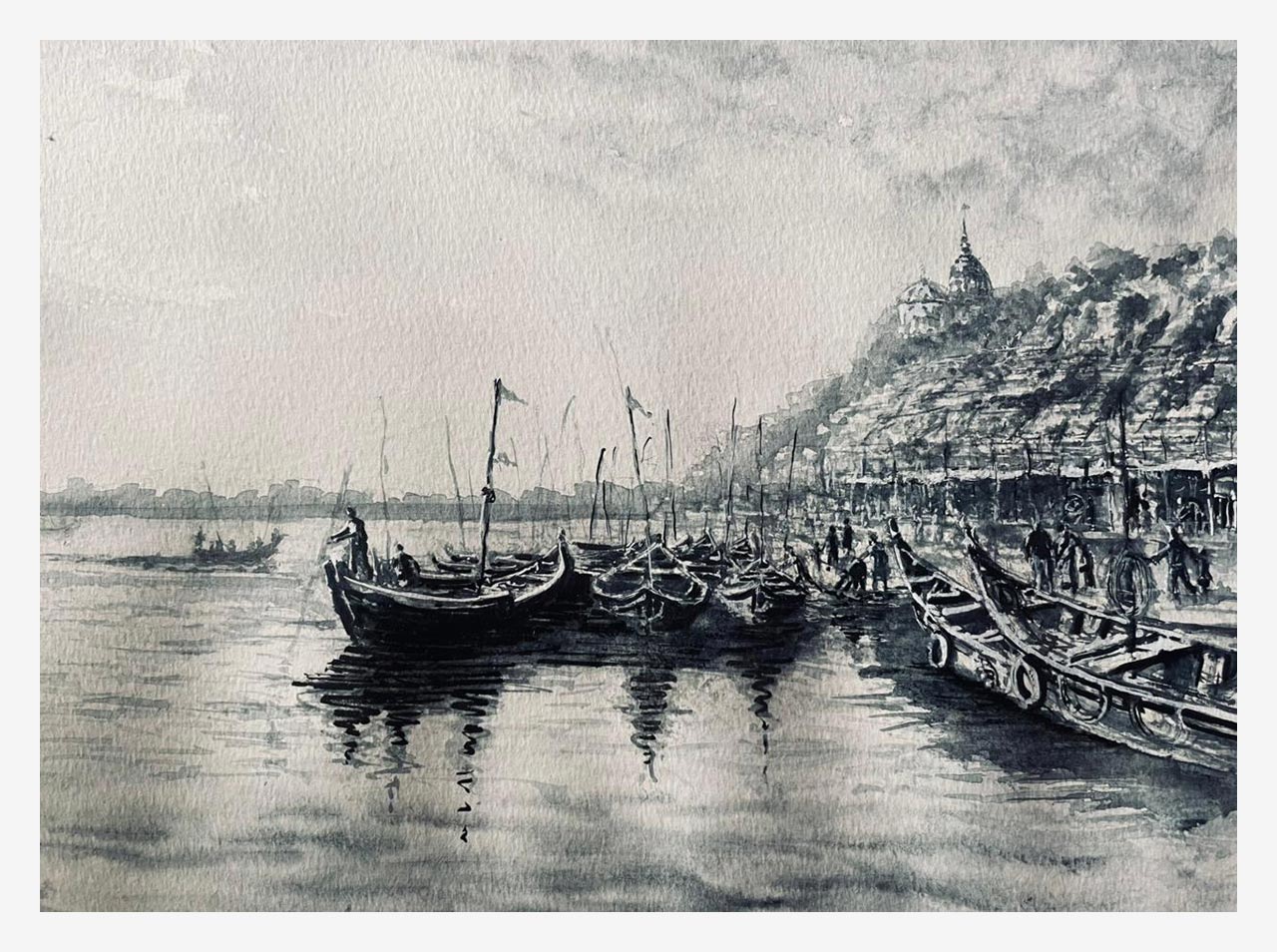
Rajiv’s collection is composed of approximately 20 watercolour paintings painted entirely in grey, while this may seem restrictive, it is revelatory. The art pieces reflect the quiet rapport nurtured in the sacred spaces that affected him the most on his travels across India. From the towering gopurams of Tamil temples to the domes of ancient mosques under star-filled skies, Rajiv discovered that colour can often distract from what matters most- the dance of light against stone, the soft shadows across their carved surfaces, and the space itself, with the dignified stillness of a space built for prayer.

In each painting, Rajiv does not depict a place, but a feeling- the feeling of stepping into a sacred courtyard and being shifted in an instant. The use of monotone is expected of the viewer to slow down, to see the nuanced transgressions between light and shadow that create the objects of great beauty. It is exertion much like listening to a conversation in whispers; you have to lean in and attend more deeply. Through his unspectacular work, Rajiv invites us on his sacred walk. Each brushstroke becomes an act of devotion.

Hoysala Heritage in Charcoal

Rajiv-Mistry-Exhibition-05

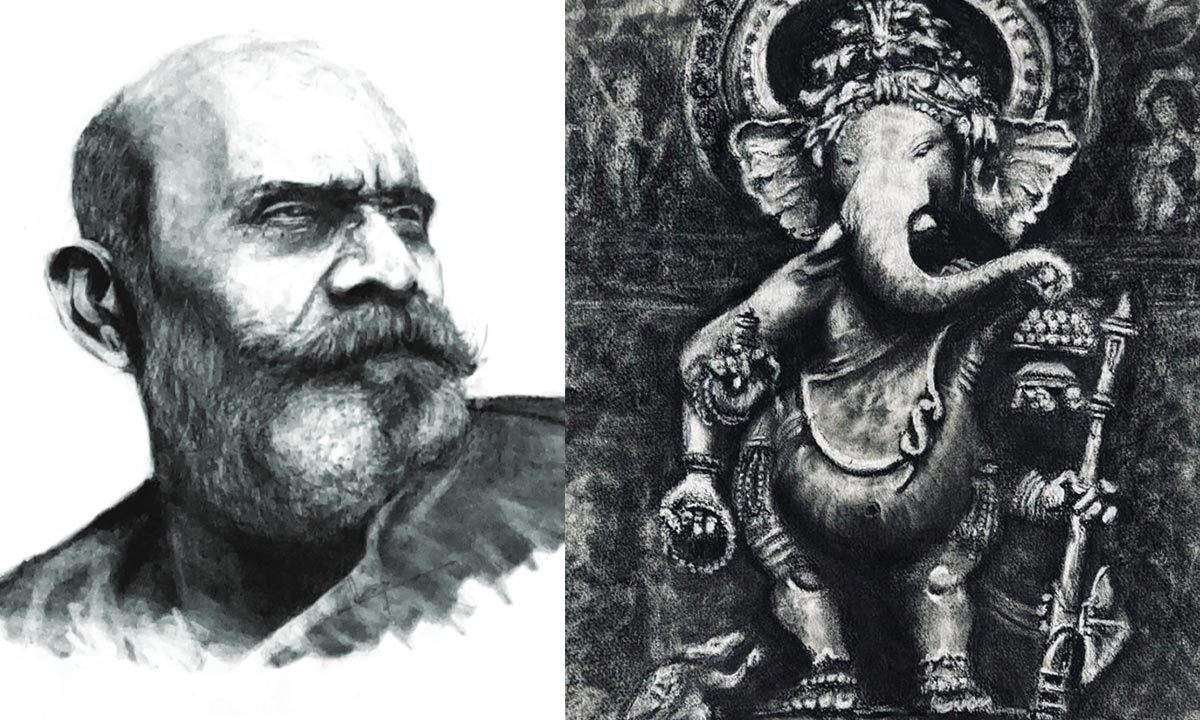
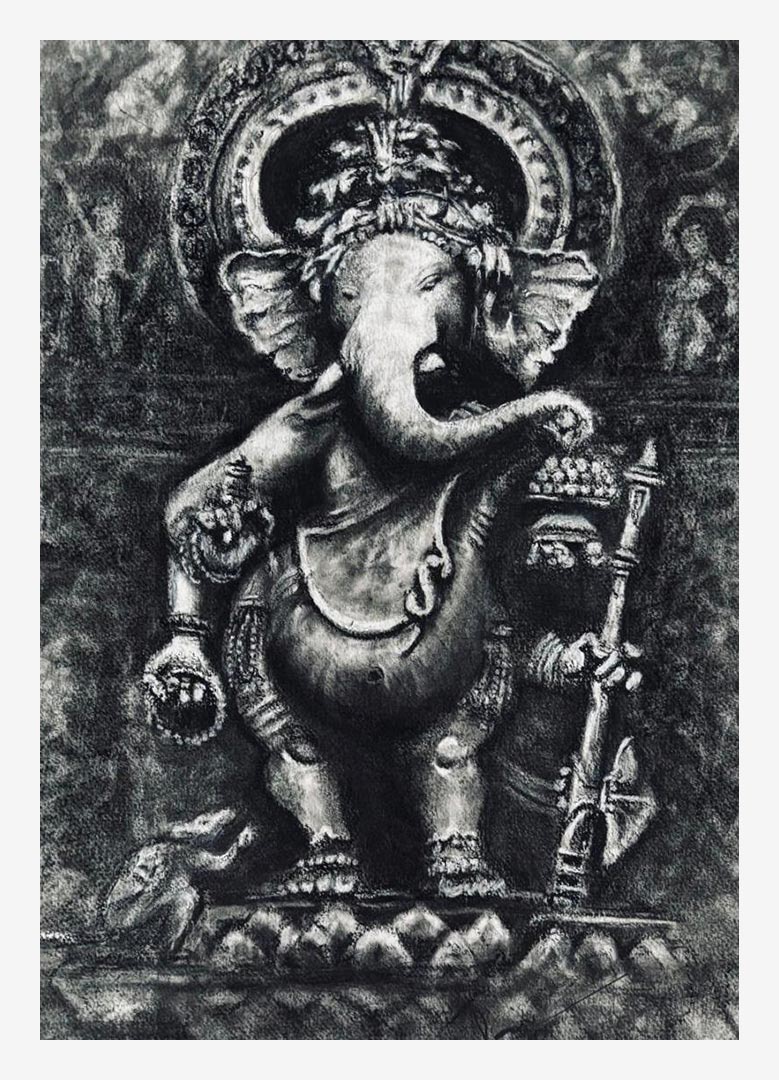
The set includes four charcoal drawings, each inspired by the remarkable stone sculptures of Karnataka’s Hoysala temples at Turuvekere. Rajiv makes a transition from the workflow of watercolour to charcoal, and its marks are emphatic, much like these 800-year-old works of art. The Hoysala artists were storytellers in stone, wrapping narratives about the divine and humanity, and selectively flowing details around the reliefs, articulating every fold of fabric, every gesture, every ornament- as if the stone, too, held a memory of its own. 

Rajiv does not improvise on the original, but instead works to provide an interpretation of the original, collecting the translation of the three-dimensional sculpture into the intimate scene of paper and graphite. When using charcoal, you write with security and resolve; in a conviction made, marks cannot be erased, nor contrasts lessened. But this quality is rightly assured in these subjects, capturing both the conviction of stone and light and the fleeting nature of the light each day at dawn and dusk that offers a life similar to their sculptures.

Aviation Art: A Tribute to Service

Rajiv-Mistry-Exhibition-04

A distinctive element of the exhibition is a dedicated section paying homage to the Indian Air Force through aviation art. This collection communicates the essence and memories of Rajiv’s service, as established by the gifted military artist tradition that has been practised for some time now in the Indian Air Force. The heritage of aviation art in the IAF is enriched by enthusiastic pilots and aircrew members who have represented their love for aviation through their depictions. These artistic impressions of operations have decorated the walls of the officers’ mess and their respective offices, serving as visual archives of military history and accomplishments. Rajiv’s aviation paintings are memory diaries transformed to canvas to depict bravery, discipline and companionship, which depict his years of service. Just like the famous military artist honouring our military heritage, Gp Capt Deb Gohain, who captured our former military operations of the IAF during the 1965 and 1971 wars, Rajiv bridges the gap between military service and art. Rajiv’s paintings not only provide artistic merit, but they also depict and leave a legacy of our military heritage for future generations.

Artistic Inspirations Behind The Works

  • Spiritual exploration of various temples and mosques throughout India through a monotone watercolour palette.
  • In-depth investigation of Hoysala temple sculptures from Turuvekere, Karnataka, that capture expressive qualities whilst continuing a lineage of traditions from antiquity.
  • Recollection of personal memories and experiences from a meaningful career in the Indian Air Force, re-imagining the experience of flight as an appreciation for service and sacrifice in military aviation.
  • A combination of values of faith, flight, and art, creating a context to situate devoted faith and service to the nation.
  • Recognition of the cultural history of India, as an extension of its rich heritage from ancient structures to military passion for a country that has maintained artist-soldier traditions of documenting history through art.

A Space for Growth and Engagement with the Community

Rajiv-Mistry-Exhibition-02

This exhibit is about more than artistic accomplishment; it is a space for sharing and growing as part of India’s community of art. The Karnataka Chitrakala Parishath is the perfect venue for this exhibition, given its rich history of promoting art and artistic exchange. Chitra Santhe, the Parishath’s annual event celebrating art with the motto “Art for All”, epitomises the collaborative and democratic experience of art appreciation that Rajiv seeks to engage.

The Artistic Process and Technical Mastery

Rajiv’s process engages the same methodical precision that defined his military career. Each monotone watercolour begins with a period of intense observation and a scaffold for composing it, assuring that the spiritual nature of the sacred parts is properly represented. His process employs layers of wash and detail that will offer depth and atmosphere to transport the viewer into the sacred spaces. While monotone watercolour assists Rajiv in using tones, colours, and moods infinitely, he could focus visually on the light and shadow that architectural beauty can offer.

While Rajiv’s charcoal work requires a whole new skill set. The use of charcoal requires confidence and control of the piece, as corrections can put you behind the eight-ball. Rajiv’s military discipline of precision and detail serves him as he creates deliberate strokes in charcoal. The Hoysala sculptures, with all their ornate details and configurations, present the perspective for Rajiv to leverage all the variable options charcoal can offer.

An Invitation to Engage with Art and Heritage

Gp Capt Rajiv Mistry (Retd.) warmly invites all art lovers, culture enthusiasts, and fellow military veterans to visit this exhibition. He particularly welcomes constructive feedback and contributions to help him grow as an artist and stay connected to his passion for art. 

The exhibition will be more than a collection of paintings. It is an invitation to travel through sacred sites in India, admire the beauty of historical architecture, and celebrate the spirit of service that defines this nation. Through “Echoes of Faith & Flight,” Capt Rajiv Mistry reflects his personal yet cultural exploration of devotion and heritage, and demonstrates the power of art, continuing the proud tradition of artist-soldiers who have, and continue to, document and celebrate both the rich cultural heritage and military heritage of India.

So don’t forget to block your calendar and save the date for experiencing this intersection of military experience and art-making, where sustained observation meets creative inquiry.

Vishwakarma Jayanti 2025: Date, Puja Rituals, Significance and Celebrations

0

Vishwakarma-Jayanti-2025-01

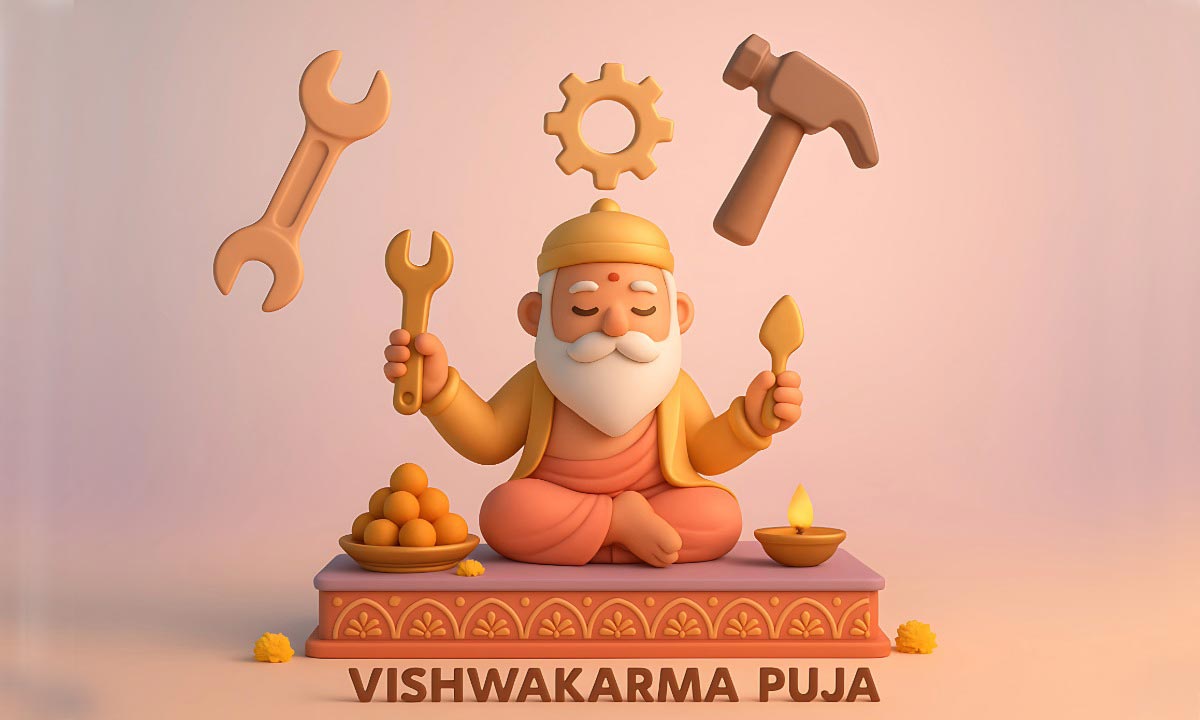
Vishwakarma Jayanti is a sacred Hindu festival that is celebrated in the honour of lord Vishwakarma, the architect of the gods and godly craftsman. It is a symbolic day by the artisers, engineers, architects, mechanics, factory workers, industrial workers, and craftsmen, who observe this day as a token of thanksgiving to the creator of all machines and buildings.

The industries are changing and the places of work are getting more technologically oriented, but Vishwakarma Jayanti has managed to preserve its classical beauty with devotion, creativity and innovation. The rituals, pujas and celebrations that come with this auspicious event will be experienced in 2025 in India particularly in industrial sites and workplaces.

Who is Lord Vishwakarma?

Lord Vishwakarma is known as the god and divine architect and engineer of the universe. He is commonly represented as a four-armed god wielding instruments such as a measuring scale, a noose, a book, and tools used by a craftsman, representing how he controls architecture, science and design.

There are a number of ancient texts that refer to Vishwakarma such as the Rigveda, Mahabharata and Puranas. The Rigveda states that he is the Devashilpi the builder of the gods  who made them their divine abodes and weapons. Mahabharata says that he made his own city Dwarka (the city of Lord Krishna), Lanka (the city of gold of Ravana) and Indraprastha (the capital of the Pandavas).

Vishwakarma, in the Puranas, is the son of Brahma who was created due to the intensity of the Creator. He is also attributed to having designed the celestial vehicles (Vimanas), the Sudarshan Chakra of Lord Vishnu, and the trident of Lord Shiva.

Therefore, Lord Vishwakarma can be viewed as the embodiment of creativity, invention, and technical perfection and can encourage everyone, who works with devices, machinery, or design to maintain the best traditions of the art.

Vishwakarma Puja 2025 Date and Muhurat

Event Details
Festival Name Vishwakarma Jayanti
Deity Worshipped Lord Vishwakarma – the divine architect and celestial craftsman
Date in 2025 Wednesday, 17 September 2025
Occasion Kanya Sankranti – Sun enters Virgo (Kanya Rashi)
Sankranti Moment (IST) 12:55 PM on 17 September 2025
Puja Muhurat Morning to midday (around Sankranti moment)

Regional traditions have a choice of celebrating Vishwakarma Jayanti on Kanya Sankranti (the day when the Sun enters Virgo) or on Rishi Panchami (the fifth day in the Shukla Paksha of the month of Bhadrapada). Kanya Sankranti is the standard date of observing in most industrial areas and places of work.

The change of the Sun into Virgo (Kanya Rashi) has a certain astrological significance considering that Virgo is the sign of analysis, precision, and workmanship, all the qualities of Lord Vishwakarma. Such a fit is said to give individuals and organisations wealth, development of skills and security in the workplace.

Rituals and Worshipping

Vishwakarma Jayanti is celebrated with a lot of reverence especially among the people involved in construction industry, industrial productions, and technical sectors. It is characterized by purification and prayer on the instruments, machines, and work places to achieve blessings of the God.

Puja Preparations

Washing and decoration: The factories, offices and workshops are well cleaned. The doors are adorned with mango leaves, marigold flowers and rangoli.

Set up on the altar: There is an image or idol of the Lord Vishwakarma set up on a raised platform surrounded by sacred things such as kalash, diyas and incense.

Puja Steps

  1. Sankalp (Resolution) – The master of the institution or the elder of the artisans starts it by swearing to perform the puja with sincerity.
  2. Ganesh Vandana – It was the worship of Lord Ganesha to get hurdles out of the way.
  3. Praying to Lord Vishwakarma – Recitation of Vishwakarma mantras and giving flowers, turmeric, grains of rice and sandalwood paste.
  4. Offering (Naivedya) – Fruits, sweets, coconuts and specially cooked prasadam are offered.
  5. Tool and Machine Worship – All the instruments, machines, computers, cars, and other tools are adorned with garlands and sprinkled with holy water.
  6. Aarti and Distribution Prasad – The puja ends with aarti and distribution of blessed food amongst all the workers.

Community Traditions

Artisans would not want to use tools and machinery on this day in most locations as a sign of respect. The employees wear clean or new garments, and no manufacturing is done thus making the day a symbolic holiday of prayer, repairs, and gratitude.

Industries and Factories rituals

The industries, workshops, and factories use this day to seek the blessings of God in case of accidents and mishaps, and smooth running all through the year. Workers also admit the origin of their means of livelihood by venerating their tools and machines and confirm their commitment to excellence.

Engineers, Artisans and Designers rituals 

The Lord Vishwakarma is regarded as the patron deity by engineers, architects, artisans and designers. They praise him because he has given them creativity, innovation, and technical savvy. The day restates the significance of discipline, accuracy and ethical practices in the way they practice in their fields.

Cultural Value

Vishwakarma Jayanti, at the cultural level, serves to remind people that every creation of material objects, whether monumental or, in fact, just as a tool, is an expression of divine wisdom. It promotes modesty, cooperation and appreciation to individuals who labor with hands and brains.

Contemporary Festivals in India

Although it is very much traditional, Vishwakarma Jayanti has changed with the current state of India, where the world is very much industrial and technologically changed. The festival is now equally celebrated in factories, workshops, corporate offices and IT hubs.

In Factories and Workshops

  • Big manufacturing plants hold group pujas at their workstations.
  • Decoration of machines and tools is done and maintenance work is performed.
  • The workers are taken out to community lunch and party events.
  • Processions of idols of Vishwakarma are also conducted in such states as Odisha, West Bengal, Bihar, and Jharkhand.

Rituals at Corporate offices and IT Hubs

  • Symbolic puja is made by many tech companies and engineering firms in recognition of performers of trade tools: computers, servers, and office equipment.
  • To celebrate the spirit of innovation and teamwork, employee engagement practices, motivation speeches, and rewarding events are organized.

Regional Celebrations

  • West Bengal and Odisha: Known due to their large size of pandals, processions and cultural events.
  • Rajasthan and Gujarat: Artisans, smiths, and construction workers are the leaders of the celebration.
  • Karnataka and Tamil Nadu: Perceived by industrial laborers and manufacturing factories, and usually in conjunction with Ayudha Puja rituals.

Vishwakarma Jayanti has therefore come out as an entirely religious celebration to an industrial festival of pan-Indian tradition in sealing disparities between spirituality and technological advancement.

Conclusion

Vishwakarma Jayanti is also a day of thanks and rebirth of the workers, engineers and artisans who form the society. Whether in small work-shops, or in gigantic factories, the blessings of the divine architect are called on to prosperity, novelty, and even security in every department of industry.

With the automation and more sophisticated technologies of industries, the spirit of Vishwakarma Jayanti should make us remember the human touch of craftsmanship, creativeness, and ethical working. It is a day when machines and hands and minds repose in prayer, and determine to make a better tomorrow

FAQs on Vishwakarma Jayanti 2025

Question: What is the date of Vishwakarma Jayanti in 2025?

Answer: On 17 September 2025 (Wednesday), on the day of Kanya Sankranti, when the Sun enters Virgo, Vishwakarma Jayanti will be observed.

Question: Why should Lord Vishwakarma be worshipped by engineers and artisans?

Answer: Lord Vishwakarma is regarded as the architect and creator of the gods who is said to have constructed the divine cities and arms and tools of the gods. Artisans, engineers and architects venerate him because he blessed them with creativity, innovation and precision.

Question: What are the rituals done during Vishwakarma Jayanti?

Answer: They involve doing rituals like cleaning the workplaces, preparing an altar of Lord Vishwakarma, praying, decorating and worshiping tools, machines, and equipment, then aarti and offering prasad.

Question: What are the states in India that observe the Vishwakarma Jayanti in a grand way?

Answer: The festival is also celebrated with much pomp in states such as West Bengal, Odisha, Bihar, Jharkhand, Rajasthan, Gujarat and in certain parts of Karnataka and Tamil Nadu particularly, in the sphere of industries and workshops.

Question: Is Vishwakarma Jayanti an Indian holiday?

Answer: Vishwakarma Jayanti is a confined or segmental holiday in various states. Most industries, factories, and workshops may declare a holiday for rituals and celebrations.

Exhibition Spotlight – Tyger Tyger Burning Bright by Virenpratap Singh Bhaika

0

Tyger-Tyger-Burning-Bright-by-Virenpratap-Singh-Bhaika-01

Tyger Tyger Burning Bright, a show of an up-and-coming artist, Virenpratap Singh Bhaika, is a great conversation between nature and men, between myth and facts, between devastation and promise. This exhibition, curated by the renowned art historian Dr. Alka Pande, will be open between 13 and 18 September 2025, and it will invite people to rethink our ways of living in the natural world.

Exhibition Details

Event Information
Exhibition Name Tyger Tyger Burning Bright
Artist Virenpratap Singh Bhaika
Curator Dr. Alka Pande
Dates 13 – 18 September 2025
Timings 11:00 AM – 7:00 PM
Venue Open Palm Court Gallery, India Habitat Centre, Lodhi Road, New Delhi
Entry Free

Message form the Show 

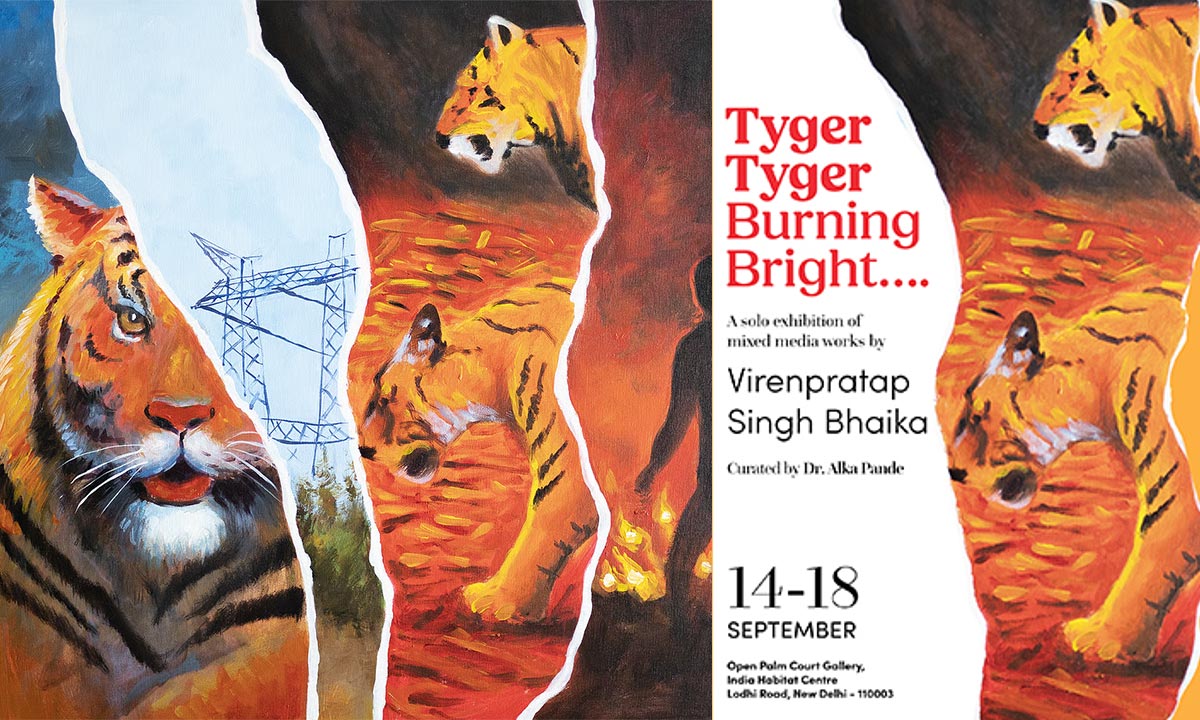
The most memorable thing about this show is its multi-sensory nature. Bhaika displays 15 bold paintings, his own sketchbooks, and a 30-minute film named Roar and Resilience. The paintings are full of colour and allegory showing tigers walk through the burning woods, metallic excavators stand like predators of the world, and broken landscapes and the boundaries between human development and the fragile balance of nature.

The movie, in the meantime, gives a sense of urgency and emotional preview of the strength of wild species and the vulnerability of their living ecosystem. The first time his sketchbooks are presented gives something personal, in the form of pencil studies, sketches, and notes of forests and conservation camps. They expose the invisible work behind the completed works and base his passion on experience.

Art Rooted in the Wild

The art of Bhaika is influenced by immersion instead of distant depiction of wildlife, unlike the work of the artists. He is now studying Fine Art at the Harrow School in the UK, and he has also done conservation work in Tadoba, Namibia and other Indian national parks. He has also been influenced by Central Indian tribal artists of Gond whose complex, nature-based visual language has had an in-depth impact on his style.

The authenticity of his works is unique due to this grounding. He does not merely paint tigers as embodiments of beauty, but he paints them as intelligent creatures at war, as the representatives of ecologies being brought to the edge. There are those that replicate Gond traditions in their designs and down-to-earth tonalities, and there are those that incorporate some elements of the Western classical and modernist art to produce sharp contrasts. He even works with renowned Gond artist Japani Shyam daughter of the legendary Jangarh Singh Shyam to further establish a link between tradition and the modern.

Preservation of Nature and Art 

The main contradiction of Tyger Tyger Burning Bright is in the images that the beauty of nature versus the ruthless development of the human race. Tigers are shown with cranes, excavators, and burning industrial figures, which imply the process of deforestation, climate change, and destruction of their habitats that now threaten their existence.

However, these images are not only warnings. There is also a strand of perseverance in them. The title of Bhaika is based on a famous poem of William Blake, which implies fear. His works are not just images over what is being lost; they are also a symbol of what remains and what can be preserved as soon as we can. The movie Roar and Resilience reflects this as nature struggles to survive even during the times of destruction.

This is the exhibition that puts the problem in the context of emotions again, when environmental crises are too often diminished to a numerical form. Bhaika makes us remember that conservation is a science or a policy but it is also about empathy, wonder, and responsibility.

Conclusion 

Tyger Tyger Burning Bright is not just an exhibition but it is a call to arms. Bhaika challenges us to realize that we will survive with the wild as long as its survival is considered. You walk out of the gallery as a lover of art, but also learning that the wild voices that are rapidly dying.

Join the Festive Beats at Fittur’s Dandiya Night with Hiten Panwar

0

Fittur-Presents-an-Electrifying-Dandiya-Night-with-Hiten-Panwar-02

New Delhi is about to become festive with Fittur’s breakout Dandiya Night on Saturday, September 27, 2025, starting at 7 PM at PSOI Club, Chanakyapuri, an immersive experience that promises an unforgettable evening filled with music, color, culture, and high energy Bollywood vibes, including the energetic live performance of Hiten Panwar, an internationally acclaimed Bollywood percussionist who has electrified audiences all over the world with his beats and rhythms. 

A Bollywood Dandiya Like Never Before

The space will be decorated in true traditional Gujarati colours of red, orange, and yellow, with fairy lights, colourful drapery and festive motifs under the night sky. The PSOI Club will by the end of the night resemble a carnival which reflects the essence of heritage with pops of pop-culture that is both vibrant and full of life. 

The highlight of the evening will be the electrifying immersive live act of Hiten Panwar. Hiten is known for his unique presentation style of live percussive elements of traditional music fused with contemporary Bollywood beats. Each instrument Hiten plays is a story. His reputation is built upon not only galvanizing each stage he performs on, but has earned a reputation as a musician that invites immediate audience engagement in a way that is memorable. His songs and music are not performances; they develop like a living breathing experience – with dhol beats that make your heart beat, sequencing pulses and rhythms that hypnotize the audience under his magnetic presence so that you can never stop moving. Dandiya will shift beyond the traditional bounds and enter Bollywood party territory.

Hiten Panwar: The Beat of the Evening

Hiten Panwar is an outstanding performer and an entertainer. Every time he is on the stage, the audience goes crazy with the ‘music madness’. He has conquered the hearts of audiences at a domestic as well as international level. Hiten Panwar is expected to create high-energy moments; moments where the thumping of the dhol and electronic beats or Bollywood remixes or live percussion comes into play. His performance for Fittur Dandiya Night has been curated to create just the right amount of Garba rhythms matched with Bollywood dance hits to ensure a night for all ages.

A Celebration for Everyone

The primary event will be all about Hiten Panwar’s performance, but there are several other aspects to this event to make it a full festive experience. Guests will be able to enjoy the following:

  • Bright Decor: Traditional Garba-style decor comes together with some modern decor and lighting on the stage. 
  • Music and Dance: Dandiya, Garba, and Bollywood song and dance, non-stop (expect only some breaks)!
  • Food: Incredible curated vendors with a fun selection of delicious food from Gujarati delicacies to popular international street food right now! 
  • Shopping: Earlier in the day, guests can also shop at events curated by Fittur, with shopping experiences of handmade, artisanal goods, clothing, jewelry, home decor, and festive accessories.
  • Community: An opportunity for all to celebrate Navratri in a cultural space that is welcoming to families, young people, and seniors, everyone can partake!

Guests are asked to wear their best festive and colorful outfits and participate in the season’s fun! While there will be a lot of traditional chaniya cholis and bandhgalas, count on people to show up in a dazzling fashion: think sequins, Indo-Western wear, Bollywood-style looks, all moving to the dance floor with traditional wear!

Words from the Visionary Behind Fittur

Bhavna Sharma, the founder of Fittur, envisions this event as more than just entertainment. Speaking about the Dandiya Night, she said:

“At Fittur, we create experiences that bring people together through culture, rhythm, and celebration. This Dandiya Night combines the traditional spirit of Garba with the vibrant style of Bollywood. Join us for an unforgettable evening filled with music, dance, and fun. Enjoy the exciting beats of Hiten Panwar and connect with a crowd that shares in the joy.”

Her words highlight the purpose driving the celebration, building a sense of community where tradition and innovation dance together under one roof.

What Makes Fittur Different

Fittur is widely recognized as a curated lifestyle exhibition that has uniquely achieved the feat of combining those elements with indulgence, culture, creativity, and commerce. Under the brilliance of Bhavna Sharma, Fittur has escalated from being a shopping event, to being a collective experience where: 

Premium boutiques and stalls showcase selected fashion, jewelry, homewares and lifestyle products.

Enjoyable food corners where culinary attractions meet festive cravings.

Stage performances that include cultural exhibitions from tradition and contemporary perspectives. 

Bhavna Sharma has founded Fittur while also managing a successful export business supplying to International hospitality chains. She has created a life which combines design, excellence and empowerment. Her life thus far embodies a unique story of both commerce and imagination, and presents us all with spaces which invite brands to have an engagement with discerning audiences while communities come together to celebrate their culture.

Event Details at a Glance

Event Details Information
Event Name Fittur Dandiya Night with Hiten Panwar
Date Saturday, September 27, 2025
Time 7:00 PM onwards
Venue PSOI Club, Chanakyapuri, New Delhi
Tickets Available now on BookMyShow and DistrictByZomato
Organizer Fittur by Bhavna Sharma
Social Media Instagram – @fittur.in

A Festive Evening Under the Stars

The selection of PSOI Club Chanakyapuri is quite fitting, with its spacious format, open-air venue and history of grandeur. This September autumn breeze is set to make you experience an intoxicating mix of sound, light and movement.

For many people, Dandiya is not just about dancing. Rather, it’s a chance to bond, relax and build relationships. Fittur Dandiya Night provides that space by creating an atmosphere where tradition and a sense of modernity can coexist. Young people will dance to Bollywood mashups, the older generations will be engaged in Garba memories, and for children, it will be a feast for the senses with colors, lights and beats.

Tickets and Anticipation

Now that tickets are available on BookMyShow and DistrictByZomato, the talked-about event has already created quite a stir in Delhi among influencers and culture buffs on social media, and has gotten enough buzz to fill the calendar with this one-night event!  

How to Prepare 

For those of you planning to attend, here’s how you can best enjoy the evening:

  • Get there early, and browse the shopping exhibits before the dancing starts.
  • Dress up in comfortable, but of course glamorous ethnic wear to allow for hours of non-stop dancing.
  • Bring along your own dandiya sticks if you’d like to, but there will be festive sets of dandiya sticks available too.
  • Be prepared to try new things! 

Don’t worry about whether or not you are a Garba or Dandiya expert, all you need is an ability to groove and groove!  The Bollywood style of the celebration ensures that you will find your groove despite whether you sway, or are “serious about Garba”.

Conclusion

The Fittur Dandiya Night with Hiten Panwar certainly isn’t just another event in your festive social calendar; it’s a cultural immersion that embodies the spirit of Navratri, the sparkle of Bollywood, and the essence of community celebration. It promises to create an ambiance that simultaneously captures the tradition and craze of the festival, and the experience will linger in memories when the dhol beats have ended.

For a city that believes festivals should be alive and excessive, this is one night that Delhi should not miss.

Mishran – A Medley of Mediums: Artist Prenita Dutt’s 18th Solo Show in Delhi

0

Mishran-A-Medley-of-Mediums--Artist-Prenita-Dutt’s-18th-Solo-Show-in-Delhi-01

The Artsy Encounter Begins

As autumn tiptoes into Delhi, the Visual Art Gallery at the India Habitat Centre transforms. It is no longer just walls and windows, it’s a forest, a riverbed, a nest for stories. 

This time, it is welcoming Mishran. On October 1st, 2025, artists, critics, collectors, and passersby step into something rare: a world woven from clay, bronze, paint, and memory. Hovering at the heart of this world is Prenita Dutt, whose 18th solo exhibition, “Mishran: A Medley of Mediums,” becomes a passage through the living language of nature and art.

Each day, the gallery fills with people searching for something human, a feeling, a memory, or perhaps just the serenity that comes from standing among artworks born of genuine dialogue between artist and earth. For Prenita, this exhibition isn’t just a display. It’s a celebration, a meditation, and, above all, an invitation to journey together from the ephemeral to the everlasting.

Prenita Dutt: Artist, Listener, Storyteller


View this post on Instagram


A post shared by Prenita Dutt (@delhidiarist)

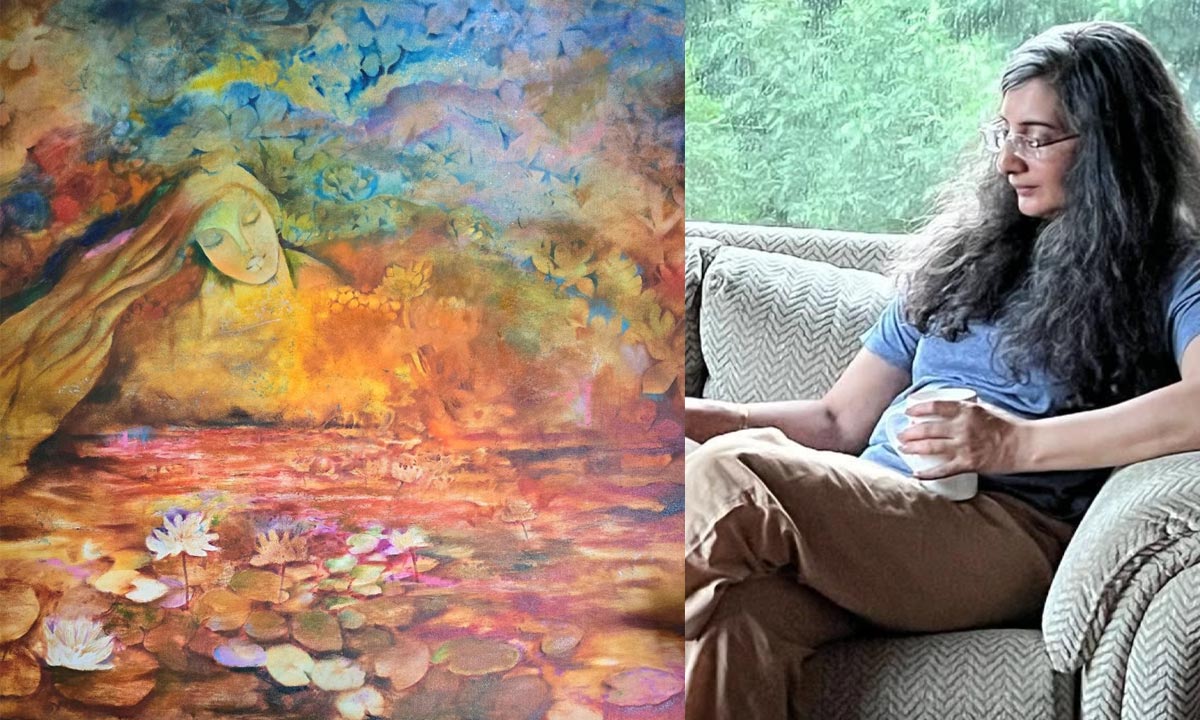
Prenita’s practice began with exploring her small garden; fingertips caress rough bark, eyes move across the veins of a fallen leaf. Here, she listens for stories embodied and contained in seeds and stones. The many years spent in close company with adults with disabilities has grown and expanded her sense of the texture of patience, resilience, and transformation. Her artistic practice is a bridge between clay and canvas, oil and terracotta, bronze and stone, not for pageantry, but because each medium lets her hold a different truth to light. 

Prenita’s self-taught roots as an artist, her first exhibition at the India Habitat Centre, in 2005, create for her the sound of freedom, curiosity, and openness to experimentation. Brush strokes are not only gestures but whispers; clay is not only formed but felt and understood, the memory of rain and sunlight, pressed into each curve. 

Mishran Solo Exhibition Details

Exhibition Details Information
Title Mishran: A Medley of Mediums
Artist Prenita Dutt
Venue Visual Art Gallery, India Habitat Centre, New Delhi
Dates October 1 to 5, 2025
Time 10:00 am to 6:00 pm

Nature’s Patterns: How Mishran Speaks

Mishran-A-Medley-of-Mediums-Prenita-Dutt-1

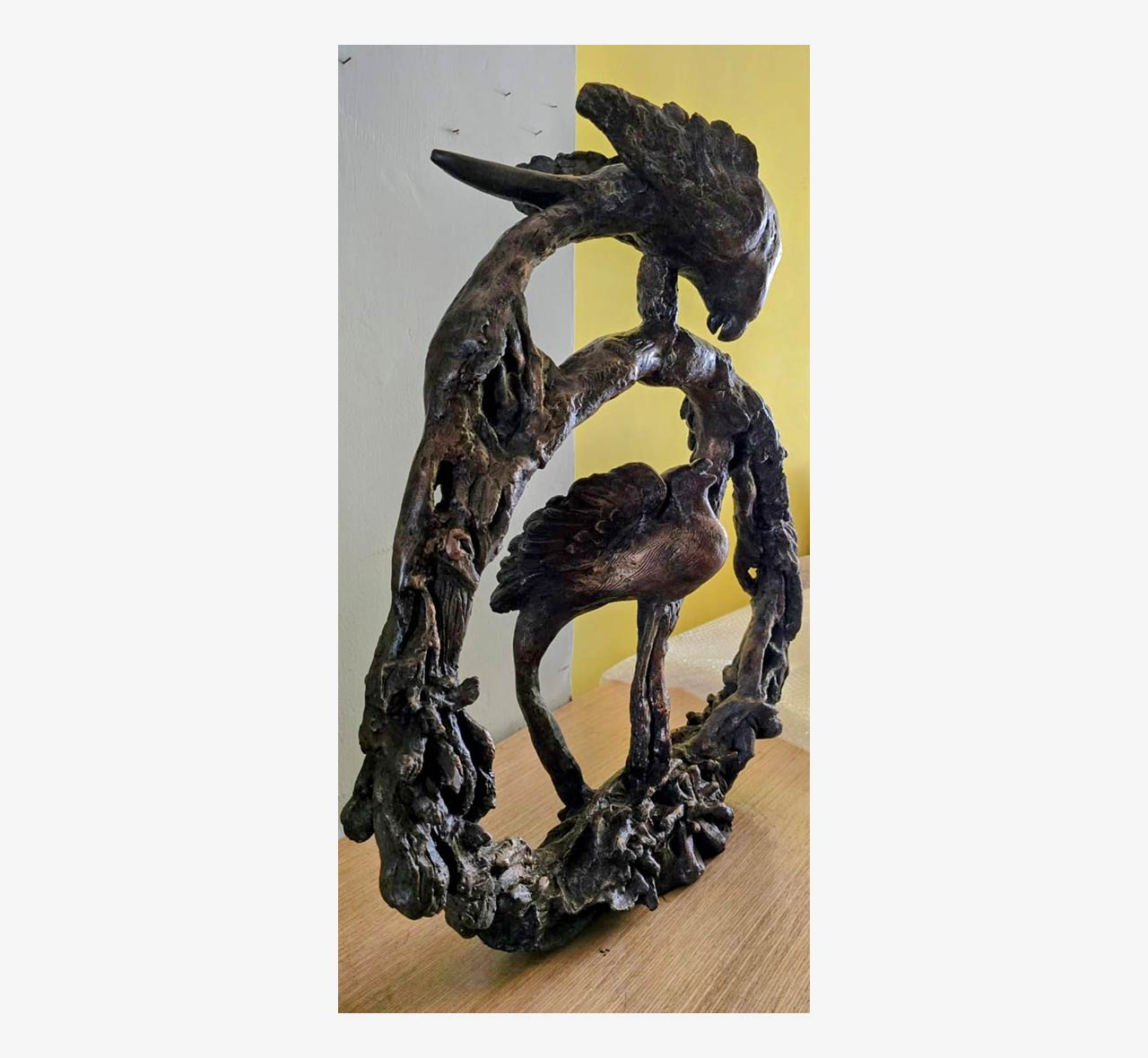
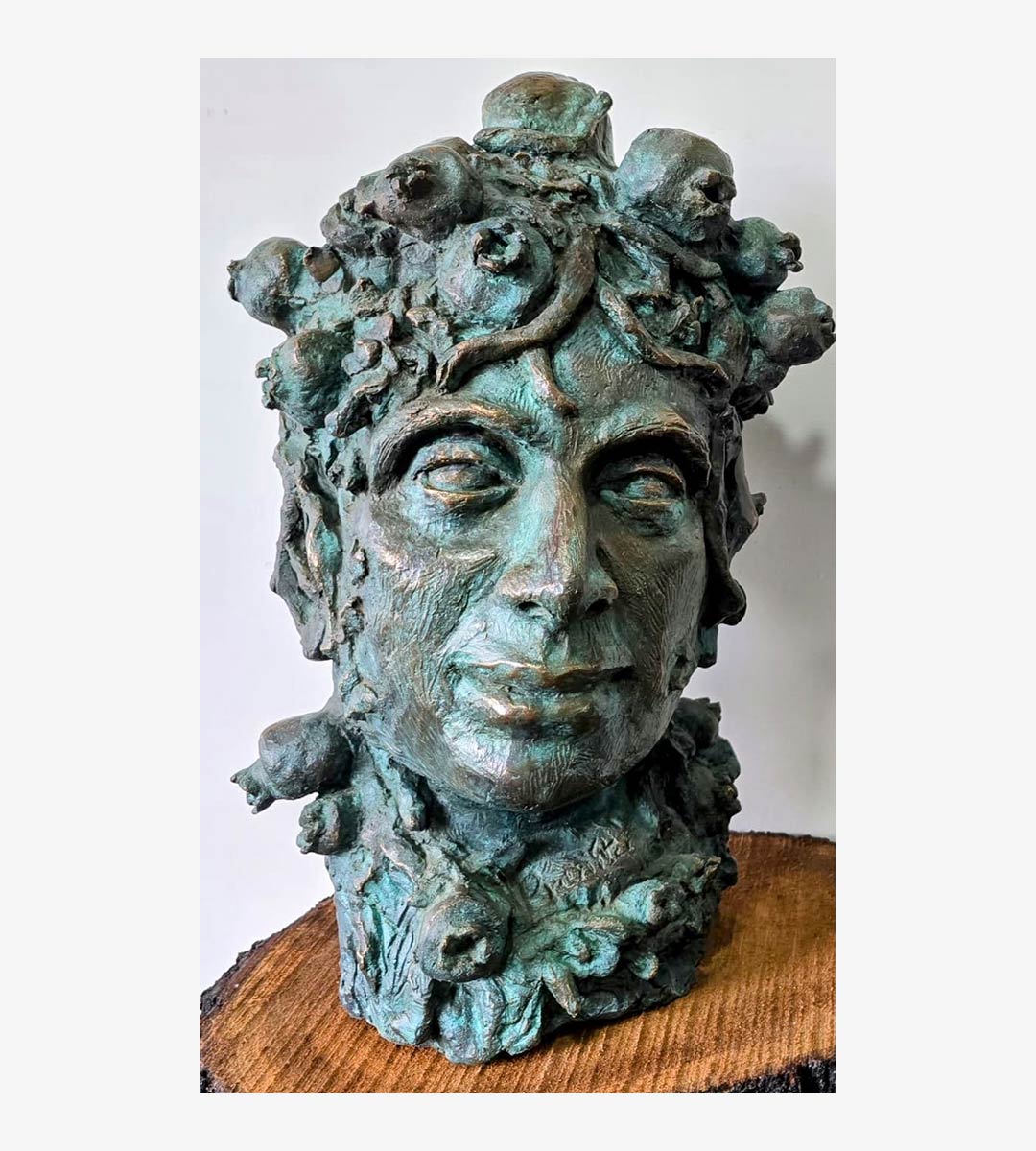
Across five days in the gallery, visitors find themselves pulled into nature’s rhythms. Watercolors drift gentle as morning mist. Oils sink deep, shimmering with memory. In ceramics, the muted reds and pomegranate shapes recall the earth itself, joyous, tactile, patient. Sculptures in fiberglass, bronze, and stone anchor fleeting thoughts, chiseling the intangible into permanence.

But the Mishran is not just a variety for its own sake. It’s an exploration of how seeds, branches, flowers, and stones, so seemingly simple, possess lives full of memory and meaning. Prenita’s art asks us: What do we carry within us, quietly growing, waiting for the sun? What have we endured, cracked by weather yet made more beautiful?

The Story Within: Prenita’s Voice, Nature’s Echo
Mishran-A-Medley-of-Mediums-Prenita-Dutt-3

Prenita often describes creation as a “conversation between self and universe.” In Mishran, visitors sense that dialogue everywhere. A clay seed, shaped over hours, emits an ancient whisper, reminding us that every sprouting is a remembering. A bronze branch twists, its surface alive with tool marks, echoing storms weathered, joys shared.

She tells those who gather in the gallery, “Nature is my constant. Whether on paper, canvas, clay, or stone, its shapes, textures, and rhythms guide my work.” Her art is not just about what endures; it’s about what heals. The cycles she portrays, seeds growing, flowers unfurling, branches reaching, mirror those of memory, loss, and renewal.

Mishran’s Meditative Invitation: A Visitor’s Journey
Mishran-A-Medley-of-Mediums-Prenita-Dutt-2

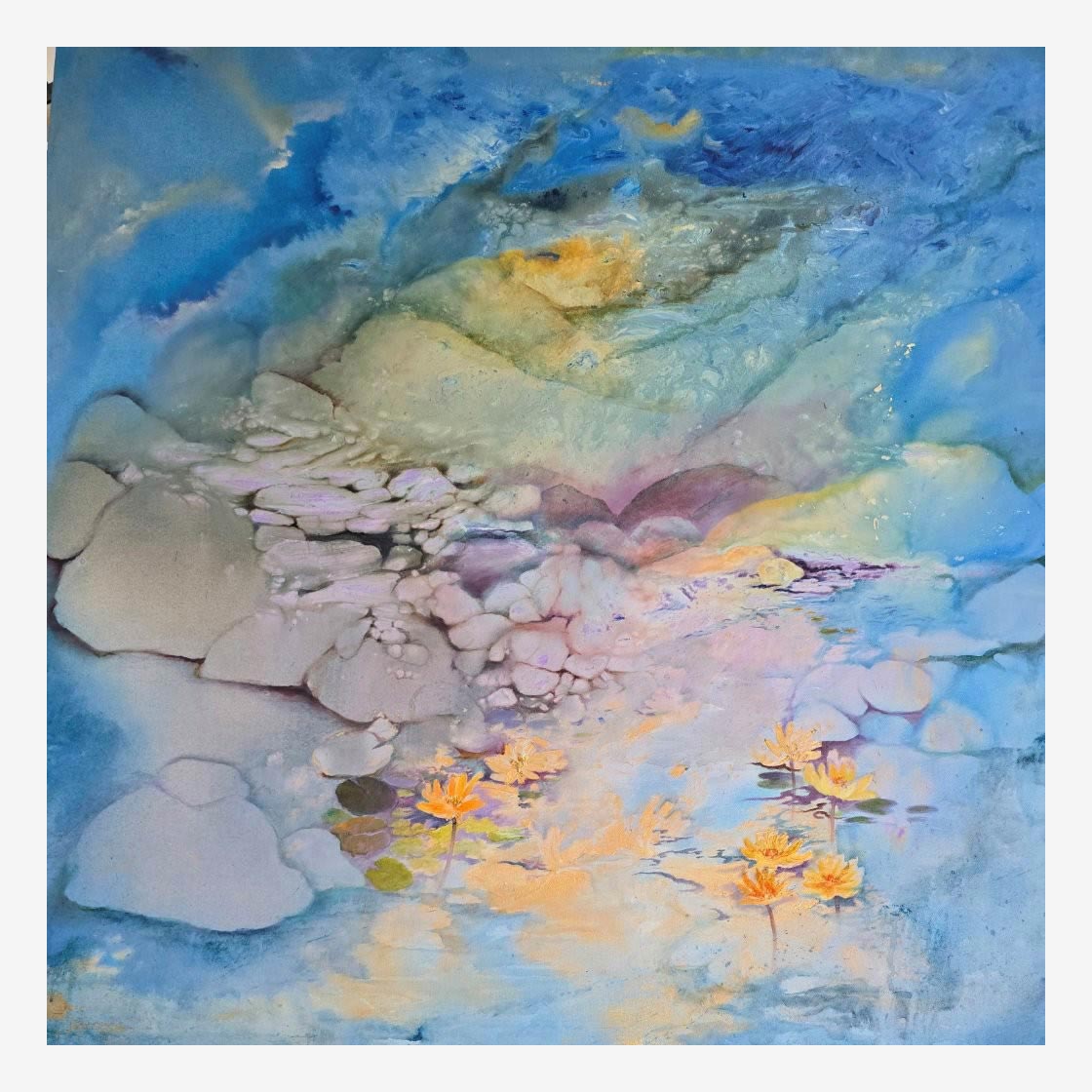
Many pause longest at the sculptures, fiberglass twisting like water, bronze glowing with the patina of patience, stone carved to reveal what has always lain inside. The dichotomy is everywhere, delicate watercolors beside sturdy ceramics; quick charcoal lines meeting slow, hand-built forms.

For some, the painted clouds evoke lost afternoons in childhood, or the simplicity of watching shadows move through leaves. For others, the ceramics and terracotta are a joyous celebration, each pomegranate glistening with possibility; each flower-shaped bowl an echo of longing or hope.

Five Senses, Five Days: Being Part of Mishran

When asked what Mishran offers, Prenita rarely describes objects alone. Instead, she talks about sensations, memories, encounters. Here’s what visitors experience, in bullet points:

  • See: Shifting lights and colors as each artwork finds its mood throughout the day; organic shapes that evoke both the familiar and the mysterious.
  • Touch: The cool density of stone, the soft grain of terracotta, the sleek curve of fiberglass, a reminder of earth and transformation.
  • Smell: Earthy tones from ceramic pieces, the faint mineral tang of sculpture, perhaps a trace of flowers on a nearby installation.
  • Hear: Silence punctuated by hushed conversations, footsteps echoing off stone floors, or the almost audible memory within each natural form.
  • Feel: The weight of memory, both personal and universal; the comfort of resilience, the gentle nudge toward healing and hope.

Mishran Resonates Memory, Healing, and Hope
Mishran-A-Medley-of-Mediums-Prenita-Dutt-4

The exhibition invites reflection. Nature’s patterns, growth, loss, renewal, enduring beauty, run through every room. Prenita’s artistry is not neat or straightforward; instead, it is complex and accessible to deliberate interpretation. Each individual accesses something unique and personal, a once-forgotten moment from their childhood, a sense of calm, perhaps an aptitude for patience.

In a city moving forward, Mishran encourages its audience to stop, and observe what the world is capable of as it cycles through fragility and strength. Whether in the transient quality of watercolor, or the durability of bronze, the message is evident: transformation can be slow, beautiful, sometimes invisible, but nonetheless a result of us.

The Artist’s Story: From First Show to Mishran

Those who follow Prenita’s journey know her work grows more exploratory with each exhibition. A degree in psychology hints at her fascination with the inner worlds of others. Years spent facilitating creativity for adults with disabilities have taught her the texture of both patience and hope. Her illustrations, including for Ruskin Bond’s “While the Birds Still Sing”, display her capacity to offer tenderness and imagination in each format.
This current exhibition shown at the Visual Art Gallery represents a return, it represents a beginning, an artist’s unending conversation with nature, with memory, and with all who walk through her forest of mediums.

Exhibition Highlights

Medium Description Themes
Paintings Soft touch of watercolours, and also layered oil paint on canvas. Memory, fragility, transience, and longing
Ceramics and Terracotta Hand made and wheel thrown pieces showing inspiration from seeds, parrots, and pomegranates. Patience, earthy feeling, touch, intimacy, and joy
Fiberglass Sculpture Light yet enduring forms, drawing inspiration from organic patterns. Endurance, continuity, and transformation
Bronze Sculpture Timeless depictions of nature-inspired motifs. Permanence, strength, and resilience
Stone Sculpture Revealing hidden forms of solid stone using chisel, hammer, and imagination. Timeless nature, strength, universality, and healing

Takeaway

As dusk falls and the gallery empties each October evening, Mishran remains alive—not just in its artworks, but in the hearts of those who have walked among seeds, stones, and stories. Prenita Dutt’s multitude of mediums is not just an exhibit; it is an experience of being, listening, and being changed.

As the visitors  leave they feel whole, they walk out of the space with a quiet knowledge that even in this fast paced modern world, art (and nature’s eternal spirit) can supply us with moments of grounding, healing, and hope.